Vevizye
Italy
Table of Contents
Package leaflet: Information for the patient
Vevizye 1 mg/mL eye drops, solution
ciclosporin
Please read all of this leaflet carefully before you start using this medicine because it contains important information for you.
- Keep this leaflet. You may need to read it again.
- If you have any questions, ask your doctor or pharmacist.
- This medicine has been prescribed for you only. Do not give it to other people, even if their symptoms are the same as yours, as it may be harmful.
- If you experience any side effects, including those not listed in this leaflet, talk to your doctor or pharmacist. See section 4.
Contents of this leaflet
- What Vevizye is and what it is used for
- What you need to know before using Vevizye
- How to use Vevizye
- Possible side effects
- How to store Vevizye
- Contents of the pack and other information
1. What Vevizye is and what it is used for
Vevizye contains the active substance ciclosporine. Ciclosporine belongs to a group of medicines known as immunosuppressants. These are medicines used to reduce inflammation.
Vevizye is used to treat adults with dry eye disease (which includes inflammation of the cornea, the transparent layer on the front part of the eye that covers the iris).
It is used in patients whose condition has not improved sufficiently with treatment using artificial tears.
A response to treatment is generally seen after 4 weeks of therapy, when symptoms and damage to the eye surface associated with dry eye disease are reduced.
2. What you need to know before using Vevizye
Do not use Vevizye
- if you are allergic to ciclosporin or to any of the other ingredients of this medicine (listed in section 6)
- if you have a tumor or a precancerous condition inside or around the eye
- if you have an infection inside or around the eye
Warnings and precautions
The use of Vevizye eye drops has not been studied in people who wear contact lenses. If you wear contact lenses, remove them before using this medicine; you may reinsert them 15 minutes after instilling the eye drops. See section 3 How to use Vevizye.
You should visit your doctor approximately 3 months after starting treatment and then every 6 months thereafter to assess the effect of Vevizye. Inform your doctor if you have glaucoma or are being treated for glaucoma.
If you develop signs of local infection (redness, eye discharge), contact your doctor.
Children and adolescents
Vevizye must not be used in children and adolescents under 18 years of age.
Other medicines and Vevizye
Inform your doctor or pharmacist if you are taking, have recently taken, or might take any other medicines.
Pregnancy and breastfeeding
If you are pregnant, think you may be pregnant, are planning to become pregnant, or are breastfeeding, consult your doctor or pharmacist before using this medicine.
Vevizye is not recommended during pregnancy unless the benefits to the mother outweigh the potential risks to the fetus.
Vevizye is not recommended during breastfeeding.
Driving and using machines
Your vision may become temporarily blurred immediately after using this medicine. If this occurs, wait until your vision clears before driving or using machinery.
3. How to use Vevizye
Use this medicine exactly as instructed by your doctor or pharmacist. If you have
any doubts, consult your doctor or pharmacist.
The recommended dose is 1 drop in each eye twice daily, approximately 12 hours apart.
Method of administration
Follow these instructions carefully and consult your doctor or pharmacist if there is
anything you do not understand.
- Wash your hands before using Vevizye.
- Do not use Vevizye if the tamper-evident ring on a new, closed bottle is not intact.
- After first opening, the tamper-evident ring of the cap remains on the neck of the bottle.
- The dropper tip of Vevizye must not touch the eyes to avoid injury or contamination of the medicine; also avoid letting the dropper tip touch fingers or other surfaces.
- If you are using Vevizye together with other eye medicines, wait at least 15 minutes between using Vevizye and the other eye medicines.
- If you wear contact lenses, remove them before using Vevizye. Wait at least 15 minutes after using the eye drops before reinserting them.
Administration
| Step 1) Remove the white cap from the bottle | |
| Step 2) Gently press the bottle in upright position and keep it pressed | 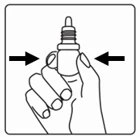 |
| Step 3) Invert the bottle and release the pressure | 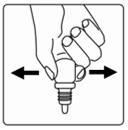 |
| Step 4) Tilt the head. Pull the lower eyelid down with one finger. Gently press the bottle while still inverted to release one drop (0.01 mL) into the first eye | |
| Step 5) Repeat step 4 for the second eye | 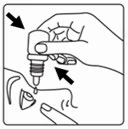 |
| Step 6) Replace the white cap on the bottle and keep the bottle tightly closed when not in use |
Due to the properties of the solution, you may not feel the drop entering the eye. If it helps, use a mirror or ask another person to check that the drop has been released from the tip of the dropper. Do not put in a second drop if you did not feel the first one enter the eye. Only administer another drop if the first one missed the eye (for example, if you felt it fall onto the skin).
If you use more Vevizye than you should
Do not put any more drops into the eye until the next scheduled dose. If you have not done so already, you may put one drop into the other eye.
If you forget to use Vevizye
Continue with the next dose as scheduled. Do not use a double dose to make up for the forgotten dose. Do not use more than 1 drop twice daily in each eye.
If you stop using Vevizye
Do not stop treatment without talking to your doctor, as symptoms may return after you have stopped using Vevizye.
If you have any doubts about how to use this medicine, consult your doctor or pharmacist.
4. Possible side effects
Like all medicines, this medicine can cause side effects, although not everybody gets them.
Common (may affect up to 1 in 10 people)
- burning sensation after instillation of the drop into the eye (pain at time of instillation)
Uncommon (may affect up to 1 in 100 people)
- blurred vision
- eye irritation
- eye redness (ocular erythema)
- eye pain
- reduced sharpness of vision (reduced visual acuity [temporarily])
- eye itching
Reporting of side effects
If you experience any side effect, including those not listed in this leaflet, talk to your doctor or pharmacist.
You can also report side effects directly via the national reporting system indicated in Annex V. Reporting side effects helps provide more information on the safety of this medicine.
5. How to store Vevizye
Keep this medicine out of the sight and reach of children.
Do not use this medicine after the expiry date stated on the vial after "Exp.". The expiry date refers to the last day of that month.
Do not store above 25 °C.
Do not refrigerate or freeze.
This medicine can be used for a maximum of 4 weeks after first opening the vial; after this period, dispose of the medicine even if the vial is not empty. The vial must be kept tightly closed when not in use. Do not use this medicine if you notice any signs of deterioration.
Do not dispose of any medicine via wastewater or household waste. Ask your pharmacist how to dispose of medicines you no longer use. This will help protect the environment.
6. Package contents and other information
What Vevizye contains
- The active substance is cyclosporine. One mL of solution contains 1 mg of cyclosporine.
- The other components are perfluorobutylpentane and anhydrous ethanol.
Description of the appearance of Vevizye and contents of the pack
Vevizye 1 mg/mL is a clear, colourless solution.
Each multidose bottle contains 2 mL of eye drops and each pack contains one bottle.
Marketing Authorisation Holder
Laboratoires Théa
Zone Industrielle du Brézet
12 rue Louis Blériot
63100 Clermont-Ferrand
France
Manufacturer
HWI Pharma Services GmbH
Rheinzaberner Strasse 8
76761 Ruelzheim
Germany
More detailed information on this medicinal product is available on the website of the European Medicines Agency: https://www.ema.europa.eu.