Vegetallumina analgesic
Italy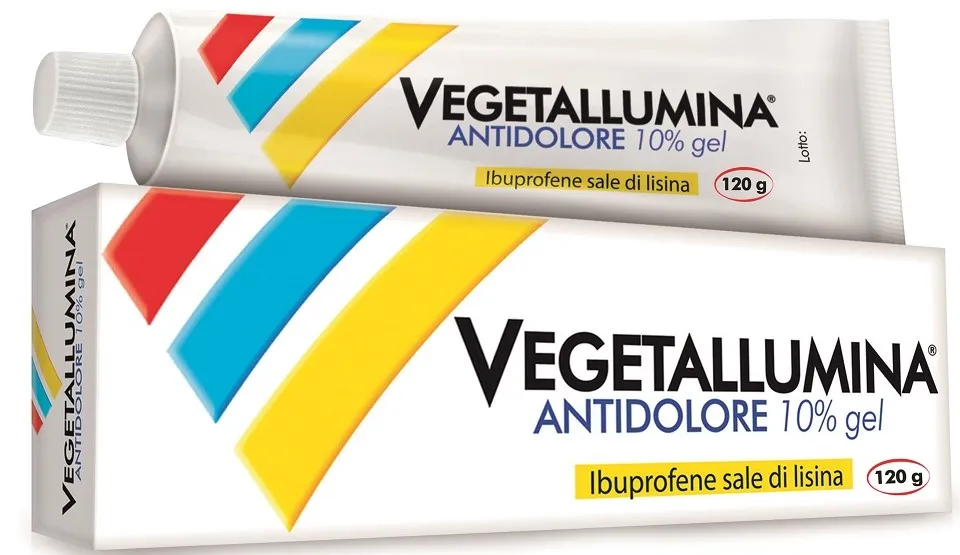
Table of Contents
- Package leaflet: Information for the user
- VEGETALLUMINA Antidolore 10% gel
- 1. What VEGETALLUMINA Antidolore is and what it is used for
- 2. What you need to know before using VEGETALLUMINA Antidolore
- 3. How to use VEGETALLUMINA Antidolore
- 4. Possible side effects
- 5. How to store VEGETALLUMINA Pain Reliever
- 6. Package contents and other information
Package leaflet: Information for the user
VEGETALLUMINA Antidolore 10% gel
Lysine ibuprofen
Please read this leaflet carefully before using this medicine because it contains important information for you.
Always use this medicine exactly as described in this leaflet or as your doctor or pharmacist has instructed you.
- Keep this leaflet. You may need to read it again.
- If you need more information or advice, consult your pharmacist.
- If you experience any side effects, including those not listed in this leaflet, consult your doctor or pharmacist. See section 4.
- Consult your doctor if you do not notice any improvement or if your symptoms worsen.
Contents of this leaflet:
- What VEGETALLUMINA Antidolore is and what it is used for
- What you need to know before using VEGETALLUMINA Antidolore
- How to use VEGETALLUMINA Antidolore
- Possible side effects
- How to store VEGETALLUMINA Antidolore
- Contents of the pack and other information
1. What VEGETALLUMINA Antidolore is and what it is used for
VEGETALLUMINA Antidolore contains ibuprofen lysine, an analgesic belonging to the class of topical Non-Steroidal Anti-Inflammatory Drugs (NSAIDs).
VEGETALLUMINA Antidolore is indicated for the local treatment of bruises, sprains, myalgia (muscle pain), muscle strains, and torticollis.
Consult your doctor if you do not notice any improvement or if your symptoms worsen.
2. What you need to know before using VEGETALLUMINA Antidolore
Do not use VEGETALLUMINA Antidolore
- If you are allergic to ibuprofen lysine or to any of the other ingredients of this medicine (listed in section 6).
- If you are allergic to other analgesics (painkillers), antipyretics (fever reducers), or non-steroidal anti-inflammatory drugs (NSAIDs) that have previously caused asthma, rhinitis, urticaria, or other allergic reactions in you.
- If you are pregnant.
- If you are breastfeeding.
- In children and adolescents under 14 years of age.
Warnings and precautions
Talk to your doctor or pharmacist before using VEGETALLUMINA Antidolore.
Do not apply VEGETALLUMINA Antidolore on open wounds or damaged skin.
The use of VEGETALLUMINA Antidolore, especially if prolonged, may cause local sensitization reactions: at the first appearance of a skin rash, mucosal lesions, or any other sign of hypersensitivity, stop treatment immediately and consult your doctor, who may take appropriate therapeutic measures.
To avoid more serious hypersensitivity or photosensitization reactions (sensitivity to light), avoid direct sunlight exposure, including sunbeds, during treatment and for two weeks afterwards.
If you experience more severe allergic reactions (skin reactions, some of which may be fatal, such as exfoliative dermatitis, Stevens-Johnson syndrome, and toxic epidermal necrolysis), stop treatment immediately and consult your doctor.
If acetylsalicylic acid or other non-steroidal anti-inflammatory drugs have previously caused asthma, rhinitis, urticaria, or other allergic reactions in you, consult your doctor before taking this medicine. It is advisable to consult your doctor even if such conditions occurred in the past.
Consult your doctor if you are undergoing concomitant treatment with anticoagulants (see Other medicines and VEGETALLUMINA Antidolore).
Children and adolescents
This medicine is intended only for patients over 14 years of age.
Other medicines and VEGETALLUMINA Antidolore
Inform your doctor or pharmacist if you are taking, have recently taken, or might take any other medicines.
Do not take VEGETALLUMINA Antidolore together with another NSAID, or in any case, do not use more than one NSAID at a time.
Ibuprofen, the active ingredient in VEGETALLUMINA Antidolore, may enhance the effects of anticoagulants such as warfarin.
No clinically relevant interactions have been observed with occasional use of ibuprofen.
Pregnancy, breastfeeding and fertility
If you are pregnant, think you might be pregnant, planning to become pregnant, or breastfeeding, consult your doctor or pharmacist before using this medicine.
Do not take VEGETALLUMINA Antidolore during pregnancy or breastfeeding, as it may cause adverse effects on pregnancy and/or fetal development, such as risk of miscarriage, cardiac malformations, and gastroschisis (an abdominal wall defect causing abdominal organs to protrude). The risk increases with dose and duration of treatment.
If you use this medicine during the third trimester of pregnancy, you may expose:
- the fetus to:
- cardiopulmonary toxicity (with premature closure of the ductus arteriosus and pulmonary hypertension);
- renal dysfunction, which may progress to renal failure with oligohydramnios (reduced amniotic fluid surrounding the fetus);
- yourself and the newborn, at the end of pregnancy, to:
- possible prolonged bleeding time and antiplatelet effects, which may occur even at very low doses;
- inhibition of uterine contractions, resulting in delayed or prolonged labor.
Therefore, the use of VEGETALLUMINA Antidolore, like any drug inhibiting prostaglandin synthesis and cyclooxygenase, is contraindicated if you are planning to become pregnant.
If you have fertility problems or are undergoing fertility investigations, discontinue treatment with VEGETALLUMINA Antidolore.
Driving and using machines
This medicine does not impair your ability to drive or operate machinery.
Important information about certain excipients
VEGETALLUMINA Antidolore contains lavender essence, which in turn contains citral, citronellol, coumarin, eugenol, oakmoss extract (evernia furfuracea extract), tree moss extract (evernia prunastri extract), geraniol, limonene, and linalool.
Citral, citronellol, coumarin, eugenol, geraniol, limonene, and linalool may cause allergic reactions.
VEGETALLUMINA Antidolore contains methyl parahydroxybenzoate sodium and ethyl parahydroxybenzoate sodium.
Methylparaben sodium and ethylparaben sodium may cause allergic reactions (including delayed reactions).
3. How to use VEGETALLUMINA Antidolore
Use this medicine exactly as stated in this leaflet or as directed by your doctor or pharmacist. If you have any doubts, consult your doctor or pharmacist.
The recommended dose is 2–4 applications per day to the affected area.
Apply a thin layer of gel to the area to be treated, massaging gently.
Wash your hands thoroughly and for a prolonged period after application.
Do not exceed the recommended doses.
Elderly patients should follow the minimum dosages indicated above.
Use the medicine for the shortest possible duration.
If symptoms recur repeatedly or if you notice any recent changes in their characteristics, consult your doctor.
If there is no noticeable improvement after a short period of treatment, consult your doctor.
If you use more VEGETALLUMINA Antidolore than you should
If you take an excessive dose (overdose) of ibuprofen, you may commonly experience the following symptoms: nausea, vomiting, stomach ache, deep sleep with reduced responsiveness to normal stimuli (lethargy), drowsiness, headache, dizziness, ringing in the ears (tinnitus), uncontrolled body movements (convulsions), and loss of consciousness. Symptoms of overdose may appear within 4–6 hours after ibuprofen intake.
Rarely, the following may occur: uncontrolled eye movements (nystagmus), increased acid levels in the blood (metabolic acidosis), lowered body temperature (hypothermia), kidney-related effects, gastrointestinal bleeding, profound loss of consciousness (coma), temporary interruption of breathing (apnea), diarrhoea, reduced activity of the nervous system (central nervous system depression), and reduced respiratory activity (respiratory depression).
Additionally, you may also experience: disorientation, excited state, fainting, low blood pressure (hypotension), decreased or increased heart rate (bradycardia or tachycardia).
If you ingest significantly high doses of ibuprofen, severe kidney and liver damage may occur.
In case of accidental ingestion or overdose of VEGETALLUMINA Antidolore, contact your doctor immediately or go to the nearest hospital.
If you have any questions about the use of VEGETALLUMINA Antidolore, consult your doctor or pharmacist.
4. Possible side effects
Like all medicines, this medicine can cause side effects, although not everybody will experience them.
Side effects can be minimised by using the lowest effective dose for the shortest duration necessary to control symptoms.
With some topical or transdermal (through the skin) non-steroidal anti-inflammatory drugs derived from propionic acid, skin reactions such as erythema, itching, irritation, sensation of warmth or burning, and contact dermatitis have been reported.
There have also been reports of variously severe blistering rashes, including Stevens-Johnson syndrome and toxic epidermal necrolysis (very rarely).
Photosensitivity reactions (the skin becomes sensitive to light) are possible (frequency not known).
Reporting of side effects
If you experience any side effect, including those not listed in this leaflet, talk to your doctor, pharmacist or nurse. You can also report side effects directly via the national reporting system at http://www.aifa.gov.it/content/come-segnalare-una-sospetta-reazione-avversa . By reporting side effects, you can help provide more information on the safety of this medicine.
5. How to store VEGETALLUMINA Pain Reliever
Keep this medicine out of the sight and reach of children.
Do not use this medicine after the expiry date stated on the packaging after "Exp.". The expiry date refers to the last day of that month.
Do not dispose of any medicine via wastewater or household waste. Ask your pharmacist how to dispose of medicines you no longer use. This will help protect the environment.
It is important to always keep the medicine information available; therefore, retain both the packaging and the leaflet.
6. Package contents and other information
What VEGETALLUMINA Antidolore contains
- The active substance is ibuprofen lysine salt. 100 g of gel contain 10 g of ibuprofen lysine salt.
- The other components are isopropanol, hydroxyethylcellulose, methyl 4-hydroxybenzoate sodium, ethyl 4-hydroxybenzoate sodium, glycerol, lavender essence, purified water.
Description of the appearance of VEGETALLUMINA Antidolore and contents of the package
VEGETALLUMINA Antidolore is presented as a gel.
The package contains a tube of 50 g or 120 g.
Marketing Authorization Holder
PIETRASANTA PHARMA S.p.A. Via di Caprino, 7 – 55012 Capannori (LU)
Manufacturer
Beltapharm S.p.A, Via Stelvio 66, 20095 Cusano Milanino (MI)
Lab. It. Biochim. Farm.co LISAPHARMA S.p.A, Via Licinio, 11, 22036 ERBA (CO)