Valontan
Italy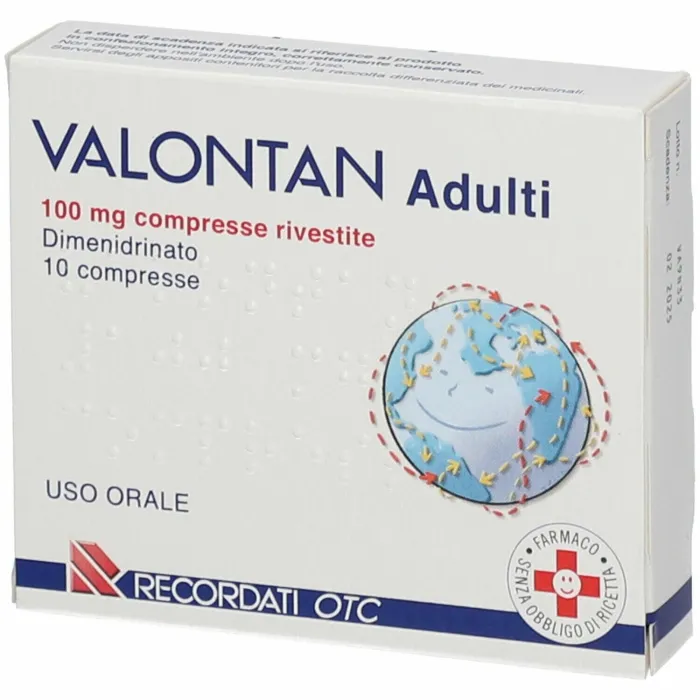
Table of Contents
Patient Information Leaflet
Valontan
100 mg tablets for adults
Film-coated tablets
dimenhydrinate
Please read this leaflet carefully before taking this medicine because it contains important information for you.
Always take this medicine exactly as described in this leaflet or as your doctor or pharmacist has instructed.
- Keep this leaflet. You may need to read it again.
- If you need more information or advice, consult your pharmacist.
- If you experience any side effects, including those not listed in this leaflet, contact your doctor or pharmacist. See section 4.
- Contact your doctor if you do not notice any improvement, or if your symptoms worsen after a short period of treatment.
Contents of this leaflet:
- What Valontan is and what it is used for
- What you need to know before taking Valontan
- How to take Valontan
- Possible side effects
- How to store Valontan
- Contents of the pack and other information
1. What Valontan is and what it is used for
Valontan contains the active substance dimenhydrinate.
It belongs to a group of medicines used against vomiting known as antiemetics and anti-nausea agents.
Valontan is used for the prevention and treatment of nausea, vomiting, and vertigo (loss of balance) associated with motion sickness such as sea, car, train, or air travel (motion sickness).
Consult your doctor if you do not feel better or if you feel worse after a short period of treatment.
2. What you need to know before taking Valontan
Do not take Valontan
- if you are allergic to dimenhydrinate or to any of the other ingredients of this medicine (listed in section 6);
- if you are allergic to related substances (other antihistamines);
- if it is for a child or adolescent;
- if you are pregnant or breastfeeding (see “Pregnancy, breastfeeding and fertility”).
Warnings and precautions
Talk to your doctor or pharmacist before taking Valontan.
Take Valontan only after consulting your doctor if:
- you have increased pressure inside the eye (glaucoma);
- you have an enlarged prostate (prostatic hypertrophy);
- you have difficulty urinating (urinary retention);
- you have intestinal motility problems (intestinal obstruction);
- you have high blood pressure (arterial hypertension);
- you have cardiovascular diseases;
- you have breathing difficulties (bronchial asthma, chronic bronchitis or emphysema);
- you have overactive thyroid (hyperthyroidism);
- you have epilepsy (seizures may worsen).
Consult your doctor also if any of these conditions occurred in the past.
Children and adolescents
Valontan must not be used in children and adolescents.
Other medicines and Valontan
Inform your doctor or pharmacist if you are taking, have recently taken, or might take any other medicines.
Do not take Valontan if you are undergoing treatment with medicines for depression, insomnia, or anxiety (antidepressants, hypnotics, sedatives or tranquillisers), to avoid excessive reduction in alertness (sedation).
Concomitant use of Valontan and certain antibiotics or other medicines that may be toxic to the ear (ototoxic) may mask the early signs of toxicity (ototoxicity), which may only become apparent when the damage is irreversible.
Valontan and alcohol
Avoid consuming alcoholic beverages while taking this medicine.
Pregnancy, breastfeeding and fertility
If you are pregnant, suspect you may be pregnant, plan to become pregnant, or are breastfeeding, consult your doctor or pharmacist before taking this medicine.
Valontan must not be used during pregnancy and breastfeeding.
Its use should also be avoided if you suspect you are pregnant or are planning a pregnancy.
If you are breastfeeding, consult your doctor to decide whether to discontinue breastfeeding and start treatment, or to continue breastfeeding while avoiding the medicine.
Driving and using machines
Since the most common side effect of Valontan is reduced alertness (sedation), which may manifest as drowsiness, you should take this into account when performing tasks requiring vigilance, such as driving vehicles or operating machinery.
Valontan Adults 100 mg film-coated tablets contain sucrose
If your doctor has diagnosed you with an intolerance to certain sugars, contact him before taking this medicine.
3. How to take Valontan
Take this medicine exactly as stated in this leaflet or as instructed by your doctor or pharmacist. If you have any doubts, consult your doctor or pharmacist.
The recommended dose to prevent nausea and vomiting associated with motion sickness (travel sickness by sea, car, train, or air) is half a tablet of Valontan (50 mg), which lasts approximately 4 hours. If necessary, this dose may be repeated every 4 hours for preventive purposes, up to a maximum of 3 tablets within 24 hours.
Do not exceed the recommended doses.
Use in children and adolescents
Valontan must not be used in children and adolescents.
If you take more Valontan than you should
In case of accidental ingestion or overdose, contact your doctor immediately or go to the nearest hospital.
The most common symptom of overdose is drowsiness. Toxic doses may cause seizures, coma, and respiratory problems.
If you forget to take Valontan
Do not take a double dose to make up for the forgotten dose.
If you stop taking Valontan
If you have any doubts about using this medicine, consult your doctor or pharmacist.
4. Possible side effects
Like all medicines, this medicine can cause side effects, although not everyone experiences them.
The following side effects may occur with the use of Valontan:
Common side effects:
- drowsiness
- reduced reactivity (sedation)
Frequent side effects:
- dry mouth
- nausea
- increased sensitivity to light (photosensitivity)
- allergic skin reactions
- eye accommodation disorder (visual disturbances)
- difficulty urinating
- headache (cephalalgia)
- decreased appetite (anorexia)
Less frequent side effects:
- loss of balance (dizziness)
- tremors
- seizures (may occur especially at high doses)
- reduced ability to perform muscular effort (asthenia)
- insomnia
- euphoria
- decrease in blood pressure (hypotension)
- increased heart rate (tachycardia)
Reporting of side effects
If you experience any side effect, including those not listed in this leaflet, please consult your doctor or pharmacist.
You may also report side effects directly through the national reporting system at https://www.aifa.gov.it/content/segnalazioni-reazioni-avverse.
By reporting side effects, you can help provide more information on the safety of this medicine.
5. How to store Valontan
This medicine does not require any special storage conditions.
Keep this medicine out of the sight and reach of children.
Do not use this medicine after the expiry date stated on the packaging after the word “Exp”.
The expiry date refers to the last day of that month.
Do not dispose of medicines via wastewater or household waste. Ask your pharmacist how to dispose of
medicines no longer in use. This will help protect the environment.
It is important to always keep the medicine information available; therefore, keep both the carton and
the package leaflet.
6. Package contents and other information
What Valontan contains
- The active substance is: dimenhydrinate. One film-coated tablet contains 100 mg of dimenhydrinate.
- The other components are: sucrose, colloidal silicon dioxide, magnesium stearate, maize starch. Tablet coating: acrylic resin (Eudragit), talc.
Description of the appearance of Valontan and contents of the pack
Valontan is available as film-coated tablets for oral use.
It is available in packs containing 4 and 10 film-coated tablets of 100 mg.
Marketing Authorisation Holder and Manufacturer
RECORDATI Industria Chimica e Farmaceutica S.p.A. - via Matteo Civitali, 1 – 20148 Milan, Italy.