Ursodeoxycholic acid Aurobindo
Italy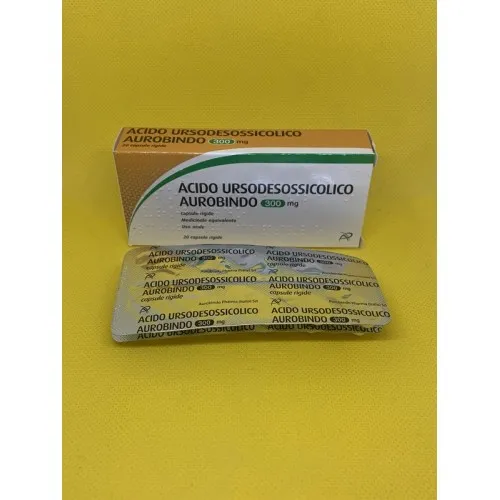
Table of Contents
- Package leaflet: Information for the patient
- Ursodeoxycholic Acid Aurobindo 300 mg hard capsules
- 1. What Acido Ursodesossicolico Aurobindo is and what it is used for
- 2. What you need to know before taking Acido Ursodesossicolico Aurobindo
- 3. How to take Ursodeoxycholic Acid Aurobindo
- 4. Possible side effects
- 5. How to store Acido Ursodesossicolico Aurobindo
- 6. Package contents and other information
Package leaflet: Information for the patient
Ursodeoxycholic Acid Aurobindo 300 mg hard capsules
Generic medicine
Please read all of this leaflet carefully before taking this medicine, because it contains important information for you.
- Keep this leaflet. You may need to read it again.
- If you have any questions, ask your doctor or pharmacist.
- This medicine has been prescribed for you only. Do not give it to other people, even if their symptoms are the same as yours, as it may be harmful.
- If you experience any side effect, including those not listed in this leaflet, contact your doctor or pharmacist. See section 4.
Contents of this leaflet:
- What Ursodeoxycholic Acid Aurobindo is and what it is used for
- What you need to know before taking Ursodeoxycholic Acid Aurobindo
- How to take Ursodeoxycholic Acid Aurobindo
- Possible side effects
- How to store Ursodeoxycholic Acid Aurobindo
- Contents of the pack and other information
1. What Acido Ursodesossicolico Aurobindo is and what it is used for
Acido Ursodesossicolico Aurobindo contains bile acids.
Acido Ursodesossicolico Aurobindo is indicated for the treatment of:
- cholesterol gallstones (cholesterol stones present in the bile);
- chronic cholestatic liver disease affecting bile production by the liver (primary biliary cirrhosis, sclerosing cholangitis);
- liver damage caused by cystic fibrosis (a genetic disease) in adults and children aged 6 years and older;
- biliary dyspepsia (digestive problems due to impaired gallbladder function).
2. What you need to know before taking Acido Ursodesossicolico Aurobindo
Do not take Acido Ursodesossicolico Aurobindo
- if you are allergic to ursodeoxycholic acid, bile acids, or any of the ingredients of this medicine (listed in section 6);
- if you have active stomach or intestinal diseases (gastric or duodenal ulcer);
- if you have acute inflammation of the gallbladder (cholecystitis) or bile ducts;
- if you have a blockage of the bile ducts (obstruction of the common bile duct or cystic duct);
- if you frequently suffer from upper abdominal pain (biliary colic);
- if you have calcified gallstones visible on X-ray;
- if you have impaired gallbladder function (reduced gallbladder motility);
- if the person taking this medicine is a child with congenital malformations of the biliary system (biliary atresia), in whom surgical intervention to restore bile flow (portoenterostomy) has failed to re-establish adequate bile flow.
Warnings and precautions
Talk to your doctor or pharmacist before taking this medicine.
Treatment with this medicine must be carried out under close medical supervision.
Before starting treatment, your doctor will perform liver function tests, specifically transaminases (AST or SGOT and ALT or SGPT) and alkaline phosphatase.
When you are prescribed Acido Ursodesossicolico Aurobindo to dissolve cholesterol stones, you will also be scheduled for monitoring of the gallbladder and biliary tract (oral cholecystography and ultrasound).
If you are of childbearing age, your doctor will advise you to use an effective non-hormonal contraceptive method before prescribing Acido Ursodesossicolico Aurobindo.
If you have an advanced liver disease called primary biliary cirrhosis, in rare cases your symptoms may worsen at the beginning of treatment. Your doctor will determine the dosage of the medicine based on your clinical condition and tolerance to the medicine.
If you experience diarrhoea, consult your doctor, who may decide to reduce the dose or discontinue treatment.
Other medicines and Acido Ursodesossicolico Aurobindo
Inform your doctor or pharmacist if you are taking, have recently taken, or might take any other medicines.
Avoid taking Acido Ursodesossicolico Aurobindo together with the following medicines:
- bile acid-binding drugs used to lower cholesterol levels, such as cholestyramine and colestipol, or antacids containing aluminium hydroxide and/or smectite (aluminium oxide);
- cyclosporine, a medicine that suppresses the immune system;
- ciprofloxacin and dapsone, antibiotics used to treat bacterial infections;
- nitrendipine, a medicine used to lower blood pressure;
- certain medicines that reduce cholesterol levels in the blood (such as clofibrate), estrogens, and hormonal contraceptives;
- medicines that may be harmful to the liver (potentially hepatotoxic);
- rosuvastatin, a medicine used to lower blood cholesterol.
Pregnancy, breastfeeding and fertility
If you are pregnant, think you may be pregnant, planning to become pregnant, or breastfeeding, consult your doctor or pharmacist before taking this medicine.
Do not use this medicine during pregnancy unless absolutely necessary, particularly during the first trimester. Before starting treatment, ensure that you are not pregnant.
If you are of childbearing age, you may begin treatment only if you are using an effective contraceptive method (non-hormonal contraceptives or low-estrogen formulations).
If you are undergoing treatment for gallstone dissolution, use an effective non-hormonal contraceptive, as hormonal oral contraceptives may increase the risk of gallstone formation.
Levels of ursodeoxycholic acid in breast milk are very low and are not expected to cause adverse effects in the breastfed infant.
Animal studies have not shown any effect of ursodeoxycholic acid on fertility.
There are insufficient data available on the effects on fertility in humans following treatment with ursodeoxycholic acid.
Driving and using machines
This medicine does not affect, or has only a negligible effect on, the ability to drive vehicles or operate machinery.
3. How to take Ursodeoxycholic Acid Aurobindo
Take this medicine exactly as directed by your doctor or pharmacist. If you have
any doubts, consult your doctor or pharmacist.
Your doctor will determine the dosage of this medicine based on your clinical condition and your tolerance
to the medicine.
Cholesterol gallstones
The recommended daily dose is 10 mg/kg, taken in 2–3 divided doses per day.
The duration of treatment should be at least 4–6 months, which may extend up to 24 months continuously, and should continue for 3–4 months after disappearance of the gallstones, as confirmed by radiological or ultrasound examinations.
In any case, treatment should not exceed 2 years.
Chronic cholestatic liver disease
Primary biliary cirrhosis and sclerosing cholangitis
The recommended dose is 13–15 mg/kg per day, given in two divided doses in the morning and evening, taken with meals. The dose should be gradually increased in steps until the optimal dose is reached after 4–8 weeks of treatment.
Cholestatic liver disease due to liver damage caused by cystic fibrosis
The recommended dose is 20 mg/kg per day, divided into two or three doses, with a possible further increase to 30 mg/kg per day, if necessary.
Biliary dyspepsia
The recommended dose is 300 mg per day, divided into 2–3 administrations.
If you take more Ursodeoxycholic Acid Aurobindo than you should
In case of accidental overdose, contact your doctor immediately or go to the nearest hospital.
Cases of overdose exceeding 4 g per day are not known.
In the event of overdose, diarrhoea may occur.
If you forget to take Ursodeoxycholic Acid Aurobindo
Do not take a double dose to make up for the missed dose. Take the next dose at the scheduled time.
If you have any further questions about the use of this medicine, consult your doctor or pharmacist.
4. Possible side effects
Like all medicines, this medicine can cause side effects, although not everybody gets them.
The following side effects may occur:
Common (may affect up to 1 in 10 people)
- soft stools or diarrhoea.
Very rare (may affect up to 1 in 10,000 people)
- pain in the upper right abdomen;
- bowel disturbances (frequency and quality of bowel movements);
- worsening of liver condition in case of hepatic cirrhosis (a serious liver disease);
- skin rash (urticaria).
Reporting of side effects
If you experience any side effect, including those not listed in this leaflet, talk to your doctor or pharmacist. You can also report side effects directly via the national reporting system at www.aifa.gov.it/content/segnalazioni-reazioni-avverse. By reporting side effects, you can help provide more information on the safety of this medicine.
5. How to store Acido Ursodesossicolico Aurobindo
Keep this medicine out of the sight and reach of children.
Do not use this medicine after the expiry date stated on the packaging after "Exp".
The expiry date refers to the last day of that month and to the product in its original intact packaging,
properly stored.
Store at room temperature.
Do not dispose of any medicine via wastewater or household waste. Ask your pharmacist how to discard
medicines you no longer use. This will help protect the environment.
6. Package contents and other information
What Acido Ursodesossicolico Aurobindo contains
Acido Ursodesossicolico Aurobindo 300 mg hard capsule
- The active substance is ursodeoxycholic acid. Each hard capsule contains 300 mg of ursodeoxycholic acid.
- The other components are: starch, magnesium stearate, colloidal silicon dioxide.
Description of the appearance of Acido Ursodesossicolico Aurobindo and contents of the pack
Box containing 20 hard capsules in blisters.
Marketing Authorization Holder
Aurobindo Pharma (Italia) S.r.l., via San Giuseppe, 102 - 21047 Saronno (VA)
Manufacturer
ICE S.p.A.
Cantone Moretti, 29
10015 (TO) – Ivrea – Italy