Talofen
Italy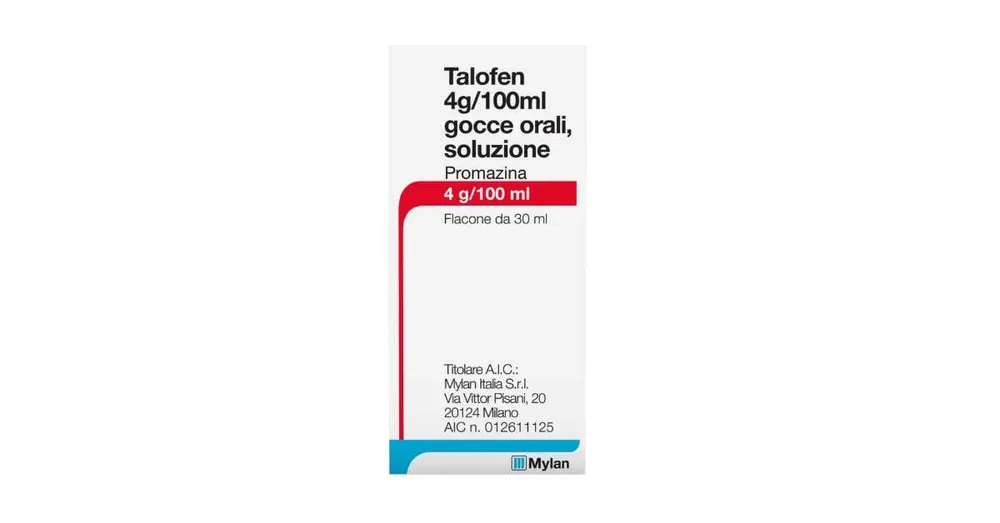
Table of Contents
- Package leaflet: Information for the patient
- TALOFEN 40 mg/ml oral drops, solution, 25 mg/ml injectable solution
- 1. What TALOFEN is and what it is used for
- 2. What you should know before taking TALOFEN
- 3. How to take TALOFEN
- 4. Possible adverse effects
- 5. How to store TALOFEN
- 6. Package contents and other information
Package leaflet: Information for the patient
TALOFEN 40 mg/ml oral drops, solution, 25 mg/ml injectable solution
Promazine Hydrochloride
Please read this leaflet carefully before taking this medicine because it contains important information for you.
- Keep this leaflet. You may need to read it again.
- If you have any questions, ask your doctor or pharmacist.
- This medicine has been prescribed for you only. Do not give it to others, even if their symptoms are the same as yours, as it may be harmful.
- If you experience any adverse reaction, including those not listed in this leaflet, contact your doctor or pharmacist. See section 4.
Contents of this leaflet:
- What TALOFEN is and what it is used for
- What you need to know before taking TALOFEN
- How to take TALOFEN
- Possible side effects
- How to store TALOFEN
- Contents of the pack and other information
1. What TALOFEN is and what it is used for
TALOFEN is a medicine containing promazine hydrochloride as the active substance, belonging to the class of phenothiazine antipsychotics, drugs which help to calm emotions.
TALOFEN is used to control mood and behaviour in cases of aggression or agitation.
2. What you should know before taking TALOFEN
Do not take TALOFEN:
- if you are allergic to the active substance or to any of the other ingredients of this medicine (listed in section 6);
- if you are allergic to other medicines containing phenothiazine antipsychotics (e.g. chlorpromazine, thioridazine) or other phenothiazines (e.g. promethazine);
- if you have symptoms such as drowsiness or difficulty with coordination, blurred vision, difficulty speaking, loss of contact with reality, signs of central nervous system depression;
- if you have reduced red blood cells and/or white blood cells and/or platelets in the blood, signs of bone marrow depression;
- if you have a tumor of a gland called the adrenal gland that causes high blood pressure (pheochromocytoma).
TALOFEN must not be administered to patients in coma.
Warnings and precautions
Talk to your doctor or pharmacist before taking TALOFEN if:
- you are taking other antipsychotic medicines;
- you have had heart disease or have changes in your electrocardiogram (prolonged QT interval), or suffer from blood vessel problems (e.g. blood clots);
- anyone in your family has or has had changes in the electrocardiogram (prolonged QT interval) or blood clots;
- you have had a stroke or think you may be at risk for this condition, for example, if you have high blood pressure, diabetes, high cholesterol, or smoke;
- you suffer from low blood pressure (hypotension);
- you have an enlarged prostate (prostatic hypertrophy);
- you have had epilepsy or think you may be at risk of seizures;
- you have increased pressure in the eye with possible worsening of vision (closed-angle glaucoma);
- you have inability to defecate, abdominal pain and swelling, signs of a bowel condition called paralytic ileus;
- you have Parkinson’s disease, which manifests as resting tremor, muscle rigidity, and slowness of movement;
- you suffer from fatigue and muscle weakness, signs of myasthenia gravis;
- you have previously experienced a reduction in certain types or numbers of white blood cells called granulocytes (drug-induced agranulocytosis);
- you engage in intense physical activity, are exposed to high temperatures, or are at risk of dehydration;
- you have liver problems.
BE CAREFUL, because during treatment with antipsychotic medicines, the following have been reported:
- body temperature above 40°C, muscle rigidity, altered mental status, irregular heartbeat (tachycardia, arrhythmias) or blood pressure, excessive sweating, unusual changes in the amount or appearance of urine produced (acute renal failure), rhabdomyolysis (breakdown of skeletal muscle cells): signs of Neuroleptic Malignant Syndrome. STOP TREATMENT AND CONTACT YOUR DOCTOR if you notice any of the symptoms listed;
- repetitive and continuous involuntary movements due to tardive dyskinesia. If this occurs, STOP TREATMENT AND CONTACT YOUR DOCTOR;
- blood clots in the veins (venous thromboembolism). If you think you may be at risk for this condition (e.g. you are elderly, have a tumor or trauma, are obese, immobilized, smoke, or have recently undergone surgery), remember to inform your doctor;
- difficulty swallowing (dysphagia), which may cause coughing, secretions, breathing difficulties, possible signs of aspiration pneumonia. If you think you may be at risk for this condition, remember to inform your doctor;
- increased sensitivity to sunlight (photosensitivity), possibly leading to skin spots or blisters. Avoid direct exposure to sunlight.
During prolonged treatment with TALOFEN, your doctor may ask you to undergo regular check-ups of blood, bone marrow, eyes, central nervous system, liver, heart, and blood vessels. If these tests show abnormalities, your doctor will assess whether to discontinue or modify the treatment.
TALOFEN may cause:
- darkening of the urine and/or false positive results in tests for amylase, urobilinogen, uroporphyrins, porphobilinogens, and 5-hydroxy-indoleacetic acid;
- false positive results in pregnancy tests in women.
Administration of promazine intravenously (intravenous route) at concentrations higher than 25 mg/ml may cause inflammation of the veins (thrombophlebitis) or inflammation of the tissue at the injection site.
Children and adolescents
Do not use TALOFEN in children and adolescents under 12 years of age.
Other medicines and TALOFEN
Inform your doctor or pharmacist if you are taking, have recently taken, or might take any other medicines, as some medicines may interact with TALOFEN or increase the risk of adverse events, even serious ones.
In particular, contact your doctor if you are using:
- medicines that cause a reduction in red blood cells and/or white blood cells and/or platelets in the blood (bone marrow depression);
- medicines that cause changes in the electrocardiogram (prolonged QT interval);
- medicines that alter blood electrolytes;
- antibiotics, medicines used against infections;
- levodopa, a medicine used, for example, in Parkinson’s disease;
- medicines acting on the nervous system, such as barbiturates, anxiolytics, hypnotics, anesthetics, antihistamines, analgesics, opioids;
- succinylcholine, a medicine used in general anesthesia;
- metrizamide, used as a contrast medium in myelography;
- lithium, used in depression;
- medicines used against seizures (anticonvulsants);
- medicines against cancer (antineoplastics);
- anticholinergics, medicines acting on the nerves;
- antacids, medicines used to treat ulcers or reduce stomach acidity;
- medicines used for high blood pressure (antihypertensives).
Do not administer TALOFEN injectable solution together with: aminophylline, fibrinogen, sodium heparin, prednisolone, sodium bicarbonate, thiopental.
TALOFEN and alcohol
Do not consume alcohol during treatment with this medicine, as it may worsen certain undesirable effects on the nervous system (e.g. sedation, drowsiness).
Pregnancy, breastfeeding and fertility
If you are pregnant, suspect you may be pregnant, plan to become pregnant, or are breastfeeding, consult your doctor or pharmacist before taking this medicine. You may take TALOFEN only if your doctor considers it strictly necessary.
Newborns born to mothers who have used antipsychotic medicines such as TALOFEN during the last three months of pregnancy may experience adverse effects such as agitation, tremor, drowsiness, breathing disorders, or feeding difficulties. If your child shows any of these symptoms, contact your doctor.
Driving and using machines
The promazine contained in TALOFEN may cause sedation, dizziness, and drowsiness. Exercise particular caution before driving vehicles or operating machinery.
Excipients with known effects
TALOFEN oral drops contain:
- sorbitol. This medicine contains 355 mg of sorbitol in 0.5 ml of solution (10 drops corresponding to 20 mg of promazine) and contains 1775 mg of sorbitol per maximum dose (50 drops), equivalent to 35.5 mg/kg and 710 mg/ml of solution (20 drops). Sorbitol is a source of fructose. If your doctor has told you that you (or the child) are intolerant to certain sugars, or if you have a diagnosis of hereditary fructose intolerance, a rare genetic disorder in which patients cannot metabolize fructose, talk to your doctor before you (or the child) take this medicine. methyl p-hydroxybenzoate and propyl p-hydroxybenzoate which may cause allergic reactions (including delayed reactions); sodium sulfite (E221) and potassium metabisulfite (E224), which rarely may cause severe hypersensitivity reactions and bronchospasm; ethanol. This medicine contains 3.12 mg of ethanol in 1 ml of solution (20 drops, corresponding to 40 mg of promazine). This medicine contains 7.72 mg of alcohol (ethanol) in each maximum dose (50 drops). The volume amount of this medicine (50 drops) is equivalent to less than 0.2 ml of beer or 0.1 ml of wine. The small amount of alcohol in this medicine will not produce significant effects.
TALOFEN injectable solution contains:
sodium sulfite (E221) and potassium metabisulfite (E224), which rarely may cause severe hypersensitivity reactions and bronchospasm;
- sodium. This medicine contains less than 1 mmol (23 mg) of sodium per dose, i.e. it is practically 'sodium-free';
- potassium. This medicine contains less than 1 mmol (39 mg) of potassium per dose, i.e. it is practically 'potassium-free'.
3. How to take TALOFEN
Take this medicine exactly as instructed by your doctor, who will determine the correct dose and method of administration based on the severity of your symptoms. If you have any doubts, consult your doctor or pharmacist.
TALOFEN injectable solution
When rapid sedation is required in patients with a severe state of agitation (acute), your doctor will prescribe TALOFEN injectable solution, to be administered into a muscle or a vein (intramuscular or intravenous route).
The usual doses are as follows:
Adults: 1 vial (50 mg). If no improvement is observed within 30 minutes after administration, the dose may be repeated, up to a maximum of 300 mg/day.
Adolescents over 12 years of age: The dose ranges between 0.25 and 0.50 mg per kg of body weight.
Elderly patients: 1 vial (50 mg) or ½ vial (25 mg) administered by intramuscular injection. Lower doses may be given intravenously via infusion.
If you have liver problems, your doctor may use lower doses than those indicated above.
Method of administration
Intramuscular route: The injection into a muscle should be performed with the patient lying face down (prone position). Administer the solution deeply and withdraw the needle slowly. Be careful not to inject TALOFEN directly into a vein. To rule out this possibility, pull back the syringe plunger to check for blood. If blood appears, withdraw the syringe and repeat the procedure at another site.
Intravenous route: Intravenous administration must be performed exclusively by medical personnel. Avoid direct intravenous injection of Talofen.
Dilute the TALOFEN dose in 5% glucose solution or in physiological saline and administer slowly.
Do not administer TALOFEN injectable solution intra-arterially.
TALOFEN Oral Drops
When rapid sedation is not required, your doctor will prescribe TALOFEN oral drops, to be taken by mouth (oral route).
One drop corresponds to 2 mg of promazine.
The usual doses are as follows:
Adults: The initial dose is 10–15 drops (20–30 mg), administered once in the evening. Your doctor may gradually increase this dose until reaching the lowest effective dose. The recommended dose is 15 drops, 4 times daily (120 mg/day). The maximum dose is 50 drops, 4 times daily (400 mg/day).
Adolescents over 12 years of age: 5–15 drops daily (10–30 mg/day). The maximum dose is 15 drops, 4 times daily (120 mg/day).
Elderly patients: 10–30 drops daily (20–60 mg/day). The maximum dose is 25 drops, 4 times daily (200 mg/day).
When the daily dose exceeds 25 drops (50 mg), your doctor will advise dividing the dose into 2–4 administrations.
If you have liver problems, your doctor may prescribe lower doses than those indicated above.
Method of administration
Oral route: Invert the bottle and hold it vertically with the opening facing downward. Dilute the drops in water, optionally adding sugar.
If you take more TALOFEN than you should
You may experience difficulty breathing, drowsiness or lack of coordination, blurred vision, difficulty speaking, loss of contact with reality (central nervous system depression), confusion, indifference or lack of motivation (apathy), cognitive disturbances, low blood pressure (hypotension), decreased body temperature (hypothermia), reduced blood flow in the heart vessels (myocardial ischemia), increased or irregular heartbeat (tachycardia, arrhythmia), abnormal body postures due to involuntary muscle contractions (dystonia), or seizures.
In case of accidental overdose or ingestion, contact your doctor immediately or go to the nearest hospital, as appropriate measures may be required.
If you forget to take TALOFEN
Do not take a double dose to make up for the missed dose.
If you stop taking TALOFEN
Do not stop treatment with TALOFEN abruptly, as withdrawal symptoms such as nausea, vomiting, dizziness, tremors, and restlessness may occur. When discontinuation is necessary, your doctor will gradually reduce the dose over one or two weeks.
If you have any questions about the use of this medicine, consult your doctor or pharmacist.
4. Possible adverse effects
Like all medicines, this medicine can cause adverse effects, although not everyone experiences them.
Stop taking TALOFEN immediately and contact your doctor if you experience any of the following:
- difficulty breathing;
- body temperature above 40 °C, muscle rigidity, altered mental status, irregular heartbeat (tachycardia, arrhythmias) or blood pressure, excessive sweating, unusual changes in the amount or appearance of urine produced (acute renal failure), signs of Neuroleptic Malignant Syndrome;
- sudden drop in blood pressure due to reduced blood volume (hypovolemic shock);
- extrapyramidal symptoms (especially when used at high doses), including:
- motor restlessness with inability to remain still or seated (akathisia), which usually occurs after the first dose;
- abnormal movements of the face and body (dystonia), more common in children and young people, and may appear after a few doses;
- tremor, muscle rigidity, and slowed movements (parkinsonism), more common in adults and elderly patients, developing gradually during treatment;
- indifference or lack of purpose (apathy), confusion;
- loss of muscle coordination (ataxia), cognitive disturbances, fainting (syncope).
Inform your doctor if, during treatment with TALOFEN, you notice:
- blood disorders such as: reduced number of certain types of white blood cells such as granulocytes (agranulocytosis) or neutrophils (neutropenia), formation of clots within blood vessels (disseminated intravascular coagulation);
- changes in blood tests such as: increased TSH, increased transaminases, increased alkaline phosphatase, increased creatine phosphokinase;
- changes in the electrocardiogram such as T-wave inversion, QT interval prolongation;
- inflammation of the liver (hepatitis);
- more or less sudden appearance of skin lesions, for example color changes in spots or widespread (erythema);
- muscle injury (rhabdomyolysis) or muscle stiffness;
- unusual changes in the amount or appearance of urine produced (acute renal failure);
- increase in body temperature above 40 °C (hyperthermia), fever.
Other adverse effects
Some adverse effects that have occurred with other medicines containing promazine or other phenothiazines may also occur during treatment with TALOFEN. These include:
- severe allergic reactions, including: swelling of the face, throat (laryngeal edema) or tongue, breathing difficulties (laryngospasm, bronchospasm), shortness of breath, skin rash with possible sudden drop in blood pressure (anaphylactic reactions);
- reduced number of red blood cells (aplastic anemia, hemolytic anemia) and/or platelets (thrombocytopenia) and/or white blood cells (leukopenia), increased number of eosinophils (eosinophilia);
- increased blood glucose (hyperglycemia), presence of glucose in urine (glycosuria);
- depression, excessive happiness (euphoria), anxiety, sleep disturbances (insomnia), restlessness;
- onset of repetitive and continuous involuntary movements (tardive dyskinesia), seizures, dizziness, sedation, drowsiness;
- eye problems such as blurred vision, changes or deposits in the lens, changes or damage to the cornea, pupil dilation (mydriasis), retinal disorders (retinopathy) or retinal pigmentation;
- changes in heart rhythm (ventricular arrhythmias such as torsades de pointes), increased heart rate (ventricular tachycardia, ventricular fibrillation), cardiac arrest, sudden death;
- sudden drop in blood pressure upon rapid change from sitting or lying down to standing (orthostatic hypotension);
- cough, secretions, breathing difficulties, possible signs of aspiration pneumonia;
- difficulty defecating (constipation), dry mouth;
- yellowing of the skin or whites of the eyes (jaundice);
- decreased body temperature, swelling of extremities (peripheral edema), worsening of psychotic symptoms;
- reduced urine output (urinary retention);
- disturbances in erection and ejaculation, abnormal milk secretion from the breast (galactorrhea), breast enlargement in men (gynecomastia), absence or irregularity of menstrual flow;
- skin rashes, even after sun exposure (photosensitivity), such as exfoliative dermatitis, eczema, urticaria, skin pigmentation, purpura;
- joint or muscle pain, skin disorders and problems in other organs (systemic lupus erythematosus);
- weight gain;
- blood clots in the veins (venous thromboembolism) which may lead to pulmonary embolism and deep vein thrombosis.
Reporting of adverse effects
If you experience any adverse effect, including those not listed in this leaflet, contact your doctor or pharmacist. You may also report adverse effects directly via the national reporting system at https://www.aifa.gov.it/content/segnalazioni-reazioni-avverse.
By reporting adverse effects, you can help provide more information on the safety of this medicine.
5. How to store TALOFEN
Keep this medicine out of the sight and reach of children.
TALOFEN injectable solution: store at room temperature and in the original packaging, protected from light and moisture.
TALOFEN oral drops: store at a temperature not exceeding 25°C and in the original packaging, protected from light and moisture. After first opening, use the contents of the bottle within 2 months.
Do not use this medicine after the expiry date stated on the packaging. The expiry date refers to the last day of that month.
Do not dispose of medicines via wastewater or household waste. Ask your pharmacist how to dispose of medicines you no longer use. This will help protect the environment.
6. Package contents and other information
What TALOFEN contains
TALOFEN oral drops
The active substance is: promazine hydrochloride.
1 ml of solution contains: 45.1 mg promazine hydrochloride equivalent to 4 mg of promazine base.
1 drop corresponds to 2 mg of promazine.
The other components are: non-crystallizable liquid sorbitol, ethanol, methyl p-hydroxybenzoate, propyl p-
hydroxybenzoate, anhydrous sodium sulfite (E221), potassium metabisulfite (E224), purified water.
TALOFEN injectable solution
The active substance is: promazine hydrochloride.
Each 2 ml ampoule of injectable solution contains: 56.4 mg promazine hydrochloride equivalent to 50 mg of
promazine base.
The other components are: anhydrous sodium sulfite (E221), potassium metabisulfite (E224), sodium chloride, sodium citrate, ascorbic acid, water for injections.
Description of the appearance of TALOFEN and contents of the pack
TALOFEN injectable solution is available in packs of 6 ampoules, each containing 2 ml.
TALOFEN oral drops are available in 30 ml bottles.
Marketing Authorization Holder
Mylan Italia S.r.l.
Via Vittor Pisani, 20
20124 Milano
Italy
Manufacturer
TALOFEN injectable solution
Alfasigma S.p.A. – Via Enrico Fermi, n. 1 – 65020 Alanno (PE)
TALOFEN oral drops
Pierrel S.p.A. – Strada Statale Appia, 81100 Capua (CE)
AbbVie S.r.L. – S.R. 148 Pontina km 52 snc-04011 Campoverde di Aprilia (LT)