Syntaris
Italy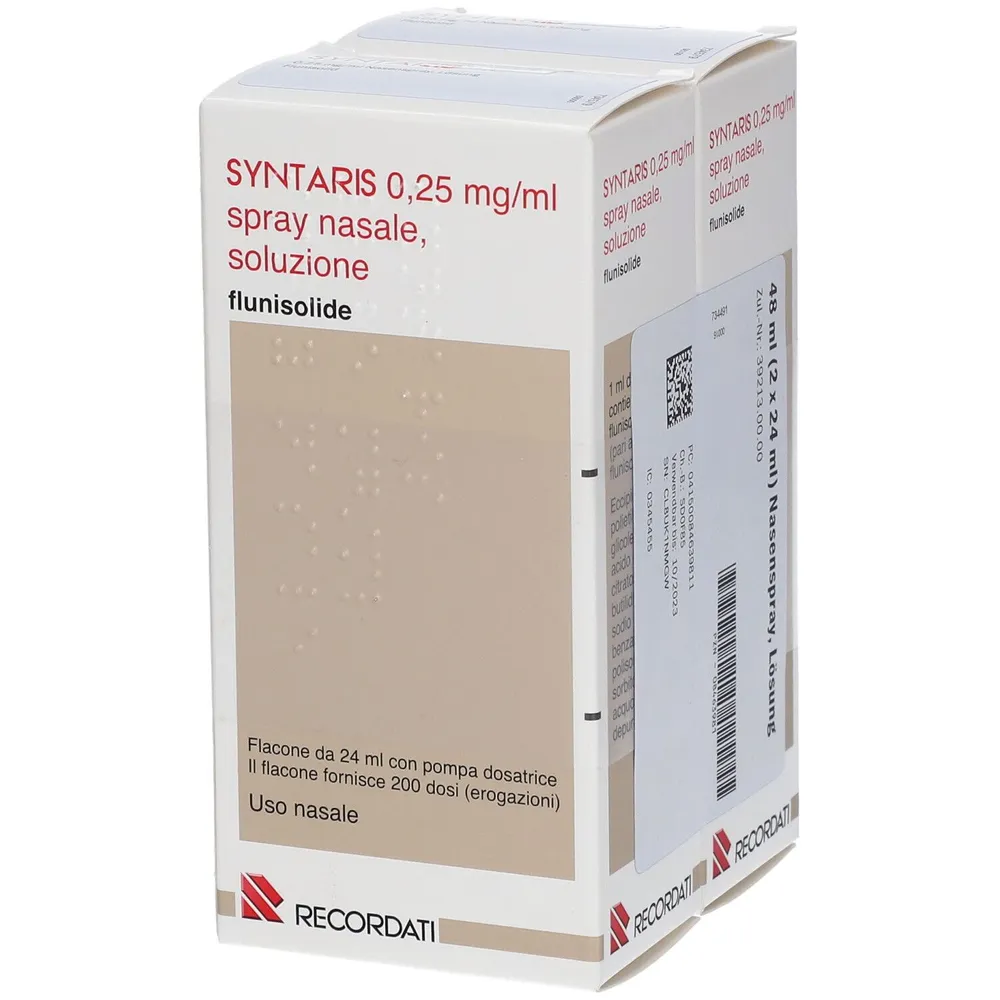
Table of Contents
Package leaflet: Information for the patient
Syntaris 0,25 mg/ml nasal spray, solution
flunisolide
Please read all of this leaflet carefully before using this medicine because it contains important information for you.
- Keep this leaflet. You may need to read it again.
- If you have any questions, ask your doctor or pharmacist.
- This medicine has been prescribed for you only. Do not give it to other people, even if their symptoms are the same as yours, as it may be harmful.
- If you experience any side effects, including those not listed in this leaflet, talk to your doctor or pharmacist. See section 4.
Contents of this leaflet:
- What Syntaris is and what it is used for
- What you need to know before using Syntaris
- How to use Syntaris
- Possible side effects
- How to store Syntaris
- Contents of the pack and other information
1. What Syntaris is and what it is used for
Syntaris contains the active substance flunisolide.
Flunisolide belongs to a group of medicines called "corticosteroids" and has potent anti-inflammatory and antiallergic activity.
Syntaris is used to prevent and treat the symptoms of allergic rhinitis (chronic and seasonal allergic rhinitis), including hay fever.
2. What you need to know before using Syntaris
Do not use Syntaris
- if you are allergic to flunisolide or to any of the other ingredients of this medicine (listed in section 6)
- if you have nasal infections caused by fungi, bacteria, or viruses that are not being treated.
Warnings and precautions
Talk to your doctor or pharmacist before using Syntaris.
In particular, inform your doctor if you have problems with your adrenal glands. Your doctor will exercise particular caution when switching you from a corticosteroid treatment that affects the entire body (systemic therapy) to Syntaris nasal spray.
It is important to take the dose of medicine as indicated in the package leaflet or as prescribed by your doctor. Using higher or lower doses than recommended may worsen your symptoms.
Avoid using this medicine for prolonged periods and at high doses, as undesirable effects may occur, such as Cushing's syndrome (a condition caused by excessive production of a hormone, cortisol), Cushingoid appearance (characterized by localized obesity mainly in the abdomen, face, and back), adrenal suppression, growth retardation in children and adolescents (who will be monitored regularly for height assessment), bone fragility, eye problems (cataract and glaucoma), hyperactivity, sleep disturbances, anxiety, depression, aggression, and behavioral disorders (especially in children).
The use, especially if prolonged, of topical products such as Syntaris may lead to allergic reactions (sensitization phenomena). In such cases, discontinue treatment and follow appropriate therapy.
Medicines such as Syntaris (corticosteroids) may mask certain signs of infection, and new infections may develop during their use.
Contact your doctor if you experience blurred vision or other visual disturbances.
Children
The use of Syntaris is not recommended in children under 5 years of age, as its safety and efficacy have not been established.
Other medicines and Syntaris
Inform your doctor or pharmacist if you are taking, have recently taken, or might take any other medicines, including those obtained without a prescription.
Some medicines may increase the effects of Syntaris, and your doctor may wish to monitor you closely if you are taking these medicines (including certain HIV treatments: ritonavir, cobicistat).
Pregnancy and breastfeeding
If you are pregnant, suspect you may be pregnant, planning a pregnancy, or breastfeeding, consult your doctor or pharmacist before using this medicine.
Syntaris is not recommended during the first three months of pregnancy.
If you are in the second or third trimester of pregnancy, your doctor will assess the benefits of using Syntaris against the potential risks to the fetus.
Caution should also be exercised during breastfeeding; consult your doctor.
Driving and operating machinery
Syntaris does not affect the ability to drive vehicles or operate machinery.
Syntaris contains
- benzalkonium chloride (BAC) as a preservative. This medicine contains 0.035 mg of benzalkonium chloride per spray, equivalent to 0.35 mg per ml of solution. It may cause irritation and swelling inside the nose, especially if used for long periods. If such a reaction is suspected (persistent nasal congestion), a nasal medicine without BAC should be used, if possible. If nasal medicines without BAC are not available, another pharmaceutical form should be considered;
- butylated hydroxytoluene, which may cause localized skin reactions (e.g., contact dermatitis) or irritation to the eyes and mucous membranes;
- propylene glycol. This medicine contains 5 mg of propylene glycol per spray, equivalent to 50 mg per ml of solution.
3. How to use Syntaris
Use this medicine exactly as directed by your doctor or pharmacist. If you have any doubts, consult your doctor or pharmacist.
Syntaris nasal spray is intended for intranasal administration only.
The recommended starting dose is:
- Adults: 2 sprays per nostril twice daily.
If symptoms are severe or worsen, your doctor may recommend 2 sprays per nostril three times daily.
The maximum daily dose must not exceed 6 sprays in each nostril.
- Children (from 5 years of age onwards): 1 spray per nostril three times daily. The maximum daily dose must not exceed 3 sprays in each nostril.
Once the desired clinical effect has been achieved, the maintenance dose should be the lowest amount needed to control symptoms.
In some cases, results may be maintained with 1 spray (approximately 25 micrograms) per nostril daily.
There is no evidence that exceeding the recommended maximum dose provides greater effectiveness; therefore, avoid using a higher dose than recommended.
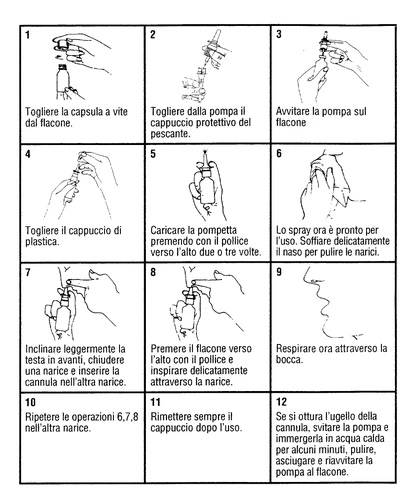
Instructions for use
NOTE
The effect of Syntaris is not immediate.
It may take 1–2 days before the beneficial action of the medicine becomes apparent.
To achieve maximum benefit, use Syntaris regularly as prescribed by your doctor.
If you use more Syntaris than you should
Administering large amounts of Syntaris within a short period of time may alter the function of certain glands in the body (suppression of hypothalamic-pituitary-adrenal function). In such cases, the dose of Syntaris nasal spray should be immediately reduced to the recommended dose.
If you accidentally take an excessive dose of Syntaris, contact your doctor immediately or go to the nearest hospital.
If you forget to use Syntaris
Do not use a double dose to make up for a missed dose.
If you stop using Syntaris
To achieve maximum benefit, use Syntaris regularly. Do not stop treatment without consulting your doctor.
If you have any questions about the use of this medicine, consult your doctor or pharmacist.
4. Possible side effects
Like all medicines, this medicine can cause side effects, although not everyone experiences them.
The most common side effects are:
- mild, temporary burning sensation
- tingling.
Other side effects observed in decreasing order of frequency are:
- nasal irritation
- nosebleeds (epistaxis)
- nasal congestion
- runny nose (rhinorrhea)
- sore throat
- hoarseness (hoarse voice)
- throat irritation.
In rare cases, these side effects may require discontinuation of treatment.
Blurred vision may occur, frequency unknown.
Systemic effects may occur with nasal corticosteroids, particularly when prescribed at high doses over prolonged periods. These may include growth retardation in children and adolescents.
Reporting of side effects
If you experience any side effect, including those not listed in this leaflet, talk to your doctor or pharmacist. You can also report side effects directly via the national reporting system at http://www.agenziafarmaco.gov.it/content/come-segnalare-una-sospetta-reazione-avversa.
By reporting side effects, you can help provide more information on the safety of this medicine.
5. How to store Syntaris
Keep in the original packaging to protect the medicine from light.
Keep this medicine out of the sight and reach of children.
Do not use this medicine after the expiry date stated on the carton after "Exp". The expiry date refers to the last day of that month.
Do not dispose of medicines via wastewater or household waste. Ask your pharmacist how to dispose of medicines you no longer use. This will help protect the environment.
6. Package contents and other information
What Syntaris contains
- The active substance is flunisolide hemihydrate. 1 ml of solution contains 0.255 mg of flunisolide hemihydrate (equivalent to 0.25 mg of anhydrous flunisolide).
- The other components are polyethylene glycol 400, propylene glycol, citric acid, disodium citrate dihydrate, butylhydroxytoluene, edetate sodium, benzalkonium chloride, polysorbate 20, sorbitol (70% aqueous solution), purified water.
Description of the appearance of Syntaris and contents of the pack
Syntaris is available as a nasal spray solution.
The pack contains a 24 ml bottle with a metering pump.
One 24 ml bottle provides 200 doses (sprays).
Marketing Authorization Holder
Konpharma s.r.l.,
Via Pietro Della Valle 1,
00193 Rome, Italy
Manufacturer
Recordati Industria Chimica e Farmaceutica S.p.A.
Via Matteo Civitali, 1
20148 Milan, Italy