Synagis
Italy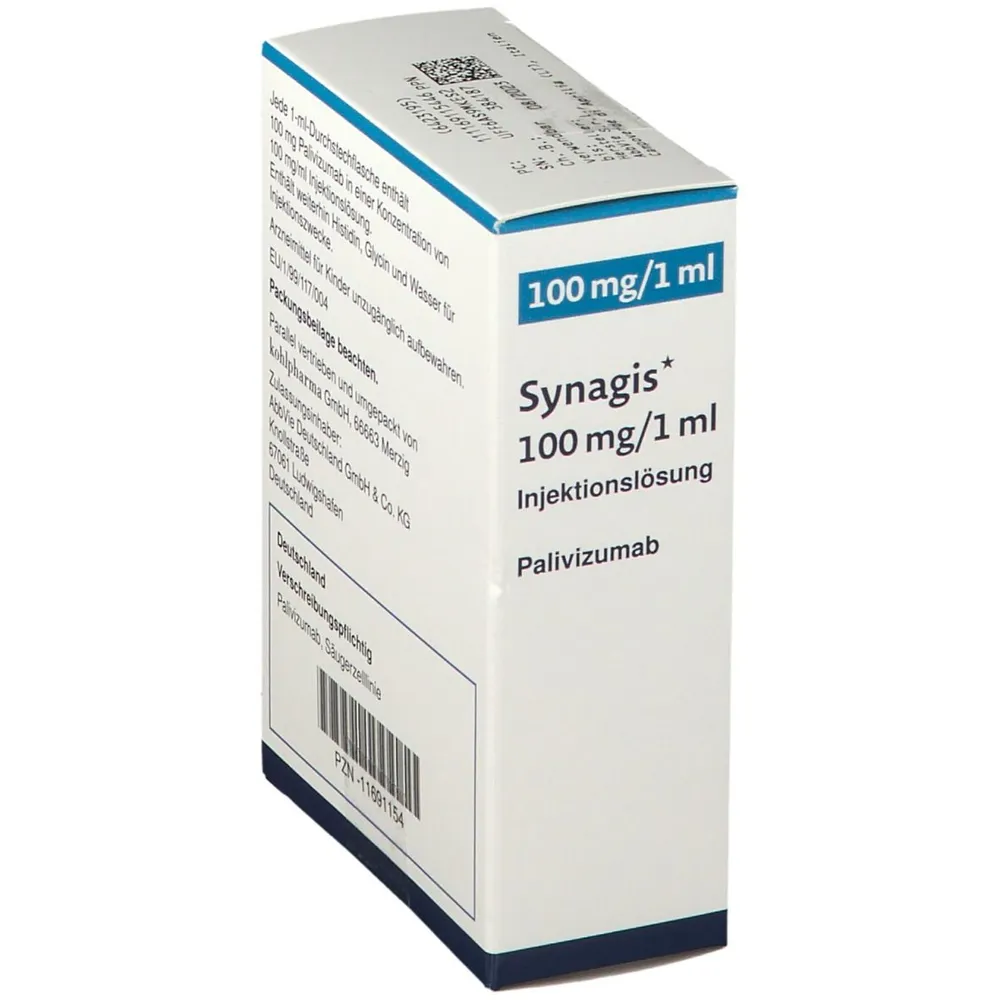
Table of Contents
- Package leaflet: Information for the user
- Synagis 50 mg/0.5 ml injectable solution, 100 mg/1 ml injectable solution
- 1. What Synagis is and what it is used for
- 2. What you should know before your child uses Synagis
- 3. How to use Synagis in the child
- 4. Possible side effects
- 5. How to store Synagis
- 6. Package contents and other information
Package leaflet: Information for the user
Synagis 50 mg/0.5 ml injectable solution, 100 mg/1 ml injectable solution
Active substance: palivizumab
Please read this leaflet carefully before giving this medicine to the child as it contains
important information for you and the child.
- Keep this leaflet. You may need to read it again.
- If you have any questions, consult your doctor or pharmacist.
- If any of the side effects worsens, or if you notice any side effects in the child not listed in this leaflet, inform your doctor or pharmacist. See section 4.
Contents of this leaflet:
- What Synagis is and what it is used for
- What you need to know before your child uses Synagis
- How to use Synagis in the child
- Possible side effects
- How to store Synagis
- Contents of the pack and other information
1. What Synagis is and what it is used for
Synagis contains an active substance called palivizumab, which is an antibody that acts specifically against a virus called respiratory syncytial virus, RSV.
The child is at high risk of developing a disease caused by the respiratory syncytial virus (RSV).
Children who are more likely to develop severe RSV disease (high-risk children) are those born prematurely (35 weeks gestation or less) or those born with certain heart or lung conditions.
Synagis is a medicine that helps protect the child from developing severe RSV disease.
2. What you should know before your child uses Synagis
Do not use Synagis in your child
If he or she is allergic to palivizumab or to any of the other ingredients of this medicine (listed in
section 6). Signs and symptoms of a severe allergic reaction include:
- severe skin rash, hives, skin itching
- swelling of the lips, tongue, or face
- throat obstruction, difficulty swallowing
- difficulty breathing, rapid or irregular breathing
- bluish color of the skin, lips, or under the nails
- muscle weakness or floppiness
- drop in blood pressure
- unresponsiveness
Warnings and precautions
Exercise special care with Synagis
- if your child does not feel well. Please inform the doctor if your child is unwell, as it may be necessary to delay administration of Synagis.
- if your child has bleeding manifestations, since Synagis is usually injected into the thigh.
Other medicines and Synagis
No interactions between Synagis and other medicines are known. However, before starting treatment with
Synagis, you must inform the doctor about all medicines your child is currently taking.
3. How to use Synagis in the child
How often should Synagis be administered to the child?
Synagis should be administered to the child at a dose of 15 mg/kg body weight once a month for as long as the risk of RSV infection persists.
To ensure optimal protection, it is important to follow the doctor's instructions regarding when to return for subsequent doses of Synagis.
If the child is scheduled to undergo heart surgery (cardiac bypass procedure), an additional dose of Synagis may be required after the surgery. After this, the child can resume the original injection schedule.
How is Synagis given to the child?
Synagis will be administered to the child as an intramuscular injection, usually in the outer part of the thigh.
What happens if the child misses an injection of Synagis?
If the child misses an injection, contact the doctor as soon as possible. Each dose of Synagis protects the child for approximately one month before the next dose is needed.
Always use this medicine exactly as the doctor or pharmacist has instructed. If you have any doubts about how to use this medicine in the child, consult the doctor or pharmacist.
4. Possible side effects
Like all medicines, this medicine can cause side effects, although not everybody gets them.
Synagis may cause serious side effects including:
- severe allergic reactions, which may be life-threatening or fatal (see "Do not use Synagis in the child" for a list of signs and symptoms).
- unusual bruising or clusters of small red spots on the skin.
Tell a doctor or seek immediate medical help if the child experiences any of the serious side effects listed above after receiving a dose of Synagis.
Other side effects
Very common (affects at least 1 in 10 people):
- rash
- fever
Common (affects from 1 to 10 in 100 people):
- pain, redness, or swelling at the injection site
- a pause in breathing or other breathing difficulties
Uncommon (affects less than 1 in 100 people):
- seizures
- hives
Reporting of side effects
If the child experiences any side effect, including those not listed in this leaflet, talk to a doctor. You may also report side effects directly through the national reporting system detailed in Annex V.
By reporting side effects, you can help provide more information on the safety of this medicine.
5. How to store Synagis
Keep this medicine out of the sight and reach of children.
Do not use this medicine after the expiry date stated on the label after “Expiry”. The expiry date refers to the last day of that month.
Store in a refrigerator (2°C - 8°C).
Do not freeze.
Keep the vial in its packaging to protect the medicine from light.
6. Package contents and other information
What Synagis contains
- The active substance is palivizumab. One ml of Synagis injectable solution contains 100 mg of palivizumab.
- Each 0.5 ml vial contains 50 mg of palivizumab.
- Each 1 ml vial contains 100 mg of palivizumab.
- The other components are histidine, glycine, and water for injections.
Description of the appearance of Synagis and contents of the pack
Synagis injectable solution is a clear or slightly opalescent solution and is available in
0.5 ml or 1 ml vials.
Pack of 1.
Marketing Authorization Holder
AstraZeneca AB
SE 151 85 Södertälje
Sweden
Manufacturer
AbbVie S.r.l.
04011 Campoverde di Aprilia (LT)
Italy
For further information about this medicinal product, please contact the local representative of the Marketing Authorization Holder:
België/Belgique/Belgien Lietuva
AstraZeneca S.A./N.V. UAB AstraZeneca Lietuva
Tel: +32 2 370 48 11 Tel: +370 5 2660550
България Luxembourg/Luxemburg
АстраЗенека България ЕООД AstraZeneca S.A./N.V.
Teл.: +359 2 44 55 000 Tél/Tel: +32 2 370 48 11
Česká republika Magyarország
AstraZeneca Czech Republic s.r.o AstraZeneca Kft.
Tel: +420 222 807 111 Tel.: +36 1 883 6500
Danmark Malta
AstraZeneca A/S Associated Drug Co. Ltd
Tlf: +45 43 66 64 62 Tel: +356 2277 8000
Deutschland Nederland
AstraZeneca GmbH AstraZeneca BV
Tel: +49 40 809034100 Tel: +31 85 808 9900
Eesti Norge
AstraZeneca AstraZeneca AS
Tel: +372 6549 600 Tlf: +47 21 00 64 00
Ελλάδα Österreich
AstraZeneca A.E. AstraZeneca Österreich GmbH
Τηλ: +30 2 106871500 Tel: +43 1 711 31 0
España Polska
AstraZeneca Farmacéutica Spain, S.A. AstraZeneca Pharma Poland Sp. z o.o.
Tel: +34 91 301 91 00 Tel.: +48 22 245 73 00
France Portugal
AstraZeneca AstraZeneca Produtos Farmacêuticos, Lda.
Tél: +33 1 41 29 40 00 Tel: +351 21 434 61 00
Hrvatska România
AstraZeneca d.o.o. AstraZeneca Pharma SRL
Tel: +385 1 4628 000 Tel: +40 21 317 60 41
Ireland Slovenija
AstraZeneca Pharmaceuticals (Ireland) DAC AstraZeneca UK Limited
Tel: +353 1609 7100 Tel: +386 1 51 35 600
Ísland Slovenská republika
Vistor hf. AstraZeneca AB, o.z.
Sími: +354 535 7000 Tel: +421 2 5737 7777
Italia Suomi/Finland
AstraZeneca S.p.A. AstraZeneca Oy
Tel: +39 02 00704500 Puh/Tel: +358 10 23 010
Κύπρος Sverige
Αλέκτωρ Φαρµακευτική Λτδ AstraZeneca AB
Τηλ: +357 22490305 Tel: +46 8 553 26 000
Latvija United Kingdom (Northern Ireland)
SIA AstraZeneca Latvija AstraZeneca UK Ltd
Tel: +371 67377100 Tel: +44 1582 836 836
More detailed information on this medicinal product is available on the European Medicines Agency website: http://www.ema.europa.eu.
The following information is intended for healthcare professionals only:
Instructions for the physician
To improve the traceability of biological medicinal products, the name and batch number of the administered medicinal product should be clearly recorded.
Palivizumab must not be mixed with other medicinal products or diluents.
Both the 0.5 ml and 1 ml vials contain an overage that allows withdrawal of 50 mg or 100 mg, respectively.
Do not dilute the product.
Do not shake the vial.
For administration, remove the cap seal and clean the stopper with 70% ethanol or equivalent. Insert the needle into the vial and withdraw the appropriate volume of solution into a syringe. The palivizumab injectable solution contains no preservatives, is for single use only, and must be administered immediately after withdrawal into the syringe.
Any unused medicinal product and waste material derived from this medicinal product must be disposed of in accordance with local requirements.
Palivizumab is administered intramuscularly once a month, preferably in the anterolateral thigh. The gluteal muscle should not be routinely used as an injection site due to the risk of sciatic nerve injury. The injection must be performed using standard aseptic technique. Volumes exceeding 1 ml should be administered as separate injections.
When using palivizumab 100 mg/1 ml, the volume (in ml) of palivizumab to be administered monthly = [patient's weight in kg] multiplied by 0.15
For example, for a child weighing 3 kg, the calculation is:
(3 x 0.15) ml = 0.45 ml of palivizumab per month