Surfedex
Italy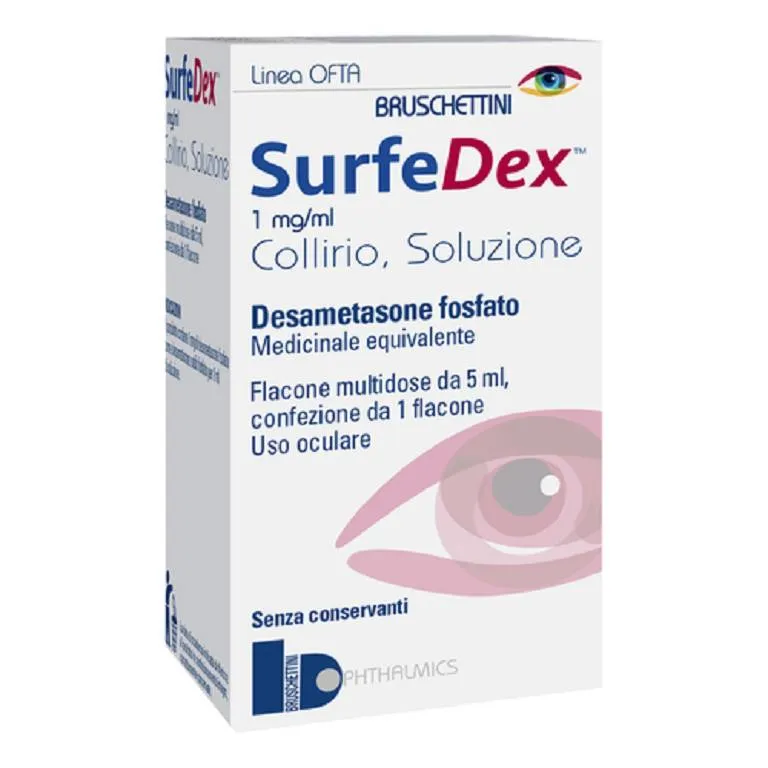
Table of Contents
PACKAGE LEAFLET: INFORMATION FOR THE USER
SURFEDEX 1 mg/ml, eye drops solution
Dexamethasone phosphate
Equivalent medicine
Please read this leaflet carefully before using this medicine because it contains
important information for you.
- Keep this leaflet. You may need to read it again.
- If you have any questions, ask your doctor or pharmacist.
- This medicine has been prescribed for you only. Do not give it to others, even if their symptoms are the same as yours, as it may be harmful.
- If you experience any adverse reactions, including those not listed in this leaflet, contact your doctor or pharmacist. See section 4.
Contents of this leaflet:
- What SURFEDEX is and what it is used for
- What you need to know before using SURFEDEX
- How to use SURFEDEX
- Possible side effects
- How to store SURFEDEX
- Contents of the pack and other information
1. WHAT SURFEDEX IS AND WHAT IT IS USED FOR
SURFEDEX is an eye drop solution containing a substance called desamethasone. This substance is a corticosteroid that relieves inflammatory symptoms.
SURFEDEX is indicated for:
- Treatment of eye inflammation. The eye must not be infected (red eye, discharge, tearing); otherwise, specific treatment for the infection must be added (see section 2).
2. WHAT YOU NEED TO KNOW BEFORE USING SURFEDEX
Do not use SURFEDEX:
- If you have an untreated ocular infection for which you are not receiving medication
- If you have an untreated ocular infection that may be caused by bacteria (including acute purulent infections), fungal infections, viral infections (e.g. Herpes simplex, vaccinia virus, varicella-zoster), or amoebic infections (a single-celled parasite)
- If there is damage to the surface of the eye (perforation, ulceration, or corneal lesion with incomplete epithelialization)
- If you have known corticosteroid-induced ocular hypertension
- If you are allergic to sodium phosphate dexamethasone or to any of the other components of this medicine (listed in section 6).
Warnings and precautions
Talk to your doctor or pharmacist before using SURFEDEX.
DO NOT INJECT, DO NOT INGEST.
Avoid contact between the tip of the container and the eye or eyelids.
SURFEDEX requires ophthalmological monitoring in all cases, and particularly:
- In children and elderly patients, more frequent ophthalmological checks are recommended,
- If you have an ocular infection. You may use SURFEDEX only if the infection is controlled by anti-infective treatment,
- If you have a corneal ulcer. You must not use topical dexamethasone treatment or SURFEDEX unless inflammation is the main cause of delayed healing,
- If you have pre-existing elevated intraocular pressure. If you previously experienced a side effect from topical steroid treatment with increased intraocular pressure, you are at risk of developing increased intraocular pressure when treated with SURFEDEX,
- If you suffer from a condition called glaucoma.
In cases of allergic conjunctivitis unresponsive to standard therapy, SURFEDEX may be used only for a short period.
Do not use SURFEDEX for prolonged periods.
SURFEDEX.
Other medicines and SURFEDEX
If you are using other eye drops at the same time, wait at least 15 minutes between each instillation.
Calcium phosphate precipitations on the corneal surface have been reported during concomitant topical therapy with steroids and beta-blockers (a class of drugs used in glaucoma).
Tell your doctor or pharmacist if you are taking, have recently taken, or might take any other medicines.
Pregnancy and breastfeeding
- There is insufficient data on the use of SURFEDEX during pregnancy to assess potential harmful effects.
For this reason, the use of SURFEDEX during pregnancy is not recommended.
- It is not known whether this medicine is excreted in breast milk. However, the total dose of dexamethasone in this medicinal product is low.
Therefore, SURFEDEX may be used during breastfeeding.
If you are pregnant, suspect you may be pregnant, planning a pregnancy, or breastfeeding, consult your doctor or pharmacist before using this medicine.
Driving and using machines
As with other eye drops, temporary blurred vision or other visual disturbances may affect your ability to drive or operate machinery. Do not drive or operate machinery until your vision is clear.
3. HOW TO USE SURFEDEX
Dosage
Use this medicine exactly as directed by your doctor.
If you have any doubts, consult your doctor or pharmacist.
The recommended dose is 1 drop instilled 4 to 6 times a day into the affected eye. In severe cases, treatment may begin with 1 drop every hour, and should be reduced to 1 drop every 4 hours once a favourable response is observed. A gradual reduction of the dosage is recommended to avoid relapse.
- No dosage adjustment is required in elderly patients.
- In children, long-term and uninterrupted therapy should be avoided.
Method of administration
Ophthalmic use: this medicine is for use in the eyes.
- Wash your hands thoroughly before using the product.
- Look upwards and pull down the lower eyelid with your finger. Instil one drop into the affected eye.
- Immediately after instillation, press gently with your finger on the inner corner of the treated eye, near the nose, for a few minutes. This helps prevent the eye drops from spreading into the rest of the body.
- Avoid touching the tip of the container to the eye or eyelids.
Frequency of administration
4 to 6 times daily.
Duration of treatment
Treatment duration generally varies from a few days up to a maximum of 14 days.
If you use more SURFEDEX than you should
If you have instilled an excessive amount of the product into the eye and experience persistent irritation, rinse the eye with sterile water.
Contact your doctor or pharmacist immediately.
If you forget to use SURFEDEX
Do not use a double dose to make up for the missed dose.
If you stop using SURFEDEX
Do not stop treatment abruptly. Always consult your doctor before stopping treatment.
If you have any questions about the use of this medicine, consult your doctor or pharmacist.
4. POSSIBLE ADVERSE EFFECTS
Like all medicines, this medicine can cause adverse effects, although not everybody experiences them.
The possible adverse effects, according to frequency, are listed below:
Very common (may affect more than 1 in 10 people):
- Increased intraocular pressure after 2 weeks of treatment.
Common (may affect up to 1 in 10 people):
- Ocular discomfort, irritation, burning, stinging pain, itching, and blurred vision after instillation. These are usually short- to medium-term symptoms.
Uncommon (may affect up to 1 in 100 people):
- Allergic and hypersensitivity reactions,
- Delayed healing of ocular wounds,
- Clouding of the lens (posterior subcapsular cataract),
- Eye infections that may normally occur (opportunistic infections, for example infections caused by pathogens that usually do not cause disease in people with a healthy immune system, but infections that may occur in people whose immune system is weakened),
- Eye disease caused by increased pressure in the eye (glaucoma),
- Weakened adrenal gland function if used frequently, causing the kidneys to not produce enough hormones (suppression of cortico-adrenal function). This may be shown by low blood sugar levels, dehydration, weight loss, and disorientation.
Very rare (may affect up to 1 in 10,000 people):
- Inflammation of the eye membranes (conjunctivitis),
- Dilation of the pupil (mydriasis),
- Swelling of the face,
- Drooping of the eyelids (ptosis),
- Inflammation inside the eye (uveitis),
- Cloudy spots on the cornea due to calcium deposits during treatment (corneal calcifications),
- Inflammation of the cornea (lens crystalline keratopathy),
- Changes in thickness of the front part of the eye (cornea),
- Swelling of the cornea,
- Corneal ulcer, or perforation which may cause pain, tearing, squinting, and loss of vision,
- Small holes on the surface of the eye (corneal perforation).
Reporting of adverse effects
If you experience any adverse effect, including those not listed in this leaflet, please contact your doctor or pharmacist.
You can also report adverse effects directly via the reporting system at the following website:
www.agenziafarmaco.gov.it/ /content/come-segnalare-una-sospetta-reazione-avversa
By reporting adverse effects, you can help provide more information on the safety of this medicine.
5. HOW TO STORE SURFEDEX
Keep this medicine out of the sight and reach of children.
Do not use SURFEDEX after the expiry date which is stated on the container after the wording “EXP.” The expiry date refers to the last day of that month.
Do not dispose of any medicine via wastewater or household waste.
Ask your pharmacist how to dispose of medicines no longer required. This will help protect the environment.
6. PACKAGING CONTENTS AND OTHER INFORMATION
What SURFEDEX contains
- The active substance is sodium phosphate dexamethasone.
- The excipients are disodium edetate, anhydrous disodium hydrogen phosphate, sodium chloride, water for injections.
Description of the appearance of SURFEDEX and contents of the pack
5 ml solution in a white opaque LDPE vial of 5 ml with white Novelia nozzle (HDPE and silicone) and white HDPE cap, clear colourless solution, free from visible particles.
Marketing Authorisation Holder
Bruschettini Srl
Via Isonzo, 6
16147 Genova
Italy
This leaflet was last updated on: