Sosefen
Italy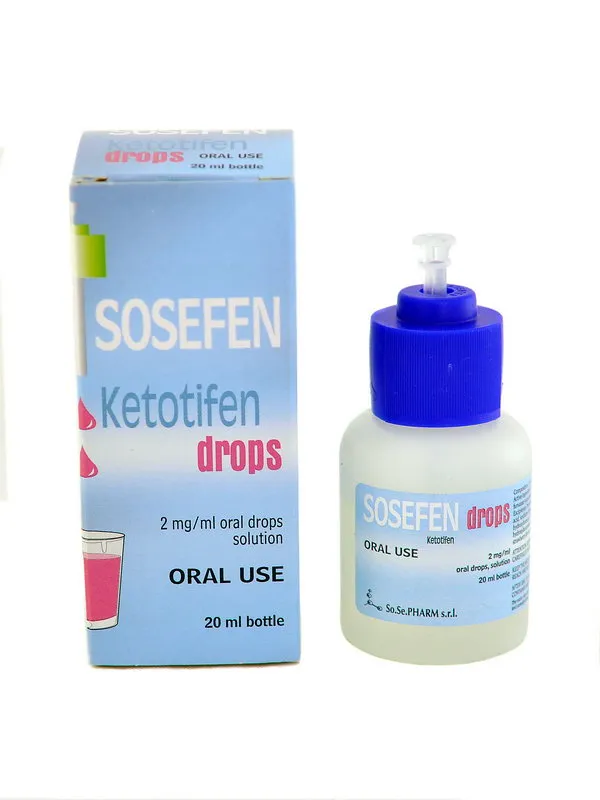
Table of Contents
PACKAGE LEAFLET
SOSEFEN 2 mg/ml oral drops, solution, 1 mg soluble tablets
Ketotifene
COMPOSITION
SOSEFEN 2 mg/ml oral drops, solution
1 ml of solution contains:
Active substance: Ketotifene fumarate 2.75 mg equivalent to 2 mg of ketotifene
Excipients: Propylene glycol, sorbitol, citric acid, sodium citrate, sodium methyl p-hydroxybenzoate,
sodium propyl p-hydroxybenzoate, sodium saccharin, strawberry flavour, purified water.
SOSEFEN 1 mg soluble tablets
One tablet contains:
Active substance: Ketotifene fumarate 1.375 mg equivalent to 1 mg of ketotifene
Excipients: Betacyclodextrin, sorbitol, microcrystalline cellulose, crospovidone, hydrated aluminium oxide,
anhydrous colloidal silica, sodium saccharin, ammonium glycyrrhizinate, magnesium stearate, mint flavour.
PHARMACEUTICAL FORM AND CONTENT
Oral drops, solution: 20 ml bottle of 0.2% solution (2 mg/ml)
Soluble tablets: box of 40 tablets of 1 mg
THERAPEUTIC CATEGORY
Antiallergics, antihistamines - ATC Code: R06AX17
MARKETING AUTHORISATION HOLDER
So.Se.PHARM S.r.l. - Via dei Castelli Romani, 22 - 00040 Pomezia (RM)
MANUFACTURER AND FINAL CONTROLLER
Special Product's Line S.r.l. - Via Campobello, 15 - 00040 Pomezia (RM)
THERAPEUTIC INDICATIONS
Symptomatic treatment of allergic rhinitis
CONTRAINDICATIONS
Hypersensitivity to ketotifene or to any of the excipients;
Patients undergoing treatment with oral antidiabetics;
Epilepsy;
Breastfeeding.
PRECAUTIONS FOR USE
Ketotifene is not effective for the prevention or treatment of acute asthma attacks.
Ketotifene may lower the seizure threshold and should therefore be administered with caution in patients
with a history of epilepsy.
Monitor for signs of severe drowsiness. Drowsiness, which is particularly common during the first
days of treatment, may impair practical abilities such as driving or operating machinery (see section 4.7).
The use of alcoholic beverages and central nervous system depressant drugs (e.g. sedative-hypnotics, other antihistamines) is discouraged.
Discontinuation of treatment should be done gradually over a period of 2–4 weeks.
Keep out of reach of children.
INTERACTIONS
SOSEFEN may enhance the effects of sedatives, hypnotics, antihistamines, alcohol, and anticoagulants.
In patients taking SOSEFEN concomitantly with oral antidiabetic drugs, thrombocytopenia may occur.
Therefore, concomitant use of these drugs should be avoided.
Ketotifene enhances the effect of bronchodilators; therefore, the frequency of use of the latter should be reduced when administered simultaneously with SOSEFEN.
SPECIAL WARNINGS
The drops contain p-hydroxybenzoates: these may cause delayed allergic reactions such as contact dermatitis; more rarely, they may cause immediate-type reactions with urticaria and bronchospasm.
Both drops and tablets contain sorbitol, which may cause gastrointestinal disturbances and diarrhoea.
The product may be taken safely by patients with coeliac disease.
Use during pregnancy and breastfeeding
Animal studies have not shown teratogenic effects of ketotifene, although it has demonstrated the ability to cross the placenta; due to the lack of human data, SOSEFEN should be used during pregnancy only if clearly needed and under strict medical supervision.
Significant amounts of various antihistamines, including ketotifene, are excreted in breast milk. Due to insufficient safety data for use during breastfeeding, SOSEFEN should not be taken by nursing mothers.
Effects on ability to drive and use machines
During the first days of treatment with SOSEFEN, patients' reaction times may be impaired; therefore, caution should be exercised when driving vehicles or operating machinery.
DOSAGE, ADMINISTRATION AND DURATION OF TREATMENT
The solution is dosed using the graduated dropper provided, marked with 25 graduations:
- 7 graduations correspond to 0.5 mg of ketotifene
- 13 graduations correspond to 1 mg of ketotifene
- 25 graduations correspond to 2 mg of ketotifene
Tablets
Adults:
2 mg once daily, preferably in the evening; if necessary, 2 mg twice daily (morning and evening, 12-hour interval);
Children:
over 3 years: 2 mg once daily, preferably in the evening.
Oral drops 2 mg/ml
Adults and children (over 3 years): 1 mg twice daily (morning and evening)
Children (6 months–3 years): 0.05 mg/kg twice daily (morning and evening)
OVERDOSE
Main symptoms of acute overdose include: drowsiness, up to severe sedation; confusion and disorientation; bradycardia or tachycardia, hypotension; hyperexcitability or seizures, especially in children; dyspnoea or respiratory depression; reversible coma.
Treatment: emesis is not recommended due to the risk of seizures; consider the possibility of gastric lavage and administration of activated charcoal. If necessary, provide symptomatic treatment and cardiovascular monitoring. In case of agitation or seizures, administer benzodiazepines (diazepam or lorazepam); if seizures persist or recur, administer phenobarbital.
UNDESIRABLE EFFECTS
Drowsiness and sedation (common at the beginning of treatment, tend to disappear during therapy), nausea, vomiting, gastralgia, dyspepsia, constipation, asthenia, dry mouth, headache, dizziness.
Occasionally, symptoms of CNS stimulation such as excitement, irritability, insomnia and nervousness may occur, especially in children. Cases of contact dermatitis, skin rashes, Stevens-Johnson syndrome, dyspnoea, weight gain, syncope and withdrawal syndrome have also been reported. Very rarely, ketotifene may cause seizures, increased liver enzymes and hepatitis. Isolated cases of arrhythmia during treatment with ketotifene have been reported.
Following the instructions in this leaflet reduces the risk of undesirable effects.
It is important to inform your doctor or pharmacist of any undesirable effect, even if not described in this leaflet.
EXPIRY DATE AND STORAGE
See the expiry date stated on the packaging. The shelf life applies to the product in unopened packaging, stored correctly.
Do not use the medicine after the expiry date stated on the packaging.
June 2007