Sonovue
Italy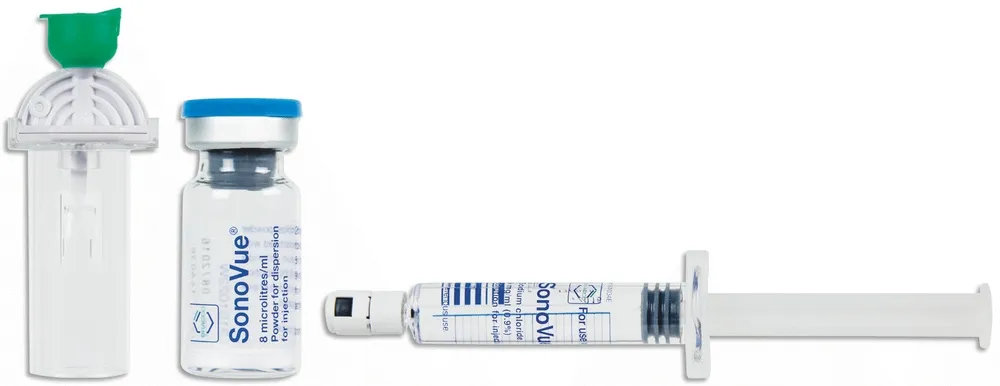
Table of Contents
- Package leaflet: Information for the patient
- SonoVue, 8 microlitres/mL, powder and solvent for injectable dispersion
- 1. What SonoVue is and what it is used for
- 2. What you should know before being given SonoVue
- 3. How SonoVue is administered
- 4. Possible side effects
- 5. How to store SonoVue
- 6. Package contents and other information
- The following information is intended exclusively for healthcare professionals:
Package leaflet: Information for the patient
SonoVue, 8 microlitres/mL, powder and solvent for injectable dispersion
Sulfur hexafluoride
Please read this leaflet carefully before you are given this medicine because it contains important information for you.
- Keep this leaflet. You may need to read it again.
- If you have any further questions, ask your doctor or pharmacist.
- This medicine has been prescribed for you only. Do not give it to other people, even if their symptoms are the same as yours, as it may be harmful.
- If you experience any side effects, including those not listed in this leaflet, tell your doctor or pharmacist. See section 4.
Contents of this leaflet
- What SonoVue is and what it is used for
- What you need to know before SonoVue is administered to you
- How SonoVue is administered
- Possible side effects
- How to store SonoVue
- Contents of the pack and other information
1. What SonoVue is and what it is used for
SonoVue is used only for diagnostic purposes.
SonoVue is an ultrasound contrast agent containing microbubbles filled with a gas called
sulfur hexafluoride.
If you are an adult patient, SonoVue will enable clearer ultrasound images of the heart,
blood vessels and/or liver and breast tissues.
SonoVue will provide more defined images of the urinary tract in children.
2. What you should know before being given SonoVue
Do not use SonoVue:
- if you are allergic to sulfur hexafluoride or to any of the other ingredients of this medicine (listed in section 6),
- if you have been told that you have a right-to-left cardiac shunt,
- if you have severe pulmonary hypertension (pressure in the pulmonary artery > 90 mmHg),
- if you have uncontrolled hypertension,
- if you have adult respiratory distress syndrome (a serious clinical condition characterized by widespread inflammation in the lungs),
- if you have been advised not to take dobutamine (a medicine that stimulates the heart) due to severe heart disease.
Warnings and precautions
Inform your doctor if within the last 2 days you have experienced:
- frequent and/or repeated episodes of angina or chest pain, or if you have a history of heart disease,
- recent changes in your electrocardiogram (ECG).
Contact your doctor before being given SonoVue if: - you have recently had a myocardial infarction or undergone coronary artery surgery,
- you suffer from angina or chest pain or severe heart disease,
- you suffer from serious cardiac arrhythmias,
- your heart condition has recently worsened,
- you have acute inflammation of the heart lining (endocarditis),
- you have artificial heart valves,
- you have acute systemic inflammation or infection,
- you have known coagulation disorders,
- you have severe renal or hepatic impairment.
If you are given SonoVue together with a medicine, physical exercise, or a device used to stimulate the heart to visualize the heart under stress, your cardiac activity, blood pressure, and heart rhythm will be monitored.
SonoVue contains macrogol, an ingredient also known as polyethylene glycol (PEG). Severe allergic reactions have been reported. The risk of serious reactions may be increased in patients with a history of allergic reactions to PEG. Inform your doctor if you have previously experienced allergic reactions to products containing PEG.
Close medical supervision for at least 30 minutes is required after administration of SonoVue to monitor for the risk of severe allergic reactions.
Children and adolescents
For patients under 18 years of age, SonoVue may only be used for urinary tract ultrasonography.
Other medicines and SonoVue
Inform your doctor if you are taking, have recently taken, or might take any other medicines.
In particular, inform your doctor if you are taking beta-blockers (medicines used for heart disease, hypertension, or glaucoma in the form of eye drops).
Pregnancy and breastfeeding
If you are pregnant, suspect you may be pregnant, planning a pregnancy, or are breastfeeding, consult your doctor before being given this medicine.
It is not known whether SonoVue passes into breast milk. However, you should suspend breastfeeding for two to three hours after the ultrasound examination.
Driving and using machines
SonoVue does not affect the ability to drive or operate machinery.
SonoVue contains sodium
This medicine contains less than 1 mmol of sodium (23 mg) per dose, i.e., essentially "sodium-free".
3. How SonoVue is administered
SonoVue is administered by medical or healthcare personnel experienced in this type of examination.
For use in cardiac and vascular and/or liver and breast ultrasonography in adults, the intravenous dose will be determined according to the body area to be examined. The recommended dose is 2 or 2.4 mL per patient. This dose may be repeated, if necessary, up to a total of 4.8 mL.
For use in urinary tract ultrasonography in children, the recommended dose is 1 mL per patient, to be administered into the bladder as follows: after emptying the bladder, a saline solution will be introduced into the bladder through a thin catheter; SonoVue will then be administered via the catheter, followed by additional saline solution to continue filling the bladder.
The filling and emptying of the bladder with saline solution may be repeated, if necessary.
You will be kept under close clinical monitoring during and for at least 30 minutes after administration of SonoVue if you have severe lung or heart problems.
If you are given more SonoVue than you should
Overdose is unlikely since SonoVue is administered by a physician. In the event of an overdose, the physician will take appropriate actions.
4. Possible side effects
Like all medicines, this medicine can cause side effects, although not everybody gets them. Most of the side effects with SonoVue are rare and generally not serious. However, some patients may experience serious side effects and may require treatment.
Tell your doctor immediately if you experience any of the following side effects, as they may require medical treatment:
- Swelling of the face, lips, mouth, or throat which may make swallowing or breathing difficult; skin rash; hives; swelling of the hands, feet, or ankles.
The following side effects have been reported with SonoVue:
Uncommon (may affect up to 1 in 100 people):
- Headache,
- Numbness,
- Dizziness,
- Altered taste,
- Flushing,
- Chest discomfort,
- Malaise (nausea),
- Abdominal pain,
- Skin redness,
- Feeling of warmth,
- Local reaction at the injection site: pain and unusual sensation at the injection site.
Rare (may affect up to 1 in 1,000 people):
- Blurred vision,
- Decrease in blood pressure,
- Itching,
- Back pain,
- General pain,
- Chest pain,
- Fatigue,
- Severe and moderate allergic reactions (including skin redness, decreased heart rate, decreased blood pressure, shortness of breath, loss of consciousness, cardiac arrest/respiratory arrest, or more severe reactions with difficulty breathing and dizziness).
Frequency not known (frequency cannot be estimated from the available data):
- Chest pain radiating to the neck or left arm, which may be a symptom of a potentially serious allergic reaction called Kounis Syndrome.
- Fainting,
- In some cases of allergic reactions, in patients with cardiovascular disease, insufficient oxygen supply to the heart or cardiac arrest have been reported.
- Vomiting.
Reporting of side effects
If you experience any side effect, including those not listed in this leaflet, talk to your doctor or pharmacist. You can also report side effects directly via the national reporting system at the address listed in Annex V. By reporting side effects, you can help provide more information on the safety of this medicine.
5. How to store SonoVue
Keep this medicine out of the sight and reach of children.
Do not use this medicine after the expiry date stated on the label. The expiry date refers to the last day of that month.
This medicine does not require any special storage conditions.
SonoVue must be administered within 6 hours of preparation.
6. Package contents and other information
What SonoVue contains
- The active substance is sulfur hexafluoride in the form of microbubbles.
- The other components are: Macrogol 4000, distearoylphosphatidylcholine, sodium dipalmitoylphosphatidylglycerol, palmitic acid. The glass syringe contains sodium chloride 9 mg/mL (0.9%) in injectable solution.
Description of the appearance of SonoVue and contents of the pack
SonoVue is a kit comprising a glass vial containing a white powder, a glass syringe containing the solvent, and a transfer device.
Marketing Authorization Holder
Bracco International B.V.
Strawinskylaan 3051
NL-1077 ZX Amsterdam
The Netherlands
Manufacturer
Bracco Imaging S.p.A
Via Ribes 5, Bioindustry Park
Colleretto Giacosa-10010 (TO)
Italy
This leaflet was last updated on
Other sources of information
More detailed information on this medicinal product is available on the website of the European Medicines Agency: http://www.ema.europa.eu.
The following information is intended exclusively for healthcare professionals:
If SonoVue is not used immediately after reconstitution, the dispersion must be shaken again before being drawn into a syringe.
This product is for a single examination. Any unused liquid remaining at the end of an examination must be discarded.
Instructions for reconstitution:
2 3
4 5
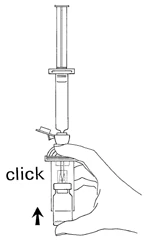
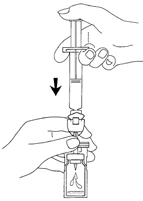
6 7 8
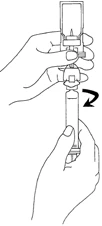
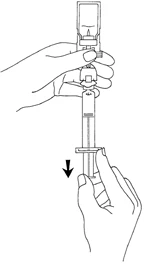
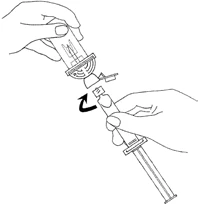
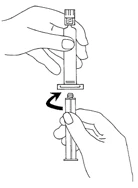
- Connect the plunger by screwing it clockwise into the syringe.
- Open the MiniSpike transfer system package and remove the syringe needle cap.
- Remove the cap from the transfer system and connect the syringe to the transfer system by screwing it clockwise.
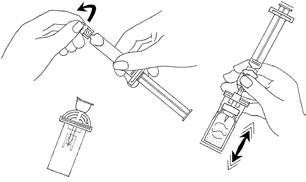
- Remove the protective disc from the vial. Insert the vial into the transparent sleeve of the transfer system and press firmly to secure the vial in place.
- Empty the syringe contents into the vial by pushing the plunger.
- Shake vigorously for 20 seconds to mix the entire contents of the vial (to obtain a homogeneous, milky white liquid).
- Invert the system and carefully aspirate SonoVue into the syringe.
- Unscrew the syringe from the transfer system.
After reconstitution, SonoVue is a homogeneous, milky white dispersion.
Do not use if the resulting liquid is clear and/or if solid particles of the lyophilisate are visible in the suspension.
SonoVue must be administered within six hours of preparation.
Do not dispose of any medicine via wastewater or household waste. Ask your pharmacist how to dispose of medicines you no longer use. This will help protect the environment.