Sodium chloride FKI
Italy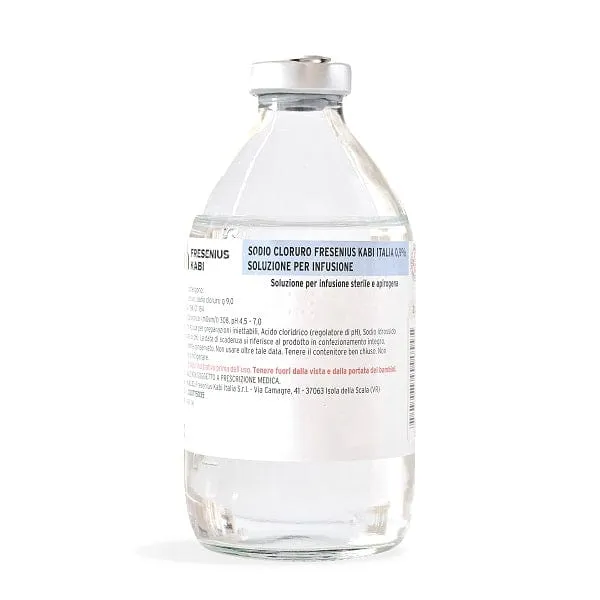
Table of Contents
- Package leaflet: Information for the user
- SODIUM CHLORIDE FRESENIUS KABI ITALIA 0.9% solution for infusion
- 1. What SODIO CLORURO FRESENIUS KABI ITALIA is and what it is used for
- 2. What you need to know before using SODIUM CHLORIDE FRESENIUS KABI ITALIA
- 3. How to use SODIO CLORURO FRESENIUS KABI ITALIA
- 4. Possible side effects
- 5. How to store SODIUM CHLORIDE FRESENIUS KABI ITALIA
- 6. Package contents and other information
- The following information is intended exclusively for healthcare professionals:
Package leaflet: Information for the user
SODIUM CHLORIDE FRESENIUS KABI ITALIA 0.9% solution for infusion
Generic Medicine
Please read this leaflet carefully before using this medicine because it contains important information for you.
- Keep this leaflet. You may need to read it again.
- If you have any questions, ask your doctor, pharmacist, or nurse.
- If you get any side effects, including those not listed in this leaflet, talk to your doctor or nurse. See section 4.
Contents of this leaflet:
- What SODIUM CHLORIDE FRESENIUS KABI ITALIA is and what it is used for
- What you need to know before using SODIUM CHLORIDE FRESENIUS KABI ITALIA
- How to use SODIUM CHLORIDE FRESENIUS KABI ITALIA
- Possible side effects
- How to store SODIUM CHLORIDE FRESENIUS KABI ITALIA
- Contents of the pack and other information
1. What SODIO CLORURO FRESENIUS KABI ITALIA is and what it is used for
SODIO CLORURO FRESENIUS KABI ITALIA is a sterile, pyrogen-free sodium chloride solution.
SODIO CLORURO FRESENIUS KABI ITALIA is indicated to replenish fluids, sodium, and chloride in the body.
2. What you need to know before using SODIUM CHLORIDE FRESENIUS KABI ITALIA
Do not use SODIUM CHLORIDE FRESENIUS KABI ITALIA
- if your blood sodium levels are high (hypernatraemia);
- if you have excess salts in the body (hydrosaline overload).
Warnings and precautions
Talk to your doctor, pharmacist, or nurse before using SODIUM CHLORIDE FRESENIUS KABI ITALIA
This medicine should be administered to you with caution in the following cases:
- if you have high blood pressure (hypertension);
- if you have heart problems (heart failure);
- if you have fluid accumulation in the legs or ankles (peripheral oedema) or in the lungs (pulmonary oedema);
- if your kidneys are poorly functioning (reduced renal function);
- if you are pregnant and suffer from a condition called pre-eclampsia, characterised by high blood pressure, swelling due to fluid retention, and presence of proteins in the urine;
- if you suffer from other conditions occurring when the body retains excessive sodium (sodium retention).
RR + OSP
This medicine should be administered to you with particular caution if you are in any of the following conditions:
- if your heart function is impaired (congestive heart failure);
- if you have severe kidney problems (severe renal failure);
- if you have fluid accumulation (oedema) and your body retains salts (saline retention);
- if you are taking medicines used to treat inflammation (corticosteroids) or medicines that stimulate the production of steroid hormones (corticotropins) (see section "Other medicines and SODIUM CHLORIDE FRESENIUS KABI ITALIA").
If prolonged treatment is required, potassium should also be administered to prevent low blood potassium levels (hypokalaemia).
During treatment, your doctor will monitor your body fluid levels, blood levels of substances such as sodium and potassium (electrolytes), blood salt concentration (plasma osmolarity), and acid-base balance in the blood.
Children
This medicine should be administered with caution in children.
Other medicines and SODIUM CHLORIDE FRESENIUS KABI ITALIA
Inform your doctor or pharmacist if you are taking, have recently taken, or might take any other medicines.
This medicine should be administered with caution if you are taking anti-inflammatory medicines (corticosteroids) and sodium salts, or medicines that stimulate the production of steroid hormones (corticotropins), as these may prevent the body from eliminating sodium and water, causing fluid accumulation (oedema) and increased blood pressure (hypertension).
For other interactions, please refer to the information provided with the medicine you intend to co-administer.
Pregnancy and breastfeeding
If you are pregnant, suspect you may be pregnant, planning a pregnancy, or are breastfeeding, consult your doctor or pharmacist before taking this medicine.
This medicine should be administered during pregnancy only if necessary and always under strict medical supervision, with careful assessment of the risk-benefit ratio.
This medicine may be administered during breastfeeding.
Driving and using machines
This medicine does not affect the ability to drive or use machinery.
3. How to use SODIO CLORURO FRESENIUS KABI ITALIA
This medicine will be administered to you in a hospital or other specialized center by a doctor or nurse.
The doctor will determine the dose based on your age, body weight, laboratory tests (amount and concentration of electrolytes in the blood), your clinical condition, and blood sodium levels.
The solution will only be administered if it is clear, colourless, and free from visible particles.
RR + OSP
SODIO CLORURO FRESENIUS KABI ITALIA must be used immediately after opening the container, for a single continuous administration; any unused residual medicine must be discarded.
If you are given more SODIO CLORURO FRESENIUS KABI ITALIA than you should
If you are administered an excessive amount of this medicine, it may cause increased sodium levels in the blood (hypernatraemia), increased blood volume (hypervolaemia), and/or increased chloride levels in the blood (hyperchloraemia).
If sodium levels in the blood become too high (hypernatraemia) and the body retains excessive sodium due to impaired renal sodium excretion, internal organs may lose fluids (dehydration), particularly the brain, and fluid accumulation (oedema) may occur, affecting the brain, lungs (pulmonary oedema), or legs and ankles (peripheral oedema).
Accumulation of chloride ions leads to a reduction in bicarbonate ion concentration, increasing blood acidity (acidosis).
In case of accidental ingestion/overdose of SODIO CLORURO FRESENIUS KABI ITALIA, inform your doctor immediately or go to the nearest hospital.
If you are concerned that you may have been given a higher dose than required, inform your doctor or pharmacist immediately.
If you have any doubts about how to use this medicine, consult your doctor or pharmacist.
4. Possible side effects
Like all medicines, this medicine can cause side effects, although not everybody will experience them.
The following side effects may occur:
Not known (frequency cannot be estimated from the available data)
- Increased sodium levels in the blood (hypernatraemia), increased blood volume (hypervolaemia), increased chloride levels in the blood (hyperchloraemia) which may lead to loss of other salts (e.g. bicarbonates) and result in increased blood acidity (acidosis);
- Headache (cephalalgia), dizziness, restlessness, fever, irritability, weakness, muscle rigidity, seizures, coma, death;
- Drowsiness, confusion;
- Reduced tear production;
- Increased heart rate (tachycardia);
- Low (hypotension) or high (hypertension) blood pressure, fluid accumulation in the lungs (pulmonary oedema) and in the legs and ankles (peripheral oedema);
- Breathing difficulties (dyspnoea), respiratory arrest;
- Thirst, reduced salivation, nausea, vomiting, diarrhoea, abdominal pain;
- Kidney function problems (renal failure);
- Infection at the infusion site, pain or local reaction, vein irritation, formation of blood clots in the vein (thrombosis) or vein inflammation (phlebitis) extending from the infusion site, leakage of the injected solution out of the vein (extravasation).
Reporting of side effects
RR + OSP
If you experience any side effect, including those not listed in this leaflet, talk to your doctor, pharmacist or nurse.
You can also report side effects directly via the national reporting system at
https://www.aifa.gov.it/content/segnalazioni-reazioni-avverse . By reporting side effects, you can help provide more information on the safety of this medicine.
5. How to store SODIUM CHLORIDE FRESENIUS KABI ITALIA
Keep this medicine out of the sight and reach of children.
Do not use this medicine after the expiry date stated on the packaging after "Expiry".
The expiry date refers to the last day of that month.
Keep the container tightly closed. Do not freeze or refrigerate.
Freeflex bags: do not store at temperatures above 25°C.
The solution must not be used if it is not clear, colourless, and free from visible particles.
Do not dispose of any medicine via wastewater or household waste. Ask your pharmacist how to dispose of medicines you no longer use. This will help protect the environment.
6. Package contents and other information
What SODIO CLORURO FRESENIUS KABI ITALIA contains
SODIO CLORURO FRESENIUS KABI ITALIA 0.9% solution for infusion
- The active substance is sodium chloride. 1000 ml of solution contain 9 g of sodium chloride, mEq/l: Na 154, mEq/l: Cl 154, theoretical osmolarity (mOsm/l): 308, pH: 4.5 - 7.0.
- The other components are water for injections, hydrochloric acid, sodium hydroxide.
Description of the appearance of SODIO CLORURO FRESENIUS KABI ITALIA and package contents
SODIO CLORURO FRESENIUS KABI ITALIA is a clear, colourless solution free from visible particles.
SODIO CLORURO FRESENIUS KABI ITALIA 0.9% solution for infusion
Glass vials: 49x50 ml, 49x100 ml, 24x250 ml, 20x500 ml;
Polyethylene (PE) vials: 10x50 ml, 40x50 ml, 40x100 ml, 20x250 ml, 30x250 ml, 10x500 ml, 20x500 ml, 10x1000 ml;
Freeflex bags, 10x1000 ml.
Freeflex bags with ship shape ports for syringe with needle or for luer lock syringe: 60x50 ml, 50x100 ml, 30x250 ml, 20x500 ml and 10x1000 ml.
Freeflex bags with overpouch and ProDapt adapter for vial: 60 x 50 ml, 50 x 100 ml, 30 x 250 ml.
Marketing Authorization Holder and Manufacturer
Marketing Authorization Holder:
Fresenius Kabi Italia S.r.l. – Via Camagre, 41 – 37063 Isola della Scala (VR), Italy
RR + OSP
Manufacturers:
FRESENIUS KABI ITALIA S.r.l. – Via Camagre, 41 – 37063 Isola della Scala (VR), Italy
FRESENIUS KABI FRANCE – Louviers – France
FRESENIUS KABI DEUTSCHLAND GmbH Friedberg – Germany
FRESENIUS KABI POLSKA Sp. z o.o – Kutno – Poland
S.M. Farmaceutici S.r.l. – Zona Industriale – 85050 Tito (Potenza) – Italy
FRESENIUS KABI ESPANA S.A.U. – C/Dr. Ferran, 12 – E-08339 Vilassar de Dalt – Spain
HP Halden Pharma AS – Svinesundsveien 80 – 1788 Halden – Norway
The following information is intended exclusively for healthcare professionals:
Therapeutic indications
Replacement of fluids and sodium chloride.
Dosage and method of administration
The medicinal product must be administered by intravenous infusion.
Treatment of isotonic fluid depletion (extracellular dehydration)
Adults and adolescents: 500 ml to 3 litres within 24 hours.
Neonates and children (up to 12 years of age): 20 to 100 ml per 24 hours per kg of body weight, depending on age and total body weight.
Dosage should be appropriately reduced in patients with renal impairment.
Treatment of sodium deficit
The dose depends on age, weight, clinical condition, electrolyte profile, osmolarity, and is related to the calculated sodium deficit.
The theoretical sodium deficit can be calculated using the following formula:
DEFICIT (mEq) = (140 – P) x V
P = plasma sodium concentration (in mEq/l)
V = total body water volume (equal to 60% of body weight in children and adult males, 50% in adult females, 50% and 45% respectively in elderly males and females).
When using hypertonic solutions (3%–5%), administer half the calculated dose over the first 8 hours, at a maximum rate of 100 ml/hour; then administer the remaining dose until plasma sodium concentration reaches 130 mEq/l or until symptoms improve.
In cases of severe sodium depletion and in the treatment of severe symptoms related to chronic hyponatremia, administer hypertonic sodium chloride solutions to increase plasma sodium concentration by 1–2 mmol/l/hour. Ensure that correction does not exceed 10–12 mmol/l within 24 hours or 18 mmol/l within 48 hours.
When sodium chloride solutions, particularly 0.9% solutions, are used as diluents for intravenous administration of drugs requiring prior dilution, verify in advance the compatibility of such medicinal products with sodium chloride and the most appropriate concentration for administration, as specified in the Summary of Product Characteristics (SmPC) of the drug to be diluted.
If concentration is not specified, use the 0.9% solution.
Contraindications
Hypernatraemia.
Hydro-saline plethoric states.
Special warnings and precautions for use
Sodium salts must be administered with caution in patients with hypertension, cardiac failure, peripheral or pulmonary oedema, reduced renal function, pre-eclampsia, or other conditions associated with sodium retention (see section: Other medicinal products and SODIO CLORURO FRESENIUS KABI ITALIA).
Solutions with concentrations higher than 0.9% (hypertonic solutions) must be used with caution, at a controlled infusion rate, and only when specifically prescribed.
Use with great caution in patients with congestive heart failure, severe renal failure, and clinical conditions with oedema and salt retention; and in patients receiving corticosteroid or corticotropin medications.
Continuous administration without potassium supplementation may lead to hypokalaemia.
Use with caution in children.
During infusion, it is good practice to monitor fluid balance, electrolytes, plasma osmolarity, and acid-base balance.
The solution must be clear, colourless, and free from visible particles. Use immediately after opening the container. The container is intended for single, uninterrupted administration; any residual solution must not be used.
Interactions with other medicinal products and other forms of interaction
Corticosteroids are associated with sodium and water retention, leading to oedema and hypertension; therefore, caution is required when administering sodium salts concomitantly with corticosteroids (see section: Warnings and precautions).
Although sodium chloride is compatible with a large number of solutions and medicinal products, compatibility should always be verified in the SmPC of the medicinal product intended for co-administration.
Overdose
Symptoms
Excessive administration of isotonic and hypertonic sodium chloride solutions may lead, depending on the patient's clinical condition, to hypernatraemia, hyperchloraemia, and/or hypervolaemia.
Hypernatraemia (mainly associated with hypertonic solutions) and excessive sodium retention in the presence of impaired renal sodium excretion cause dehydration of internal organs, particularly the brain, and accumulation of extracellular fluid leading to oedema affecting cerebral, pulmonary, and peripheral circulation, with development of pulmonary and peripheral oedema.
Chloride ion accumulation leads to a reduction in bicarbonate ion concentration, resulting in acidosis.
Treatment
In case of accidental infusion, treatment should be discontinued and the patient kept under observation to monitor for any signs and symptoms related to the administered drug, providing appropriate symptomatic and supportive measures as required.
In case of overdose, therapy should aim to restore physiological sodium ion concentrations.
In such cases, intravenous administration of 5% glucose or hypotonic or isotonic sodium chloride solutions (which are effectively hypotonic in hypernatraemic patients) is recommended.
Loop diuretics may be used in cases of marked hypernatraemia.
A serum sodium concentration exceeding 200 mmol/l may require dialysis.
Incompatibilities
Sodium chloride is a water-soluble salt and is rarely incompatible with other solutes.
For further information, please consult the Summary of Product Characteristics.
RR + OSP
SODIO CLORURO FRESENIUS KABI ITALIA is a sterile, pyrogen-free saline solution of sodium chloride.
SOP
SOP
SOP
SOP
SOP
SOP
SOP
SOP
SOP