Sodium bicarbonate Monico
Italy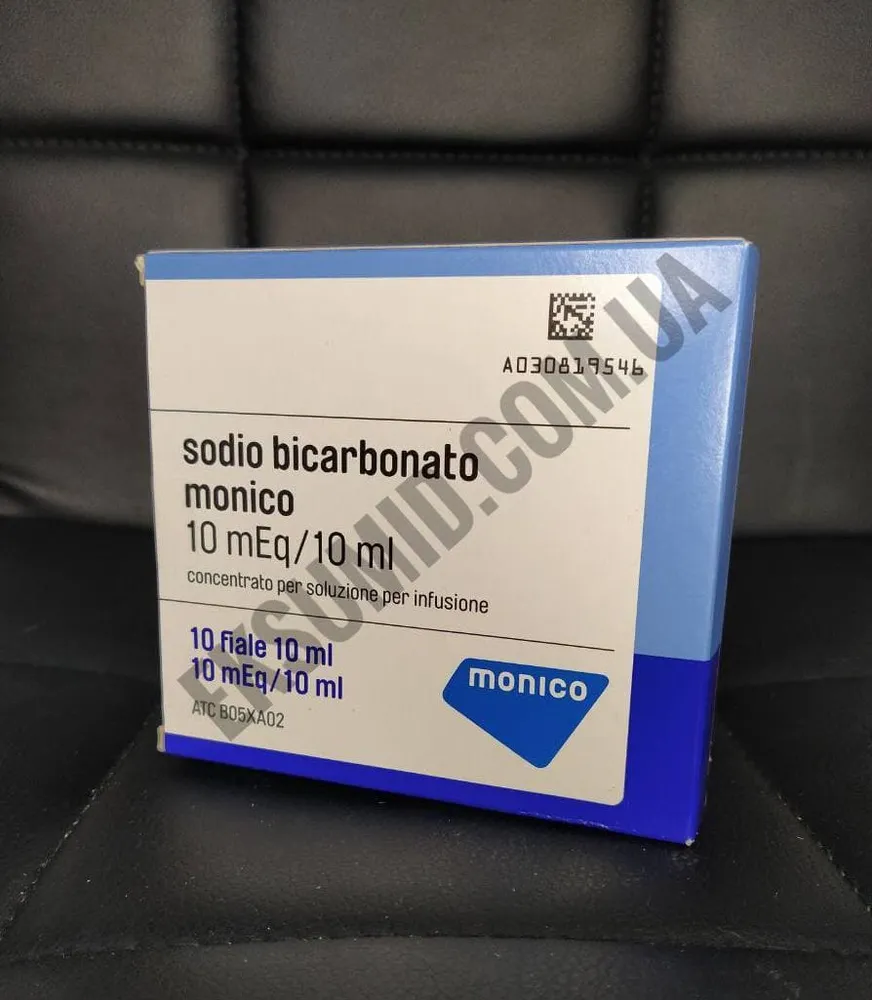
Table of Contents
PACKAGE LEAFLET – SODIUM BICARBONATE VIALS 10 mEq/10 ml
SODIUM BICARBONATE MONICO 10 mEq/10 ml
Concentrate for solution for infusion
PHARMACOTHERAPEUTIC CATEGORY
Electrolyte solutions.
THERAPEUTIC INDICATIONS
Treatment of:
- Cardiocirculatory arrest
- Metabolic acidosis
- Shock
- Barbiturate, salicylate, and methanol poisoning
- Hemolytic and rhabdomyolytic syndromes
- Hyperuricemia
- Intestinal bicarbonate losses (due to diarrhea).
CONTRAINDICATIONS
- Hypersensitivity to the active substance or to any of the excipients;
- Metabolic or respiratory alkalosis, especially if hypochloremic (vomiting, gastrointestinal losses, diuretic therapy);
- Hypocalcemia.
PRECAUTIONS FOR USE
Use with caution in patients with congestive heart failure, severe renal insufficiency, and clinical conditions
associated with edema and salt retention; in patients receiving cardiac inotropic agents and corticosteroids or
corticotropin.
Sodium salts should be administered cautiously in patients with hypertension, cardiac insufficiency, peripheral
or pulmonary edema, reduced renal function, pre-eclampsia, or other conditions associated with sodium
retention (see Interactions).
During infusion, it is advisable to monitor fluid balance, electrolytes, plasma osmolarity, and acid-base balance,
correcting, if necessary, any potassium or calcium depletion to prevent tetany.
INTERACTIONS
Inform your doctor or pharmacist if you have recently taken any other medicines, including those not
prescribed.
Corticosteroids are associated with sodium and water retention, leading to edema and hypertension: therefore,
caution is required when administering sodium salts concomitantly with corticosteroids (see Precautions for
use).
Sodium bicarbonate increases the renal clearance of tetracyclines.
Concomitant administration of sodium bicarbonate and drugs promoting potassium excretion increases the
risk of hypochloremic alkalosis.
Sodium bicarbonate increases the half-life and thus the duration of action of basic drugs such as quinidine,
ephedrine, and pseudoephedrine.
SPECIAL WARNINGS
The solution must be clear, colorless, and free from visible particles. Use immediately after opening the
container. The container is intended for single, uninterrupted administration and any unused portion must
not be reused.
Pregnancy and breastfeeding
Consult your doctor or pharmacist before taking any medicine.
There are no available data on possible adverse effects of the medicine when administered during
pregnancy or breastfeeding or on reproductive capacity.
Therefore, the medicine should not be used during pregnancy or breastfeeding unless strictly necessary and
only after careful assessment of the risk/benefit ratio.
Effects on ability to drive and use machines
The medicine does not affect the ability to drive or operate machinery.
DOSAGE, METHOD AND DURATION OF ADMINISTRATION
The medicine is a hypertonic solution relative to blood and must be administered intravenously with caution
and at a controlled infusion rate only after dilution to isotonicity (approximately 1.5% sodium bicarbonate,
corresponding to about 16 mEq bicarbonate per 100 ml) with compatible solutions (see section 6.2).
The solution may be administered undiluted intravenously only in cases of cardiac arrest.
In general, dosage depends on age, weight, clinical condition, electrolyte status, acid-base balance, and
osmolarity of the patient, aiming to restore normal pH and electrolyte values (in cases of shock, hemolytic and
rhabdomyolytic syndromes, and bicarbonate losses) or to alkalinize urine in cases of poisoning or
hyperuricemia (to at least pH 7.0).
Specifically:
In cardiac arrest:
50 to 100 mEq as a bolus, followed by 50 mEq every 5–10 minutes according to acid-base monitoring results.
In acute and subacute forms of metabolic acidosis:
Adults: initial dose of 2 to 5 mEq/kg body weight over 4–8 hours, depending on severity of acidosis. The dose
should then be adjusted based on measured blood bicarbonate levels or blood gas analysis results (target
increase of 20–22 mmol/L).
Children: initial dose of 1 mEq/kg administered by slow intravenous infusion, diluted to 0.5 mEq/ml, up to a
maximum dosage of 8 mEq/kg body weight per day to avoid excessive reduction in cerebrospinal pressure and
possible intracranial hemorrhage.
The safety and efficacy of sodium bicarbonate in children have not been established.
Elderly: in patients over 60 years of age, the maximum daily dose is 90–100 mEq of bicarbonate.
It is advisable NOT to achieve full correction of acidosis within the first 24 hours to avoid alkalosis due to
excessive respiratory compensation.
Incompatibilities with SODIUM BICARBONATE MONICO: do not use with medicines containing noradrenaline,
dobutamine, or calcium.
Dilute the solution immediately after opening the container; the diluted solution must be used immediately.
The solution must be clear, colorless, and free from visible particles. It is intended for single, uninterrupted
administration and any unused portion must not be reused.
Do not use the medicine if the solution is not clear and colorless or contains particles.
Take all standard precautions to maintain sterility before and during infusion.
OVERDOSAGE
Symptoms
Excessive administration of sodium bicarbonate solutions may lead, depending on the patient's clinical
condition, to alkalemia, hypernatremia, and/or hypervolemia.
Hypernatremia and excessive sodium retention, especially when renal sodium excretion is impaired, may cause
dehydration of internal organs, particularly the brain, and accumulation of extracellular fluid leading to edema
affecting cerebral, pulmonary, and peripheral circulation, potentially resulting in pulmonary and peripheral
edema.
Symptoms of alkalosis include muscle weakness associated with potassium depletion, muscle hypertonia,
muscle spasms, and tetany, which may be particularly evident in hypocalcemic patients.
Treatment
Immediately discontinue the infusion and initiate corrective therapy to reduce plasma levels of excess ions
and, if necessary, restore acid-base balance.
The patient should be closely monitored for the appearance of any signs or symptoms related to the
administered drug, with appropriate symptomatic and supportive measures provided as needed.
In cases of severe hypernatremia, loop diuretics may be used.
A serum sodium level exceeding 200 mmol/L may require dialysis.
Hyperirritability and tetany associated with alkalosis may be treated with administration of adequate doses of
calcium gluconate. In cases of severe alkalosis, ammonium chloride administration is recommended, except
in patients with liver disease.
In case of accidental ingestion or overdose of SODIUM BICARBONATE MONICO, contact a doctor immediately or
go to the nearest hospital.
If you have any doubts about the use of SODIUM BICARBONATE MONICO, consult your doctor or pharmacist.
UNDESIRABLE EFFECTS
Like all medicines, SODIUM BICARBONATE may cause side effects, although not everyone experiences them.
The following undesirable effects of SODIUM BICARBONATE are reported. There are insufficient data to
determine the frequency of individual listed effects.
Disorders of water and electrolyte balance: alkalemia, hypernatremia, hypervolemia, hyperosmolarity
Systemic disorders and administration site conditions: febrile episodes, infusion site infection, local pain or
reaction, venous irritation, thrombosis or phlebitis, chemical cellulitis with soft tissue necrosis due to accidental
extravasation.
Following the instructions in this leaflet reduces the risk of undesirable effects.
If any of the undesirable effects worsens, or if you notice any undesirable effect not listed in this leaflet,
inform your doctor or pharmacist.
EXPIRY DATE AND STORAGE
Expiry date: see the date on the packaging.
The expiry date refers to the product stored unopened and under recommended conditions.
Caution: do not use the medicine after the expiry date stated on the packaging.
Store in a tightly closed container. Do not freeze and do not refrigerate.
Medicines must not be disposed of via wastewater or household waste. Ask your pharmacist how to dispose
of medicines no longer used. This will help protect the environment.
Keep the medicine out of the reach and sight of children.
COMPOSITION
10 ml of solution contain:
Active substance: sodium bicarbonate 0.84 g.
Excipients: edetate sodium 0.001 g, water for injections q.s.
PHARMACEUTICAL FORM AND CONTENT
Concentrate for solution for infusion.
Carton containing 5 or 10 vials of 10 ml each.
MARKETING AUTHORIZATION HOLDER
MONICO SPA - via Ponte di Pietra 7, VENEZIA/MESTRE.
MANUFACTURER
MONICO SPA - via Ponte di Pietra 7, VENEZIA/MESTRE.
INSTRUCTIONS FOR USE – SODIUM BICARBONATE 1.4%, 5%, 7.5%, 8.4%
SODIUM BICARBONATE MONICO 1.4%, 5%, 7.5%, 8.4%
Infusion Solution
PHARMACOTHERAPEUTIC CATEGORY
Electrolytes.
THERAPEUTIC INDICATIONS
Treatment of:
- Metabolic acidosis
- Shock
- Poisoning by barbiturates, salicylates, and methanol
- Hemolytic and rhabdomyolytic syndromes
- Hyperuricemia
- Intestinal bicarbonate losses (due to diarrhea).
CONTRAINDICATIONS
- Hypersensitivity to the active substance or to any of the excipients;
- Metabolic or respiratory alkalosis, especially if hypochloremic (vomiting, gastrointestinal losses, diuretic therapy);
- Hypocalcemia.
PRECAUTIONS FOR USE
Use with caution in patients with congestive heart failure, severe renal insufficiency, and clinical conditions
associated with edema and salt retention; in patients receiving cardiac inotropic agents or corticosteroid or
corticotropin therapy.
Sodium salts should be administered cautiously in patients with hypertension, heart failure, peripheral or
pulmonary edema, reduced renal function, pre-eclampsia, or other conditions associated with sodium
retention (see Interactions).
During infusion, it is advisable to monitor fluid balance, electrolytes, plasma osmolarity, and acid-base
balance, correcting, if necessary, any potassium or calcium depletion to prevent tetany.
INTERACTIONS
Inform your doctor or pharmacist if you have recently taken any other medicines, including those
without a prescription.
Corticosteroids are associated with sodium and water retention, leading to edema and hypertension:
therefore, caution is required when administering sodium salts concomitantly with corticosteroids (see
Precautions for Use). Sodium bicarbonate increases the renal clearance of tetracyclines. Administration of
sodium bicarbonate together with drugs promoting potassium excretion increases the risk of hypochloremic
alkalosis. Sodium bicarbonate increases the half-life and thus the duration of action of basic drugs such as
quinidine, ephedrine, and pseudoephedrine.
SPECIAL WARNINGS
The solution must be clear, colorless, and free of visible particles. Use immediately after opening the
container. The container is intended for single and uninterrupted administration; any remaining solution
must not be used.
Pregnancy and breastfeeding
Consult your doctor or pharmacist before taking any medicine.
No data are available on possible adverse effects of the medicine when administered during pregnancy or
breastfeeding, or on reproductive capacity. Therefore, the medicine should not be used during pregnancy
or breastfeeding unless absolutely necessary and only after careful assessment of the risk/benefit ratio.
Effects on ability to drive vehicles and use machinery
The medicine does not impair the ability to drive vehicles or operate machinery.
DOSAGE, ROUTE AND DURATION OF ADMINISTRATION
The 1.4% solution is isotonic with blood; the 5%, 7.5%, and 8.4% solutions are hypertonic with blood.
Solutions must be administered by intravenous infusion with caution and at a controlled infusion rate, avoiding
the infusion of large volumes at high infusion rates. The medicine must not be used unless specifically
prescribed. In general, the dose depends on age, weight, clinical condition, electrolyte status, acid-base
balance, and osmolarity of the patient, aiming to restore normal pH and electrolyte values (in cases of shock,
hemolytic and rhabdomyolytic syndromes, and bicarbonate losses) or to alkalinize urine in cases of poisoning
or hyperuricemia (to at least pH 7.0).
Specifically:
Acute and subacute forms of metabolic acidosis
Adults
Initial dose of 2 to 5 mEq/kg body weight over 4–8 hours, depending on the severity of acidosis. The dose
should then be adjusted according to measured blood bicarbonate levels or blood gas analysis results
(increase of 20–22 mmol/L).
Children
Initial dose of 1 mEq/kg administered by slow intravenous infusion, diluted to 0.5 mEq/ml, up to a maximum
daily dose of 8 mEq/kg body weight to avoid excessive reduction in cerebrospinal pressure and possible
intracranial hemorrhage. The safety and efficacy of sodium bicarbonate in children have not been established.
Elderly
In elderly patients over 60 years, the maximum daily dose is 90–100 mEq of bicarbonate. It is advisable NOT
to achieve full correction of acidosis within the first 24 hours to avoid alkalosis due to excessive respiratory
compensation.
Incompatibilities with SODIUM BICARBONATE MONICO: do not use with solutions containing noradrenaline,
dobutamine, or calcium.
Use the solution immediately after opening the container. It is intended for single and uninterrupted
administration; any remaining solution must not be used. Do not use the medicine if the solution is not clear
and colorless or contains particles. Adopt all standard precautions to maintain sterility before and during
intravenous infusion.
OVERDOSE
Symptoms
Excessive administration of sodium bicarbonate solutions may lead, depending on the patient's clinical
condition, to alkalemia, hypernatremia, and/or hypervolemia.
Hypernatremia and excessive sodium retention, particularly when renal sodium excretion is impaired, may
cause dehydration of internal organs, especially the brain, and accumulation of extracellular fluid leading to
edema affecting the cerebral, pulmonary, and peripheral circulation, potentially resulting in pulmonary and
peripheral edema. Symptoms of alkalosis include muscle weakness associated with potassium depletion,
muscular hypertonia, muscle spasms, and tetany, which may be particularly evident in hypocalcemic
patients.
Treatment
Immediately discontinue the infusion and initiate corrective therapy to reduce plasma levels of excess ions
and, if necessary, restore acid-base balance (see Precautions for Use).
The patient should be closely monitored for signs and symptoms related to the administered drug, with
appropriate symptomatic and supportive measures provided as needed.
Loop diuretics may be used in cases of severe hypernatremia.
A serum sodium level exceeding 200 mmol/L may require dialysis.
Hyperirritability and tetany associated with alkalosis may be controlled by administration of adequate doses
of calcium gluconate. In cases of severe alkalosis, ammonium chloride administration is recommended, except
in patients with liver disease.
In case of accidental ingestion/overdose of SODIUM BICARBONATE MONICO, contact a doctor immediately
or go to the nearest hospital.
If you have any doubts about the use of SODIUM BICARBONATE MONICO, consult your doctor or pharmacist.
ADVERSE REACTIONS
Like all medicines, Sodium Bicarbonate may cause adverse reactions, although not everyone experiences
them.
Listed below are the adverse reactions associated with Sodium Bicarbonate. There are insufficient data to
determine the frequency of individual listed events.
Disorders of fluid and electrolyte balance: alkalemia, hypernatremia, hypervolemia, hyperosmolarity.
Systemic disorders and administration site conditions: febrile episodes, infusion site infection, pain or local
reaction, venous irritation, thrombosis or phlebitis, chemical cellulitis with tissue necrosis due to accidental
extravasation into soft tissues.
Following the instructions in this leaflet reduces the risk of adverse reactions.
If any of the adverse reactions worsen, or if you notice any adverse reaction not listed in this leaflet, inform
your doctor or pharmacist.
EXPIRY DATE AND STORAGE
Expiry date: see date on the packaging.
The expiry date refers to the product stored unopened and under proper storage conditions.
Warning: do not use the medicine after the expiry date stated on the packaging.
Storage conditions: store in the original packaging and in a tightly closed container. Do not refrigerate or
freeze.
Medicines must not be disposed of via wastewater or household waste. Ask your pharmacist how to dispose
of medicines no longer in use. This will help protect the environment.
Keep the medicine out of the reach and sight of children.
COMPOSITION
SODIUM BICARBONATE 1.4% infusion solution
1000 ml of solution contains:
Active substance: sodium bicarbonate 14.0 g
Excipients: edetic acid sodium salt 0.1 g, water for injections q.s.
mEq/liter Na 167
HCO₃⁻ 167
Theoretical osmolarity (mOsm/liter): 334
pH: 7.0 ÷ 8.5
SODIUM BICARBONATE 5% infusion solution
1000 ml of solution contains:
Active substance: sodium bicarbonate 50.0 g
Excipients: edetic acid sodium salt 0.1 g, water for injections q.s.
mEq/liter Na 595
HCO₃⁻ 595
Theoretical osmolarity (mOsm/liter): 1190
pH: 7.0 ÷ 8.5
SODIUM BICARBONATE 7.5% infusion solution
1000 ml of solution contains:
Active substance: sodium bicarbonate 75.0 g
Excipients: edetic acid sodium salt 0.1 g, water for injections q.s.
mEq/liter Na 893
HCO₃⁻ 893
Theoretical osmolarity (mOsm/liter): 1785
pH: 7.0 ÷ 8.5
SODIUM BICARBONATE 8.4% infusion solution
1000 ml of solution contains:
Active substance: sodium bicarbonate 84.0 g
Excipients: edetic acid sodium salt 0.1 g, water for injections q.s.
mEq/liter Na 1000
HCO₃⁻ 1000
Theoretical osmolarity (mOsm/liter): 2000
pH: 7.0 ÷ 8.5
PHARMACEUTICAL FORM AND CONTENT
Sterile, pyrogen-free infusion solution.
Glass vial or plastic bag (polypropylene) containing 50, 100, 250, 500, or 1000 ml of 1.4%, 5%, 7.5%, or 8.4%
solution.
MARKETING AUTHORIZATION HOLDER
MONICO SPA - via Ponte di Pietra 7, VENEZIA/MESTRE.
MANUFACTURER
MONICO SPA - via Ponte di Pietra 7, VENEZIA/MESTRE.
8 March 2013