Sibnayal
ItalyTable of Contents
- Package leaflet: Information for the user
- Sibnayal 8 mEq prolonged-release granules, 24 mEq prolonged-release granules
- 1. What Sibnayal is and what it is used for
- 2. What you need to know before taking Sibnayal
- 3. How to take Sibnayal
- 4. Possible side effects
- 5. How to store Sibnayal
- 6. Package contents and other information What Sibnayal contains
B. PACKAGE LEAFLET
Package leaflet: Information for the user
Sibnayal 8 mEq prolonged-release granules, 24 mEq prolonged-release granules
potassium citrate/potassium hydrogen carbonate
Please read this leaflet carefully before taking this medicine because it contains
important information for you.
- Keep this leaflet. You may need to read it again.
- If you have any questions, ask your doctor or pharmacist.
- This medicine has been prescribed for you only. Do not give it to others, even if their symptoms are the same as yours, because it could be harmful.
- If you experience any adverse reaction, including those not listed in this leaflet, contact your doctor or pharmacist. See section 4.
Contents of this leaflet
- What Sibnayal is and what it is used for
- What you need to know before taking Sibnayal
- How to take Sibnayal
- Possible side effects
- How to store Sibnayal
- Package contents and other information
1. What Sibnayal is and what it is used for
Sibnayal contains two active substances, potassium citrate and potassium hydrogen carbonate (also known as potassium bicarbonate).
Sibnayal is an alkalising medicine used to control blood acidity caused by a kidney disease called distal renal tubular acidosis (dRTA).
It will help reduce the impact of dRTA on your daily life. Sibnayal is used in adults, adolescents, and children above 1 year of age.
2. What you need to know before taking Sibnayal
Do not take Sibnayal
- if you are allergic to potassium citrate or potassium bicarbonate or to any of the other ingredients of this medicine (listed in section 6),
- if you have severe kidney disease or renal failure,
- if you have high levels of potassium in your blood (hyperkalaemia).
Warnings and precautions
Talk to your doctor before taking Sibnayal:
- if you have a disease or are taking a medicine that may increase potassium levels in your blood (see below “Other medicines and Sibnayal”),
- if you frequently experience gastrointestinal symptoms such as bloating, diarrhoea, nausea, vomiting, or if you have chronic kidney disease.
Sibnayal prolonged-release granules are designed to slowly release the active substances after ingestion. You may see granule residues in your stools. This is normal and does not reduce the effectiveness of the medicine.
You should schedule regular appointments with your doctor. Periodically, your doctor may request blood, urine or heart tests in order to adjust your Sibnayal dosage. Your doctor will regularly monitor your kidney function if you are elderly and/or if your kidney function is impaired.
Children
Do not give this medicine to children under 1 year of age due to the risk of choking.
Other medicines and Sibnayal
Tell your doctor or pharmacist if you are taking, have recently taken or might take any other medicines.
Some medicines may affect the effectiveness of Sibnayal or make side effects more likely. These include:
- any medicine that increases potassium levels in the blood, such as:
- angiotensin-converting enzyme (ACE) inhibitors (used to treat hypertension, heart disease and kidney disease in patients with type 1 diabetes),
- potassium-sparing diuretics (used to treat hypertension, fluid accumulation in tissues (oedema) and heart conditions),
- potassium supplements (used to prevent or treat low potassium levels in the blood),
- ciclosporin (used to prevent or treat transplant rejection),
- sodium heparin (used to prevent or slow blood clotting),
- non-steroidal anti-inflammatory drugs (NSAIDs) (used to reduce fever, pain and inflammation);
- any medicine that may be affected by changes in blood potassium levels, such as:
- cardiac glycosides (such as digoxin, used to treat heart failure and certain heart rhythm disorders),
- corticosteroids (used to treat inflammation);
- any other medicine that could cause heart rhythm disturbances, such as:
- amiodarone and quinidine (used to control heart rhythm),
- chlorpromazine (used to treat certain mental illnesses),
- cisapride (used to treat heartburn),
- sparfloxacin (used to treat certain bacterial infections).
Some medicines may be affected by an increase in urine pH due to treatment with Sibnayal, such as:
- salicylates (used to treat pain and inflammation, medicines similar to aspirin),
- tetracyclines (used to treat certain bacterial infections),
- barbiturates (medicines that induce sleep).
Sibnayal with food, drinks and alcohol
Do not mix Sibnayal with hot food or hot liquids. Do not drink alcohol while taking Sibnayal.
Pregnancy, breastfeeding and fertility
If you are pregnant, think you may be pregnant or are planning to become pregnant, or if you are breastfeeding, please consult your doctor or pharmacist before taking this medicine.
Driving and using machines
It is unlikely that this medicine will affect your ability to drive or operate machinery.
Sibnayal contains potassium
Sibnayal 8 mEq contains 308 mg of potassium per sachet. This should be taken into account if you have reduced kidney function or are on a low-potassium diet.
Sibnayal 24 mEq contains 924 mg of potassium per sachet. This should be taken into account if you have reduced kidney function or are on a low-potassium diet.
3. How to take Sibnayal
Take this medicine exactly as directed by your doctor. If you have any doubts, consult your doctor or pharmacist.
The amount of Sibnayal to take depends on age, body weight, and individual medical conditions.
Your doctor will determine the exact dose of this medicine you should take, which will always consist of one or more complete sachets.
Your doctor may need to adjust your dose of Sibnayal.
Use of this medicine requires medical supervision.
Dosage
The dose will be adjusted by your doctor based on your blood bicarbonate levels.
Instructions for use
This medicine is for oral use (to be taken by mouth).
If you have any doubts about how to use Sibnayal, contact your doctor or pharmacist.
- Hold the sachet upright, with your fingers above the dotted line. Shake it from side to side to ensure the contents move to the bottom of the sachet.
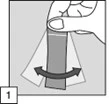
- Cut the sachet along the dotted line, using scissors if necessary.
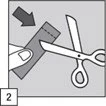
- Pour all or part of the sachet contents directly into the mouth, onto the tongue.
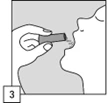
- Immediately swallow the granules with a full glass of water. Do not chew or crush the granules. Repeat steps 1 to 4 as directed until you have taken the complete dose.
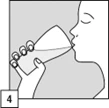
For patients unable to swallow the granules
- Mix Sibnayal with small amounts of soft, cold food (e.g., fruit puree or yogurt) directly on a spoon. The mixture must be swallowed immediately. Do not store the mixture for later use.
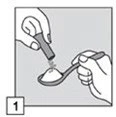
- Pour the mixture directly into the mouth and swallow without chewing. Make sure Sibnayal does not remain in the mouth. Repeat steps 1 and 2 as directed until you have taken the complete dose.
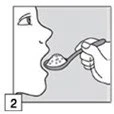
Do not mix the granules with liquids before taking.
When to take Sibnayal
Take Sibnayal in the morning and evening, during meals. An interval of approximately 12 hours should be maintained between doses to cover both day and night periods.

If vomiting occurs within two hours after taking the medicine, take another dose.
Dose adjustment
Dose increases or decreases must be gradual and occur over several weeks. Your doctor will adjust the dose according to your condition.
Consult your doctor if you experience any adverse effects, as it may be necessary to adjust the dose of this medicine.
Switching from another alkalinizing medicine
If switching from another alkalinizing medicine to Sibnayal, your doctor must closely monitor the transition.
If you take more Sibnayal than you should
Contact your doctor or pharmacist if you have taken more Sibnayal than prescribed. You may experience nausea, urge to vomit, and diarrhea.
If you have taken a large amount of this medicine, you may feel weak or experience unexplained muscle tension, spasms (muscle contractions), unusual sensations of tingling or burning, pins and needles, numbness, mental confusion, or an abnormal heart rhythm.
If you forget to take Sibnayal
Do not take a double dose to make up for the missed dose. Take the missed dose as soon as you remember. However, if less than six hours remain before the next scheduled dose, skip the missed dose. Do not take more than two doses per day.
Contact your doctor if you forget to take one or more doses.
If you stop taking Sibnayal
This medicine is intended for long-term use. It will only be effective as long as you continue taking it.
Do not stop unless instructed by your doctor, even if you feel better, as your condition may worsen. If you plan to stop treatment, discuss this with your doctor first.
If you have any questions about using this medicine, consult your doctor.
4. Possible side effects
Like all medicines, this medicine can cause side effects, although not everyone gets them.
Very common side effects (may affect more than 1 in 10 people)
- abdominal pain (stomach ache)
Common side effects (may affect up to 1 in 10 people)
- upper abdominal pain (pain in the upper part of the stomach),
- gastrointestinal pain and disorders (stomach and intestinal pain and discomfort),
- dyspepsia (indigestion),
- vomiting,
- diarrhoea,
- feeling unwell (nausea) at the beginning of treatment.
Reporting of side effects
If you experience any side effect, including those not listed in this leaflet, talk to your doctor or pharmacist. You can also report side effects directly via the national reporting system referred to in Annex V. By reporting side effects, you can help provide more information on the safety of this medicine.
5. How to store Sibnayal
Keep this medicine out of sight and reach of children.
Do not use this medicine after the expiry date stated on the sachet and packaging
after Exp. The expiry date refers to the last day of that month.
Do not store above 25 °C.
After opening a sachet, discard any unused contents.
Do not dispose of any medicine via wastewater or household waste. Ask your pharmacist how
to dispose of medicines you no longer use. This will help protect the environment.
6. Package contents and other information What Sibnayal contains
The active substances are potassium citrate and potassium hydrogen carbonate (also known as potassium bicarbonate).
Each sachet of Sibnayal 8 mEq contains 282 mg of potassium citrate and 527 mg of potassium hydrogen carbonate.
Each sachet of Sibnayal 24 mEq contains 847 mg of potassium citrate and 1,582 mg of potassium hydrogen carbonate.
The other components are hypromellose (E464), microcrystalline cellulose (E460 (i)), glyceryl dibehenate, magnesium stearate (E470b), anhydrous colloidal silica, heavy magnesium oxide (E530), ethylcellulose (E462), chlorophyllin (E140 (ii)), talc.
Description of the appearance of Sibnayal and contents of the pack
Sibnayal is a prolonged-release green and white granular mixture available in sachets. The cartons contain 60 sachets.
Sibnayal is available in multiple packs of 2, 3, 4, 5 and 6 cartons, each carton containing 60 sachets.
Not all pack sizes may be marketed.
Marketing Authorisation Holder and Manufacturer
ADVICENNE
262 rue du Faubourg Saint Honoré
75008 Paris
France
For further information about this medicinal product, please contact the local representative of the Marketing Authorisation Holder:
België/Belgique/Belgien - Italia
Luxembourg/Luxemburg - Nederland
SPA Società Prodotti Antibiotici S.p.A.
TwinPharma BV
Trasmolenlaan 5
3447 GZ Woerden
Nederland
Tel: +31 348 71 24 05
[email protected]
Via Biella, 8
20143 Milano
Italy
Tel: +39 02 891391
[email protected]
България
ExCEEd Orphan Distribution d.o.o.
Dužice 1, 10000 Zagreb
Croatia
Tel: +359 888 918 090
[email protected]
Magyarország
ExCEEd Orphan Distribution d.o.o.
Dužice 1, 10000 Zagreb
Croatia
Tel: +36 20 399 4269
[email protected]
Česká republika
ExCEEd Orphan s.r.o.
Bucharova 2657/12, Prague 5, 158 00
Czech Republic
Tel: +420 608 076 274
[email protected]
Polska
ExCEEd Orphan s.r.o.
Bucharova 2657/12, Prague 5, 158 00
Czech Republic
Tel: +48 502 188 023
[email protected]
Danmark - Norge - Suomi/Finland – Sverige-
Deutschland-Malta-Ireland-Österreich-
Ελλάδα- Κύπρος- Ísland
Avanzanite Bioscience B.V.
Strawinskylaan 3051,
1077 ZX Amsterdam
Netherlands
Tlf / Puh /Tel/ Τηλ/Simi: +31 20 808 6361
Portugal
Prospa – Laboratórios Farmacêuticos, S.A.
Av.do Forte, nº3, Edifício Suécia IV, Piso 2
2790-073 Carnaxide
Portugal
Tel: +351 214171747
[email protected]
France
ADVICENNE
262 rue du Faubourg Saint Honoré
75008 Paris
France
Tel: +33 1 85 73 36 20
[email protected]
România
ExCEEd Orphan Distribution d.o.o.
Dužice 1, 10000 Zagreb
Croatia
Tel: +40 744 366 015
[email protected]
España
SPA Farma Ibérica
Carrer de Roc Boronat, 147
08018 Barcelona
Spain
Tel: +34 622 273 108
Slovenija
ExCEEd Orphan Distribution d.o.o.
Dužice 1, 10000 Zagreb
Croatia
Tel: +386 30 210 050
[email protected]
Hrvatska
ExCEEd Orphan Distribution d.o.o.
Dužice 1, 10000 Zagreb
Croatia
Tel: +385 99 320 0330
[email protected]
Slovenská republika
ExCEEd Orphan s.r.o.
Bucharova 2657/12, Prague 5, 158 00
Czech Republic
Tel: +420 608 076 274
[email protected]
Eesti - Latvija - Lietuva
ExCEEd Orphan Distribution d.o.o.
Dužice 1, 10000 Zagreb
Croatia
Tel: +370 661 663 99
[email protected]
Other sources of information
More detailed information on this medicinal product is available on the website of the European Medicines Agency: https://www.ema.europa.eu.