Seacor
Italy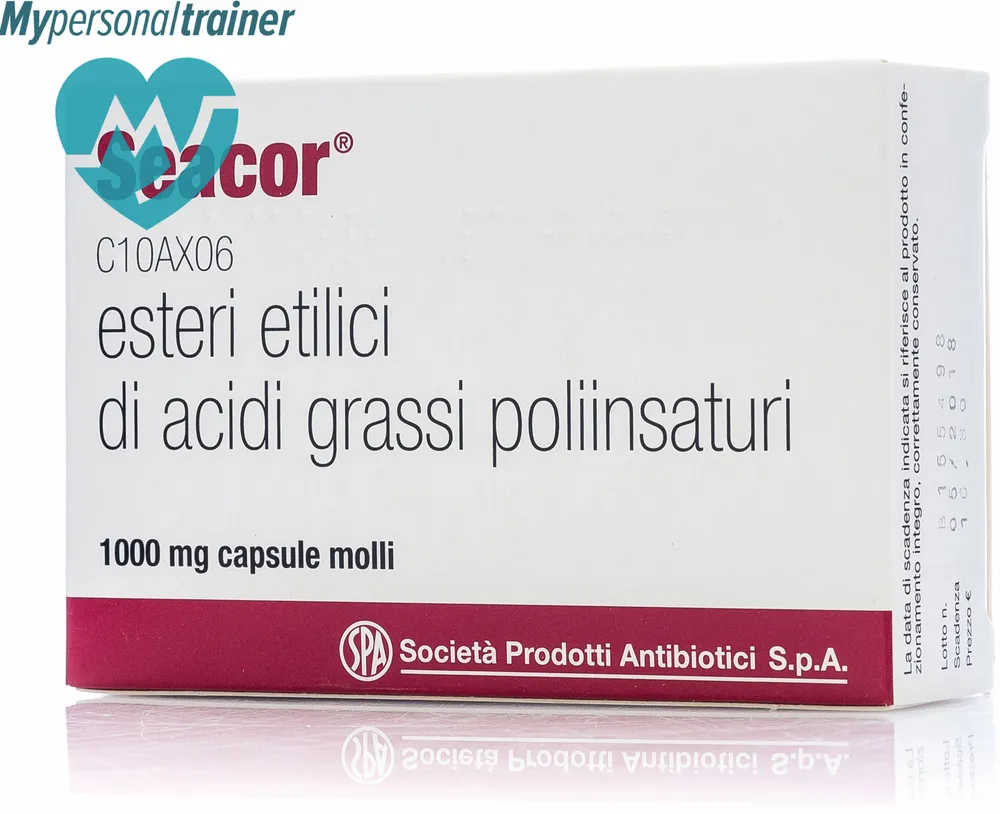
Table of Contents
Patient Information Leaflet
SEACOR 1000 mg soft capsules, 500 mg soft capsules
ethyl esters of polyunsaturated fatty acids
Please read this leaflet carefully before you start taking this medicine because it contains important information for you.
- Keep this leaflet. You may need to read it again.
- If you have any questions, ask your doctor or pharmacist.
- This medicine has been prescribed for you only. Do not give it to other people, even if their symptoms are the same as yours, as it may be harmful.
- If you experience any side effect, including those not listed in this leaflet, contact your doctor or pharmacist. See section 4.
Contents of this leaflet:
- What SEACOR is and what it is used for
- What you need to know before taking SEACOR
- How to take SEACOR
- Possible side effects
- How to store SEACOR
- Contents of the pack and other information
1. What SEACOR is and what it is used for
SEACOR contains, as active substances, ethyl esters of highly concentrated and pure polyunsaturated fatty acids (derived from fish oil), which reduce the levels of certain fats in the blood (triglycerides) and have beneficial effects on the heart and blood vessels.
SEACOR is indicated to reduce high levels of fats (triglycerides) in the blood, when diet and other non-pharmacological measures alone have not been sufficient. Treatment with SEACOR must always be accompanied by appropriate dietary measures.
2. What you need to know before taking SEACOR
Do not take SEACOR
- if you are allergic to ethyl esters of polyunsaturated fatty acids (derived from fish oil) or to any of the other ingredients of this medicine (listed in section 6)
- if you are pregnant or breastfeeding (see section “Pregnancy and breastfeeding”)
- This medicine contains soya. If you are allergic to peanuts or soya, do not use this medicine.
Warnings and precautions
Talk to your doctor or pharmacist before taking SEACOR.
Inform your doctor or pharmacist before taking SEACOR:
- if you are allergic to fish, as the active substance in SEACOR is derived from fish oil;
- if you have liver problems. Your doctor will monitor your liver function during treatment, especially if you are taking high doses of SEACOR;
- if you have conditions that make you prone to bleeding;
- if you have or have had heart problems;
- if you experience dizziness, weakness, palpitations, or shortness of breath, as these may be symptoms of an irregular and often very rapid heart rhythm (atrial fibrillation).
Other medicines and SEACOR
Inform your doctor or pharmacist if you are taking, have recently taken, or might take any other medicines.
Tell your doctor if you are being treated with:
- medicines to thin the blood (anticoagulants), e.g. coumarin anticoagulants;
- other medicines that affect blood clotting, as this may lead to an increased bleeding time.
Pregnancy and breastfeeding
Do not use SEACOR if you are pregnant or breastfeeding.
Driving and using machines
SEACOR does not affect the ability to drive or operate machinery.
SEACOR contains sodium ethyl p-hydroxybenzoate and sodium propyl p-hydroxybenzoate
SEACOR contains sodium ethyl p-hydroxybenzoate and sodium propyl p-hydroxybenzoate, which may cause allergic reactions (including delayed reactions).
This medicine contains less than 1 mmol (23 mg) of sodium per soft capsule, i.e. essentially ‘sodium-free’.
3. How to take SEACOR
Take this medicine exactly as directed by your doctor. If you have any doubts, consult your doctor or pharmacist.
Swallow the SEACOR capsules whole with some water.
Use in adults
The recommended dose is 1 capsule of 1000 mg 1-3 times daily, according to your doctor's prescription.
For dose adjustment and maintenance therapy, your doctor may prescribe the 500 mg capsules.
Use in the paediatric population
No data are available on the use of SEACOR in the paediatric population for the approved indications.
Use in elderly patients and patients with impaired kidney function
No dose adjustment is required in these patients.
Use in patients with impaired liver function
Your doctor will monitor your liver function during treatment, especially if you are taking high doses of SEACOR (see section "Warnings and precautions").
If you take more SEACOR than you should
In case of accidental overdose, inform your doctor or pharmacist.
If you forget to take SEACOR
Do not take a double dose to make up for the missed dose.
If you stop taking SEACOR
If you have any questions about the use of this medicine, consult your doctor or pharmacist.
4. Possible side effects
Like all medicines, this medicine can cause side effects, although not everyone experiences them.
Common side effects (may affect up to 1 in 10 people)
- fast, irregular heartbeat
- stomach and/or intestinal disturbances
Uncommon side effects (may affect up to 1 in 100 people)
- nausea
- difficulty digesting
- pain in the upper abdomen
- diarrhoea
Rare side effects (may affect up to 1 in 1,000 people)
- allergic reactions (hypersensitivity), allergy to ingredients
- dizziness
- inflammation of the stomach and/or intestine (gastritis, gastroenteritis)
- abdominal pain
- stomach burning
- changes in liver function
- skin reactions
- weakness
Other side effects that have occurred in a very small number of people, but whose exact frequency is unknown:
- itching
- itchy skin rash (urticaria)
Reporting of side effects
If you experience any side effect, including those not listed in this leaflet, talk to your doctor or pharmacist. You can also report side effects directly via the national reporting system at https://www.aifa.gov.it/content/segnalazioni-reazioni-avverse
By reporting side effects, you can help provide more information on the safety of this medicine.
5. How to store SEACOR
Keep this medicine out of the sight and reach of children.
Do not use this medicine after the expiry date which is stated on the packaging after "Exp." The expiry date refers to the last day of that month.
Do not dispose of any medicine via wastewater or household waste. Ask your pharmacist how to dispose of medicines you no longer use. This will help protect the environment.
6. Package contents and other information
What SEACOR contains
SEACOR 1000 mg soft capsules
- The active substances are ethyl esters of polyunsaturated fatty acids. Each soft capsule contains 1000 mg of ethyl esters of polyunsaturated fatty acids, with a content of EPA and DHA not less than 85%, and a ratio between them of 0.9 - 1.5.
- The other components are D,L α-tocopherol, soybean oil, gelatin, glycerol, ethyl p-hydroxybenzoate sodium, propyl p-hydroxybenzoate sodium.
SEACOR 500 mg soft capsules
- The active substances are ethyl esters of polyunsaturated fatty acids. Each soft capsule contains 500 mg of ethyl esters of polyunsaturated fatty acids, with a content of EPA and DHA not less than 85%, and a ratio between them of 0.9 - 1.5.
- The other components are D,L α-tocopherol, soybean oil, succinated gelatin, glycerol, ethyl p-hydroxybenzoate sodium, propyl p-hydroxybenzoate sodium.
Description of the appearance of SEACOR and contents of the pack
SEACOR 1000 mg soft capsules
Transparent, oblong soft capsules.
Each pack contains 20 or 30 soft capsules in blisters.
SEACOR 500 mg soft capsules
Transparent, oval soft capsules.
Each pack contains 30 soft capsules in blisters.
It is possible that not all pack sizes are marketed.
Marketing Authorization Holder
SPA – Società Prodotti Antibiotici S.p.A.
Via Biella, 8
20143 Milan
Manufacturer
CATALENT ITALY S.p.A.
Via Nettunense km 20,100
04011 Aprilia (Latina)
DOPPEL FARMACEUTICI S.r.l.
Via Martiri delle Foibe, 1
29016 Cortemaggiore (Piacenza)