Scintimun
Italy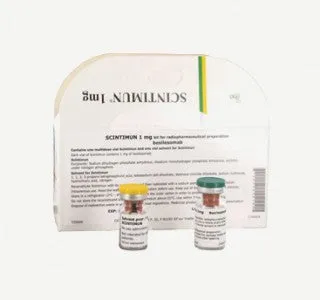
Table of Contents
- Package leaflet: Information for the patient
- Scintimun 1 mg kit for radiopharmaceutical preparation
- 1. What Scintimun is and what it is used for
- 2. What you need to know before you are given Scintimun
- 3. How Scintimun will be administered to you
- 4. Possible side effects
- 5. How Scintimun is stored
- 6. Contents of the pack and other information
- The following information is intended for healthcare professionals only:
Package leaflet: Information for the patient
Scintimun 1 mg kit for radiopharmaceutical preparation
besilesomab
Please read all of this leaflet carefully before you are given this medicine because it contains important information for you.
- Keep this leaflet. You may need to read it again.
- If you have any questions, ask the doctor or nuclear medicine specialist who will supervise the procedure.
- If you get any side effects, talk to the nuclear medicine specialist or pharmacist. This includes any side effects not listed in this leaflet. See section 4.
Contents of this leaflet
- What Scintimun is and what it is used for
- What you need to know before you are given Scintimun
- How Scintimun will be administered to you
- Possible side effects
- How Scintimun is stored
- Contents of the pack and other information
1. What Scintimun is and what it is used for
Scintimun is a medicine containing an antibody (besilesomab) used to target specific cells called granulocytes (a type of white blood cell involved in the inflammatory process) present in your body. Scintimun is used to prepare a radioactive solution for injection of technetium (Tc) besilesomab. Technetium (Tc) is a radioactive element that allows visualization of the organs where besilesomab accumulates, using a special camera.
This medicine is a radiopharmaceutical product intended exclusively for diagnostic use in adults.
After intravenous injection, your doctor can obtain images (scans) of organs, providing additional information to identify sites of inflammation and/or infection. However, Scintimun must not be used for the diagnosis of diabetic foot infections.
Use of Scintimun involves exposure to small amounts of radioactivity. Your doctor and the nuclear medicine specialist have determined that the clinical benefit you will receive from the radiopharmaceutical procedure outweighs the risk associated with radiation exposure.
2. What you need to know before you are given Scintimun
Scintimun must not be used:
- if you are allergic to besilesomab, to mouse-derived antibodies or to any other antibody, or to sodium pertechnetate (Tc) solution or to any of the other ingredients of this medicine (listed in section 6).
- if you have a positive test result for human anti-mouse antibodies (HAMA test). If you are unsure, consult your doctor.
- if you are pregnant.
Warnings and precautions
Talk to the nuclear medicine specialist before using Scintimun:
- if you have previously been administered Scintimun, as Scintimun should only be administered once in a lifetime. If you are unsure whether you have already received this medicine, inform your doctor.
- if you have undergone a technetium scintigraphy within the last 2 years.
- if you have a tumour disease associated with carcinoembryonic antigen (CEA) secretion, which could interfere with this investigation.
- if you have blood disorders.
- if you are breastfeeding.
Before administration of Scintimun
To obtain images of the best possible quality and to reduce radiation exposure to the bladder, you should drink sufficient fluids and empty your bladder before and after the scintigraphic examination.
Children and adolescents
This product is not recommended for use in patients under 18 years of age, as the safety and efficacy of the product have not been established.
Other medicines and Scintimun
Inform the nuclear medicine specialist if you are taking, have recently taken, or might take any other medicines, including those without a prescription, as they could interfere with the interpretation of the images.
Medicines that reduce inflammation and those that affect blood cell production (such as corticosteroids or antibiotics) may influence the results of the examinations you will undergo.
Pregnancy and breastfeeding
If you are pregnant or breastfeeding, if you suspect you may be pregnant, or if you are planning a pregnancy, consult the nuclear medicine specialist before receiving this medicine.
You must inform the nuclear medicine specialist before Scintimun is administered if there is any possibility that you are pregnant, if you have missed your menstrual period, or if you are breastfeeding. If in doubt, it is important to consult the nuclear medicine specialist in charge of the procedure.
Scintimun must not be administered if you are pregnant.
Nuclear medicine investigations may pose a risk to the fetus.
If you are breastfeeding, you must stop breastfeeding for 3 days after the injection and discard the milk produced during this period. If desired, you may express and store breast milk before the injection. This will protect your baby from potential radiation in your milk. Ask your nuclear medicine specialist when you can resume breastfeeding.
Additionally, you should avoid close contact with your child for the first 12 hours after the injection.
Driving and using machines
Scintimun is considered unlikely to affect your ability to drive or operate machinery.
Scintimun contains sorbitol and sodium
This medicine contains 2 mg of sorbitol per vial of Scintimun. Sorbitol is a source of fructose. If your doctor has diagnosed you with hereditary fructose intolerance, a rare genetic disorder, you must not take this medicine. Patients with hereditary fructose intolerance are unable to metabolize fructose, and its accumulation may cause serious side effects.
Before taking this medicine, inform your doctor if you have hereditary fructose intolerance.
This medicine contains less than 1 mmol (23 mg) of sodium per vial, i.e. it is essentially “sodium-free”.
3. How Scintimun will be administered to you
There are strict regulations governing the use, handling, and disposal of radiopharmaceuticals. Scintimun will only be used in designated controlled areas. This product will be handled and administered exclusively by trained and qualified personnel who are skilled in its safe use. These individuals will take special care in using the product safely and will keep you informed about their actions.
The nuclear medicine specialist performing the procedure will determine the amount of technetium (99mTc) besilesomab to be administered in your case. This will be the smallest amount necessary to obtain the required diagnostic information.
The usually recommended administered activity for an adult ranges between 400 and 800 MBq (megabecquerel, the unit used to measure radioactivity).
Administration of Scintimun and performance of the procedure
Scintimun is administered intravenously.
A single injection into a vein in the arm is sufficient to carry out the examination required by the physician.
Duration of the procedure
The nuclear medicine specialist will inform you about the expected duration of the procedure.
After administration of Scintimun
You should avoid close contact with young children and pregnant women during the 12 hours following the injection, as you may emit radiation that could be particularly harmful to young children during this time.
The nuclear medicine specialist will inform you of any special precautions to follow after administration of the medicinal product. Please consult the nuclear medicine specialist if you have any questions.
If you have been administered more Scintimun than you should have received
It is unlikely that you will receive an excessive dose of the medicinal product, as the injection is prepared as a single dose by hospital personnel under strictly controlled conditions.
However, in the event of an overdose, you will be advised to drink plenty of water and take laxatives to increase the elimination of the product from your body.
If you have further doubts about the use of Scintimun, please consult the nuclear medicine specialist in charge of performing the procedure.
4. Possible side effects
Like all medicines, this medicinal product can cause side effects, although not everyone gets them.
This radiopharmaceutical will emit small amounts of ionising radiation, associated with a minimal possible risk of cancer and hereditary abnormalities.
In approximately 14 out of 100 patients who have received this injection, production of antibodies in the blood reacting against the antibody present in Scintimun has been observed. This could increase the risk of allergic reactions if Scintimun is administered again. Therefore, you must not receive Scintimun a second time.
In case of allergic reactions, your doctor will provide appropriate treatment.
The possible side effects are listed below, classified by frequency:
Very common (may occur in more than 1 in 10 people):
Development of human anti-mouse antibodies reacting against the antibody present in Scintimun (mouse cell antibody), with a risk of allergic reaction
Common (may affect up to 1 in 10 people):
Low blood pressure
Uncommon (may affect up to 1 in 100 people):
Allergic reaction, such as facial swelling, itching (urticaria)
Rare (may affect up to 1 in 1,000 people):
- Severe allergic reaction causing breathing difficulties and dizziness
- Muscle or joint pain
Reporting of side effects
If you experience any side effect, including those not listed in this leaflet, consult your doctor or the nuclear medicine specialist. You can also report side effects directly via the national reporting system listed in Annex V. By reporting side effects, you can help provide more information on the safety of this medicine.
5. How Scintimun is stored
You should not store this medicinal product. This medicinal product is stored under the responsibility of a specialist in suitable premises. Storage of radiopharmaceuticals must comply with national regulations regarding radioactive materials.
6. Contents of the pack and other information
What Scintimun contains
- The active substance is besilesomab (a murine monoclonal anti-granulocyte antibody). Each vial of Scintimun contains 1 mg of besilesomab.
- The excipients are (See section 2 “Scintimun contains sorbitol and sodium”)
Scintimun:
Anhydrous disodium hydrogen phosphate
Anhydrous sodium dihydrogen phosphate
Sorbitol E420
In a nitrogen atmosphere
Solvent for Scintimun
Tetrasodium salt dihydrate of propano-1,1,3,3-tetraphosphonic acid (PTP)
Stannous chloride dihydrate
Sodium hydroxide/hydrochloric acid
Nitrogen
Description of the appearance of Scintimun and contents of the pack
Scintimun is a kit for radiopharmaceutical preparation.
The Scintimun vial contains a white powder.
The solvent vial for Scintimun contains a white powder.
The kit contains one or two multidose vials of Scintimun with one or two solvent vials.
It is possible that not all pack sizes are marketed.
Marketing Authorisation Holder
TELIX INNOVATIONS
Rue De Hermée 255
4040 Herstal
Belgium
Manufacturer
CIS BIO INTERNATIONAL
B.P. 32
F-91192 Gif-sur-Yvette Cedex
France
Other sources of information
More detailed information on this medicinal product is available on the website of the European Medicines Agency: https://www.ema.europa.eu.
The following information is intended for healthcare professionals only:
The complete Summary of Product Characteristics (SmPC) for Scintimun is provided as
a detachable section at the end of the package leaflet included in the product packaging,
in order to provide healthcare professionals with additional scientific and practical information
on the administration and use of this radiopharmaceutical.
Refer to the SmPC.