Salazopyrin EN
Italy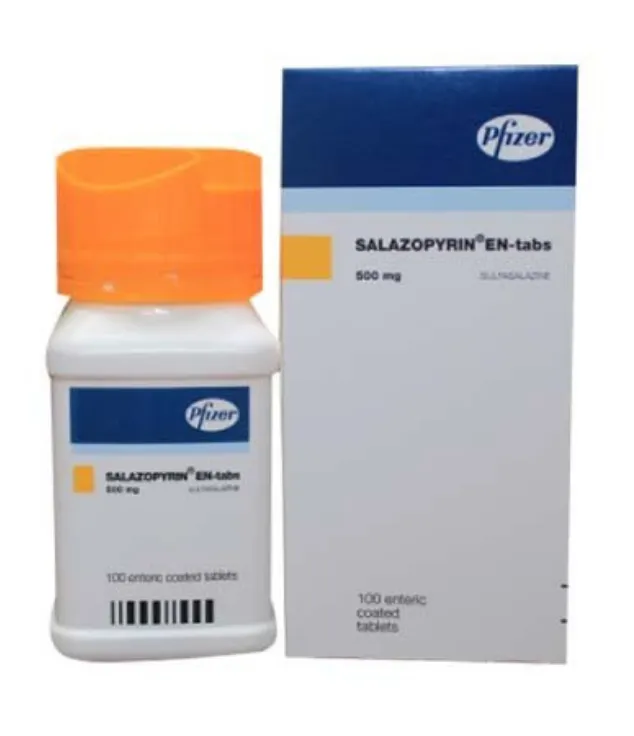
Table of Contents
- Package leaflet: Information for the patient
- Salazopyrin EN 500 mg gastro-resistant tablets
- 1. What Salazopyrin EN is and what it is used for
- 2. What you should know before taking Salazopyrin EN
- 3. How to take Salazopyrin EN
- 4. Possible side effects
- 5. How to store Salazopyrin EN
- 6. Package contents and other information
Package leaflet: Information for the patient
Salazopyrin EN 500 mg gastro-resistant tablets
Sulfasalazine
Please read all of this leaflet carefully before taking this medicine because it contains important information for you.
- Keep this leaflet. You may need to read it again.
- If you have any questions, ask your doctor or pharmacist.
- This medicine has been prescribed for you only. Do not give it to others, even if their symptoms are the same as yours, as it may be harmful.
- If you experience any side effects, including those not listed in this leaflet, talk to your doctor or pharmacist. See section 4.
Contents of this leaflet:
- What Salazopyrin EN is and what it is used for
- What you need to know before taking Salazopyrin EN
- How to take Salazopyrin EN
- Possible side effects
- How to store Salazopyrin EN
- Contents of the pack and other information
1. What Salazopyrin EN is and what it is used for
Salazopyrin EN contains the active substance sulfasalazine, which within the body is split into two components: sulfapyridine (an antibiotic belonging to the sulfonamide group) and 5-aminosalicylic acid (belonging to a group of medicines called aminosalicylates). Sulfasalazine acts against inflammation, reduces the activity of the immune system (the body's defence system), and has antibacterial effects.
Salazopyrin EN is indicated for the treatment of:
- ulcerative colitis (inflammation of the colon, a part of the intestine) of mild to moderate severity, when used as monotherapy, or severe ulcerative colitis, when used in combination with other medicinal products;
- Crohn's disease, a chronic inflammation of the intestine;
- rheumatoid arthritis, a chronic inflammation of the joints, when other medicines such as non-steroidal anti-inflammatory drugs (NSAIDs) have not been effective.
Salazopyrin EN is also indicated for the prevention of relapses of ulcerative colitis.
2. What you should know before taking Salazopyrin EN
Do not take Salazopyrin EN
- if you are allergic to sulfasalazine or to substances produced during its metabolism, to sulfonamides or salicylates (medicines similar to sulfasalazine), or to any of the other ingredients of this medicine (listed in section 6);
- if you have severe kidney or liver problems;
- if you have a tendency to bleed easily;
- if you are a child under 2 years of age;
- if you are in the final stage of pregnancy or if you are breastfeeding (see section “Pregnancy, breastfeeding and fertility”);
- if you suffer from porphyria, an inherited blood disorder.
Warnings and precautions
Talk to your doctor or pharmacist before taking Salazopyrin EN if:
- you have previously suffered from frequent or chronic infections or diseases that predispose you to infections;
- you have problems with your kidneys, liver, or blood;
- you suffer from severe allergies or asthma;
- if you are a child and suffer from systemic-onset juvenile arthritis, a chronic inflammation of the joints. In this case, the use of Salazopyrin EN is not recommended;
- you suffer from an inherited disorder in which your body does not have enough glucose-6-phosphate dehydrogenase, an enzyme that contributes to the normal function of red blood cells.
Contact your doctor or pharmacist if you experience any of the following conditions during treatment with
Salazopyrin EN (see also section 4 “Possible side effects”):
- infections. Discontinue treatment with Salazopyrin EN if you develop any signs of serious infection;
- fever and swollen lymph nodes. These could be the first signs of systemic hypersensitivity to Salazopyrin EN, a serious reaction that may involve multiple organs. If you experience these symptoms, your doctor will monitor you closely and may decide to discontinue treatment;
- severe skin reactions such as skin inflammation with scaling (exfoliative dermatitis), severe forms of skin peeling (Stevens-Johnson syndrome), or skin breakdown (toxic epidermal necrolysis). Treatment with Salazopyrin EN must be stopped immediately at the first sign of skin problems (e.g., rash), and this medicine should not be used again;
- reduced levels of folic acid in the body. Folic acid deficiency can lead to serious blood disorders.
Drink plenty of water during treatment with this medicine to avoid the formation of kidney stones.
Salazopyrin EN may cause a yellow-orange discoloration of the urine and skin.
Inform your doctor if you are taking or have recently taken Salazopyrin EN or any other medicine containing sulfasalazine, as they may affect the results of blood and urine tests.
Before and during treatment with Salazopyrin EN, your doctor will perform regular medical checks to monitor kidney, liver, and bone marrow function. If you develop symptoms indicating bone marrow problems (myelosuppression), blood disorders (hemolysis), or liver problems (hepatotoxicity), such as sore throat, fever, paleness, appearance of reddish-brown spots on the skin (purpura), or yellowing of the skin and whites of the eyes (jaundice), treatment with this medicine must be stopped until blood test results are available.
Other medicines and Salazopyrin EN
Inform your doctor or pharmacist if you are taking, have recently taken, or might take any other medicines.
Tell your doctor if you are taking any of the following medicines, as they may interact with Salazopyrin EN:
- folic acid (a vitamin);
- digoxin (a medicine used to treat certain heart conditions);
- diuretics (medicines used to increase urine production);
- oral hypoglycemics (medicines used to treat diabetes);
- medicines for thyroid enlargement;
- thiopurine, mercaptopurine (medicines used to treat certain types of leukemia and lymphomas), and azathioprine (a medicine used to prevent organ transplant rejection);
- methotrexate (a medicine used for autoimmune diseases);
- anticoagulants (medicines used to thin the blood).
Pregnancy, breastfeeding, fertility
If you are pregnant, think you might be pregnant, are planning to become pregnant, or are breastfeeding, consult your doctor or pharmacist before taking this medicine.
Pregnancy
Your doctor will prescribe this medicine during pregnancy only if clearly needed.
Breastfeeding
Salazopyrin EN passes into breast milk and may cause unwanted effects in the infant (diarrhea and blood in stools). You must not breastfeed while being treated with this medicine.
Fertility
Salazopyrin EN may reduce sperm production and cause infertility in men. These effects usually reverse 2–3 months after stopping treatment with this medicine.
Driving and using machines
It is not known whether this medicine affects the ability to drive vehicles or operate machinery.
3. How to take Salazopyrin EN
Take this medicine exactly as directed by your doctor or pharmacist. If you have
any doubts, consult your doctor or pharmacist.
Your doctor will decide the most appropriate dose based on the severity of your condition.
You must swallow the tablets whole with a little water.
Treatment and prevention of ulcerative colitis and treatment of Crohn's disease
Adults
The recommended dose is 2–4 tablets per day, divided into 4 doses.
Children
The recommended dose is 40–60 mg per kg of body weight per day, divided into 3–6 doses.
It is very important that you divide the doses into equal parts for each administration and that no more than
8 hours pass between one dose and the next during the night.
In cases of acute colitis and diarrhea, your doctor may adjust your dose to start treatment with higher doses
(up to 16 tablets per day). If nausea occurs, the dose should be halved and treatment should be interrupted for
2 days, then resumed at reduced doses. You should take the medicine for two
weeks and stop for one week. Your doctor will monitor the treatment outcome by means of rectoscopy.
In some cases, it may be necessary to interrupt treatment for several months. Even if diarrhea stops after a few
days, as often happens, treatment must be continued until rectoscopic examinations are
satisfactory. Afterwards, a maintenance therapy with reduced doses will be sufficient, e.g. 4 tablets. At the first
sign of relapse, the dose should be increased immediately.
Treatment of rheumatoid arthritis unresponsive to non-steroidal anti-inflammatory drugs (NSAIDs)
The recommended doses are as follows, expressed as number of tablets:
| Week | 1st | 2nd | 3rd | 4th and following |
| MORNING (number of tablets) | none | 1 | 1 | 2 |
| EVENING (number of tablets) | 1 | 1 | 2 | 2 |
If you take more Salazopyrin EN than you should
If you take an excessive dose of this medicine, contact your doctor immediately or go to the nearest hospital emergency department. You may experience nausea and vomiting.
If you forget to take Salazopyrin EN
If you forget to take a dose, take it as soon as you remember, unless it is almost time for your next dose. Do not take a double dose to make up for the forgotten dose.
If you stop taking Salazopyrin EN
Do not stop taking Salazopyrin EN unless your doctor tells you to, even if you feel better, because the treatment or prevention of the disease may become less effective.
If you have any doubts about how to use this medicine, consult your doctor or pharmacist.
4. Possible side effects
Like all medicines, this medicine can cause side effects, although not everyone will experience them.
Stop treatment with Salazopyrin EN and contact your doctor immediately if you experience:
- inflammation of the meninges, the membranes covering the brain (aseptic meningitis);
- severe inflammation of the final part of the intestine called the colon (pseudomembranous colitis);
- severe allergic reaction (anaphylaxis);
- inflammation of the heart (myocarditis) or of the membrane surrounding it (pericarditis);
- problems affecting the brain (encephalopathy), spinal cord (transverse myelitis), and spinal column;
- lung problems causing difficulty breathing (dyspnea), dry cough, and other symptoms;
- worsening of ulcerative colitis;
- severe inflammation of the liver (fulminant hepatitis);
- severe skin reactions characterized by rash, redness, blisters, pustules, necrosis, or skin peeling (Stevens-Johnson syndrome, toxic epidermal necrolysis, exfoliative dermatitis, toxic pustuloderma);
- severe allergic reaction characterized by fever, swollen lymph nodes, and symptoms affecting multiple organs (DRESS syndrome);
- swelling of the face, tongue, and throat leading to difficulty swallowing and breathing;
- autoimmune inflammatory diseases affecting the joints and/or other organs (systemic lupus erythematosus, Sjögren's syndrome, polyarteritis nodosa);
- fever, pallor, mouth and throat pain (oropharyngeal pain), appearance of reddish-brown spots on the skin (purpura), yellowing of the skin or the whites of the eyes.
Contact your doctor if you experience any of the following side effects:
Very common (may affect more than 1 in 10 people):
- stomach discomfort, nausea
Common (may affect up to 1 in 10 people):
- reduced number of white blood cells in the blood (leucopenia)
- decreased appetite
- dizziness, headache, taste disturbances
- ringing in the ears (tinnitus)
- cough
- abdominal pain, diarrhoea, vomiting
- itching (pruritus)
- joint pain (arthralgia)
- presence of protein in the urine
Uncommon (may affect up to 1 in 100 people):
- reduced number of platelets in the blood (thrombocytopenia)
- depression
- difficulty breathing
- hives (urticaria)
- hair loss (alopecia)
- facial swelling
- changes in certain blood test results indicating liver function abnormalities
Frequency not known (frequency cannot be estimated from the available data):
- reduced number of all types of blood cells, including white blood cells, red blood cells, and platelets (pancytopenia), abnormalities in red blood cells (macrocytosis), bone marrow disorder resulting in insufficient production of various blood cells (aplastic anaemia), reduced red blood cells (haemolytic anaemia), vitamin B12 deficiency (megaloblastic anaemia), increased levels of methaemoglobin in the blood (methaemoglobinaemia), increased tendency to bleed (hypoprothrombinaemia)
- symptoms resembling those of an infection known as infectious mononucleosis (pseudo-mononucleosis)
- general feeling of illness, fever, joint pain, hives, swollen glands, rash, and itching. These may be signs of a condition known as serum sickness
- deficiency of folic acid (a vitamin) in the body
- insomnia, hallucinations
- disorders affecting the peripheral nerves, changes in smell, dizziness, migraine, seizures, inability to coordinate movements (ataxia)
- bluish discoloration of the skin (cyanosis)
- abnormal presence of eosinophils (a type of white blood cell) in the lungs (eosinophilic infiltration)
- inflammation of the lining tissue of the lung alveoli (interstitial lung tissue) (interstitial lung disease)
- inflammation of the pancreas (pancreatitis), inflammation of the mouth lining (stomatitis), impaired absorption of folic acid from the intestine, stomach pain (epigastralgia), inflammation of the salivary glands (parotitis)
- liver problems (liver failure), inflammation of the liver (hepatitis, cholestatic hepatitis), disturbances in the normal flow of bile (cholestasis)
- skin rashes, lesions of the skin and mucous membranes of the mouth, genitals, and anus (lichen planus)
- increased sensitivity of the skin to sunlight and ultraviolet rays
- skin redness
- eye infections (conjunctivitis or scleritis), swelling around the eye (periorbital oedema)
- kidney problems, kidney stones, presence of blood or crystals in the urine
- reversible decrease in sperm production
- yellow discoloration of the skin and other body fluids
- formation of autoantibodies (antibodies from the immune system that attack various components of the body itself)
Other side effects:
- enlargement of the thyroid gland
- increased urine production
- decreased blood glucose levels (hypoglycaemia)
Reporting of side effects
If you experience any side effect, including those not listed in this leaflet, talk to your doctor or pharmacist.
You can also report side effects directly via the national reporting system at: https://www.aifa.gov.it/content/segnalazioni-reazioni-avverse.
By reporting side effects, you can help provide more information on the safety of this medicine.
5. How to store Salazopyrin EN
Keep this medicine out of the sight and reach of children.
Do not use this medicine after the expiry date stated on the carton and container after "Exp." The expiry date refers to the last day of that month.
This medicine requires no special storage conditions.
Do not dispose of medicines via wastewater or household waste. Ask your pharmacist how to dispose of medicines you no longer use. This will help protect the environment.
6. Package contents and other information
What Salazopyrin EN contains
The active substance is sulfasalazine.
Each enteric-coated tablet contains 500 mg of sulfasalazine.
The other components are: povidone, maize starch, magnesium stearate, anhydrous colloidal silica, cellulose
acetate phthalate, propylene glycol, yellow wax, carnauba wax, macrogol 20,000, glycerol monostearate,
talc.
Description of the appearance of Salazopyrin EN and contents of the package
Salazopyrin EN enteric-coated tablets are supplied in plastic bottles made of high-density polyethylene (HDPE) with a polypropylene cap.
Bottle containing 100 enteric-coated tablets.
Upon opening the bottle, a characteristic sharp odour resembling acetone may be noticed. This odour is part of the product's characteristics and does not affect the quality of the medicinal product.
Marketing Authorisation Holder and Manufacturer
Marketing Authorisation Holder
Pfizer Italia S.r.l.
Via Isonzo 71,
04100 Latina (LT)
Manufacturer
Recipharm Uppsala AB
Bjorkgatan 30
75182 Uppsala (Sweden)