Priorix
Italy
Table of Contents
- Package leaflet: Information for the user
- Priorix, powder and solvent for injectable solution in a pre-filled syringe
- 1. What Priorix is and what it is used for
- 2. What you should know before receiving Priorix
- 3. How Priorix is administered
- 4. Possible side effects
- 5. How to store Priorix
- 6. Package contents and other information
- The following information is intended exclusively for healthcare professionals:
Package leaflet: Information for the user
Priorix, powder and solvent for injectable solution in a pre-filled syringe
Measles, mumps and rubella (live) vaccine
Please read all of this leaflet carefully before you use this medicine because it contains important information for you.
- Keep this leaflet. You may need to read it again.
- If you have any questions, ask your doctor or pharmacist.
- This medicine has been prescribed for you only. Never give it to others.
- If you experience any adverse reaction, including those not listed in this leaflet, inform your doctor or pharmacist. See section 4. This leaflet is intended for the person receiving the vaccine. However, the vaccine may be administered to both adults and children, and therefore this leaflet may also be read when administering the vaccine to a child.
Contents of this leaflet:
- What Priorix is and what it is used for
- What you need to know before you receive Priorix
- How Priorix is administered
- Possible side effects
- How to store Priorix
- Contents of the pack and other information
1. What Priorix is and what it is used for
Priorix is a vaccine used in children from 9 months of age, adolescents, and adults for the prevention of diseases caused by the measles, mumps, and rubella viruses.
How Priorix works
When a person is vaccinated with Priorix, their immune system (the body's natural defence system) produces antibodies that protect them against infection by the measles, mumps, and rubella viruses.
Although Priorix contains live viruses, they are too weakened to cause measles, mumps, or rubella in healthy individuals.
2. What you should know before receiving Priorix
Priorix must not be given if:
- you are allergic to any of the components of this vaccine (listed in section 6). Signs of an allergic reaction may include itchy rash, shortness of breath, and swelling of the face or tongue,
- you have had an allergic reaction to neomycin (an antibiotic). Known contact dermatitis (skin rash occurring when the skin is in direct contact with allergens such as neomycin) should not be a problem but must be reported to your doctor beforehand,
- you have a serious infection accompanied by high fever. In such cases, vaccination will be postponed until recovery. A mild infection such as a cold does not pose a problem, but you should inform your doctor,
- you have any illness (such as Human Immunodeficiency Virus (HIV) or Acquired Immunodeficiency Syndrome (AIDS)) or are taking medicines that weaken the immune system. The decision to administer the vaccine will depend on the level of your immune defenses,
- you are pregnant. In addition, pregnancy must be avoided during the first month following vaccination.
Warnings and precautions
Talk to your doctor or pharmacist before receiving Priorix if:
- you have disorders of the central nervous system, a history of febrile seizures, or a family history of seizures. If high fever occurs after vaccination, please consult your doctor immediately,
- you have previously experienced a severe allergic reaction to egg proteins,
- you have experienced, after vaccination against measles, mumps or rubella, an adverse effect characterized by increased tendency to bruising or bleeding lasting longer than normal (see section 4),
- you have a weakened immune system (for example, due to HIV infection). You must be closely monitored, as the response to the vaccine may not be sufficient to ensure protection against the disease (see section 2 “Priorix must not be given if”).
Fainting (especially in adolescents) may occur following, or even before, any needle injection. Therefore, inform your doctor or nurse if you have previously fainted after an injection.
If you were vaccinated within 72 hours of exposure to someone with measles, Priorix may provide some degree of protection against the disease.
Children under 12 months of age
Children vaccinated during their first year of life may not be fully protected. Your doctor will advise whether additional vaccine doses are needed.
Like all vaccines, Priorix may not fully protect all individuals who receive it.
Other medicines and Priorix
Inform your doctor if you are currently taking, have recently taken, or might take any other medicines (or other vaccines).
Priorix may be administered simultaneously with other vaccines such as diphtheria, tetanus, acellular pertussis, Haemophilus influenzae type b, oral or inactivated polio, hepatitis A and hepatitis B, varicella, meningococcal serogroup B vaccines as well as meningococcal serogroup C, meningococcal serogroups A, C, W-135 and Y, and pneumococcal conjugate vaccines. Consult your doctor or nurse for further information.
A different injection site will be used for each vaccine.
If not administered simultaneously, an interval of at least one month is recommended between administration of Priorix and other live attenuated vaccines.
Your doctor may delay vaccination for at least 3 months if you have received blood transfusions or human antibodies (immunoglobulins).
If a tuberculin skin test is required, it should be performed before, simultaneously with, or 6 weeks after vaccination with Priorix.
Pregnancy, breastfeeding and fertility
Priorix must not be given to pregnant women.
If you are pregnant, suspect you may be pregnant, are planning to become pregnant, or are breastfeeding, consult your doctor or pharmacist before receiving this vaccine. It is also important to avoid pregnancy during the first month following vaccination. During this time, you must use an effective contraceptive method to prevent pregnancy.
Accidental vaccination of pregnant women with Priorix should not be a reason for terminating the pregnancy.
Priorix contains sorbitol, para-aminobenzoic acid, phenylalanine, sodium and potassium
This vaccine contains 9 mg of sorbitol per dose.
Priorix contains para-aminobenzoic acid. It may cause allergic reactions (including delayed reactions) and, rarely, bronchospasm.
This vaccine contains 334 micrograms of phenylalanine per dose. Phenylalanine may be harmful for individuals with phenylketonuria, a rare genetic disorder causing accumulation of phenylalanine because the body cannot properly eliminate it.
This vaccine contains less than 1 mmol of sodium (23 mg) per dose, i.e. essentially 'sodium-free'.
This vaccine contains less than 1 mmol of potassium (39 mg) per dose, i.e. essentially 'potassium-free'.
3. How Priorix is administered
Priorix is administered by subcutaneous or intramuscular injection, in the upper arm or the outer side of the thigh.
Priorix is suitable for children from the age of 9 months, adolescents, and adults. Your doctor will determine the timing and number of injections according to official recommendations.
The vaccine must never be administered intravenously.
4. Possible side effects
Like all medicines, this vaccine may cause side effects, although not everybody will experience them.
The side effects observed during clinical studies with Priorix are:
- Very common (may occur in more than 1 case out of every 10 doses of vaccine):
- redness at the injection site
- fever of 38°C or higher
- Common (may occur in up to 1 case out of every 10 doses of vaccine):
- pain and swelling at the injection site
- fever above 39.5°C
- skin rash (spots)
- upper respiratory tract infection
- Uncommon (may occur in up to 1 case out of every 100 doses of vaccine):
- middle ear infection
- swollen lymph nodes (glands in the neck, armpit or groin)
- loss of appetite
- restlessness
- unusual crying
- inability to sleep (insomnia)
- redness, irritation and tearing of the eyes (conjunctivitis)
- bronchitis
- cough
- swelling of the parotid glands (glands in the cheeks)
- diarrhoea
- vomiting
- Rare (may occur in up to 1 case out of every 1,000 doses of vaccine):
- seizures associated with high fever
- allergic reactions
After the marketing of Priorix, the following adverse reactions have been reported in some cases:
- joint and muscle pain
- pinpoint or small spot bleeding, or more frequent bruising than normal due to a drop in platelet count
- sudden allergic reaction that is life-threatening
- infection or inflammation of the brain, spinal cord and peripheral nerves leading to temporary difficulty walking (instability) and/or temporary loss of control of body movements, inflammation of certain nerves, possibly with tingling or loss of normal sensation or movement (Guillain-Barré syndrome)
- narrowing or blockage of blood vessels
- erythema multiforme (symptoms include red spots, often itchy, similar to measles rash, starting on the limbs and sometimes on the face and rest of the body)
- measles-like and mumps-like symptoms (including transient painful swelling of the testicles and swelling of the neck glands)
Reporting of side effects
If you experience any side effect, including those not listed in this leaflet, talk to your doctor or pharmacist. You can also report side effects directly via the website.
By reporting side effects, you can help provide more information on the safety of this medicine.
5. How to store Priorix
Keep this vaccine out of the sight and reach of children.
Do not use this vaccine after the expiry date stated on the carton after "Exp".
Store and transport in a refrigerator (2 °C – 8 °C).
Do not freeze.
Keep in the original packaging to protect the medicine from light.
After reconstitution, the vaccine should be administered immediately. If this is not possible, it should be
stored in a refrigerator (2 °C – 8 °C) and used within 8 hours of reconstitution.
Do not dispose of any medicine via wastewater or household waste. Ask your pharmacist how to dispose of
medicines you no longer use. This will help protect the environment.
6. Package contents and other information
What Priorix contains
The active substances are: live attenuated measles, mumps and rubella viruses.
The excipients are:
Powder: amino acids (containing phenylalanine), lactose (anhydrous), mannitol (E421), sorbitol (E420), medium
199 (containing phenylalanine, para-aminobenzoic acid, sodium and potassium).
Solvent: water for injections
Description of the appearance of Priorix and package contents
Priorix is presented as powder and solvent for injectable solution (powder in a vial of 1 dose and
solvent in a pre-filled syringe (0.5 ml)) with or without needles in the following pack sizes:
- with 2 separate needles: packs of 1 or 10
- without needles: packs of 1 or 10.
Priorix is supplied as a powder ranging in colour from white to slightly pink and a clear, colourless solvent (water for injections) for reconstitution of the vaccine.
It is possible that not all pack sizes are marketed.
Marketing Authorisation Holder
GlaxoSmithKline S.p.A. Viale dell’Agricoltura, 7 - 37135 Verona - Italy
Manufacturer responsible for batch release
GlaxoSmithKline Biologicals Rue de l’Institut, 89 - 1330 - Rixensart – (Belgium)
This patient information leaflet was last approved on
Other sources of information
The following information is intended exclusively for healthcare professionals:
As with all injectable vaccines, appropriate medical supervision and immediate treatment must be readily available in the event of a rare anaphylactic reaction following vaccine administration.
Alcohol and other disinfectants must be allowed to evaporate completely from the skin prior to vaccine injection, as they may inactivate the attenuated viruses contained in the vaccine.
Under no circumstances must Priorix be administered intravascularly.
In the absence of compatibility studies, the medicinal product must not be mixed with other medicinal products.
The solvent and the reconstituted vaccine must be inspected visually for the presence of foreign particles and/or any change in physical appearance before reconstitution or administration. If such changes are observed, the solvent or reconstituted vaccine must not be used.
The vaccine must be reconstituted by adding the entire contents of the pre-filled syringe of solvent to the vial containing the powder.
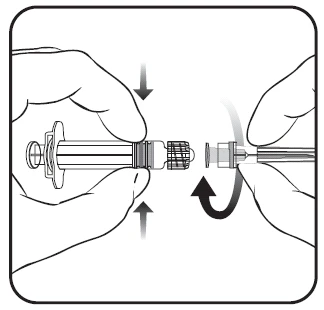
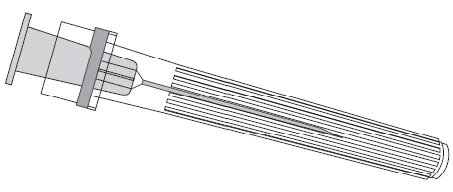
To insert the needle into the syringe, carefully read the instructions shown in drawing 1 and 2. However, the syringe supplied with Priorix may be slightly different (without threading) compared to the syringe shown in the drawing.
In this case, the needle must be attached without screwing.
Needle
Syringe
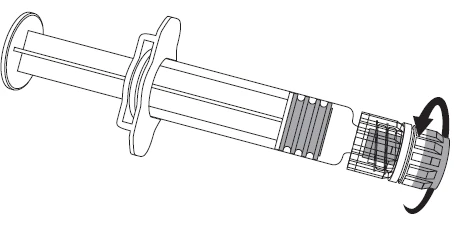
Figure 1 Figure 2
Always hold the syringe by its barrel, not by the plunger or the Luer Lock adapter (LLA), and keep the needle aligned with the syringe (as shown in Figure 2). Failure to do so may cause deformation and leakage of the Luer Lock adapter.
If during syringe assembly the LLA detaches, a new vaccine dose (new syringe and new vial) must be used.
-
Unscrew the syringe cap by turning it counterclockwise (as shown in Figure 1).
Regardless of whether the LLA rotates or not, proceed with the following steps: -
Attach the needle to the syringe by gently connecting the needle hub to the Luer Lock adapter and rotate one-quarter turn clockwise until a click is felt (as shown in Figure 2).
-
Remove the needle cap, which may require some effort.
-
Add the solvent to the powder. The mixture must be gently agitated until the powder is completely dissolved in the solvent.
Due to slight variations in its pH, the color of the reconstituted vaccine may range from light peach to fuchsia pink without any reduction in vaccine potency.
Aspirate the entire contents of the vial.
- A new needle must be used for vaccine administration. Unscrew the needle from the syringe and attach the injection needle by repeating step 2 described above.
After reconstitution, the vaccine must be administered immediately. If this is not possible, it must be stored refrigerated (2°C – 8°C) and used within 8 hours of reconstitution.
Any unused medicinal product and waste material derived from this medicinal product must be disposed of in accordance with local regulations.