Piperacillin and tazobactam Sandoz
Italy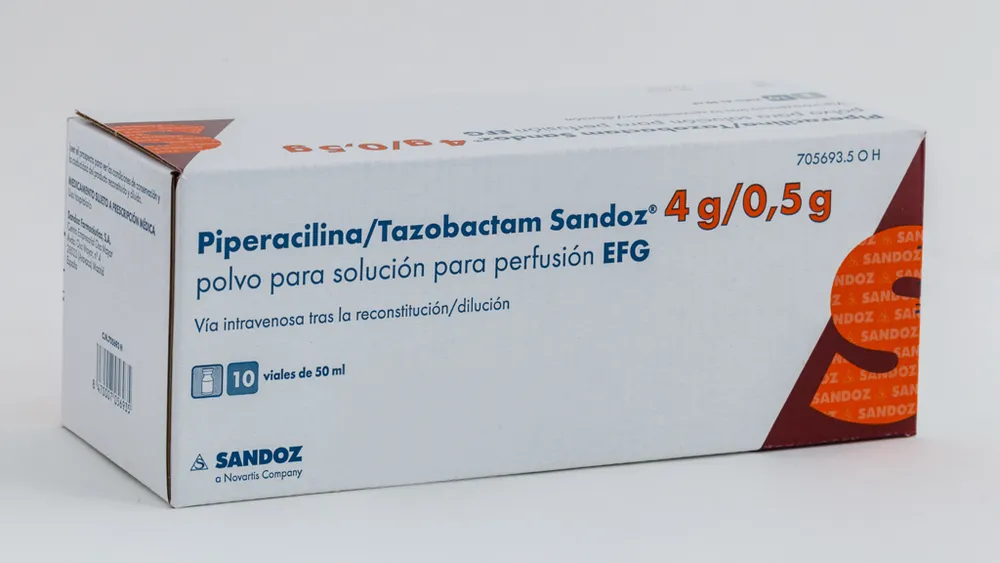
Table of Contents
- Package leaflet: Information for the user
- Piperacillina e Tazobactam Sandoz 2 g/0.25 g powder for solution for infusion, 4 g/0.5 g powder for solution for infusion
- 1. What Piperacillin and Tazobactam Sandoz is and what it is used for
- 2. What you need to know before using Piperacillin and Tazobactam Sandoz
- 3. How to use Piperacillin and Tazobactam Sandoz
- 4. Possible side effects
- 5. How to store Piperacillin and Tazobactam Sandoz
- 6. Package contents and other information
- The following information is intended exclusively for healthcare professionals
Package leaflet: Information for the user
Piperacillina e Tazobactam Sandoz 2 g/0.25 g powder for solution for infusion, 4 g/0.5 g powder for solution for infusion
piperacillin/tazobactam
Please read all of this leaflet carefully before you start using this medicine
because it contains important information for you.
- Keep this leaflet. You may need to read it again.
- If you have any questions, ask your doctor, pharmacist, or nurse.
- This medicine has been prescribed for you only. Do not give it to other people, even if their symptoms are the same as yours, as it may be harmful.
- If you experience any side effects, including those not listed in this leaflet, tell your doctor, pharmacist, or nurse (see section 4).
Contents of this leaflet
- What Piperacillina e Tazobactam Sandoz is and what it is used for
- What you need to know before using Piperacillina e Tazobactam Sandoz
- How to use Piperacillina e Tazobactam Sandoz
- Possible side effects
- How to store Piperacillina e Tazobactam Sandoz
- Contents of the pack and other information
1. What Piperacillin and Tazobactam Sandoz is and what it is used for
Piperacillin belongs to a group of medicines known as "broad-spectrum penicillin antibiotics"
and is capable of killing many types of bacteria. Tazobactam can prevent certain resistant
bacteria from surviving the effects of piperacillin. This means that when piperacillin and tazobactam
are administered together, they can kill a greater number of bacterial types.
Piperacillin and Tazobactam Sandoz is used in adults and adolescents for the treatment of
bacterial infections, such as those affecting the lower respiratory tract (lungs), urinary
tract (kidneys and bladder), abdomen, skin or blood. Piperacillin and Tazobactam Sandoz may be
used to treat bacterial infections in patients with low white blood cell counts (reduced
resistance to infections).
Piperacillin and Tazobactam Sandoz is used in children aged between 2 and 12 years for the treatment
of abdominal infections, such as appendicitis, peritonitis (infection of the fluid and lining of abdominal
organs), and gallbladder (biliary) infections. Piperacillin and Tazobactam Sandoz may be
used to treat bacterial infections in patients with low white blood cell counts (reduced
resistance to infections).
In certain severe infections, your doctor may consider using Piperacillin and Tazobactam Sandoz
in combination with other antibiotics.
2. What you need to know before using Piperacillin and Tazobactam Sandoz
Do not use Piperacillin and Tazobactam Sandoz
FI Piperacillin and Tazobactam SZ_
- if you are allergic to piperacillin or tazobactam, or to any of the other ingredients of this medicine (listed in section 6)
- if you are allergic to antibiotics known as penicillins, cephalosporins, or other beta-lactamase inhibitors, as you may be allergic to Piperacillin and Tazobactam Sandoz.
Warnings and precautions
Talk to your doctor, pharmacist, or nurse before using Piperacillin and Tazobactam Sandoz
- If you have allergies. If you have multiple allergies, inform your doctor or healthcare provider before receiving this medicine.
- If you have had diarrhoea previously, or if you develop diarrhoea during or after treatment. In this case, you must inform your doctor or healthcare provider immediately. Do not take medicines for diarrhoea without first consulting your doctor.
- If you have low levels of potassium in your blood. Your doctor will need to check your kidney function before administering this medicine and may perform periodic blood tests during treatment.
- If you have kidney or liver problems or are undergoing haemodialysis. Your doctor will need to check your kidney function before administering this medicine and may perform periodic blood tests during treatment.
- If you are taking another antibiotic called vancomycin. Taking Piperacillin and Tazobactam Sandoz together with vancomycin may increase the risk of kidney damage (see also section “Other medicines and Piperacillin and Tazobactam Sandoz” in this leaflet).
- If you are taking certain medicines (called anticoagulants) to prevent excessive blood clotting (see also section “Other medicines and Piperacillin and Tazobactam Sandoz” in this leaflet), or if unexpected bleeding occurs during treatment. In this case, you must inform your doctor or healthcare provider immediately.
- If you develop seizures during treatment. In this case, you must inform your doctor or healthcare provider.
- If you think you have developed a new infection or if your infection has worsened. In this case, you must inform your doctor or healthcare provider.
Haemophagocytic lymphohistiocytosis
Cases of a condition in which the immune system produces higher than normal numbers of white blood cells called histiocytes and lymphocytes, leading to inflammation (haemophagocytic lymphohistiocytosis), have been reported. This condition can be life-threatening if not diagnosed and treated early.
If you develop several symptoms such as fever, swollen glands, feeling weak, mental confusion, shortness of breath, bruising, or rash, contact your doctor immediately.
If you notice signs or symptoms of an allergic reaction together with chest pain, inform your doctor immediately. This could be a condition called Kounis syndrome.
If you experience muscle pain, tenderness, or weakness and/or dark-coloured urine, inform your doctor immediately, as treatment will be stopped. These symptoms could indicate muscle breakdown (rhabdomyolysis), which may lead to kidney problems.
Children under 2 years of age
The use of piperacillin/tazobactam is not recommended in children under 2 years of age due to insufficient data on safety and efficacy.
Other medicines and Piperacillin and Tazobactam Sandoz
FI Piperacillin and Tazobactam SZ_
Inform your doctor or healthcare provider if you are taking, have recently taken, or might take any other medicines, including those without a prescription. Some medicines may interact with piperacillin and tazobactam.
These include:
- Medicines for gout (probenecid). This may increase the time required for piperacillin and tazobactam to be eliminated from the body.
- Medicines to thin the blood or treat blood clots (e.g. heparin, warfarin, or aspirin).
- Medicines used to relax muscles during surgery. Inform your doctor if you are undergoing general anaesthesia.
- Methotrexate (a medicine used to treat cancer, arthritis, or psoriasis). Piperacillin and tazobactam may increase the time required for methotrexate to be eliminated from the body.
- Medicines that may reduce potassium levels in the blood (e.g. tablets that increase urine production or certain cancer medicines).
- Medicines containing the other antibiotics tobramycin, gentamicin, or vancomycin. Inform your doctor if you have kidney problems. Taking Piperacillin and Tazobactam Sandoz together with vancomycin may cause acute kidney damage, even if you do not have pre-existing kidney problems.
Effect on laboratory tests
Inform your doctor or laboratory staff that you are taking Piperacillin and Tazobactam Sandoz if you are required to provide a blood or urine sample.
Pregnancy and breastfeeding
If you are pregnant, breastfeeding, suspect you may be pregnant, or are planning to become pregnant, consult your doctor or healthcare professional before taking this medicine.
Your doctor will decide whether Piperacillin and Tazobactam Sandoz is suitable for you.
Piperacillin and tazobactam may pass to the baby in the womb or through breast milk. If you are breastfeeding, your doctor will decide whether Piperacillin and Tazobactam Sandoz is suitable for you.
Driving and using machines
Piperacillin and Tazobactam Sandoz is not expected to affect the ability to drive or use machines.
Piperacillin and Tazobactam Sandoz 2 g/0.25 g contains sodium
This medicine contains 109 mg of sodium (the main component of table salt) per vial. This is equivalent to 6% of the maximum daily intake recommended in an adult's diet.
Piperacillin and Tazobactam Sandoz 4 g/0.5 g contains 217 mg of sodium (the main component of table salt) per dose. This is equivalent to 11% of the maximum daily intake recommended in an adult's diet. This should be taken into account if you are on a controlled sodium diet.
3. How to use Piperacillin and Tazobactam Sandoz
Your doctor or healthcare professional will administer this medicine to you as an infusion (a drip) into a vein over 30 minutes.
Dosage
The dose of medicine given depends on the reason for treatment, your age, and whether or not you have kidney problems.
FI Piperacillin and Tazobactam SZ_
Adults and adolescents over 12 years of age
The usual dose is 4 g/0.5 g of piperacillin/tazobactam every 6–8 hours, administered intravenously (directly into the bloodstream).
Children from 2 to 12 years of age
The usual dose for children with abdominal infections is 100 mg/12.5 mg per kg of body weight of piperacillin/tazobactam every 8 hours, administered intravenously (directly into the bloodstream).
The usual dose for children with low white blood cell counts is 80 mg/10 mg per kg of body weight of piperacillin/tazobactam every 6 hours, administered intravenously (directly into the bloodstream).
The doctor will calculate the dose based on the child's body weight; however, no individual dose will exceed 4 g/0.5 g of Piperacillin and Tazobactam Sandoz.
Piperacillin and Tazobactam Sandoz will be administered until all signs of infection have completely disappeared (5–14 days).
Patients with kidney problems
Your doctor may need to reduce the dose of Piperacillin and Tazobactam Sandoz or the frequency of administration. Your doctor may also perform blood tests to ensure that the prescribed dose is appropriate, especially if you are to receive this medicine for a prolonged period.
If you receive more Piperacillin and Tazobactam Sandoz than you should
Since Piperacillin and Tazobactam Sandoz will be administered by a doctor or healthcare professional, it is unlikely that you will receive an incorrect dose. However, if you experience side effects such as seizures, or if you think you have been given too high a dose, inform your doctor immediately.
If you miss a dose of Piperacillin and Tazobactam Sandoz
If you think a dose of Piperacillin and Tazobactam Sandoz has not been administered, inform your doctor or healthcare professional immediately.
If you have any doubts about how to use this medicine, ask your doctor or nurse.
4. Possible side effects
Like all medicines, this medicine can cause side effects, although not everyone gets them.
If you experience any of the following potentially serious side effects of Piperacillin and Tazobactam Sandoz, seek immediate medical advice.
The serious side effects (frequency in brackets) of Piperacillin and Tazobactam Sandoz are:
- severe skin reactions that initially appear as reddish spots or circular rashes, often with central blisters on the trunk. Further symptoms include ulcers in the mouth, throat, nose, extremities, genitals, and conjunctivitis (red and swollen eyes).
FI Piperacillin and Tazobactam SZ
The skin rash may progress to widespread blistering or peeling of the skin, which could potentially be life-threatening. These may be signs of Stevens-Johnson syndrome (Not known), bullous dermatitis (Not known), exfoliative dermatitis (Not known), or toxic epidermal necrolysis (Rare).
- a skin condition accompanied by fever, characterized by numerous small fluid-filled blisters appearing within large areas of swollen and red skin, known as acute generalized exanthematous pustulosis (Not known)
- a severe, potentially fatal allergic condition (drug reaction with eosinophilia and systemic symptoms) that may affect the skin and, particularly, other organs beneath the skin, such as the kidneys and liver (Not known)
- swelling of the face, lips, tongue, or other parts of the body (Not known)
- shortness of breath, wheezing, or difficulty breathing (allergic reactions including anaphylactic shock, Not known)
- sudden chest pain that may occur with an allergic reaction known as Kounis syndrome (Not known)
- severe rash or hives (Uncommon), itching or skin rash (Common)
- inflammation of the liver (Hepatitis, Not known), yellowing of the skin or whites of the eyes (Jaundice, Not known)
- low levels of red blood cells (Anaemia, Common), excessive destruction of red blood cells causing unexplained breathlessness, red or brown urine (Haemolytic anaemia, Not known)
- low platelet levels, which may lead to bleeding and bruising (Thrombocytopenia, Common)
- low levels of white blood cells, blood cells that fight infections (Leukopenia, Uncommon or Neutropenia, Not known)
- very low levels of a type of white blood cells called granulocytes (Agranulocytosis, Rare)
- elevated platelet levels (Thrombocytosis, Not known)
- elevated levels of a type of white blood cells called eosinophils (Eosinophilia, Not known)
- low levels of all types of blood cells, including platelets (Pancytopenia, Not known)
- severe or persistent diarrhoea accompanied by fever or weakness (Pseudomembranous colitis, Rare)
- decreased potassium levels in the blood (Uncommon)
- seizures (Convulsions), observed in patients treated with high doses or with kidney problems (Uncommon)
- severe muscle pain, tenderness, or weakness (Rhabdomyolysis, Not known).
If any of the following side effects worsen, or if you notice any side effects not listed in this leaflet, inform your doctor or another healthcare professional.
Very common side effects ( may affect more than 1 in 10 people):
- diarrhoea.
Common side effects (may affect up to 1 in 10 people):
- yeast infection
- formation of antibodies in the blood that attack red blood cells (positive direct Coombs test), prolonged blood clotting time (prolonged activated partial thromboplastin time)
- reduced protein levels in the blood
- headache, insomnia
- abdominal pain, vomiting, nausea, constipation, stomach discomfort
- increased liver enzymes in the blood
- abnormal kidney blood tests FI Piperacillin and Tazobactam SZ
- fever, injection site reactions.
Uncommon side effects (may affect up to 1 in 100 people):
- prolonged blood clotting time (prolonged prothrombin time)
- low blood sugar levels
- low blood pressure, inflammation of veins (felt as tenderness or redness in the affected area), skin redness
- increased levels of a blood pigment waste product (bilirubin)
- skin reactions with redness, skin lesion formation
- joint and muscle pain
- chills.
Rare side effects (may affect up to 1 in 1,000 people):
- nosebleeds
- inflammation of the mucous membranes lining the mouth.
Side effects not known ( frequency cannot be estimated from available data):
- appearance of bruising with small spots, prolonged bleeding time
- blistering skin disease characterized by blisters on the skin and mucous membranes (linear IgA disease)
- reduced kidney function and kidney problems
- a form of lung disease in which eosinophils (a type of white blood cell) appear in increased numbers in the lungs
- acute disorientation and confusion (delirium).
Treatment with piperacillin has been associated with a higher incidence of fever and rash in patients with cystic fibrosis.
Beta-lactam antibiotics, including piperacillin/tazobactam, may lead to manifestations of signs of impaired brain function (encephalopathy) and seizures.
Reporting of side effects
If you experience any side effect, including those not listed in this leaflet, talk to your doctor, pharmacist, or nurse. You can also report side effects directly via the national reporting system at https://www.aifa.gov.it/content/segnalazioni-reazioni-avverse. By reporting side effects, you can help provide more information on the safety of this medicine.
5. How to store Piperacillin and Tazobactam Sandoz
Keep this medicine out of the sight and reach of children.
Do not use this medicine after the expiry date stated on the carton and vial after "Exp.".
The expiry date refers to the last day of that month.
Unopened vials/vials:
This medicine does not require any special storage conditions.
For storage conditions of the reconstituted and diluted medicinal product, see at the end of the
package leaflet “The following information is intended exclusively for healthcare professionals”.
FI Piperacillin and Tazobactam SZ_
For single use only. Discard any unused solution.
Do not dispose of medicines via wastewater or household waste. Ask your pharmacist how to dispose of medicines you no longer use. This will help protect the environment.
6. Package contents and other information
What Piperacillina e Tazobactam Sandoz contains
- The active substances are piperacillin and tazobactam. Each vial contains 2 g of piperacillin (as sodium piperacillin) and 0.25 g of tazobactam (as sodium tazobactam). Each bottle contains 4 g of piperacillin (as sodium piperacillin) and 0.5 g of tazobactam (as sodium tazobactam).
- Other components: This medicinal product contains no excipients other than the active substances.
Description of the appearance of Piperacillina e Tazobactam Sandoz and contents of the pack
Piperacillina e Tazobactam Sandoz 2 g/0.25 g is a white to off-white powder for solution for infusion, contained in glass vials. The vials are packed in cardboard boxes.
Pack sizes: 1, 5, 10, 12 and 50 vials.
Piperacillina e Tazobactam Sandoz 4 g/0.5 g is a white to off-white powder for solution for infusion, contained in glass vials or bottles. The vials or bottles are packed in cardboard boxes.
Pack sizes: 1, 5, 10, 12 and 50 vials/bottles.
Not all pack sizes may be marketed.
Marketing Authorisation Holder and Manufacturer
Marketing Authorisation Holder
Sandoz S.p.A.
Viale Luigi Sturzo 43
20154 Milan
Italy
Manufacturer
Sandoz GmbH
Biochemiestrasse 10
6250 Kundl
Austria
This medicinal product has been authorised in the Member States of the European Economic Area and in the United Kingdom (Northern Ireland) under the following names:
Belgium:
Piperacilline/Tazobactam Sandoz 2g/250 mg, powder for solution for infusion
Piperacilline/Tazobactam Sandoz 4g/500 mg, powder for solution for infusion
Denmark:
FI Piperacillina e Tazobactam SZ
Piperacillin/Tazobactam Sandoz
Estonia:
Piperazillin/Tazobactam Sandoz 4000 mg/500 mg
France:
Piperacilline/Tazobactam Sandoz 2 g/0,25 g, poudre pour solution pour perfusion
Piperacilline/Tazobactam Sandoz 4 g/0,5 g, poudre pour solution pour perfusion
Hungary:
Piperacillin/Tazobactam Sandoz 4 g/0,5 g por oldatos infúzióhoz
Ireland:
Piperin 2 g/0.25 g Powder for Solution for Infusion
Piperin 4 g/0.5 g Powder for Solution for Infusion
Italy:
Piperacillina e Tazobactam Sandoz
Lithuania:
Piperacillin/Tazobactam Sandoz 4000 mg/500 mg milteliai infuziniam tirpalui
Latvia:
Piperacillin/Tazobactam Sandoz 4000 mg/500 mg pulveris infūziju šķīduma pagatavošanai
Sweden:
Piperazillin/Tazobactam Sandoz 2 g/0.25 g pulver till injektions-/infusionsvätska, lösning
Piperazillin/Tazobactam Sandoz 4 g/0.5 g pulver till injektions-/infusionsvätska, lösning
United Kingdom:
Piperacillin/Tazobactam 2 g/0.25 g Powder for Solution for infusion
Piperacillin/Tazobactam 4 g/0.5 g Powder for Solution for infusion
Spain:
Piperacillina/Tazobactam Sandoz 2 g/0,25 polvo para solución para perfusión EFG
Piperacillina/Tazobactam Sandoz 4 g/0,5 polvo para solución para perfusión EFG
Poland:
Piperacillin/Tazobactam Sandoz 4g/0,5, 4g+500 mg, proszek do sporządzania roztworu do infuzji
Slovakia:
Piperacilin comp. Sandoz 4 g/0,5 g prášok na infúzny roztok
Austria:
Piperacillin/Tazobactam Sandoz 4,0 g/0,5 g – Pulver zur Herstellung einer Infusionslösung
This Patient Information Leaflet was last approved in 04/2026
The following information is intended exclusively for healthcare professionals
Note: Use for bacteraemia due to E. coli and K. pneumoniae (non-susceptible to ceftriaxone) producing extended-spectrum beta-lactamases (ESBL) is not recommended in adult patients.
After reconstitution (and dilution):
Chemical and physical in-use stability has been demonstrated for 24 hours at 20–25°C and for 48 hours at 2–8°C.
From a microbiological standpoint, once opened, the product should be used immediately.
If not used immediately, the duration and conditions of storage prior to use are the responsibility of the user and should normally not exceed 24 hours at 2–8°C, unless reconstitution/dilution has taken place under controlled and validated aseptic conditions.
Instructions for use
Piperacillin and Tazobactam Sandoz must be administered by intravenous infusion (a 30-minute infusion).
FI Piperacillin and Tazobactam SZ_
Reconstitution and dilution must be carried out under aseptic conditions. The solution should be inspected visually for the presence of particulate matter and discoloration prior to administration. The solution should only be used if it is clear and free from particles.
Intravenous use
Reconstitute each vial with the volume of solvent indicated in the following table, using one of the compatible solvents for reconstitution. Shake by rotating motion until dissolved. If shaken continuously with rotary motion, reconstitution is generally achieved within 3 minutes (for details on handling, see below).
| Content of the vial/bottle | Volume of solvent* to be added to the vial/bottle |
| 2 g/0.25 g (2 g of piperacillin and 0.25 g of tazobactam) | 10 ml |
| 4 g/0.5 g (4 g of piperacillin and 0.5 g of tazobactam) | 20 ml |
* Compatible solvents for reconstitution:
- Sterile water for injections
- 9 mg/ml (0.9%) sodium chloride injection solution
- 50 mg/ml (5%) glucose injection solution
- 50 mg/ml (5%) glucose solution in 9 mg/ml (0.9%) sodium chloride solution
The reconstituted solution must be withdrawn from the vial using a syringe. Once reconstituted according to instructions, the vial contents withdrawn with the provided syringe will deliver the amount of piperacillin and tazobactam stated on the label.
The reconstituted solutions may be further diluted to the desired volume (e.g., from 50 ml to 150 ml) with one of the following compatible diluents:
- 9 mg/ml (0.9%) sodium chloride injection solution
- 50 mg/ml (5%) glucose injection solution
- 60 mg/ml (6%) dextran (40) solution in 9 mg/ml (0.9%) sodium chloride solution.
Incompatibilities
When Piperacillin and Tazobactam Sandoz is used concomitantly with another antibiotic (e.g., aminoglycosides), the substances must be administered separately. Mixing beta-lactam antibiotics with aminoglycosides in vitro may cause substantial inactivation of the aminoglycoside. However, it has been established that amikacin and gentamicin are compatible with Piperacillin and Tazobactam Sandoz in vitro when using certain diluents at specific concentrations (see below Co-administration of Piperacillin and Tazobactam Sandoz with aminoglycosides).
Piperacillin/tazobactam must not be mixed with other medicinal substances in a syringe or infusion vial, as compatibility has not been established.
Piperacillin/tazobactam must be administered through a separate infusion line from that used for any other medicinal product, unless compatibility has been proven.
Due to chemical instability, piperacillin/tazobactam must not be used in solutions containing sodium bicarbonate alone.
Ringer's lactate solution (Hartmann's solution) is not compatible with piperacillin/tazobactam.
FI Piperacillina e Tazobactam SZ_
Piperacillin/tazobactam must not be added to blood derivatives or hydrolysed albumins.
Co-administration of Piperacillin and Tazobactam Sandoz with aminoglycosides
Due to in vitro inactivation of aminoglycosides by beta-lactam antibiotics, it is recommended that Piperacillin and Tazobactam Sandoz and the aminoglycoside be administered separately.
When concomitant therapy with aminoglycosides is indicated, Piperacillin and Tazobactam Sandoz and the aminoglycoside must be reconstituted and diluted separately.
Under circumstances where co-administration is recommended, Piperacillin and Tazobactam Sandoz is compatible for simultaneous co-administration via infusion using a Y-site connector only with the following aminoglycosides and under the following conditions:
| Aminoglycosides | Dose of Piperacillin and Tazobactam Sandoz | Diluent volume (ml) for Piperacillin and Tazobactam Sandoz | Aminoglycoside concentration range* (mg/ml) | Permitted diluents |
| Amikacin | 2g/0.25g | 50, 100, 150 | 1.75 – 7.5 | 0.9% Sodium chloride or 5% Glucose |
| 4g/0.5g | ||||
| Gentamicin | 2g/0.25g | 50, 100, 150 | 0.7 – 3.32 | 0.9% Sodium chloride or 5% Glucose |
| 4g/0.5g |
*The aminoglycoside dose must be based on the patient's body weight, the severity of the infection (serious or
potentially life-threatening), and renal function (creatinine clearance).
The compatibility of Piperacillin and Tazobactam Sandoz with other aminoglycosides has not been established.
Compatibility for co-administration by infusion using a Y-site connector has been confirmed only for the
concentrations and diluents of amikacin and gentamicin together with the dose of Piperacillin and
Tazobactam Sandoz, as reported in the previous table. Simultaneous co-administration by infusion using a Y-site
connector in a manner different from that described above may result in inactivation of the aminoglycoside by
Piperacillin and Tazobactam Sandoz.
FI Piperacillin and Tazobactam SZ_