OXA
ItalyTable of Contents
PACKAGE LEAFLET: INFORMATION FOR
THE USER
OXA 5 mg/ml eye drops, solution
Moxifloxacin (as hydrochloride)
Read this leaflet carefully before using this medicine because it contains important information for you
- Keep this leaflet. You may need to read it again.
- If you have any questions, consult your doctor or pharmacist.
- This medicine has been prescribed for you only. Do not give it to others, even if their symptoms are the same as yours, as it may be harmful.
- If you experience any side effects, including those not listed in this leaflet, consult your doctor or pharmacist. See section 4.
Contents of this leaflet
- What OXA is and what it is used for
- What you need to know before using OXA
- How to use OXA
- Possible side effects
- How to store OXA
- Contents of the pack and other information
1. What OXA is and what it is used for
OXA eye drops are used to treat eye infections (conjunctivitis) when caused by bacteria. The active substance is moxifloxacin, an ophthalmic anti-infective.
2. What you need to know before using OXA
Do not use OXA
- If you are allergic (hypersensitive) to moxifloxacin, to other quinolones, or to any of the excipients of this medicine (listed in section 6).
Warnings and precautions
- If you have an allergic reaction to OXA – Allergic reactions occur uncommonly, and severe reactions occur rarely. In case of allergic reactions (hypersensitivity) or any type of adverse effects, refer to section 4.
- If you wear contact lenses – Stop wearing them if you experience signs or symptoms of eye infection. Wear glasses instead. Do not resume wearing contact lenses until signs and symptoms of infection have resolved and until you have stopped using the medicine.
- Tendon swelling and rupture have occurred in individuals treated with oral or intravenous fluorquinolones, particularly in elderly patients and in patients receiving concomitant corticosteroid therapy. Discontinue use of OXA if you experience tendon pain or swelling (tendinitis).
As with any antibiotic, prolonged use of OXA may lead to other infections.
Other medicines and OXA
Inform your doctor or pharmacist if you are taking or have recently taken any other medicines, including those without a prescription.
Pregnancy, breastfeeding and fertility
If you are pregnant, suspect you may be pregnant, planning to become pregnant, or breastfeeding, consult your doctor or pharmacist before using OXA eye drops.
Driving and using machines
You may experience blurred vision for a short period immediately after using OXA. Do not drive or operate machinery until this sensation has passed.
3. How to use OXA
Use OXA exactly as instructed by your doctor. If you have any doubts, consult your doctor or
pharmacist.
Adults, including elderly patients, and children: 1 drop in the affected eye(s), 3 times daily (in the
morning, afternoon, and evening).
OXA can be used in children, in patients over 65 years of age, and in patients with renal or hepatic
impairment. There is only very limited information on the use of this medicine in newborns, and its use
in newborns is not recommended.
Use the medicine in both eyes only if specifically instructed by your doctor. OXA must be used only
as an eye drop.
The infection usually improves within 5 days. If you do not observe any improvement, consult your
doctor. You should continue using the drops for another 2–3 days or as long as prescribed by your
doctor.
1 2 3
- Take the OXA bottle and position yourself in front of a mirror.
- Wash your hands.
- Unscrew the cap.
- After removing the cap, if the safety ring has loosened, remove it before using the product.
- Hold the bottle between your thumb and other fingers, inverted.
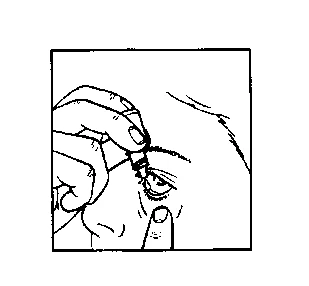
- Tilt your head backward. Pull down the lower eyelid with a clean finger to form a "pocket" between the eyelid and the eye. The drop should be placed in this pocket (figure 1).
- Hold the tip of the bottle close to the eye. Looking in the mirror may help.
- Do not touch the eye, eyelid, surrounding areas, or any other surfaces with the dropper tip. This could contaminate the eye drops.
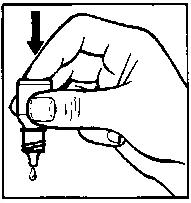
- Gently press the bottom of the bottle to release one drop of OXA at a time (figure 2).
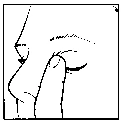
- After using OXA, press with one finger on the inner corner of the eye, near the nose, for 2–3 minutes (figure 3). This helps prevent the medicine from spreading into the rest of the body, which is particularly important in young children.
- If you need to apply the eye drops to both eyes, wash your hands before repeating the steps for the other eye. This helps prevent the infection from spreading from one eye to the other.
- Immediately after use, tightly replace the cap on the bottle.
If a drop misses the eye, try again.
If you use more OXA than you should, immediately rinse the eye with lukewarm water. Do not use the eye drops again until it is time for your next dose.
If you accidentally swallow OXA, consult your doctor or pharmacist.
If you forget to use OXA, continue treatment with the next dose as scheduled. Do not use a double dose to make up for the forgotten dose.
If you are using another eye drop at the same time, wait at least 5 minutes between instilling OXA and the other eye drop.
If you stop using OXA
If you have any questions about using this medicine, consult your doctor or pharmacist.
4. Possible side effects
Like all medicines, OXA can cause side effects, although not everyone gets them.
You can generally continue using the drops, unless the side effects are severe or you have a serious allergic reaction.
If you experience a severe allergic reaction or any of the following side effects, stop taking OXA immediately and contact your doctor straight away: swelling of the hands, feet, ankles, face, lips, mouth or throat causing difficulty in swallowing or breathing, skin rash or hives, large fluid-filled blisters, sores and ulceration.
Common side effects
(may affect up to 1 in 10 people)
Eye effects: eye pain, eye irritation.
Uncommon side effects
(may affect up to 1 in 100 people)
Eye effects: dry eyes, itchy eyes, eye redness, inflammation or scarring of the eye surface, broken blood vessels in the eye, abnormal sensation in the eye, eyelid disorder, itching, redness or swelling.
General side effects: headache, bad taste.
Rare side effects
(may affect up to 1 in 1,000 people)
Eye effects: corneal disorder, blurred or reduced vision, inflammation or infection of the conjunctiva, eye fatigue, eye swelling.
General side effects: vomiting, nasal discomfort, sensation of a lump in the throat, reduced iron in the blood, abnormal liver blood tests, abnormal skin sensation, pain, throat irritation.
Not known
(frequency cannot be estimated from the available data)
Eye effects: eye infection, clouding of the eye surface, corneal swelling, deposits on the eye surface, increased eye pressure, scratch on the eye surface, eye allergy, eye discharge, increased tearing, light sensitivity.
General side effects: shortness of breath, irregular heartbeat, dizziness, worsening of allergy symptoms, itching, skin rash, skin redness, nausea and hives.
Reporting of side effects
If you experience any side effect, including those not listed in this leaflet, please inform your doctor or pharmacist. You can also report side effects directly via the national reporting system at https://www.aifa.gov.it/content/segnalazioni-reazioni-avverse.
By reporting side effects, you can help provide more information on the safety of this medicine.
5. How to store OXA
Keep this medicine out of the sight and reach of children.
Do not use this medicine after the expiry date stated on the vial and the outer carton after 'Exp'. The expiry date refers to the last day of the month.
This medicine does not require any special storage conditions.
Discard the vial 4 weeks after first opening. This is to avoid the risk of infection.
Do not dispose of medicines via wastewater or household waste. Ask your pharmacist how to dispose of medicines you no longer use. This will help protect the environment.
6. Package contents and other information
What OXA contains
- The active substance is moxifloxacin. One ml of eye drops contains 5 mg of moxifloxacin (as moxifloxacin hydrochloride, 5.45 mg). The other components are: sodium chloride, boric acid, water for injections.
Small amounts of sodium hydroxide and hydrochloric acid may be added to maintain normal acidity levels (pH).
Description of the appearance of OXA and pack contents
The medicine is a liquid (a clear, yellowish-green solution) supplied in a pack containing one 5 ml plastic bottle with a screw cap.
Marketing Authorisation Holder
DOC Generici S.r.l., Via Turati 40, 20121 Milan, Italy.
Manufacturer
BALKANPHARMA-RAZGRAD AD
68, Aprilsko Vastanie Blvd. 7200 Razgrad,
BULGARIA