Omegaven
Italy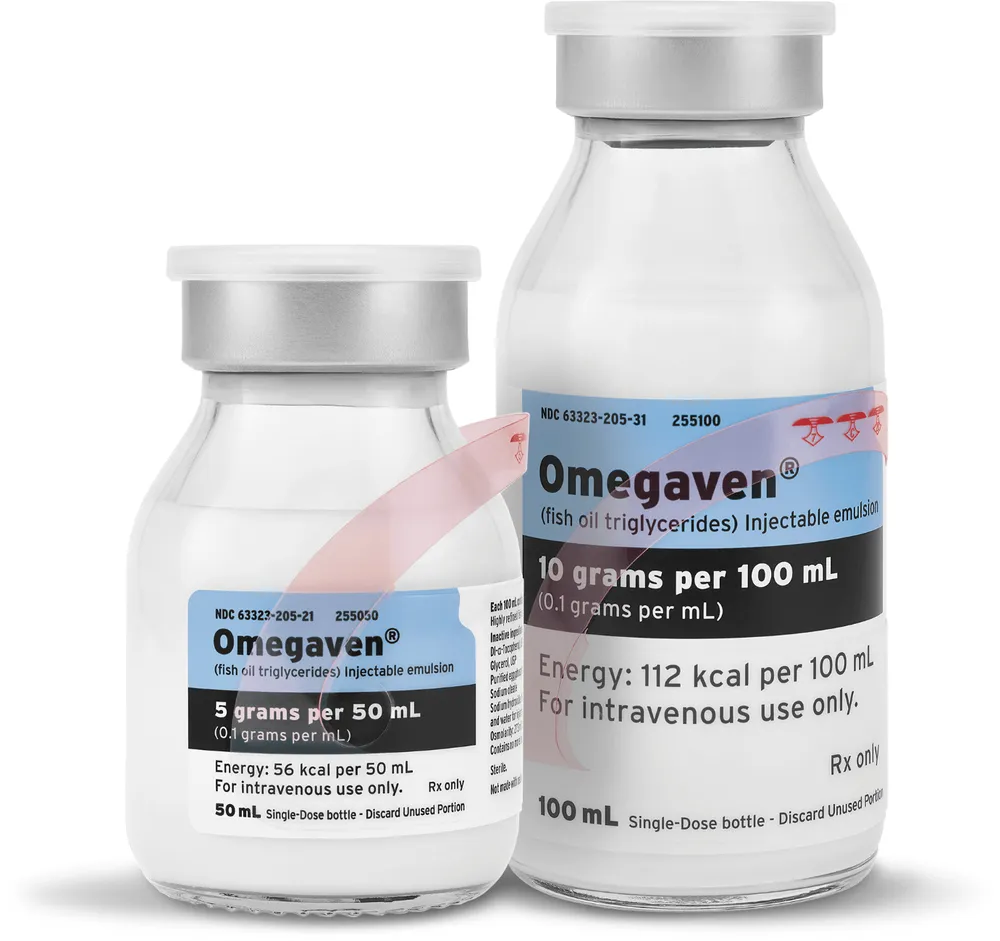
Table of Contents
Package leaflet: Information for the user
OMEGAVEN
Infusion emulsion
Please read all of this leaflet carefully before taking this medicine because it contains
important information for you.
- Keep this leaflet. You may need to read it again.
- If you have any questions, ask your doctor, pharmacist or nurse.
- If you get any side effects, including those not listed in this leaflet, tell your doctor, pharmacist or nurse. See section 4.
Contents of this leaflet:
- What Omegaven is and what it is used for
- What you need to know before Omegaven is administered
- How Omegaven is administered
- Possible side effects
- How to store Omegaven
- Contents of the pack and other information
1. What Omegaven is and what it is used for
Omegaven provides energy and omega-3 fatty acids derived from fish oil through the bloodstream when oral nutrition is not possible, is insufficient, or is not recommended.
2. What you need to know before Omegaven is administered
Omegaven must not be administered to you if:
- You are allergic to the active substances or to any of the other ingredients of this medicine (listed in section 6)
- You are allergic (hypersensitive) to fish or egg proteins
- You have severe coagulation disorders
- You have experienced collapse with shock
- You have recently had a severe heart attack
- You have recently had a severe stroke
- You have been diagnosed with severe embolism (blockage of arteries)
- You suffer from low potassium levels (hypokalaemia)
- You have excess fluid in the body (overhydration)
- You are dehydrated with low sodium levels (hypotonic dehydration)
- Your metabolism is unstable
- You have acidosis (acid levels in body fluids and tissues become too high)
- You suffer from severe liver or kidney failure
This medicine must not be administered if you are in an undefined comatose state.
Warnings and precautions
Talk to your doctor before using Omegaven if you suffer from:
- Diabetes (type 1 and 2)
- A condition in which the body has difficulty properly metabolizing fats
If you are taking medications to thin the blood (anticoagulants), your doctor may wish to perform regular blood tests to ensure your anticoagulant therapy is well controlled.
Serum triglyceride levels may be monitored daily, and their concentration must not exceed 3 mmol/l during fat emulsion infusions.
Children
Due to limited experience, Omegaven must not be administered to premature infants, newborns, infants, or children up to 11 years of age.
Other medicines and Omegaven
Inform your doctor or pharmacist if you are taking, have recently taken, or might take any other medicines.
Specifically inform your doctor if you are taking:
- Medicines used in anticoagulant therapy to thin the blood (such as heparin)
Pregnancy and breastfeeding
If you are pregnant, suspect you may be pregnant, planning a pregnancy, or are breastfeeding, consult your doctor or pharmacist before taking this medicine.
There is no information available on the safety of this medicine during pregnancy or breastfeeding.
This medicine should only be used during pregnancy and breastfeeding if strictly necessary.
3. How Omegaven is administered
You will be given this medicine by infusion.
Your doctor will decide the correct dose and rate of infusion for you. This will depend on your body weight in kilograms and your body's ability to use fats. The infusion will be administered to you in hospital by a medical professional.
The duration of administration should not exceed 4 weeks.
Dosage
Daily dose:
1 ml up to a maximum of 2 ml of Omegaven/kg body weight = 0.1 g up to a maximum of 0.2 g of fish oil/kg body weight = 70 ml up to a maximum of 140 ml of Omegaven for a patient with a body weight of 70 kg.
Maximum infusion rate:
The infusion rate must not exceed 0.5 ml of Omegaven/kg body weight/hour, corresponding to 0.05 g of fish oil/kg body weight/hour.
The maximum infusion rate must be strictly observed; otherwise, a significant increase in serum triglyceride concentration may occur.
Omegaven must be administered in combination with other lipid emulsions. Based on the recommended total daily lipid intake of 1–2 g/kg body weight, the fish oil portion from Omegaven should constitute 10–20% of this amount.
If you receive too much Omegaven
It is unlikely that you will receive more than you should, as your doctor or nurse will monitor you during treatment.
For symptoms of overdose, see section 4 “Possible side effects”. If you think you have been given too much Omegaven, inform your doctor or nurse immediately. If this happens, the infusion will be stopped immediately. Treatment may continue with a reduced dose. These symptoms generally resolve with reduction or interruption of the infusion.
If you have any questions about the use of this product, ask your doctor.
4. Possible adverse reactions
Like all medicines, this medicine can cause adverse reactions, although not everyone experiences them.
Adverse reactions observed during administration of Omegaven
| Rare (may affect up to 1 in 1000 people) |
|
Adverse reactions observed during administration of lipid emulsions
| Uncommon (may affect up to 1 in 100 people) |
|
| Very rare (may affect up to 1 in 10,000 people) |
|
| Priapism (persistent, usually painful erection) |
Possible symptoms of metabolic overload should be monitored. The cause may be genetic
(metabolic differences from individual to individual) or due to a previous illness.
However, this is mainly observed when using cottonseed oil emulsions.
Metabolic overload may lead to the following symptoms:
- Enlargement of the liver (hepatomegalia), with or without jaundice (yellowing of the skin)
- Alteration or reduction of certain coagulation parameters (e.g. bleeding time, coagulation time, prothrombin time, platelet count)
- Enlargement of the spleen (splenomegaly)
- Abnormalities in blood anemia, low white blood cell count
- Bleeding and tendency to bleed
- Liver function tests abnormalities
- Fever
- Elevated levels of lipids in the blood (hyperlipidemia)
- Headache, stomach pain, fatigue
- Elevated blood sugar levels (hyperglycemia)
If any adverse reaction occurs, the infusion must be stopped or, if necessary, continued at reduced doses.
An overdose may occur, leading to lipid overload syndrome.
This may happen when the body has difficulty utilizing fats due to an excess of Omegaven. It may also occur due to a rapid change in clinical condition (such as kidney problems or infections). Possible symptoms include fever, dysfunction of various organs, and coma. All these symptoms will resolve once the infusion is discontinued.
A severe overdose of Omegaven without concomitant administration of carbohydrate solutions may lead to metabolic acidosis.
Reporting of adverse reactions
If you experience any adverse reaction, including those not listed in this leaflet, consult your doctor, pharmacist, or nurse. You may also report adverse reactions directly via the national reporting system at the website
http://www.agenziafarmaco.gov.it/it/responsabili. By reporting adverse reactions, you can help provide more information on the safety of this medicine.
5. How to store Omegaven
Keep this medicine out of the sight and reach of children.
Do not use Omegaven after the expiry date stated on the label after "Exp". The expiry date refers to the last day of the month.
Do not store above 25°C. Do not freeze.
Do not dispose of medicines via wastewater or household waste. Ask your pharmacist how to dispose of medicines no longer required. This will help protect the environment.
6. Package contents and other information
What Omegaven contains:
Active substances:
100 ml of emulsion contain:
highly refined fish oil 10.0 g
containing:
eicosapentaenoic acid (EPA) 1.25-2.82 g
docosahexaenoic acid (DHA) 1.44-3.09 g
dl-α-tocopherol (as antioxidant) 0.015-0.0296 g
Glycerol 2.5 g
purified egg phospholipids 1.2 g
Other components are
sodium oleate
sodium hydroxide
water for injections
Total caloric value: 470 kJ/100ml = 112 kcal/100ml
pH value 7.5-8.7
Titratable acidity: < 1 mmol HCl/l
Osmolality 308-376 mOsm/kg
Description of the appearance of Omegaven and package contents
Emulsion for infusion, white homogeneous emulsion.
Glass flacons (Type II, colourless) with bromobutyl rubber stoppers.
Packaging: 1x50ml, 10x50ml, 1x100ml, 10x100ml.
Not all pack sizes may be marketed.
Marketing Authorisation Holder and Manufacturer
Marketing Authorisation Holder
Fresenius Kabi Deutschland GmbH
61346 Bad Homburg v.d.H., Germany
Manufacturer
Fresenius Kabi Austria GmbH
8055 Graz, Austria
Representative in Italy and Importer
Fresenius Kabi Italia S.r.l.
Via Camagre, 41
37063 Isola della Scala
Verona, Italy
This medicinal product is authorised in the Member States of the European Economic Area under the following names:
| Austria | Omegaven "Fresenius" - Emulsion for Infusion |
| Bulgaria | Omegaven |
| Czech Republic | Omegaven Fresenius |
| Denmark | Omegaven |
| Estonia | Omegaven |
| France | Omegaven |
| Germany | Omegaven Fresenius |
| Hungary | Omegaven |
| Italy | Omegaven |
| Latvia | Omegaven |
| Lithuania | Omegaven |
| Luxembourg | Omegaven |
| Netherlands | Omegaven Fresenius |
| Poland | Omegaven |
| Portugal | Omegaven Fresenius |
| Romania | Omegaven |
| Slovakia | Omegaven |
| Slovenia | Omegaven 10% |
| Sweden | Omegaven |
| United Kingdom | Omegaven |
The following information is intended exclusively for healthcare professionals:
Usual daily dose:
1 ml up to a maximum of 2 ml of Omegaven/kg body weight = 0.1 g up to a maximum of 0.2 g of fish oil/kg
body weight = 70 ml up to a maximum of 140 ml of Omegaven for a patient weighing 70 kg.
The infusion rate must not exceed 0.5 ml of Omegaven/kg body weight/hour, corresponding to
0.05 g of fish oil/kg body weight/hour.
The maximum infusion rate must be strictly observed; otherwise, a significant increase in serum triglyceride
concentration may occur.
Omegaven must be administered in combination with other lipid emulsions. Based on the recommended
daily lipid intake of 1–2 g/kg, the fish oil portion from Omegaven should constitute 10–20% of this amount.
Method of administration:
For intravenous infusion via central or peripheral vein.
Vials must be shaken before use. Use only if the emulsion is homogeneous and the container is undamaged.
Where possible, administration sets free of phthalates should be used. Any unused portion of the contents or
mixtures after use must be discarded.
Incompatibilities
When Omegaven is administered with other infusion solutions (e.g., amino acid solutions, carbohydrate
solutions) through a common infusion line (by-pass, Y-tube), compatibility (tolerance) of the solutions/
emulsions used must be ensured.
Incompatibilities may occur upon addition of polyvalent cations, e.g., calcium, especially when combined
with heparin (anticoagulant).
Duration of administration
The duration of administration must not exceed 4 weeks.
PHARMACOLOGICAL PROPERTIES
Pharmacodynamic properties
Pharmacotherapeutic group: Parenteral nutrition emulsion
ATC code: B05BA02
The long-chain omega-3 fatty acids present in Omegaven are partially incorporated into plasma and tissue
lipids.
Docosahexaenoic acid is an important structural component in phospholipid membranes, while
eicosapentaenoic acid is a precursor in the synthesis of a special class of eicosanoids (prostaglandins,
thromboxanes, leukotrienes, and other lipid mediators). An increased synthesis of these mediators derived
from eicosapentaenoic acid may help promote anti-aggregatory and anti-inflammatory effects and is
associated with immunomodulatory effects.
The glycerol contained in Omegaven is intended for use in energy production via glycolysis or is re-
esterified together with free fatty acids in the liver to form triglycerides.
Omegaven also contains egg phospholipids, which are hydrolyzed or incorporated into cell membranes,
where they are essential for maintaining membrane integrity.
Pharmacokinetic properties
The lipid particles administered with Omegaven are similar in size and elimination to physiological
chylomicrons. In healthy male volunteers, a half-life of 54 minutes for triglycerides from Omegaven has
been calculated.