Oftalmil
Italy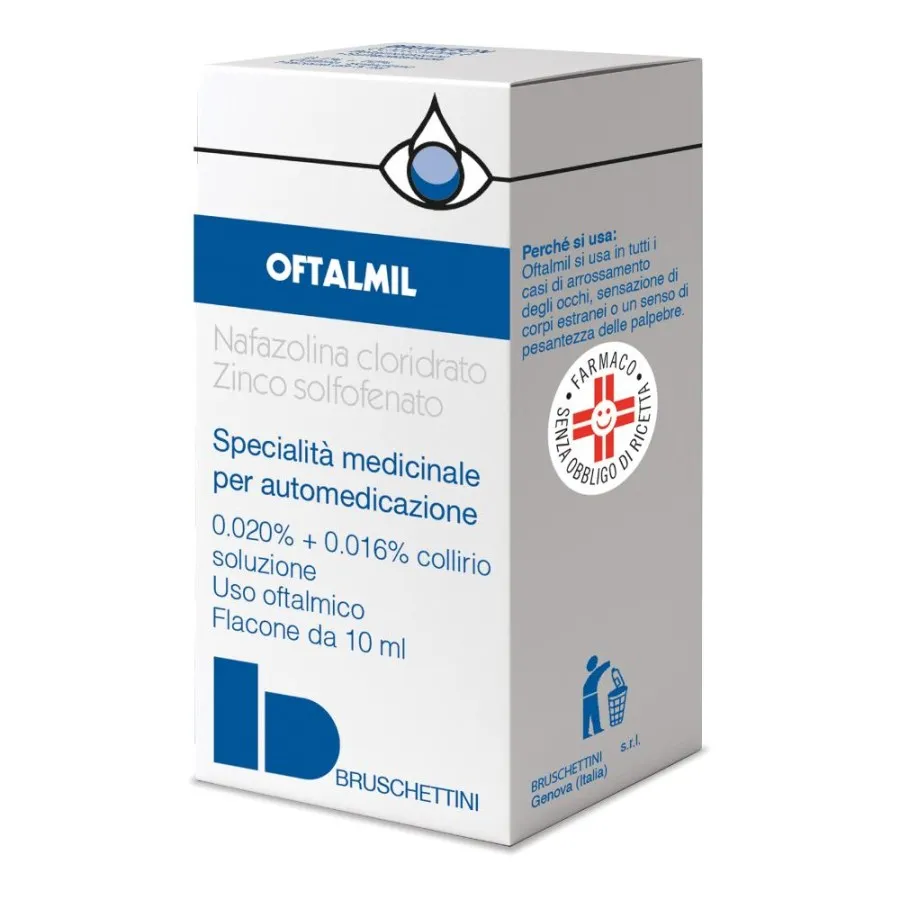
Table of Contents
Package leaflet: Information for the user
OFTALMIL 0.020% + 0.016% eye drops solution
Sulfophenamide zinc and naphazoline hydrochloride
Please read this leaflet carefully before using this medicine because it contains important information for you.
Always use this medicine exactly as described in this leaflet or as your doctor or pharmacist has instructed.
- Keep this leaflet. You may need to read it again.
- If you need more information or advice, consult your pharmacist.
- If you experience any side effects, including those not listed in this leaflet, contact your doctor or pharmacist. See section 4.
- Contact your doctor if you do not notice any improvement or if your symptoms worsen after 4 days.
Contents of this leaflet:
- What OFTALMIL is and what it is used for
- What you need to know before using OFTALMIL
- How to use OFTALMIL
- Possible side effects
- How to store OFTALMIL
- Contents of the pack and other information
1. What OFTALMIL is and what it is used for
OFTALMIL contains two active substances, zinc sulphomethazine and naphazoline hydrochloride, which have anti-inflammatory and decongestant effects on the eyes.
OFTALMIL is indicated for all cases of eye redness, when there is a sensation of a foreign body in the eye or a feeling of heaviness of the eyelids.
Consult your doctor if you do not feel better or if you feel worse after 4 days.
2. What you need to know before using OFTALMIL
Do not use OFTALMIL
- if you are allergic to sulfaphenazole zinc, naphazoline hydrochloride, or to any of the ingredients of this medicine (listed in section 6);
- if you have closed-angle glaucoma, a disease affecting the optic nerve;
- if you have developed severe eye infections;
- in children under 6 years of age (See section “Children”).
Warnings and precautions
Talk to your doctor or pharmacist before using OFTALMIL.
Before using this medicine, consult your doctor in the following cases:
- you have infections, pus, or foreign bodies in the eye;
- you have suffered an eye injury (mechanical damage);
- your eyes have been damaged due to contact with corrosive chemicals (chemical damage) or heat. Consult your doctor also if such conditions occurred in the past.
Use OFTALMIL with caution and inform your doctor if any of the following apply to you:
- you have high blood pressure (hypertension);
- your thyroid gland is overactive (hyperthyroidism);
- you have heart problems (cardiac disorders);
- you have high blood sugar levels (hyperglycemia) or suffer from diabetes;
- you are taking medicines for the treatment of depression (antidepressants) (See section “Other medicines and OFTALMIL”).
Children
The use of OFTALMIL is contraindicated in children under 6 years of age (See section “Do not use OFTALMIL”).
Other medicines and OFTALMIL
Inform your doctor or pharmacist if you are taking, have recently taken, or might take any other medicines.
Use OFTALMIL with caution and inform your doctor if you are taking medicines used to treat depression (antidepressants).
Pregnancy and breastfeeding
If you are pregnant, think you may be pregnant, planning to become pregnant, or breastfeeding, consult your doctor or pharmacist before using this medicine.
If you are pregnant or breastfeeding, you may use OFTALMIL.
Driving and using machines
The effects on the ability to drive vehicles and use machinery are unknown.
OFTALMIL contains parahydroxybenzoates
This medicine contains parahydroxybenzoates which may cause allergic reactions (including delayed reactions).
3. How to use OFTALMIL
Use this medicine exactly as stated in this leaflet or as directed by your doctor or pharmacist. If you have any doubts, consult your doctor or pharmacist.
The recommended dose is 1-2 drops of eye drops, administered several times a day.
Apply the eye drops into the lower part of the eye (inferior conjunctival fornix).
You may use this medicine even if you wear contact lenses.
After a short period of treatment, inform your doctor if you do not notice any improvement in your condition or if your symptoms worsen.
Do not exceed the recommended doses and do not use this medicine for more than 4 consecutive days.
Even brief periods of exceeding the recommended dose may cause serious adverse effects (See section “Possible side effects”).
Consult your doctor if the condition recurs or if you have noticed any recent changes in its characteristics.
If you use more OFTALMIL than you should
Using significantly more than the recommended dose of OFTALMIL, for example in case of accidental ingestion, may cause serious adverse effects on the heart and blood circulation. Symptoms may include: reduced heart rate (bradycardia), severe headache, nausea, vomiting, breathing difficulties, increased heart rate (tachycardia), and chest pain.
In particular, accidental ingestion in children may cause marked sedation.
If you experience any adverse effects or have accidentally ingested or taken an overdose of OFTALMIL, seek immediate medical attention.
If you forget to use OFTALMIL
Do not use a double dose to make up for the forgotten dose.
If you have any questions about the use of this medicine, consult your doctor or pharmacist.
4. Possible side effects
Like all medicines, this medicine can cause side effects, although not everybody gets them.
The following side effects may occur:
Frequency not known (frequency cannot be estimated from the available data)
- dilation of the pupils;
- increased blood pressure (hypertension), heart problems (cardiac disorders), increased blood sugar levels (hyperglycaemia) if the medicine is absorbed throughout the body (systemic absorption effects);
- increased pressure inside the eye (intraocular pressure) if you are predisposed;
- nausea;
- headache (cephalalgia);
- allergic reactions (hypersensitivity). In such cases, stop treatment and inform your doctor, who will advise appropriate therapy;
- temporary burning sensation if eyes are highly irritated, especially during the first applications of the medicine.
These side effects are generally temporary. However, if they occur, it is advisable to consult your doctor or pharmacist.
Reporting of side effects
If you experience any side effect, including those not listed in this leaflet, talk to your doctor or pharmacist. You can also report side effects directly via the national reporting system at https://www.aifa.gov.it/content/segnalazioni-reazioni-avverse.
By reporting side effects, you can help provide more information on the safety of this medicine.
5. How to store OFTALMIL
Keep this medicine out of the sight and reach of children.
Do not use this medicine after the expiry date stated on the packaging after "Exp.".
The expiry date refers to the last day of that month and applies to the product in its original, undamaged packaging,
correctly stored.
Store below 30 °C.
After first opening the container, use the medicine within 30 days.
Do not dispose of any medicine via wastewater or household waste. Ask your pharmacist how to dispose of medicines no longer in use. This will help protect the environment.
6. Contents of the package and other information
What OFTALMIL contains
- The active substances are zinc sulfophenate and naphazoline hydrochloride. 100 ml of eye drops contain 0.020 g of zinc sulfophenate and 0.016 g of naphazoline hydrochloride.
- The other components are: methyl p-hydroxybenzoate, propyl p-hydroxybenzoate, menthol, sodium chloride, distilled water of Hamamelis virginiana, distilled water of Rosa gallica, distilled water of Malva silvestris.
Description of the appearance of OFTALMIL and contents of the pack
10 ml bottle with dropper and sealed screw cap.
Marketing Authorization Holder and Manufacturer
BRUSCHETTINI S.r.l. – Via Isonzo 6 – Genoa – Italy