Octreoscan
Italy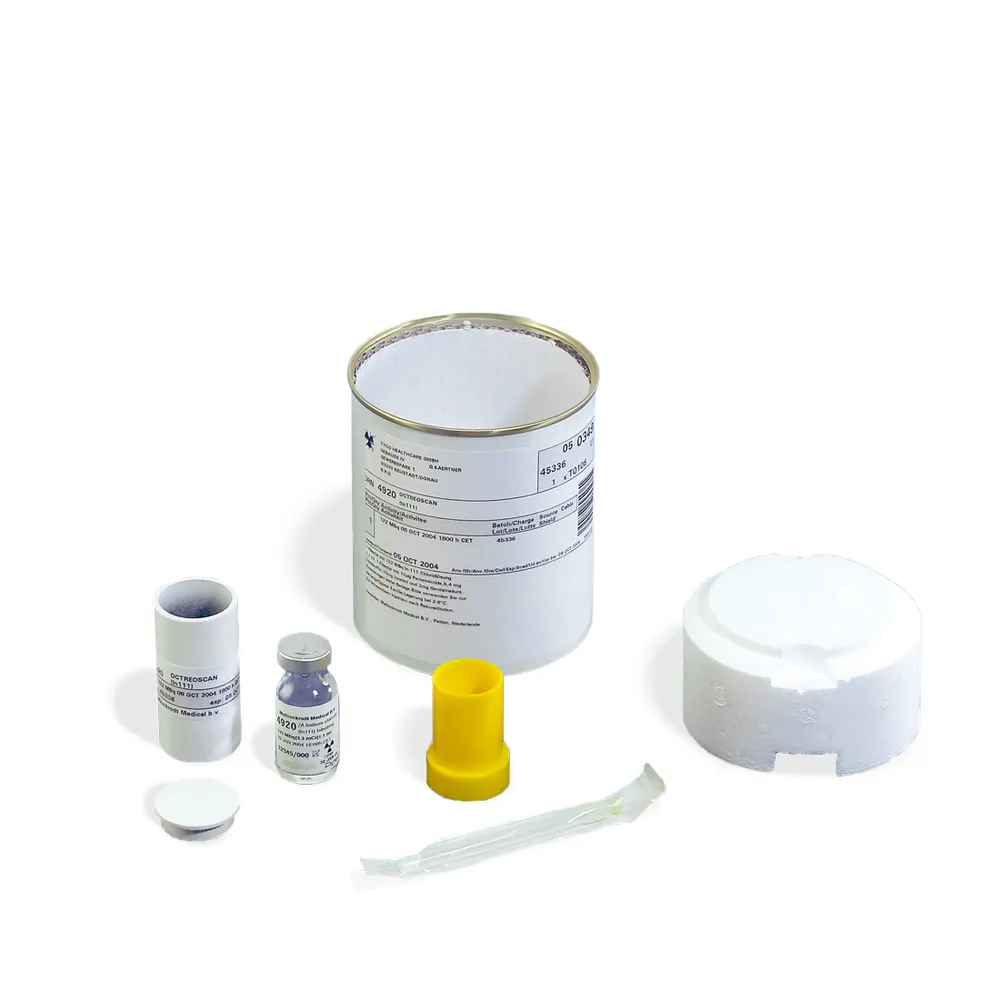
Table of Contents
PACKAGE LEAFLET: INFORMATION FOR THE PATIENT
Octreoscan
Kit for radiopharmaceutical preparation of In-pentetreotide, 111 MBq/mL
Please read this leaflet carefully before you are given this medicine.
- Keep this leaflet. You may need to read it again.
- If you have any questions, ask the nuclear medicine specialist supervising the procedure.
- If you experience any side effects, including those not listed in this leaflet, inform the nuclear medicine specialist.
Contents of this leaflet:
- What Octreoscan is and what it is used for
- What you need to know before you are given Octreoscan
- How Octreoscan is used
- Possible side effects
- How to store Octreoscan
- Contents of the pack and other information
1. WHAT OCTREOSCAN IS AND WHAT IT IS USED FOR
This medicinal product is a radiopharmaceutical for diagnostic use only.
Octreoscan is used by means of scanning to detect specific cells in the stomach, intestine, and pancreas such as:
- abnormal tissues or
- tumours.
This medicine is a powder for injectable solution and includes a radioactive substance. These two components
must not be used separately. Once mixed by qualified personnel and administered into the body, the medicine accumulates in specific cells.
The radioactive substance can be imaged from outside the body using special machines capable of recording a scan. This scan shows the distribution of radioactivity within the human body. It also provides the physician with important information about the structure and function of a specific part of the body.
The use of Octreoscan involves exposure to small amounts of radioactivity. Your doctor or nuclear medicine specialist has determined that the clinical benefit you will obtain from this radiopharmaceutical procedure outweighs the risk associated with radiation exposure.
2. WHAT YOU MUST KNOW BEFORE OCTREOSCAN IS ADMINISTERED
OCTREOSCAN
Otreoscan must not be used
if you are allergic (hypersensitive) to pentetreotide or to any of the other excipients of Octreoscan (listed in
section 6).
Warnings and precautions
Exercise particular caution with Octreoscan
- if you have reduced kidney function, your doctor will administer Octreoscan only if absolutely necessary
- if you are pregnant or suspect you may be pregnant
- if you are breastfeeding.
Before administration of Octreoscan you must:
- drink at least 2 litres of fluids, for example water, and urinate as frequently as possible before and for 2–3 days after treatment. This prevents accumulation of the active substance in the kidneys and bladder.
- Your doctor may also prescribe a laxative.
Children and adolescents
Consult the nuclear medicine specialist if you are under 18 years of age.
Other medicines and Octreoscan
Inform the nuclear medicine specialist if you are taking or have recently taken any other
medicines, including those without a prescription, as they could interfere with the interpretation of the
images.
The following medicines may affect or be affected by Octreoscan:
- Octreotide, a medicine used to treat symptoms of certain tumours. Your doctor might temporarily discontinue treatment with octreotide. If discontinuation of octreotide is considered, it should occur over a period of three days to avoid adverse effects.
- Insulin. When Otreoscan is administered to patients using high doses of insulin, severe decreases in blood glucose levels may occur.
Pregnancy and breastfeeding
If you are pregnant, breastfeeding, suspect you may be pregnant, or are planning a
pregnancy, consult the nuclear medicine specialist before receiving this
medicine.
Inform the nuclear medicine specialist before administration of Octreoscan if there is any possibility you may be pregnant, if you have missed a menstrual period, or if you are breastfeeding.
If you have any doubts, it is important that you consult the nuclear medicine specialist who will supervise the procedure.
If you are pregnant
The nuclear medicine specialist will administer Octreoscan during pregnancy only if the expected benefit outweighs the risks.
If you are breastfeeding
Inform your doctor if you are breastfeeding, as he or she may decide to postpone the treatment
until after breastfeeding has ended. Your doctor may also ask you to interrupt breastfeeding
and discard breast milk until radioactivity has cleared from your body. Ask the nuclear medicine specialist when you can resume breastfeeding.
Consult the nuclear medicine specialist before taking any medicine.
Driving and using machines
Octreoscan is unlikely to affect your ability to drive or operate machinery.
3. HOW TO USE OCTREOSCAN
There are very strict regulations regarding the use, handling, and disposal of radiopharmaceuticals.
Octreoscan will be used only in specialized and controlled areas. This product will be handled and administered to you only by trained and qualified personnel who are experienced in its safe use. These individuals will take particular care in the safe handling of this product and will keep you informed about their actions.
The nuclear medicine specialist supervising the procedure will determine the amount of Octreoscan to be used in your case. This will be the minimum quantity necessary to obtain the required diagnostic information.
The recommended amount for administration in adults in most cases ranges from
- 110–220 MBq (Mega Becquerel, the unit used to express radioactivity).
Use in children and adolescents
Your doctor will administer Octreoscan to patients in this age group only if absolutely necessary.
Administration of Octreoscan and procedure management
Octreoscan is injected into a vein.
A single injection is sufficient to perform the test required by the doctor.
Duration of the procedure
The nuclear medicine specialist will inform you about the usual duration of the procedure.
Scans are usually performed within one or two days after the injection, depending on the information that needs to be obtained.
Sometimes scans are repeated several days after the initial examination to better clarify the results.
After receiving Octreoscan, you must:
- avoid close contact with children and pregnant women during the first few hours after the injection;
- drink at least 2 litres of fluids, for example water, and urinate frequently for 2–3 days after treatment to help eliminate the product from your body.
- Your doctor will inform you if you need to take any special precautions after using this medicine. Contact your doctor if you have any questions.
If you are given more Octreoscan than you should
Overdose is unlikely, as you will receive a single, precisely controlled dose of Octreoscan administered by the nuclear medicine specialist supervising the procedure. However, in the event of an overdose, appropriate treatment will be given.
Drink as much as possible, for example water, to accelerate the elimination of the radioactive substance.
If you have any doubts about the use of Octreoscan, consult the nuclear medicine specialist supervising the procedure.
4. POSSIBLE ADVERSE REACTIONS
Like all medicines, Octreoscan may cause adverse reactions, although not everyone experiences them.
The radiopharmaceutical administered will deliver a low amount of ionizing radiation, with a very low risk of cancer and hereditary abnormalities.
Adverse reactions may occur with the following frequencies:
Uncommon, occurs in 1–10 users out of 1,000
- allergic reactions may occur, with symptoms such as:
- hot flushes
- skin redness
- itching
- nausea or
- breathing difficulties. Hospital staff will treat these reactions, if they occur.
Frequency not known (frequency cannot be estimated from the available data)
- cancer; however, the risk is very low because low doses are used for this examination.
If you notice any adverse reaction, including those not listed in this leaflet,
consult the nuclear medicine specialist.
5. HOW TO STORE OCTREOSCAN
This medicine must not be stored by the user. This medicine is stored under the responsibility of a specialist in appropriate locations. Storage of radiopharmaceuticals must comply with national regulations concerning radioactive materials.
This information is intended exclusively for the specialist.
Octreoscan must not be used after the expiry date stated on the label.
Octreoscan must not be used if the integrity of the tin container has been compromised and/or if any of the vials are damaged.
6. CONTENTS OF THE PACKAGE AND FURTHER INFORMATION
What Octreoscan contains
Octreoscan consists of a package containing two vials (A and B). Vial A contains 1.1 ml of solution, while vial B contains a powder for injectable solution.
The active substances are:
- Vial A: each vial contains 122 MBq of In as indium chloride in 1.1 ml (111 MBq/ml) at the reference time of activity.
- Vial B: 10 micrograms of pentetreotide.
Mixed solution (A plus B): In-Pentetreotide 111 MBq/ml at the reference time of activity.
The other excipients are:
- Vial A: hydrochloric acid, water for injections, ferric chloride hexahydrate.
- Vial B: sodium citrate dihydrate, citric acid monohydrate, inositol, gentisic acid.
Description of the appearance of Octreoscan and contents of the package
The Octreoscan kit for the preparation of the radiopharmaceutical In-Pentetreotide, 122 MBq/1.1 ml at the reference time of activity, is supplied in a sealed tin container containing two vials and a Sterican Luer Lock needle.
Vial A is a lead-shielded glass vial containing a clear, colourless solution.
Vial B is a glass vial with a grey butyl rubber stopper and an aluminium flip-off cap with an orange seal. It contains a white, lyophilized powder.
The vials cannot be used separately.
Marketing Authorization Holder and Manufacturer
- Marketing Authorization Holder Mallinckrodt Medical B.V., Westerduinweg 3 1755 LE Petten, The Netherlands
- Manufacturer Mallinckrodt Medical B.V., Westerduinweg 3 1755 LE Petten, The Netherlands
This medicinal product is authorized in the Member States of the European Economic Area under the following names:
Germany, Denmark, Greece, Spain, Finland, France, Ireland, Italy, Luxembourg, The Netherlands, Portugal, Sweden, United Kingdom: Octreoscan.
This Patient Information Leaflet was last approved in 06/2013.