Octaplas
Italy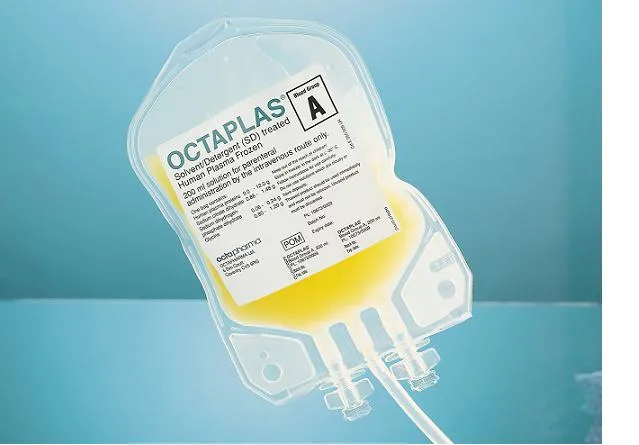
Table of Contents
PACKAGE LEAFLET: INFORMATION FOR THE USER
OCTAPLAS
Human plasma proteins 9.0–14.0 grams
solution for infusion
Please read this leaflet carefully before using this medicine because it contains important information for you.
- Keep this leaflet. You may need to read it again.
- If you have any questions, ask your doctor.
- This medicine has been prescribed for you. Do not give it to other people, even if their symptoms are the same as yours, because it could be harmful.
- If you experience any side effects, including those not listed in this leaflet, tell your doctor. See section 4.
Contents of this leaflet:
- What OCTAPLAS is and what it is used for
- What you need to know before using OCTAPLAS
- How to use OCTAPLAS
- Possible side effects
- How to store OCTAPLAS
- Contents of the pack and other information
1. WHAT OCTAPLAS IS AND WHAT IT IS USED FOR
OCTAPLAS is a pooled, AB0 blood group-specific, frozen human plasma solution that has undergone a specific viral inactivation treatment. Human plasma is the fluid portion of human blood and contains plasma proteins that are important for maintaining normal blood coagulation properties. It is used in the same way as fresh frozen plasma (FFP) obtained from individual donations.
OCTAPLAS is indicated in cases of complex deficiencies of coagulation factors, which may be caused by severe liver damage or massive transfusion following trauma. OCTAPLAS may also be administered in emergency situations when a specific coagulation factor concentrate (e.g., factor V or factor XI) is not available or when specific laboratory diagnosis cannot be established promptly.
It may also be given for the rapid reversal of the effect of oral anticoagulants (such as coumarins or indanediones) when vitamin K is insufficient due to decompensated liver function or in emergency situations.
OCTAPLAS may be administered to patients undergoing plasmapheresis to restore the balance of coagulation factors, in patients with thrombotic thrombocytopenic purpura (TTP), a condition characterized by reduced levels of specific blood cells called platelets, and for the treatment of internal bleeding following intensive plasma exchange procedures.
2. C OCTAPLAS
Do not use OCTAPLAS:
- if you are allergic (hypersensitive) to human plasma proteins or to any of the other components of this medicine (listed in section 6);
- if you know you have antibodies against the immunoglobulin called IgA;
- if you have had previous reactions to any human plasma preparation or to PFC;
- if you know you have low levels of protein S (a vitamin K-dependent protein in the blood).
Warnings and precautions
Talk to your doctor before using OCTAPLAS.
Exercise particular caution with OCTAPLAS
- If you have low levels of immunoglobulin A.
- If you have had previous reactions to plasma proteins, including PFC.
- If you suffer from heart failure or have fluid in the lungs (pulmonary edema).
- If you have known risks of thrombotic complications (blood clot formation), due to the possible increased risk of venous thromboembolism (blood clots forming in the veins).
- In case of increased inhibition of blood coagulation (fibrinolysis).
Inform your doctor if you are at risk of blood hypercoagulability (thrombus formation), due to the possible increased risk of venous thromboembolism (blood clots obstructing venous vessels away from their site of formation).
OCTAPLAS is generally not recommended for the treatment of von Willebrand disease.
Viral safety
When medicines are manufactured from human blood or plasma, certain measures are taken to prevent transmission of infections to patients. These include careful selection of blood or plasma donors to ensure that those at risk of carrying infections are excluded, and testing of each donation and plasma pool for signs of viruses/infections. Manufacturers of these products also include in the manufacturing process steps capable of inactivating or removing viruses. Despite these measures, when administering medicines prepared from human blood or plasma, the possibility of transmitting an infection cannot be completely excluded. This also applies to any unknown or emerging viruses or other types of infections.
The measures taken are considered effective against enveloped viruses such as human immunodeficiency virus (HIV), hepatitis B virus, and hepatitis C virus.
The measures taken may have limited effectiveness against certain non-enveloped viruses such as hepatitis A virus, hepatitis E virus, and Parvovirus B19.
It is strongly recommended to record the name and batch number of the product each time a dose of OCTAPLAS is administered, in order to maintain documentation of the batch used.
Your doctor may advise you to consider vaccination against hepatitis A and B viruses if you are receiving repeated or regular administration of human plasma-derived products.
When a medicine is purified or produced from human blood or plasma, there is a very limited possibility that infectious agents present in the source material could be transmitted to the patient. OCTAPHARMA uses only carefully screened plasma for the production of OCTAPLAS. Donors are rigorously screened at donation centers, and plasma is tested for the presence of viruses after donation. After pooling, OCTAPHARMA retests the plasma once multiple plasma batches have been mixed. During the manufacturing process of OCTAPLAS, a specific step using a chemical product (solvent/detergent) is included to help destroy other viruses that may not have been detected during initial testing. However, this step is not always completely effective against all viruses.
OCTAPLAS contains antibodies that protect against many viruses. These antibodies have demonstrated protection for patients against numerous viruses not destroyed during the solvent/detergent purification process.
Nevertheless, despite all precautionary measures taken by OCTAPHARMA, the possibility of transmitting a blood-borne infection cannot be completely ruled out.
Children
During therapeutic plasma exchange in children, cases of hypocalcemia have been observed, likely caused by citrate binding. Monitoring of ionized calcium is recommended during such use of OCTAPLAS.
Other medicines and OCTAPLAS
Inform your doctor if you are taking, have recently taken, or might take any other medicines.
In clinical studies, OCTAPLAS has been administered concomitantly with various other drugs, and no interactions have been identified.
Due to passive transmission of the pregnancy hormone (β-hCG), false-positive results in blood pregnancy tests may occur.
OCTAPLAS must not be mixed with other medicines or intravenous infusion fluids, except with red blood cells or platelet concentrates.
To avoid clot formation, calcium-containing solutions must not be administered through the same intravenous line.
No known interactions exist with other medicines.
OCTAPLAS with food, drinks and alcohol
No effects have been observed.
Pregnancy, breastfeeding and fertility
If you are pregnant, suspect you may be pregnant, are planning a pregnancy, or are breastfeeding, consult your doctor before taking this medicine.
Driving and use of machines
OCTAPLAS does not affect or affects negligibly the ability to drive vehicles or operate machinery.
Important information about some components of OCTAPLAS
For the complete list of excipients, see section 6.
This medicine contains up to 920 mg of sodium (a main component of table salt) per bag. This corresponds to 46% of the maximum daily dietary intake recommended for an adult.
3. HOW TO USE OCTAPLAS
Use this medicinal product exactly as instructed by your doctor. If you have any doubts, consult your
doctor.
OCTAPLAS will be administered exclusively by a doctor or nurse through intravenous infusion (into a
vein).
The recommended dose depends on the patient's clinical condition and body weight. The doctor will
determine the appropriate amount to administer.
- Before OCTAPLAS can be infused, an ABO blood group compatibility test must be performed.
- In emergency situations, OCTAPLAS for blood group AB may be administered to all patients, as it can be considered universal plasma.
It is important that the infusion rate does not exceed 1 mL of OCTAPLAS per kg of body weight per
minute. Calcium gluconate may be administered through another vein to minimize the negative effects
of citrate contained in OCTAPLAS.
Allow the bag contents to warm in a thermostatically controlled water bath at approximately 37 °C prior to
infusion. The temperature of OCTAPLAS must not exceed 37 °C.
The thawing procedure should not exceed 30 minutes.
Use in children and adolescents
Data in children and adolescents (0–16 years) are limited.
If you use more OCTAPLAS than you should
High doses may lead to fluid overload (edema), fluid in the lungs (pulmonary edema), and/or heart problems (cardiocirculatory decompensation).
If you forget to take OCTAPLAS
The doctor is responsible for monitoring administration and maintaining laboratory test values within the specified range.
If you stop treatment with OCTAPLAS
If you have any doubts about using this medicinal product, consult your doctor.
Based on laboratory test results, the doctor will decide when to discontinue OCTAPLAS administration and will evaluate any potential risks.
4. POSSIBLE ADVERSE EFFECTS
Like all medicines, this medicine can cause adverse effects, although not everyone experiences them.
Such effects may include: fatigue, general malaise, tremors, hot flushes, flushing, chills (trembling with or without fever), nausea, vomiting, local swelling (edema), fever, abnormal lung symptoms, and low calcium levels. Some patients may experience allergic-type reactions such as urticaria, fever, chills, nausea, vomiting, abdominal pain, or back pain (lumbar pain). Rarely, infusion of human blood may cause anaphylactic shock (an immediate and severe allergic reaction causing skin redness, sudden and marked drop in blood pressure, breathing difficulties, loss of consciousness). High infusion rates of the medicine may cause circulatory disturbances, particularly in patients with liver dysfunction (hepatic).
Rarely, incompatibility between antibodies present in OCTAPLAS and antibodies in the patient's blood may cause hemolytic-type reactions (destruction of blood cells), chills, fever, dry cough, breathing difficulties, skin rashes, and internal organ bleeding (internal hemorrhages).
Infusion of OCTAPLAS may lead to the development of antibodies specific to coagulation factors.
High doses or high infusion rates may result in increased circulating blood volume, leading to fluid accumulation in the lungs (pulmonary edema) and/or cardiac disturbances (heart failure).
Acute respiratory problems have been reported during or after OCTAPLAS infusion.
Depending on the type and severity of adverse reactions, the infusion rate should be reduced or administration discontinued. The physician will take appropriate measures.
If any of the adverse effects worsen, or if you notice any adverse effects not listed in this leaflet, inform your doctor.
Paediatric population
Hypocalcemia may occur in children undergoing plasmapheresis procedures, especially in patients with impaired liver function or when high infusion rates are used. Monitoring of ionized calcium levels is recommended during such use of OCTAPLAS.
Reporting of adverse effects
If you experience any adverse effect, including those not listed in this leaflet, contact your doctor. You may also report adverse effects directly via the Italian Medicines Agency (Agenzia Italiana del Farmaco – AIFA), website: https://www.aifa.gov.it/content/segnalazioni-reazioni-avverse .
By reporting adverse effects, you can help provide more information on the safety of this medicine.
HOW TO STORE OCTAPLAS
Keep this medicine out of sight and reach of children.
Do not use this medicine after the expiry date stated on the label. The expiry date refers to the last day of that month.
Store in a freezer at ≥ –18 °C and protect from light.
Always check the expiry date shown on the label. OCTAPLAS has a shelf life of 4 years.
Do not use this medicine after the expiry date stated on the label following the abbreviation "Exp."
After thawing, OCTAPLAS may be stored for up to 8 hours at +4 °C or up to 4 hours at room temperature (+20–25 °C) prior to use.
Once the bag has been opened, the product must be used immediately.
Thawed OCTAPLAS must not be refrozen. Unused product must be discarded.
Do not use this medicine if you notice that the solution is cloudy or contains deposits.
Do not dispose of any medicine via wastewater or household waste. Ask your pharmacist how to dispose of medicines no longer required. This will help protect the environment.
6. PACKAGING CONTENTS AND OTHER INFORMATION
What OCTAPLAS contains
- The active substance is human plasma proteins (45–70 mg/mL).
- The other components are: disodium citrate dihydrate, sodium dihydrogen phosphate dihydrate, and glycine.
Description of the appearance of OCTAPLAS and packaging contents
OCTAPLAS is an infusion solution.
OCTAPLAS is a clear or slightly opalescent yellow solution. OCTAPLAS is available in 200 mL transfusion bags.
Marketing Authorization Holder and Manufacturer:
Octapharma Pharmazeutika Produktionges.m.b.H.
Oberlaaerstr. 235
A-1100 Vienna
Austria
Manufacturers:
Octapharma Pharmazeutika Produktionsges.m.b.H
Oberlaaer Strasse 235
A-1100 Vienna
Austria
Octapharma AB
SE-112 75 Stockholm, Sweden
The following information is intended for healthcare professionals only:
Dosage and administration
Dosage
The dosage depends on the clinical condition and underlying pathology, but 12–15 mL of
OCTAPLAS/kg body weight is generally accepted as an initial dose. This should increase
plasma levels of coagulation factors in the patient by approximately 25%.
It is important to monitor the response clinically and by measuring, for example, activated partial thromboplastin time (aPTT), prothrombin time (PT), and/or specific coagulation factor assays.
Dosage for coagulation factor deficiency:
In patients with coagulation factor deficiencies, adequate hemostatic effect is normally achieved in mild to moderate bleeding or during surgical procedures after infusion of 5–20 mL of OCTAPLAS/kg body weight. This should increase plasma levels of coagulation factors by approximately 10–33%. In cases of severe bleeding or major surgery, consultation with a hematologist is recommended.
Dosage for PTT and bleeding in therapeutic plasma exchange procedures:
For therapeutic plasma exchange procedures, consultation with a hematologist is required.
In patients with thrombotic thrombocytopenic purpura (TTP), the entire volume of plasma exchanged should be replaced with OCTAPLAS.
Method of administration
OCTAPLAS should be administered according to the patient's specific blood group.
In emergency situations, OCTAPLAS for blood group AB may be considered universal plasma, as it can be administered to all patients regardless of blood group.
After thawing, OCTAPLAS should be administered intravenously using infusion equipment with filters. Aseptic technique must be maintained during infusion.
Citrate toxicity may occur at infusion rates exceeding 0.020–0.025 mmol of citrate per kg body weight/minute. Therefore, the infusion rate should not exceed 1 mL of OCTAPLAS per kg body weight/minute. The toxic effects of citrate can be minimized by administering calcium gluconate intravenously through a separate venous access.
Warnings and precautions for administration:
In case of anaphylactic reaction or shock, infusion must be stopped immediately. Treatment should follow established guidelines for shock management.
Patients should be monitored for at least 20 minutes after administration.
Incompatibilities:
OCTAPLAS may be mixed with red blood cells and platelets.
OCTAPLAS must not be mixed with other medicinal products, as inactivation or precipitation may occur.
To avoid the risk of clot formation, calcium-containing solutions must not be administered through the same intravenous line used for OCTAPLAS.
Interferences:
Due to passive transfer of human beta-chorionic gonadotropin (β-hCG), false-positive results in serum pregnancy tests may occur.
Shelf life
The shelf life of OCTAPLAS is 4 years when stored at ≤ -18 °C and protected from light.
Do not use after the expiry date stated on the label.
After thawing, OCTAPLAS may be stored for up to 8 hours at +4 °C or up to 4 hours at room temperature (+20–25 °C) prior to use.
Once the bag has been opened, the product must be used immediately.