Nodigap
Italy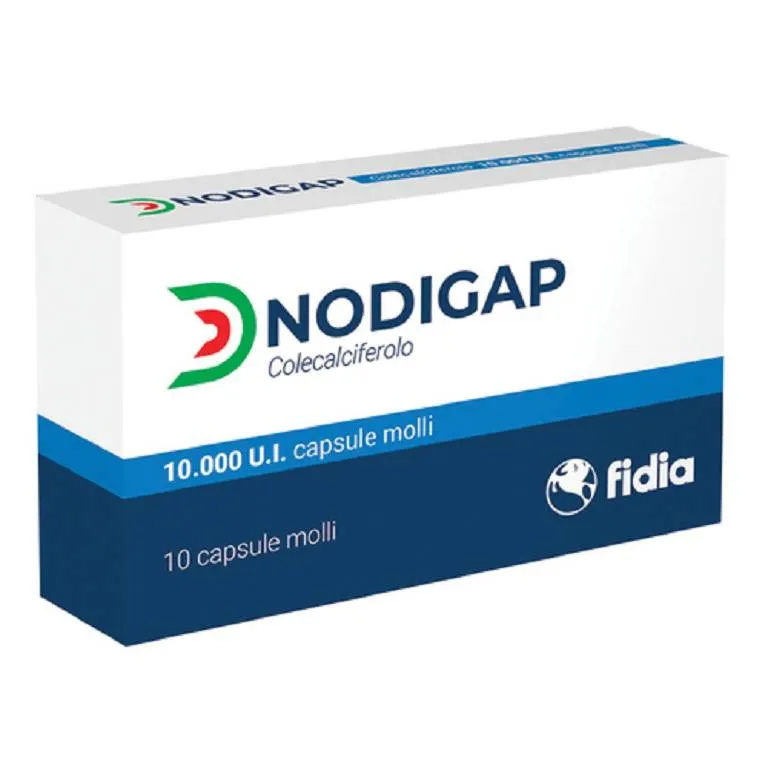
Table of Contents
- Package leaflet: Information for the user
- NODIGAP soft capsules 1,000 I.U. (25 micrograms), soft capsules 10,000 I.U. (250 micrograms), soft capsules 20,000 I.U. (500 micrograms), soft capsules 50,000 I.U. (1,250 micrograms)
- 1. What NODIGAP is and what it is used for
- 2. What you need to know before taking NODIGAP
- 3. How to take NODIGAP
- 4. Possible side effects
- 5. How to store NODIGAP
- 6. Contents of the pack and other information
Package leaflet: Information for the user
NODIGAP soft capsules 1,000 I.U. (25 micrograms), soft capsules 10,000 I.U. (250 micrograms), soft capsules 20,000 I.U. (500 micrograms), soft capsules 50,000 I.U. (1,250 micrograms)
Colecalciferol
Please read all of this leaflet carefully before taking this medicine because it contains important information for you.
- Keep this leaflet. You may need to read it again.
- If you have any questions, ask your doctor or pharmacist.
- This medicine has been prescribed for you only. Do not give it to other people, even if they have the same symptoms as yours, because it could be harmful.
- If you experience any side effect, including those not listed in this leaflet, talk to your doctor or pharmacist. See section 4.
Contents of this leaflet
- What NODIGAP is and what it is used for
- What you need to know before taking NODIGAP
- How to take NODIGAP
- Possible side effects
- How to store NODIGAP
- Contents of the pack and other information
1. What NODIGAP is and what it is used for
The active substance of NODIGAP is vitamin D3. Vitamin D promotes calcium absorption by the body and improves bone formation.
This medicinal product is recommended in the following cases:
- prevention and treatment of vitamin D deficiency.
Capsules 1,000 IU
NODIGAP is indicated in adults and adolescents aged 12 to 18 years.
Capsules 10,000, 20,000, 50,000 IU
NODIGAP is indicated in adults and elderly people.
2. What you need to know before taking NODIGAP
Do not take NODIGAP:
- if you are allergic to cholecalciferol or to any of the other ingredients of this medicine (listed in section 6)
- if you have high levels of calcium in your blood (hypercalcemia) or in your urine (hypercalciuria)
- if you have severe kidney problems (severe renal impairment)
- if you have high levels of vitamin D in your blood (hypervitaminosis D)
- if you have kidney stones or calcium deposits in the kidneys.
Warnings and precautions
Talk to your doctor or pharmacist before taking NODIGAP if:
- You are prone to developing kidney stones.
- You have cancer or any other condition that may have affected your bones.
- You have a parathyroid hormone imbalance (pseudohypoparathyroidism).
If you have any of the following conditions, your doctor will monitor your calcium or phosphate levels in
your blood or the level of calcium in your urine:
- if you are being treated with this medicine for a long time
- if you have kidney problems
- if you suffer from sarcoidosis, an immune system disorder that may affect the liver, lungs, skin, or lymph nodes.
Children
NODIGAP is not intended for use in children under 12 years of age.
Other medicines and NODIGAP
Inform your doctor or pharmacist if you are taking, have recently taken, or might take any other medicines.
This is particularly important if you are taking:
- diuretics, as your doctor will need to regularly monitor calcium levels in your blood
- corticosteroids (‘steroids’ e.g. prednisolone, dexamethasone), as the dose of vitamin D may need to be increased
- cholestyramine (a medicine to lower cholesterol) or laxatives (e.g. liquid paraffin), as they reduce the absorption of vitamin D
- heart medicines (cardiac glycosides), as you will need to be monitored by a doctor, possibly undergo an ECG, and have your calcium levels checked
- anticonvulsants (for the treatment of epilepsy), cytotoxic agents, imidazole-derived antifungals and actinomycin, sleeping medicines (e.g. hydantoin, barbiturates) or primidone, as they reduce the effect of vitamin D
- calcitonin, etidronate, gallium nitrate, pamidronate or plicamycin, as they reduce calcium levels in the blood
- calcium-containing products at high doses, as they increase the risk of high calcium levels in the blood
- magnesium-containing products (e.g. antacids), as they should not be used during vitamin D treatment due to the risk of high magnesium levels
- high-dose phosphate-containing products, as, at high doses, they increase the risk of high phosphate levels in the blood
- other vitamin D-containing products such as multivitamin preparations and dietary supplements containing vitamin D should be avoided.
Pregnancy and breastfeeding
If you are pregnant, suspect you may be pregnant, planning a pregnancy, or breastfeeding, ask your doctor or pharmacist for advice before taking this medicine. These formulations may be used during pregnancy, but only if vitamin D deficiency has been diagnosed and after consulting a doctor.
Driving and using machines
No effects on the ability to drive or use machines are known.
NODIGAP contains:
Sorbitol: If your doctor has told you that you have an intolerance to certain sugars, consult your doctor before taking this medicine. This medicine contains 16.5 mg of sorbitol in each capsule.
Sunset Yellow: NODIGAP 10,000 IU capsules contain sunset yellow. It may cause allergic reactions.
3. How to take NODIGAP
Take this medicine exactly as directed by your doctor or pharmacist. If you
have any doubts, consult your doctor or pharmacist.
Adults
NODIGAP 1,000 U.I.:
The doctor usually prescribes 1–4 capsules daily for a maximum period of 3 months, followed by
a maintenance and prevention therapy of 1 capsule daily. In severe vitamin D deficiency in adults and elderly patients, the dosage will depend on vitamin D levels and response to
treatment.
NODIGAP 10,000 U.I.:
The doctor usually prescribes 2 capsules per week for a period of 1–3 months, followed by a
maintenance and prevention therapy of 1 capsule every 2 weeks. In severe vitamin D deficiency in adults and elderly patients, the dosage will depend on vitamin D levels and response to
treatment.
NODIGAP 20,000 U.I.:
The doctor usually prescribes 1 capsule per week for a period of 1–3 months, followed by a
maintenance and prevention therapy of 1 capsule per month. In severe vitamin D deficiency
in adults and elderly patients, the dosage will depend on vitamin D levels and response to
treatment.
NODIGAP 50,000 U.I.:
The doctor usually prescribes 1 capsule per week for a period of 6–8 weeks, followed by a
maintenance and prevention therapy of 1 capsule every 2 months. In severe vitamin D deficiency in adults and elderly patients, the dosage will depend on vitamin D levels and response to
treatment.
Adolescents
NODIGAP 1,000 U.I.:
The doctor usually prescribes 1–4 capsules daily for a maximum period of 3 months, followed by a maintenance and prevention therapy of 1 capsule daily. In severe vitamin D deficiency, the dosage will depend on vitamin D levels and response to treatment. Do not take more than 4
capsules per day.
Use in children
NODIGAP is not indicated for children under 12 years of age.
Method of administration
Swallow the capsules whole with water, without chewing them.
NODIGAP with food and drinks
NODIGAP can be taken with or without food.
If you take more NODIGAP than you should
You may experience the following symptoms: decreased appetite, thirst, nausea, vomiting, constipation, abdominal pain, muscle weakness, fatigue, confusion, increased need to urinate, bone pain, kidney problems and, in severe cases, irregular heartbeat, coma or death.
If you have taken too many capsules, contact your doctor immediately or go to the nearest hospital.
Take the pack and any remaining capsules with you.
If you have any doubts about how to use this medicine, consult your doctor or pharmacist.
If you forget to take NODIGAP
Do not take a double dose to make up for the forgotten dose.
If you have any doubts about how to use this medicine, consult your doctor or pharmacist.
4. Possible side effects
Like all medicines, this medicine can cause side effects, although not everybody gets them.
Stop taking NODIGAP and consult a doctor if you experience symptoms of a serious allergic reaction, such as:
- swelling of the face, lips, tongue or throat
- difficulty swallowing
- hives and difficulty breathing.
Side effects of NODIGAP may include:
Common (may affect up to 1 in 10 people):
- nausea, constipation, flatulence, stomach ache, diarrhoea.
Uncommon (may affect up to 1 in 100 people):
- excessive calcium in the blood (hypercalcaemia). Symptoms include nausea, vomiting, loss of appetite, constipation, stomach ache, bone pain, excessive thirst, increased need to urinate, muscle weakness, drowsiness and confusion
- excessive calcium in the urine (hypercalciuria).
Rare (may affect up to 1 in 1,000 people):
- skin rash (itching, hives)
- itching.
Reporting of side effects
If you experience any side effect, including those not listed in this leaflet, talk to your doctor or pharmacist. You can also report side effects directly via the national reporting system at: http://www.agenziafarmaco.gov.it/content/come-segnalare-una-sospetta-reazione-avversa .
By reporting side effects, you can help provide more information on the safety of this medicine.
5. How to store NODIGAP
Keep this medicine out of the sight and reach of children.
This medicine does not require any special storage precautions.
Do not use this medicine after the expiry date stated on the label after EXP. The expiry date refers to the last day of that month.
Do not dispose of medicines via wastewater or household waste. Ask your pharmacist how to dispose of medicines you no longer use. This will help protect the environment.
6. Contents of the pack and other information
What NODIGAP contains
- The active substance is colecalciferol: Each 1,000 IU capsule contains 1,000 IU of colecalciferol, equivalent to 25 micrograms of vitamin D3. Each 10,000 IU capsule contains 10,000 IU of colecalciferol, equivalent to 250 micrograms of vitamin D3. Each 20,000 IU capsule contains 20,000 IU of colecalciferol, equivalent to 500 micrograms of vitamin D3. Each 50,000 IU capsule contains 50,000 IU of colecalciferol, equivalent to 1,250 micrograms of vitamin D3.
- The other components are: Capsule: medium-chain triglycerides and vitamin E acetate (α-tocopheryl acetate). Capsule shell of the 1,000 IU capsule: gelatin, glycerol, partially dehydrated liquid sorbitol (E420), brilliant blue (E133), quinoline yellow (E104) and purified water. Capsule shell of the 10,000 IU capsule: gelatin, glycerol, partially dehydrated liquid sorbitol (E420), sunset yellow (E110) and purified water. Capsule shell of the 20,000 IU capsule: gelatin, glycerol, partially dehydrated liquid sorbitol (E420) and purified water. Capsule shell of the 50,000 IU capsule: gelatin, glycerol, partially dehydrated liquid sorbitol (E420), quinoline yellow (E104) and purified water.
Description of the appearance of NODIGAP and contents of the pack
- The 1,000 IU vitamin D3 capsules are green, transparent, rounded gelatin capsules containing a colourless transparent liquid.
- The 10,000 IU vitamin D3 capsules are orange, transparent, rounded gelatin capsules containing a colourless transparent liquid.
- The 20,000 IU vitamin D3 capsules are light yellow, transparent, rounded gelatin capsules.
- The 50,000 IU vitamin D3 capsules are yellow, transparent, rounded gelatin capsules containing a colourless transparent liquid.
NODIGAP is available in HDPE bottles containing 60 capsules (1,000 IU) and in blisters containing 10 capsules (10,000 IU), 5 capsules (20,000 IU) and 2 capsules (50,000 IU).
Not all pack sizes may be marketed.
Marketing Authorisation Holder and Manufacturer
Marketing Authorisation Holder:
Fidia Farmaceutici S.p.A., Via Ponte della Fabbrica, 3/A, 35031 Abano Terme, Padova, Italy
Manufacturer:
Geryon Pharma Limited, 18 Owen Drive, Liverpool, United Kingdom, L24 1YL
This medicinal product is authorised in the EEA Member States under the following names:
Denmark: DIPRIMIS, capsule, soft 1,000, 10,000, 20,000 and 50,000 IU
Italy: NODIGAP 1,000, 10,000, 20,000 and 50,000 IU soft capsules