Ninoxan
Italy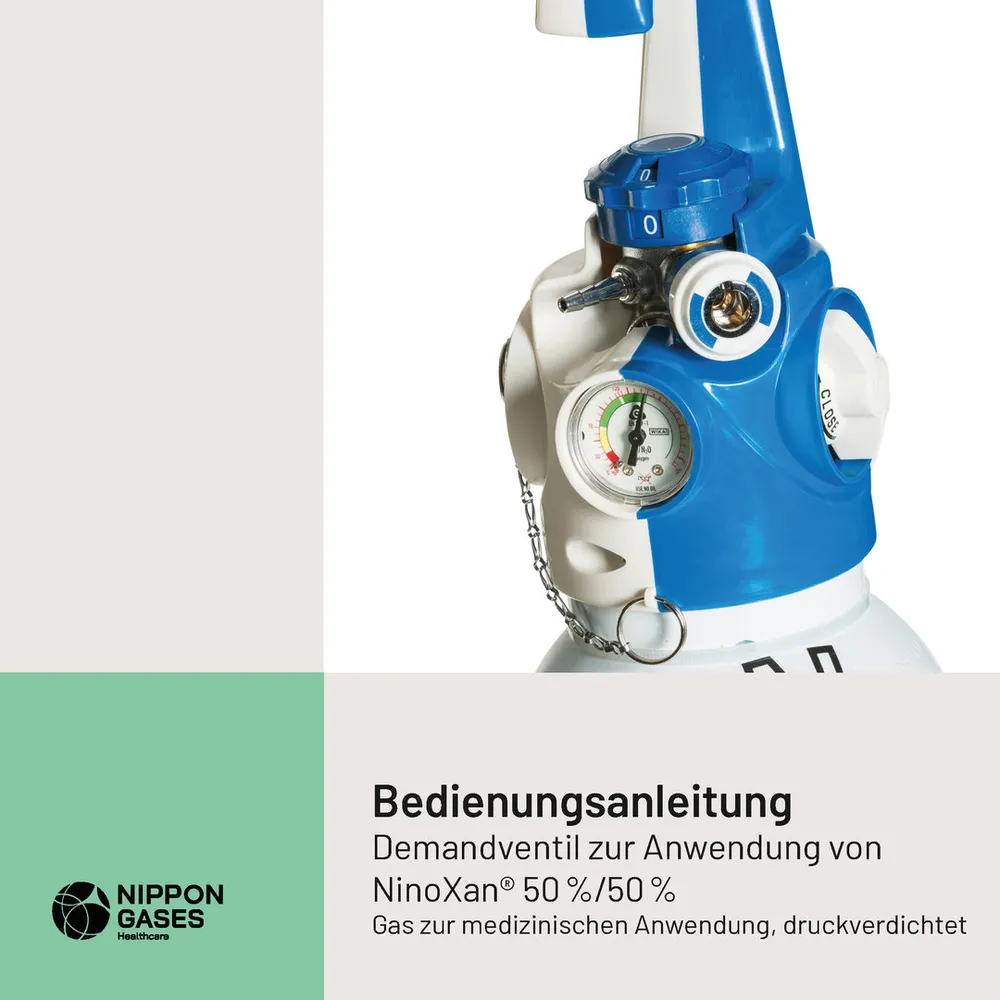
Table of Contents
- PACKAGE LEAFLET: INFORMATION FOR THE USER
- NINOXAN 50%/50%, MEDICINAL GAS, COMPRESSED
- 1. What Ninoxan is and what it is used for
- 2. What you need to know before using Ninoxan
- 3. How to use Ninoxan
- 4. Possible side effects
- 5. How to store Ninoxan
- 6. Package contents and other information
- The following information is intended exclusively for healthcare professionals:
PACKAGE LEAFLET: INFORMATION FOR THE USER
NINOXAN 50%/50%, MEDICINAL GAS, COMPRESSED
nitrous oxide/oxygen
Please read this leaflet carefully before using this medicinal product because it contains important information for you.
Keep this leaflet. You may need to read it again.
If you have any questions, consult your doctor or pharmacist.
This medicine has been prescribed for you only. Do not give it to others. It could be harmful, even if their symptoms are the same as yours.
If you experience any adverse reaction, contact your doctor or pharmacist. This includes any possible side effects not listed in this leaflet. See section 4.
Contents of this leaflet:
- What Ninoxan is and what it is used for
- What you need to know before using Ninoxan
- How to use Ninoxan
- Possible side effects
- How to store Ninoxan
- Contents of the pack and other information
1. What Ninoxan is and what it is used for
Ninoxan contains a ready-to-use gas mixture of 50% nitrous oxide (medicinal "laughing gas", N O) and
50% oxygen (medicinal oxygen, O ). It must be used by inhaling the gas mixture.
Effects of Ninoxan:
Nitrous oxide constitutes 50% of the gas mixture. Nitrous oxide has an analgesic effect,
reduces the sensation of pain and increases the pain threshold. Nitrous oxide also has a relaxing
and mildly sedative effect. These effects are due to the action of nitrous oxide on
neurotransmitters.
The 50% oxygen concentration, approximately double that present in ambient air, ensures a safe
oxygen concentration in the inhaled mixture.
Use of Ninoxan
Ninoxan should be used when rapid-onset and short-duration analgesic effects are desired, in cases of mild to moderate pain of limited duration.
Ninoxan produces an analgesic effect after a few breaths, and the pain-relieving effect disappears within a few minutes after discontinuation of use.
Children
Ninoxan can be used in children over 1 month of age.
2. What you need to know before using Ninoxan
Do not use Ninoxan:
Before using Ninoxan, you should inform your doctor if you have any of the following symptoms/conditions:
- Gas pockets or gas bubbles: if, due to illness or any other reason, there is suspicion of air in the pleural cavity outside the lungs, or gas bubbles in the blood or other organs (for example, if you have been scuba diving, you may have gas bubbles in the blood, decompression sickness); or if you have been treated with a gas injection into the eye (e.g., for retinal detachment or similar). These gas bubbles may expand and cause harm.
- Heart conditions: if you suffer from heart failure or severely impaired cardiac function, as the slight relaxing effect of nitrous oxide on the heart muscle may further impair heart function.
- After cardiopulmonary bypass with heart-lung machine or coronary bypass without heart-lung machine.
- Central nervous system injuries: if you have increased intracranial pressure, for example due to a brain tumor or cerebral bleeding. Nitrous oxide may further increase intracranial pressure, potentially causing harm.
- Vitamin deficiencies: if you have diagnosed but untreated deficiency of vitamin B12 or folic acid, the use of nitrous oxide may worsen symptoms caused by the lack of vitamin B12 and folic acid.
- Intestinal distension (ileus): if you suffer from severe abdominal pain or other symptoms that may indicate ileus, as Ninoxan may further increase intestinal distension.
- Facial trauma: the use of the mask may cause difficulties or risks.
- Reduced level of consciousness or reduced ability to cooperate and follow instructions due to the risk of additional sedation from nitrous oxide, which may impair natural protective reflexes.
Warnings and precautions
Talk to your doctor or nurse before receiving Ninoxan if:
- you are or have been abusing drugs/medicines, as there is an increased risk of developing dependence on nitrous oxide if used repeatedly. Your doctor will decide whether treatment with Ninoxan is appropriate in your case.
Inform your doctor if you have any of the following symptoms:
- Ear discomfort: for example, ear inflammation, as Ninoxan may increase pressure in the middle ear.
- Vitamin deficiency: if you are at risk of vitamin B12 or folic acid deficiency, for example, if you have reduced intake or absorption of vitamin B12 or folic acid, or a genetic disease affecting the metabolism of these vitamins, or if you are immunocompromised. The use of nitrous oxide may worsen symptoms caused by deficiency of vitamin B12 and folic acid.
Your doctor will decide whether it is appropriate to use Ninoxan.
Repeated or long-term use of nitrous oxide may increase the risk of vitamin B12 deficiency, which can cause damage to the bone marrow or nervous system. Your doctor may order blood tests before and after treatment to assess the potential consequences of vitamin B12 deficiency.
Children
Ninoxan should not be used in children under 1 month of age.
Your doctor will decide when it is appropriate to use Ninoxan.
Other medicines and Ninoxan
Inform your doctor or healthcare professional if you are taking, have recently taken, or might take any other medicines.
If you are taking other medicines that act on the brain or its functions, for example benzodiazepines (tranquilizers) or morphine-like drugs, you must inform your doctor. Ninoxan may enhance the effects of these medicines. The use of Ninoxan together with other sedatives or medicines acting on the central nervous system increases the risk of side effects.
You should also inform your doctor if you are taking medicines containing methotrexate (e.g., for the treatment of rheumatoid arthritis), bleomycin (cancer treatment), nitrofurantoin and other antibiotics (for treatment of infections), or amiodarone (for treatment of heart conditions). Ninoxan increases the side effects of these medicines.
Pregnancy and breastfeeding
If you are pregnant or breastfeeding, think you may be pregnant, or are planning to become pregnant, consult your doctor or healthcare professional for advice before using this medicine.
Pregnancy
Ninoxan may be used during pregnancy if your doctor considers it clinically necessary. It may also be used during childbirth.
When Ninoxan is used close to delivery, the newborn should be monitored for possible adverse effects.
Breastfeeding
Ninoxan may be used during the breastfeeding period; however, it should not be used during actual breastfeeding.
Driving and using machines
Ninoxan has a sedative effect and may affect mental and physical functions. For safety reasons, you should therefore avoid driving, operating machinery, or performing complex tasks until you have fully recovered. Check with healthcare personnel that your mental and physical functions have fully returned to normal.
3. How to use Ninoxan
Ninoxan must always be administered under supervision and in the presence of healthcare professionals who are
familiar with this type of medicine and equipment. Throughout the period of using Ninoxan, the patient and the
delivery of the medicine must be monitored to ensure it is administered safely. After completing treatment, the
patient must be assessed by competent personnel capable of evaluating full recovery.
Always use Ninoxan exactly as instructed by your doctor, who must explain to you how to use Ninoxan, how it
works, and what effects may result from its use. Consult your doctor if you are unsure.
Ninoxan is usually inhaled through a mask connected to a special valve, which allows complete control of the
gas flow according to your own breathing. The valve opens only during inspiration. Ninoxan may also be
administered through a so-called nasal mask. Regardless of which type of mask you use, you should breathe
regularly, taking normal breaths into the mask. Ideally, you should hold the mask yourself.
You should start using Ninoxan shortly before the analgesic effect is needed and continue throughout the
painful procedure. The effect of Ninoxan ends a few minutes after stopping inhalation.
After stopping the use of Ninoxan, you must rest and recover until you feel mentally alert again.
Safety precautions:
- Smoking and open flames are prohibited in rooms where Ninoxan treatment is being administered.
- Ninoxan is intended for medical use only.
Use in children
Ninoxan must not be used in children under 1 month of age.
If you use more Ninoxan than you should
It is unlikely that you will receive too much gas, as the gas is inhaled and controlled by your own breathing, and the
gas mixture is fixed (containing 50% nitrous oxide and 50% oxygen).
If you breathe faster than normal, thereby inhaling more nitrous oxide than you would with normal breathing, you
may feel significantly drowsy and disconnected from your surroundings. In this case, you must promptly inform
healthcare professionals and stop inhaling Ninoxan.
If you have any doubts about using this medicine, consult your doctor or a healthcare professional.
4. Possible side effects
Like all medicines, Ninoxan can cause side effects, although not everyone experiences them.
The following side effects are reported:
Common (may affect up to 1 in 10 people):
- Dizziness, vertigo (a sensation of dizziness or "spinning"), feeling faint.
- Mild headache.
- Euphoria.
- Nausea and vomiting.
Uncommon (may affect up to 1 in 100 people):
- Extreme fatigue.
- Middle ear disorder, if Ninoxan is used for a prolonged period.
- Abdominal swelling, because Ninoxan slowly increases the volume of gas in the intestine.
Very rare (may affect up to 1 in 10,000 people):
- Effects on nerve function, numbness and weakness, usually in the legs.
Frequency not known (cannot be estimated from the available data):
- Effects on bone marrow, which may cause anaemia. Low levels of white blood cells.
- Psychiatric effects, including psychosis, confusion and anxiety.
- Headache.
- Respiratory depression.
- Generalised epileptic seizures.
- Dependence.
- Effects on nerve function, sensations of numbness and weakness, usually in the legs.
Reporting of side effects
If you experience any side effects, including any not listed in this leaflet, talk to your doctor.
You can also report side effects directly via the website
https://www.aifa.gov.it/content/segnalazioni-reazioni-avverse.
By reporting side effects, you can help provide more information on the safety of this medicine.
5. How to store Ninoxan
Keep this medicine out of the reach of children.
Do not use this medicine after the expiry date stated on the gas cylinder after EXP. The expiry date refers to the last day of the month.
Do not store at temperatures below -5°C.
The mixture is unstable below -5°C. If there is any suspicion that Ninoxan has been stored at temperatures below -5°C, cylinders must be stored horizontally at a temperature above 10°C for at least 48 hours before use.
When used in emergency service vehicles, cylinders must be protected from cold and securely fastened, both inside and outside the vehicles.
Keep the cylinder in a designated storage area for medical gases.
Different types of gases must be kept separate from each other. Full and empty gas cylinders must be stored separately.
Do not smoke. Do not expose to strong heat.
Vapours may cause drowsiness and dizziness.
Keep away from flammable materials.
In case of fire risk, move to a safe location.
Keep the cylinder clean, dry and free from oil and grease.
Keep the cylinder in an upright position.
Ensure that the cylinder does not fall over or leak.
Store and transport with valves closed.
6. Package contents and other information
What Ninoxan contains:
- The active substances are: Nitrous oxide 50% = medicinal laughing gas (chemical formula: N₂O) and Oxygen 50% = medicinal oxygen (chemical formula: O₂).
- Ninoxan does not contain any other type of ingredient.
Description of the appearance of Ninoxan and contents of the pack
Ninoxan is a colourless, odourless gas, available in a steel or aluminium cylinder equipped with a valve to control gas flow.
The cylinders are identified by specific colours (white body with blue and white shoulder, with two horizontal bands, the lower one being blue).
Packaging:
Aluminium cylinder with integrated pressure-reducing valve or standard PRV valve:
- 2-litre cylinder filled to 170 bar provides 0.56 m³ of gas at atmospheric pressure and 15°C.
- 5-litre cylinder filled to 170 bar provides 1.4 m³ of gas at atmospheric pressure and 15°C.
- 10-litre cylinder filled to 170 bar provides 2.8 m³ of gas at atmospheric pressure and 15°C.
Steel cylinder with integrated pressure-reducing valve or standard PRV valve:
- 5-litre cylinder filled to 170 bar provides 1.4 m³ of gas at atmospheric pressure and 15°C.
- 10-litre cylinder filled to 170 bar provides 2.8 m³ of gas at atmospheric pressure and 15°C.
Steel cylinder with standard PRV valve:
- 50-litre cylinder filled to 170 bar provides 14 m³ of gas at atmospheric pressure and 15°C.
Not all pack sizes are marketed.
Marketing Authorization Holder and Manufacturer:
NIPPON GASES PHARMA srl
Via Benigno Crespi, 19
Milan, Italy
Manufacturer:
Nippon Gases España, S.L.U
Calle Embajadores 474, 28053 Madrid
Spain
This leaflet was last updated on
The following information is intended exclusively for healthcare professionals:
Safety Instructions
Special precautions must be taken when handling nitrous oxide. Nitrous oxide must be administered in accordance with national guidelines.
Repeated administration or exposure to nitrous oxide may lead to dependence. Caution should be exercised in healthcare workers with occupational exposure to nitrous oxide.
Ninoxan must be used only in well-ventilated areas and where special equipment is available to remove excess gas. By using an exhaust system and ensuring adequate ventilation, high ambient concentrations of nitrous oxide in the air can be avoided.
High concentrations of nitrous oxide in ambient air may cause adverse health effects in personnel or other individuals near the administration site. National occupational exposure limit values for nitrous oxide in ambient air are established. These must not be exceeded to ensure personnel are not exposed to risks. The so-called "threshold limit values" (TLV) for occupational exposure to chemical substances are often expressed as TWA (time-weighted average), indicating the average exposure level over a working day, and STEL (short-term exposure limit), indicating the short-term exposure limit.
Ninoxan is an unstable mixture below -5°C. Temperatures below this may cause temporary liquefaction of nitrous oxide, resulting in an uneven mixture—excess oxygen at the beginning of administration (leading to a mixture with reduced analgesic effect) and excess nitrous oxide at the end (hypoxic mixture) of inhalation.
If it is suspected that Ninoxan has been stored at temperatures below -5°C, cylinders must be stored horizontally at a temperature above 10°C for at least 48 hours prior to use. It is recommended to invert the cylinder completely and shake it at least three times to ensure homogeneity before use.
Store cylinders in a designated storage area for medical gases. Different types of gases must be kept separated from each other. Full and empty gas cylinders must be stored separately.
When used in emergency service vehicles, cylinders must be protected from cold and securely fastened, both inside and outside the vehicle.
Other instructions:
- Keep away from combustible materials. Do not smoke.
- Open the valve slowly and carefully.
- Never use oil or grease, even if the cylinder valve is difficult to open or the regulator is hard to connect. Do not force the valve; use only connecting devices and seals compatible with the specific gas mixture and oxidizing gases. Do not use tools to connect the pressure/flow regulator if it is designed for manual connection, to avoid damaging the connection.
- Close the cylinder valve in case of fire or when not in use. Store and transport cylinders with valves closed, even when empty.
- When in use, the cylinder must be secured to an appropriate support. Keep containers in an upright position; however, cylinders must be stored horizontally if there is suspicion they have been stored at temperatures below -5°C.
- The gas cylinder should be replaced when the pressure drops to the point where the valve indicator enters the yellow range.
- When a small amount of gas remains in the cylinder, the valve must be closed. It is important to maintain a small residual pressure in the cylinder to prevent entry of contaminants. Keep full and empty cylinders separate.
- After use, close the valve by hand. Depressurize the regulator or connection.
- For further details, read the Summary of Product Characteristics (SmPC) or contact the supplier.