Ninlaro
Italy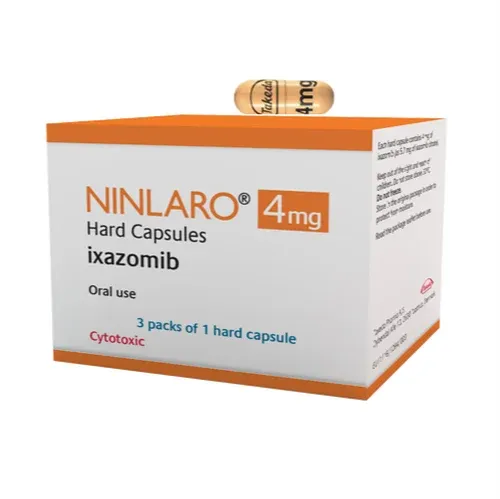
Table of Contents
- Package leaflet: Information for the user
- NINLARO 2.3 mg hard capsules, 3 mg hard capsules, 4 mg hard capsules
- 1. What NINLARO is and what it is used for
- 2. What you need to know before taking NINLARO
- 3. How to take NINLARO
- 4. Possible side effects
- 5. How to store NINLARO
- 6. Package contents and other information
Package leaflet: Information for the user
NINLARO 2.3 mg hard capsules, 3 mg hard capsules, 4 mg hard capsules
ixazomib
Please read all of this leaflet carefully before you start taking this medicine because it contains important information for you.
- Keep this leaflet. You may need to read it again.
- If you have any further questions, ask your doctor, pharmacist, or nurse.
- This medicine has been prescribed for you only. Do not pass it on to other people, even if their symptoms are the same as yours, as it may be harmful.
- If you experience any side effect, including those not listed in this leaflet, tell your doctor, pharmacist, or nurse. See section 4.
What is in this leaflet
- What NINLARO is and what it is used for
- What you need to know before taking NINLARO
- How to take NINLARO
- Possible side effects
- How to store NINLARO
- Contents of the pack and other information
1. What NINLARO is and what it is used for
What NINLARO is
NINLARO is an anticancer medicine that contains ixazomib, a "proteasome inhibitor".
NINLARO is used to treat a bone marrow cancer called multiple myeloma. Its active substance, ixazomib, works by blocking the action of proteasomes. Proteasomes are structures found within cells that break down proteins and are important for cell survival. Since multiple myeloma cells produce large amounts of protein, blocking proteasome activity can lead to the death of cancer cells.
What NINLARO is used for
NINLARO is used in the treatment of adult patients with multiple myeloma. NINLARO will be given to you in combination with lenalidomide and dexamethasone, which are other medicines used to treat multiple myeloma.
What is multiple myeloma
Multiple myeloma is a type of blood cancer that affects a specific kind of cell called plasma cells. Plasma cells are blood cells that normally produce proteins to help fight infections. In people with multiple myeloma, abnormal plasma cells—also called myeloma cells—can damage bones. The proteins produced by myeloma cells can also damage the kidneys. Treatment for multiple myeloma aims to destroy myeloma cells and reduce disease symptoms.
2. What you need to know before taking NINLARO
Do not take NINLARO
- if you are allergic to ixazomib or to any of the other ingredients of this medicine (listed in section 6).
If you are unsure whether this applies to you, consult your doctor, pharmacist, or nurse before taking NINLARO.
Warnings and precautions
Talk to your doctor, pharmacist, or nurse before or during treatment with NINLARO if:
- you have previously had bleeding episodes
- you suffer from persistent nausea, vomiting, or diarrhoea
- you have previously suffered from nerve problems, such as tingling or numbness
- you have a history of swelling (oedema)
- you suffer from persistent or severe skin rashes with skin peeling and mouth ulcers (Stevens-Johnson syndrome or toxic epidermal necrolysis, see section 4)
- you currently have or have previously had liver or kidney problems, as your dose may need to be adjusted
- you have or have previously had damage to the small blood vessels known as thrombotic microangiopathy or thrombotic thrombocytopenic purpura. Contact your doctor immediately if you experience fatigue, fever, bruising, bleeding, reduced urine output, swelling, confusion, vision loss, or seizures.
You will be examined by your doctor and closely monitored during treatment. Before starting NINLARO and throughout treatment, you will undergo blood tests to ensure that your blood cell counts are not too low.
Children and adolescents
The use of NINLARO is not recommended in children and adolescents under 18 years of age.
Other medicines and NINLARO
Inform your doctor, pharmacist, or nurse if you are taking, have recently taken, or might take any other medicines. This includes any medicines obtained without a prescription, such as vitamins or herbal supplements. Other medicines may affect how NINLARO works. In particular, inform your doctor, pharmacist, or nurse if you are taking any of the following: carbamazepine, phenytoin, rifampicin, or St. John’s wort (Hypericum perforatum). These medicines should be avoided, as they may reduce the effectiveness of NINLARO.
Pregnancy and breastfeeding
The use of NINLARO during pregnancy is not recommended, as this medicine may be harmful to the unborn child. Breastfeeding must be discontinued during treatment with NINLARO.
While being treated with NINLARO, women must avoid becoming pregnant and must not breastfeed. If you are pregnant, suspect you may be pregnant, are planning a pregnancy, or are breastfeeding, consult your doctor or pharmacist before taking this medicine.
Women of childbearing potential and men who are able to father children must use effective contraception during treatment and for 90 days after treatment ends. Women using hormonal contraceptives should also use an additional barrier method of contraception. Inform your doctor immediately if you or your partner become pregnant during treatment with NINLARO.
Since NINLARO is administered in combination with lenalidomide, you must follow the pregnancy prevention programme required for lenalidomide, as lenalidomide may be harmful to the unborn child.
Please refer to the package leaflets for lenalidomide and dexamethasone for further information on pregnancy and breastfeeding.
Driving and using machines
NINLARO may affect your ability to drive or operate machinery. During treatment with NINLARO, you may feel tired or dizzy. Do not drive or operate machinery if you experience these side effects.
3. How to take NINLARO
NINLARO must be prescribed by a physician experienced in the treatment of multiple myeloma. Always take this medicine exactly as instructed by your doctor or pharmacist.
NINLARO is used in combination with "lenalidomide" (a medicine that affects the functioning of the immune system) and "dexamethasone" (an anti-inflammatory medicine).
NINLARO, lenalidomide, and dexamethasone are taken in 4-week treatment cycles.
NINLARO is taken once weekly (on the same day each week) during the first three weeks of each cycle.
The recommended dose of NINLARO is one 4 mg capsule by mouth. The recommended dose of lenalidomide is 25 mg daily during the first three weeks of a cycle. The recommended dose of dexamethasone is 40 mg once weekly, taken on the same day, for all four weeks of the cycle.
Dosing schedule: administration of NINLARO in combination with lenalidomide and dexamethasone
When to take the medicine
28-day cycle (4 weeks)
Week 1 Week 2 Week 3 Week 4
Day Days Day Days Day Days Day Days
1 to 8 9 to 14 15 to 21 22 to 28
NINLARO
Lenalidomide every every every
day day day
Dexamethasone
For further information on the respective uses and effects, please read the package leaflets included with the other medicines.
If you have liver or kidney problems, your doctor may prescribe 3 mg NINLARO capsules. If you experience adverse effects, your doctor may prescribe NINLARO capsules containing 3 mg or 2.3 mg. Your doctor may also adjust the doses of the other medicines.
How and when to take NINLARO
- Take NINLARO at least one hour before a meal or at least two hours after a meal.
- Swallow the capsule whole with water. Do not crush, chew, or open the capsule.
- Avoid contact of the capsule contents with your skin. If the powder accidentally comes into contact with your skin, wash thoroughly with soap and water. If a capsule breaks, clean up the powder carefully, taking care to avoid dispersal into the air.
If you take more NINLARO than you should
Accidental overdose may cause serious adverse effects. If you take more NINLARO than prescribed, inform your doctor immediately or go to the hospital straight away, taking the medicine packaging with you.
Duration of treatment with NINLARO
You should continue treatment until your doctor tells you to stop.
If you forget to take NINLARO
If you miss a dose or take it late, you should only take the capsule if there are more than 3 days or 72 hours until your next scheduled dose. Do not take a missed dose if less than 3 days or 72 hours remain before your next scheduled dose.
If you vomit after taking the dose, do not take another capsule. Take your next dose as scheduled.
If you have any questions about the use of this medicine, consult your doctor or pharmacist.
4. Possible side effects
Like all medicines, this medicine can cause side effects, although not everybody gets them.
Stop taking ixazomib and contact your doctor immediately if you notice any of the following symptoms:
- flat, red, circular or target-shaped spots on the trunk, often with blisters in the centre, peeling of the skin, ulcers in the mouth, throat, nose, genitals or eyes. These serious skin rashes may be preceded by fever and flu-like symptoms (Stevens-Johnson syndrome, toxic epidermal necrolysis, which may affect up to 1 in 1,000 people).
Contact your doctor or pharmacist immediately if you notice any of the following serious, very common side effects which may affect more than 1 in 10 people:
- reduced number of platelets (thrombocytopenia), possibly increasing the risk of nosebleeds or bruising
- nausea, vomiting and diarrhoea
- numbness, tingling or burning sensations in the hands and feet (peripheral neuropathy)
- swelling in the legs or feet (peripheral oedema)
- skin rashes, which may cause itching, in some or all areas of the body
- cough, chest discomfort or pain, or nasal congestion (bronchitis)
Also, contact your doctor immediately if you notice any of the following rare side effects which may affect up to 1 in 1,000 people:
- severe skin rashes such as red to purple-coloured papules (Sweet’s syndrome)
- muscle weakness, loss of sensation in toes, feet or loss of movement in legs (transverse myelitis)
- changes in vision, changes in mental status or seizures (reversible posterior encephalopathy syndrome)
- rapid death of tumour cells leading to possible dizziness, reduced urine output, confusion, vomiting, nausea, swelling, shortness of breath or heart rhythm disturbances (tumour lysis syndrome)
- a rare blood disorder caused by blood clots (thrombi), possibly causing fatigue, fever, bruising, bleeding (e.g. nosebleeds), reduced urine output, swelling, confusion, loss of vision or seizures (thrombotic microangiopathy, thrombotic thrombocytopenic purpura)
- swelling of the face, lips, tongue or throat, difficulty breathing or swallowing, wheezing, chest tightness or dizziness, skin itching and hives (angioedema or anaphylactic reaction)
Other possible side effects
Inform your doctor or pharmacist if any of the following listed side effects worsen.
Very common: may affect more than 1 in 10 people
- constipation
- back pain
- cold-like symptoms (upper respiratory tract infections)
- feeling tired or weak (fatigue)
- fever (pyrexia)
- joint pain (arthralgia)
- reduced number of white blood cells called neutrophils (neutropenia), possibly increasing the risk of infections
- loss of appetite
- irregular heartbeat (arrhythmia)
- vision disorders, such as blurred vision, dry or red eyes (conjunctivitis)
Common: may affect up to 1 in 10 people
- reactivation of the varicella virus, which may cause painful skin rashes (herpes zoster or shingles)
- low blood pressure (arterial hypotension)
- shortness of breath, persistent cough or wheezing (heart failure)
- yellowing of the skin and eyes (jaundice; may be a sign of liver problems)
- low levels of potassium in the blood (hypokalaemia)
Reporting of side effects
If you experience any side effects, including those not listed in this leaflet, talk to your doctor, pharmacist or nurse. You can also report side effects directly through the national reporting system listed in Annex V. By reporting side effects, you can help provide more information on the safety of this medicine.
5. How to store NINLARO
Keep this medicine out of the sight and reach of children.
Do not use this medicine after the expiry date stated on the blister, the folding carton, and the outer box following "Exp./EXP.". The expiry date refers to the last day of that month.
Do not store above 30 °C. Do not freeze.
Store in the original packaging to protect the medicine from moisture.
Remove the capsule from the packaging only immediately before swallowing.
Do not use this medicine if you notice any damage or signs of tampering with the packaging.
Do not dispose of any medicine via wastewater or household waste. Ask your pharmacist how to dispose of medicines no longer required. This will help protect the environment.
6. Package contents and other information
What NINLARO contains
NINLARO 2.3 mg hard capsules:
- The active substance is ixazomib. Each capsule contains 2.3 mg of ixazomib (as 3.3 mg of ixazomib citrate).
- The other ingredients are:
- In the capsule: microcrystalline cellulose, magnesium stearate and talc.
- The capsule shell contains: gelatin, titanium dioxide (E171) and red iron oxide (E172).
- The printing ink contains: shellac, propylene glycol, potassium hydroxide and black iron oxide (E172).
NINLARO 3 mg hard capsules:
- The active substance is ixazomib. Each capsule contains 3 mg of ixazomib (as 4.3 mg of ixazomib citrate).
- The other ingredients are:
- In the capsule: microcrystalline cellulose, magnesium stearate and talc.
- The capsule shell contains: gelatin, titanium dioxide (E171), black iron oxide (E172).
- The printing ink contains: shellac, propylene glycol, potassium hydroxide and black iron oxide (E172).
NINLARO 4 mg hard capsules:
- The active substance is ixazomib. Each capsule contains 4 mg of ixazomib (as 5.7 mg of ixazomib citrate).
- The other ingredients are:
- In the capsule: microcrystalline cellulose, magnesium stearate and talc.
- The capsule shell contains: gelatin, titanium dioxide (E171), yellow iron oxide (E172) and red iron oxide (E172).
- The printing ink contains: shellac, propylene glycol, potassium hydroxide and black iron oxide (E172).
Description of the appearance of NINLARO and contents of the pack
NINLARO 2.3 mg hard capsules: light pink in colour, size 4, marked with “Takeda” on the cap and “2.3 mg” on the body of the capsule, printed in black ink.
NINLARO 3 mg hard capsules: light grey in colour, size 4, marked with “Takeda” on the cap and “3 mg” on the body of the capsule, printed in black ink.
NINLARO 4 mg hard capsules: light orange in colour, size 3, marked with “Takeda” on the cap and “4 mg” on the body of the capsule, printed in black ink.
Each pack contains 3 hard capsules (three sealed blisters in a blister strip inside a folding carton. Each blister contains one capsule).
Marketing Authorisation Holder
Takeda Pharma A/S
Delta Park 45
2665 Vallensbaek Strand
Denmark
Manufacturer
Takeda Ireland Limited
Grange Castle Business Park
Nangor Road
Dublin 22
D22 XR57
Ireland
Takeda GmbH
Takeda (Werk Singen)
Robert Bosch Strasse 8
78224 Singen
Germany
For further information about this medicine, please contact the local representative of the Marketing Authorisation Holder:
België/Belgique/Belgien Lietuva
Takeda Belgium NV Takeda, UAB
Tél/Tel: +32 2 464 06 11 Tel: +370 521 09 070
[email protected] [email protected]
България Luxembourg/Luxemburg
Такеда България ЕООД Takeda Belgium NV
Тел.: + 359 2 958 27 36 Tél/Tel: +32 2 464 06 11
[email protected] [email protected]
Česká republika Magyarország
Takeda Pharmaceuticals Czech Republic s.r.o. Takeda Pharma Kft.
Tel: +420 234 722 722 Tel.: +36 1 270 7030
[email protected] [email protected]
Danmark Malta
Takeda Pharma A/S Drugsales Ltd
Tlf.: +45 46 77 10 10 Tel: +356 21419070
[email protected] [email protected]
Deutschland Nederland
Takeda GmbH Takeda Nederland B.V.
Tel: +49 (0)800 825 3325 Tel: +31 20 203 5492
[email protected] [email protected]
Eesti Norge
Takeda Pharma OÜ Takeda AS
Tel: +372 6177 669 Tlf: +47 800 800 30
[email protected] [email protected]
Ελλάδα Österreich
Takeda ΕΛΛΑΣ Α.Ε. Takeda Pharma Ges.m.b.H.
Tηλ: +30 210 6387800 Tel: +43 (0) 800-20 80 50
[email protected] [email protected]
España Polska
Takeda Farmacéutica España, S.A. Takeda Pharma Sp. z o.o.
Tel: +34 917 90 42 22 Tel.: +48223062447
[email protected] [email protected]
France Portugal
Takeda France SAS Takeda Farmacêuticos Portugal, Lda.
Tél: + 33 1 40 67 33 00 Tel: + 351 21 120 1457
[email protected] [email protected]
Hrvatska România
Takeda Pharmaceuticals Croatia d.o.o. Takeda Pharmaceuticals SRL
Tel: +385 1 377 88 96 Tel: +40 21 335 03 91
[email protected] [email protected]
Ireland Slovenija
Takeda Products Ireland Ltd Takeda Pharmaceuticals farmacevtska družba d.o.o.
Tel: 1800 937 970 Tel: + 386 (0) 59 082 480
[email protected] [email protected]
Ísland Slovenská republika
Vistor hf. Takeda Pharmaceuticals Slovakia s.r.o.
Sími: +354 535 7000 Tel: +421 (2) 20 602 600
[email protected] [email protected]
Italia Suomi/Finland
Takeda Italia S.p.A. Takeda Oy
Tel: +39 06 502601 Puh/Tel: 0800 774 051
[email protected] [email protected]
Κύπρος Sverige
A.POTAMITIS MEDICARE LTD Takeda Pharma AB
Tηλ: +357 22583333 Tel: 020 795 079
[email protected] [email protected]
Latvija United Kingdom (Northern Ireland)
Takeda Latvia SIA Takeda UK Ltd
Tel: +371 67840082 Tel: +44 (0) 3333 000 181
[email protected] [email protected]
Other sources of information
More detailed information on this medicine is available on the website of the European Medicines Agency: https://www.ema.europa.eu