Neo Borocillina cough
Italy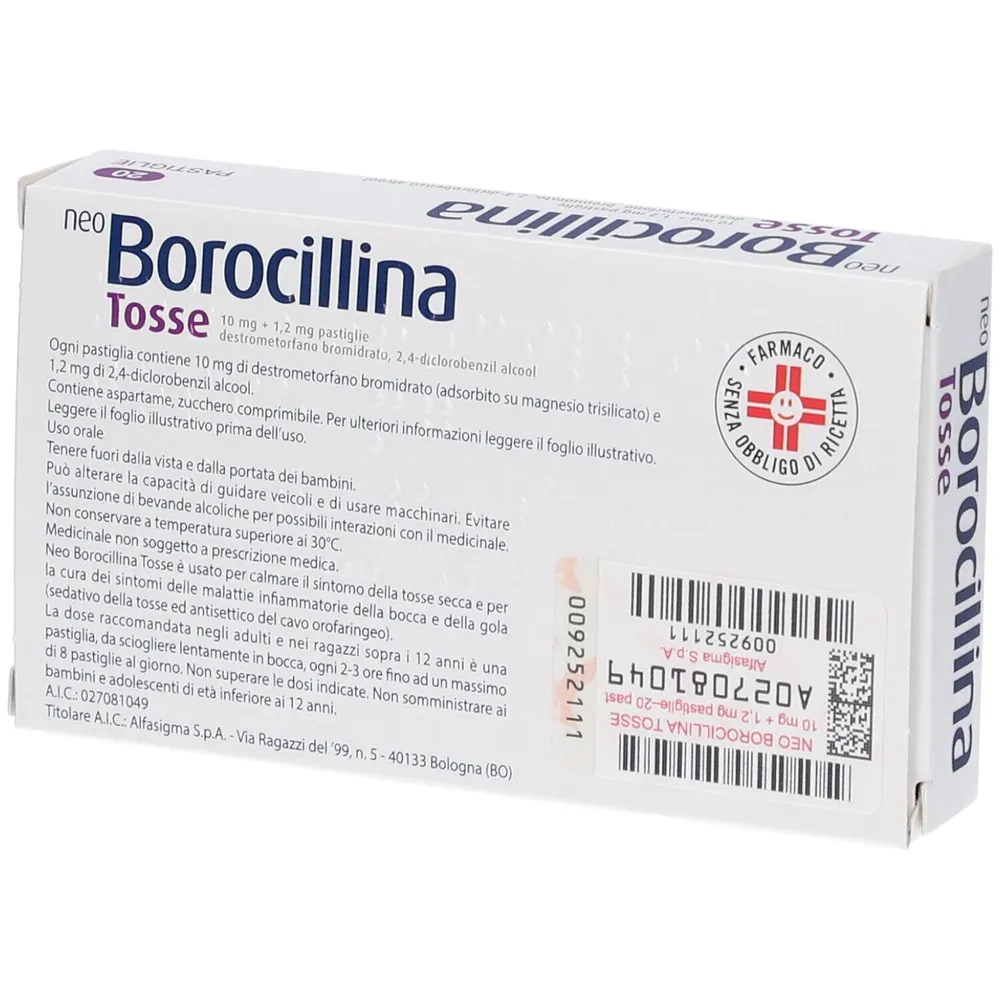
Table of Contents
- Package leaflet: information for the user
- Neo Borocillina Cough 10 mg + 1.2 mg tablets
- 1. What Neo Borocillina Cough is and what it is used for
- 2. What you need to know before taking Neo Borocillina Cough
- 3. How to take Neo Borocillina Tosse
- 4. Possible side effects
- 5. How to store Neo Borocillina Tosse
- 6. Package contents and other information
PACKAGE LEAFLET
Package leaflet: information for the user
Neo Borocillina Cough 10 mg + 1.2 mg tablets
dextromethorphan hydrobromide and 2,4-dichlorobenzyl alcohol
Please read this leaflet carefully before taking this medicine because it contains important information for you.
Always take this medicine exactly as described in this leaflet or as your doctor or pharmacist has instructed.
- Keep this leaflet. You may need to read it again.
- If you need more information or advice, consult your pharmacist.
- If you experience any side effects, including those not listed in this leaflet, contact your doctor or pharmacist. See section 4.
- Contact your doctor if you do not notice any improvement or if your symptoms worsen after 5–7 days of treatment.
Contents of this leaflet:
- What Neo Borocillina Cough is and what it is used for
- What you need to know before taking Neo Borocillina Cough
- How to take Neo Borocillina Cough
- Possible side effects
- How to store Neo Borocillina Cough
- Package contents and other information
1. What Neo Borocillina Cough is and what it is used for
Neo Borocillina Cough contains the active ingredients dextromethorphan hydrobromide and 2,4-dichlorobenzyl alcohol.
Dextromethorphan belongs to a class of drugs known as cough suppressants (antitussives); 2,4-dichlorobenzyl alcohol belongs to a class of drugs called antiseptics (antibacterials) for the oropharyngeal cavity (mouth and throat).
Neo Borocillina Cough is used as a suppressant for dry cough (to calm coughing) and for the treatment of symptoms associated with inflammatory conditions of the mouth and throat.
2. What you need to know before taking Neo Borocillina Cough
DO NOT take Neo Borocillina Cough:
- if you are allergic to dextromethorphan, 2,4-dichlorobenzyl alcohol, or any of the other ingredients of this medicine (listed in section 6);
- if you have asthma, chronic bronchitis (COPD), pneumonia, breathing difficulties, or respiratory depression;
- if you have cardiovascular diseases or suffer from high blood pressure;
- if you suffer from hyperthyroidism (overactive thyroid gland);
- if you have diabetes;
- if you suffer from increased pressure inside the eye (glaucoma);
- if you have urinary disorders caused by an enlarged prostate or other obstructions of the genital organs or urinary tract;
- if you have obstructions of the esophagus, stomach, or intestines;
- if you have severe liver disease;
- if you have epilepsy;
- if you are taking antidepressant monoamine oxidase inhibitor (MAOI) medications, or if you have discontinued such treatment less than two weeks ago (see section “Other medicines and Neo Borocillina Cough”);
- if you are pregnant, especially during the first trimester (see section “Pregnancy and breastfeeding”);
- if you are breastfeeding (see section “Pregnancy and breastfeeding”);
- in children under 12 years of age.
Warnings and precautions
This medicine may lead to dependence. Therefore, treatment should be short-term.
Take Neo Borocillina Cough with caution and only after consulting your doctor:
- if you have an irritating cough with significant mucus production (phlegm);
- if your cough has lasted for a long time (chronic cough);
- if you have neurological disorders associated with a reduced cough reflex (e.g., stroke, Parkinson’s disease, dementia);
- if you have a history of drug or psychoactive substance abuse;
- if you have liver disease;
- if you have kidney disease;
- if you suffer from a rare blood disorder called mastocytosis;
- if you have specific genetic characteristics causing you to metabolize this medicine slowly. If in doubt, consult your doctor. You should also consult your doctor if such conditions have occurred previously.
Prolonged use, especially, of topical products may lead to allergic reactions (sensitization). In such cases, discontinue treatment and consult your doctor.
Children
Neo Borocillina Cough is contraindicated in children under 12 years of age.
Other medicines and Neo Borocillina Cough
Talk to your doctor or pharmacist before taking Neo Borocillina Cough.
Inform your doctor or pharmacist if you are taking, have recently taken, or might take any other medicine.
In particular, inform your doctor if you are taking or have recently taken:
- medicines belonging to the class of monoamine oxidase inhibitors (MAOIs) (see section 2 “DO NOT take Neo Borocillina Cough”), such as:
- medicines for the treatment of Parkinson’s disease (e.g., selegiline or rasagiline);
- medicines such as certain antidepressants or antipsychotics: (isocarboxazide, nialamide, phenelzine, tranylcypromine, iproniazid, iproclozide, moclobemide, and toloxatone). Neo Borocillina Cough may interact with these medicines, leading to changes in mental status (e.g., agitation, hallucinations, coma) and other effects such as body temperature above 38°C, increased heart rate, breathing difficulties, unstable blood pressure, exaggerated reflexes, muscle rigidity, lack of coordination, and/or gastrointestinal symptoms (e.g., nausea, vomiting, diarrhea), even when treatment with these medicines was discontinued less than 2 weeks ago;
- the following medicines, as they may increase dextromethorphan blood levels by inhibiting its metabolism:
- medicines for treating depression such as fluoxetine, paroxetine, sertraline, and bupropion (see section 2 “DO NOT take Neo Borocillina Cough”);
- medicines for treating severe pain or reducing withdrawal symptoms in cases of dependence (methadone);
- medicines for treating psychiatric disorders (haloperidol, thioridazine, perphenazine);
- medicines for treating heart rhythm disorders (amiodarone, quinidine, propafenone);
- medicines for treating cardiac arrhythmias (flecainide);
- medicines for reducing calcium levels in the blood and treating dysfunction due to reduced secretion of the hormone regulating these levels (hyperparathyroidism), such as cinacalcet;
- medicines used to prevent fungal (mold) growth (terbinafine);
- a medicine used for treating stomach disorders due to high acidity (cimetidine);
- a medicine used in the treatment of AIDS (ritonavir);
- medicines for reducing cholesterol levels (berberine);
- medicines for treating anxiety or insomnia (hypnotics, sedatives, or anxiolytics), as they may increase dextromethorphan’s effects on the central nervous system;
- mucolytic medicines, as reduced cough reflex may lead to excessive mucus accumulation.
Concomitant use of Neo Borocillina Cough and sedative medicines such as benzodiazepines or related medicines increases the risk of drowsiness, breathing difficulties (respiratory depression), coma, and may be life-threatening. For this reason, concomitant use should only be considered when no other treatment options are available.
However, if your doctor prescribes Neo Borocillina Cough together with sedative medicines, the dose and duration of concomitant treatment must be determined by your doctor. Inform your doctor about all sedative medicines you are taking and follow your doctor’s dosage recommendations carefully. It may be helpful to inform friends or family members to watch for the signs and symptoms listed above. Contact your doctor if you experience such symptoms.
Neo Borocillina Cough and alcohol
If you are taking Neo Borocillina Cough, avoid alcoholic beverages and medicines containing alcohol: alcohol enhances the sedative effect of dextromethorphan, possibly reducing alertness (see section “Driving and using machines”).
Pregnancy and breastfeeding
If you are pregnant, suspect you may be pregnant, plan to become pregnant, or are breastfeeding, consult your doctor or pharmacist before taking this medicine.
Pregnancy
Do not use Neo Borocillina Cough during the first trimester of pregnancy. In later months, the medicine may be taken only if necessary, after consulting your doctor and evaluating the benefit-risk ratio in your individual case.
Breastfeeding
Do not use Neo Borocillina Cough while breastfeeding, as it is not known whether the medicine passes into breast milk and a respiratory depressant effect on the newborn cannot be ruled out.
Driving and using machines
Neo Borocillina Cough may cause drowsiness and/or dizziness, which may affect your ability to drive vehicles and operate machinery, especially when taken together with alcohol or other medicines that may slow reaction times.
Neo Borocillina Cough contains aspartame
This medicine contains 9.6 mg of aspartame per tablet. Aspartame is a source of phenylalanine. It may be harmful if you have phenylketonuria, a rare genetic disorder causing phenylalanine accumulation because the body cannot properly eliminate it.
Neo Borocillina Cough contains sucrose
Contains 1.386 g of sucrose (sugar) per tablet. This should be considered in patients with diabetes mellitus.
If your doctor has diagnosed you with an intolerance to certain sugars, contact him before taking this medicine.
HEALTH EDUCATION NOTES
Dry cough is a symptom frequently accompanying colds and influenza-like conditions; it results from inflammation of the respiratory tract and is not accompanied by mucus and/or phlegm production. Dry cough increases in frequency and intensity at night, when the patient is lying down, disturbing sleep and worsening airway inflammation.
Dry air, mouth breathing, and supine position can trigger coughing episodes.
To prevent coughing episodes, it is advisable to properly humidify indoor environments and promote nasal breathing.
3. How to take Neo Borocillina Tosse
Take this medicine exactly as stated in this leaflet or according to the instructions given by your
doctor or pharmacist. If you have any doubts, consult your doctor or pharmacist.
The recommended dose for adults and adolescents over 12 years of age is:
one tablet, to be slowly dissolved in the mouth, every 2–3 hours, up to a maximum of 8 tablets per day.
Do not exceed the stated doses.
Do not take for longer than 5–7 days.
Consult your doctor if the symptoms occur repeatedly or if you have noticed any recent changes
in their characteristics.
If you take more Neo Borocillina Tosse than you should
If you take more Neo Borocillina Tosse than recommended, the following symptoms may occur: nausea and
vomiting, involuntary muscle contractions, agitation, confusion, dizziness, drowsiness, cognitive disturbances,
involuntary and rapid eye movements, cardiac disorders (accelerated heartbeat), low blood pressure,
coordination disturbances, psychosis with visual hallucinations, and hyperexcitability.
Additional symptoms in case of massive overdose may include: inability to urinate, coma, severe
respiratory problems, and seizures.
Seek immediate medical advice or go to the hospital if any of the above-mentioned symptoms occur.
4. Possible side effects
Like all medicines, Neo Borocillina Tosse may cause side effects, although not everyone experiences them.
There are insufficient data available to establish the frequency of each individual adverse reaction listed.
The following side effects may occur:
- hypersensitivity reactions (including anaphylactic reaction, angioedema, urticaria, pruritus, rash, and erythema);
- nausea, vomiting, stomach and/or intestinal disturbances;
- dizziness;
- drowsiness, hallucinations, fatigue;
- difficulty breathing;
- allergic skin reactions;
- loss of appetite;
- psychological dependence: cases of abuse and dependence on dextromethorphan have been reported.
Reporting of side effects
If you experience any side effect, including those not listed in this leaflet, talk to your doctor or pharmacist.
You can also report side effects directly via the national reporting system at http://www.aifa.gov.it/content/segnalazioni-reazioni-avverse
By reporting side effects, you can help provide more information on the safety of this medicine.
5. How to store Neo Borocillina Tosse
Keep this medicine out of the sight and reach of children.
Do not use this medicine after the expiry date stated on the packaging after "Exp.".
The expiry date refers to the last day of that month.
Store below 30°C.
Do not use this medicine if the packaging is open or damaged.
Do not dispose of medicines via wastewater or household waste. Ask your pharmacist how to dispose of medicines you no longer use. This will help protect the environment.
It is important to always keep the information about the medicine available; therefore, retain both the carton and the package leaflet.
6. Package contents and other information
What Neo Borocillina Tosse contains
- The active substances are dextromethorphan hydrobromide and 2,4-dichlorobenzyl alcohol. Each tablet contains 10 mg of dextromethorphan hydrobromide (adsorbed onto magnesium trisilicate) and 1.2 mg of 2,4-dichlorobenzyl alcohol.
- The other components are: freshflavor flavouring, ammonium glycyrrhizinate, magnesium stearate, aspartame, copovidone, compressible sugar.
Description of the appearance of Neo Borocillina Tosse and contents of the pack
Neo Borocillina Tosse is presented as tablets.
Pack contents: 16, 18 or 20 tablets. Not all pack sizes may be marketed.
Marketing Authorisation Holder and Manufacturer
Marketing Authorisation Holder:
Alfasigma S.p.A. - Via Ragazzi del '99, n. 5 - 40133 Bologna (BO)
Manufacturer:
Alfasigma S.p.A. – Via E. Fermi, n. 1 – 65020 Alanno (PE)
Alfasigma S.p.A. – Via Pontina km 30,400 – 00071 Pomezia (RM)