Nasipral
Italy
Table of Contents
Package leaflet: Information for the user
Nasipral 0,3 mg/ml nasal spray, solution
Ipratropium bromide
Generic medicine
Please read all of this leaflet carefully before you start using this medicine, because it contains important information for you.
- Keep this leaflet. You may need to read it again.
- If you have any questions, ask your doctor or pharmacist.
- This medicine has been prescribed for you only. Do not pass it on to others, even if their symptoms are the same as yours, as it could be harmful.
- If you experience any side effects, including those not listed in this leaflet, tell your doctor or pharmacist. See section 4.
Contents of this leaflet:
- What Nasipral is and what it is used for
- What you need to know before using Nasipral
- How to use Nasipral
- Possible side effects
- How to store Nasipral
- Contents of the pack and other information
1. What Nasipral is and what it is used for
The active substance of Nasipral is ipratropium bromide, a substance which reduces nasal secretion (nasal anticholinergics).
This medicinal product is indicated for the symptomatic treatment of rhinorrhea (runny nose) associated with allergic and non-allergic rhinitis in adults, adolescents and children over 6 years of age.
Consult your doctor if you do not feel better or if you feel worse.
2. What you need to know before using Nasipral
Do not use Nasipral
- if you are allergic to ipratropium bromide or to any of the other ingredients of this medicine (listed in section 6).
Warnings and precautions
- Close your eyes during application of Nasipral into the nose. Do not spray directly into the eyes. If Nasipral comes into contact with the eyes, rinse immediately with cold water. You may subsequently experience vision problems and increased sensitivity to light for several hours.
- Caution is advised in patients with enlarged prostate, bladder obstruction, glaucoma (an eye disease caused by increased intraocular pressure), or urinary retention.
- If you are already taking other medicines, please also read the section "Other medicines and Nasipral".
- Consult your doctor or pharmacist before using Nasipral.
Children and adolescents
Do not use in children under 6 years of age.
Other medicines and Nasipral
- No interactions are known with antihistamines, decongestants, or intranasal corticosteroids for nasal use.
- There is a risk of increased adverse reactions if used concomitantly with other anticholinergic medicines (oral or inhaled).
- There is also a risk of interaction with salbutamol (contained in some medicines used for the treatment of asthma).
- Inform your doctor or pharmacist if you are taking, have recently taken, or might take any other medicines.
Pregnancy, breastfeeding and fertility
As a precautionary measure, the use of Nasipral during pregnancy and breastfeeding should be avoided.
Preclinical studies conducted with ipratropium bromide have not shown adverse effects on fertility.
Clinical data on fertility for ipratropium bromide are not available.
If you are pregnant, suspect you may be pregnant, planning a pregnancy, or are breastfeeding, consult your doctor or pharmacist before taking this medicine.
Driving and using machines
You may experience dizziness, difficulty focusing, or blurred vision while using Nasipral. If this occurs, do not drive or operate machinery.
Nasipral contains benzalkonium chloride (preservative)
Benzalkonium chloride may cause irritation and swelling inside the nose, especially if used for prolonged periods.
This medicine contains 17.5 mcg of benzalkonium chloride per spray, equivalent to 0.25 mg/ml.
3. How to use Nasipral
Use this medicine exactly as directed by your doctor. If you have any doubts, consult your doctor or pharmacist.
The recommended dose is:
Adults
- 2 sprays into each nostril administered 2–3 times daily.
Use in children and adolescents
- Adolescents over 12 years of age: 2 sprays into each nostril administered 2–3 times daily.
- Children aged 6 to 12 years: 2 sprays into each nostril administered twice daily.
- Do not use in children under 6 years of age.
Method of administration
- Remove the dust cap.
- Prime the pump for the first use or if it has not been used for more than 2 weeks: hold the base of the bottle with your thumb and the white shoulder with your index and middle fingers (Fig. 1). Hold the bottle upright, not directed towards the eyes. Press firmly and quickly seven times. The pump is now primed and ready for use. The pump must be re-primed if it has not been used for more than 24 hours up to a maximum of two weeks. Two sprays are sufficient to re-prime the pump.
- Before using Nasipral, blow your nose to clear the nostrils.
- Close one nostril by pressing a finger against the side of the nose and insert the nasal applicator tip into the opposite nostril. Tilt your head slightly forward and keep the bottle upright (Fig. 2).
- Press firmly and quickly. After each spray, inhale deeply through the nose and exhale through the mouth.
- After spraying into the nostril and removing the bottle, tilt your head backward slightly so that the solution covers the entire nasal mucosa.
- Repeat steps 4–6 for the other nostril.
- Replace the dust cap.
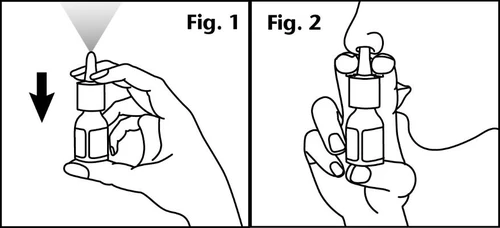
Fig. 1 Fig. 2
If the nasal applicator tip becomes blocked, remove the plastic dust cap. Hold the nasal applicator tip under warm running water for about one minute. Dry the applicator tip, re-prime the nasal spray pump, and replace the plastic dust cap.
If you use more Nasipral than you should
Symptoms: dry mouth, visual accommodation disorders, and increased heart rate may occur.
If you have used more Nasipral than you should, contact your doctor, pharmacist, or national poison control center immediately.
If you forget to use Nasipral
Do not take a double dose to make up for a forgotten dose.
If you have any doubts about how to use this medicine, consult your doctor or pharmacist.
4. Possible side effects
Like all medicines, this medicine can cause side effects, although not everybody will experience them.
Most of the side effects can be attributed to the anticholinergic properties of Nasipral.
As with any topical treatment, Nasipral may cause local irritation. The adverse effects have been identified based on data from clinical studies and pharmacovigilance during post-marketing use of the medicine.
The most common side effects are nosebleeds, nasal dryness, headache, nasal discomfort and sore throat.
Important side effects to be aware of:
Allergic reactions (hypersensitivity and anaphylactic reactions):
- Symptoms may include itching or hives (may affect up to 1 in 1,000 people)
- In severe cases, symptoms may include swelling of the mouth, tongue, lips and/or face, skin rash, sudden difficulty breathing (bronchospasm), decreased blood pressure, and narrowing of the throat (laryngospasm, pharyngeal edema) (may affect up to 1 in 100 people)
- Increased heart rate, irregular heartbeat (may affect up to 1 in 100 people)
- Palpitations (rapid or irregular heartbeat) (may affect up to 1 in 1,000 people)
→ Contact a doctor immediately if you experience any of these symptoms. Stop using Nasipral.
Common: may affect up to 1 in 10 people
- Headache
- Nosebleeds, nasal dryness, nasal discomfort
- Sore throat
Uncommon: may affect up to 1 in 100 people
- Dizziness
- Feeling unwell (nausea), burning sensation
- Gastrointestinal motility disorder
- Mouth ulcers
- Dry mouth, dry throat
- Difficulty urinating (urinary retention)
- Accommodation disorders (visual), dilated pupils, increased intraocular pressure, glaucoma, eye pain, blurred vision, visual halos, eye irritation or redness, corneal edema
Reporting of side effects
If you experience any side effect, including those not listed in this leaflet, talk to your doctor or pharmacist. You can also report side effects directly via the national reporting system:
https://www.aifa.gov.it/content/segnalazioni-reazioni-avverse
By reporting side effects, you can help provide more information on the safety of this medicine.
5. How to store Nasipral
Do not freeze.
Store in the cardboard box to prevent potential accidental activation.
Keep this medicine out of sight and reach of children.
Do not use this medicine after the expiry date stated on the carton and label after Exp. The expiry date refers to the last day of that month.
Do not use this bottle for more than 3 months.
Do not dispose of any medicine via wastewater or household waste. Ask your pharmacist how to dispose of medicines no longer required. This will help protect the environment.
6. Package contents and other information
What Nasipral contains
- The active substance is ipratropium bromide anhydrous 0.3 mg (= 0.31 mg of ipratropium bromide monohydrate)/ml.
- The other components are sodium chloride, benzalkonium chloride, sodium edetate, hydrochloric acid, sodium hydroxide, purified water.
Description of the appearance of Nasipral and contents of the pack
Nasal spray, solution: 20 ml bottle with a nasal spray metering pump. One ml of solution contains 300 mcg of anhydrous ipratropium bromide (equivalent to 310 mcg of ipratropium bromide monohydrate). Each spray delivers 21 mcg of anhydrous active substance (22 mcg of monohydrate). One bottle contains 240 doses.
Nasipral is available in 20 ml pack sizes.
Marketing Authorization Holder and Manufacturer
INFECTOPHARM Arzneimittel und Consilium GmbH
Von-Humboldt-Straße 1
64646 Heppenheim
Germany
This medicinal product is authorized in the European Economic Area Member States under the following names:
Belgium: Nasipral 0.3 mg/ml neusspray, oplossing / 0.3 mg/ml solution for nasal spray / 0.3 mg/ml Nasenspray, Lösung
Italy: Nasipral 0.3 mg/ml nasal spray, solution
Austria: Ipratropiumbromid Infectopharm 0.3 mg/ml Nasenspray, Lösung
Spain: Nasipral 0.3 mg/ml solución para pulverización nasal