Namuscla
Italy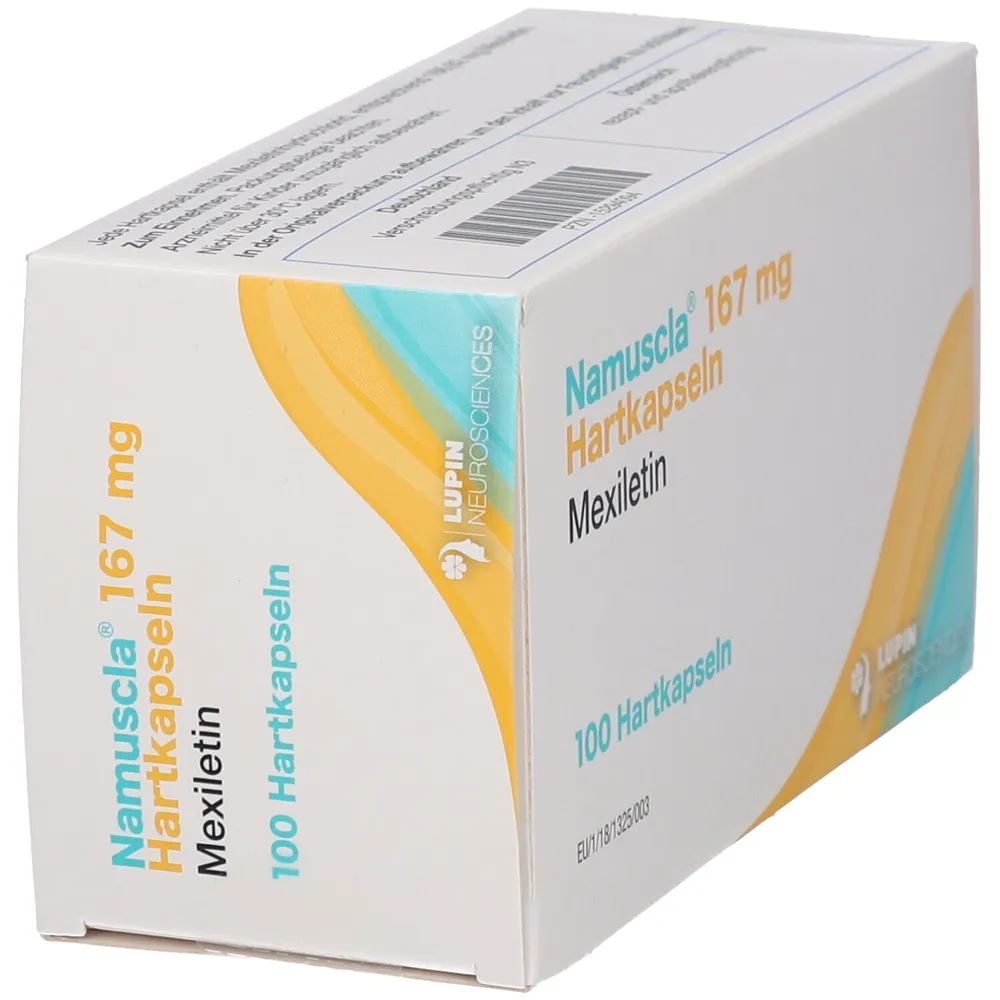
Table of Contents
Package leaflet: Information for the patient
Namuscla 167 mg hard capsules
mexiletine
Please read all of this leaflet carefully before taking this medicine because it contains
important information for you.
- Keep this leaflet. You may need to read it again.
- If you have any questions, ask your doctor or pharmacist.
- This medicine has been prescribed for you only. Do not give it to others, even if they have the same symptoms as you, because it could be harmful.
- If you experience any adverse reactions, including those not listed in this leaflet, contact your doctor or pharmacist. See section 4.
An Alert Card is distributed together with Namuscla to remind you and medical personnel of the
risk of cardiac arrhythmias. Read the Alert Card together with this leaflet and always carry the card
with you.
Contents of this leaflet
- What Namuscla is and what it is used for
- What you need to know before taking Namuscla
- How to take Namuscla
- Possible side effects
- How to store Namuscla
- Contents of the pack and other information
1. What Namuscla is and what it is used for
Namuscla is a medicine that contains the active substance mexiletine.
Namuscla is used to treat symptoms of myotonia (when muscles relax slowly and
with difficulty after being used) in adults with non-dystrophic myotonic disorders, which are caused by
genetic defects affecting muscle function. Namuscla improves symptoms related to muscle stiffness
and helps patients perform daily activities.
2. What you should know before taking Namuscla
Do not take Namuscla
- If you are allergic to mexiletine or to any of the other ingredients of this medicine (listed in section 6)
- If you are allergic to any local anaesthetic
- If you have had a heart attack
- If your heart is not functioning adequately
- If you have a heart condition causing irregular heartbeat
- If your heart beats too fast
- If the blood vessels of your heart are damaged
- If you are also taking certain medicines used to treat heart rhythm disorders (see “Other medicines and Namuscla”)
- If you are also taking certain medicines with a narrow therapeutic window (see “Other medicines and Namuscla”)
If in doubt, consult your doctor or pharmacist.
Warnings and precautions
Talk to your doctor, pharmacist, or nurse before taking Namuscla if you have:
- Heart problems
- Liver problems
- Kidney problems
- Low or high blood levels of potassium
- Low blood levels of magnesium
- Epilepsy
Heart function
Before starting treatment with Namuscla, you will undergo a series of tests to monitor your heart function, including an ECG (electrocardiogram). These tests will also be performed regularly during treatment with Namuscla, as well as before and after any dose adjustments. The frequency of these tests depends on your heart function.
If you or your doctor notice any heart rhythm disturbances or any of the conditions listed under “Do not take Namuscla”, your doctor will stop treatment with Namuscla.
If you notice changes in your heart rhythm (your heart beating faster or slower than usual), experience palpitations or chest pain, have difficulty breathing, feel dizzy, start sweating, or faint, you must contact an emergency centre immediately.
Some patients may have higher blood levels of Namuscla due to slower metabolism in the liver, and a dose adjustment may be necessary.
Before starting and during treatment with Namuscla, your doctor may monitor your blood levels of potassium and magnesium.
Drug reaction with eosinophilia and systemic symptoms (DRESS)
If you are hypersensitive to mexiletine or to other ingredients of this product or to any local anaesthetic, do not take Namuscla and contact your doctor immediately. Symptoms of hypersensitivity and DRESS include fever, rash and blisters, facial swelling and swollen lymph nodes.
Children and adolescents
Namuscla must not be used in children and adolescents under 18 years of age.
Other medicines and Namuscla
Inform your doctor or pharmacist if you are taking, have recently taken, or might take any other medicine.
Do not take Namuscla with certain medicines used to treat heart rhythm disorders (quinidine, procainamide, disopyramide, ajmaline, encainide, flecainide, propafenone, moricizine, amiodarone, sotalol, ibutilide, dofetilide, dronedarone, vernakalant). See section “Do not take Namuscla”. Taking Namuscla together with any of these medicines increases the risk of a serious heart rhythm disorder called torsades de pointes.
Do not take Namuscla with certain medicines that have a so-called narrow therapeutic window (medicines in which small differences in dose or blood concentration can affect the medicine’s effect or its side effects). Examples of such medicines are digoxin (for heart problems), lithium (a mood stabilizer), phenytoin (for treating epilepsy), theophylline (for asthma), and warfarin (for blood clots).
Inform your doctor or pharmacist if you are taking any of the following medicines, as they may interact with or be affected by Namuscla:
- Medicines for heart problems (lidocaine, tocainide, propranolol, esmolol, metoprolol, atenolol, carvedilol, bisoprolol, nebivolol, verapamil, diltiazem)
- Other specific medicines:
o Timolol, used to treat high eye pressure (glaucoma),
o Some antibiotics (ciprofloxacin, rifampicin),
o Some antidepressants (fluvoxamine),
o Tizanidine (used to relax muscles),
o Metformin (used for diabetes),
o Omeprazole (used to treat stomach ulcers and acid reflux).
Smoking and Namuscla
Inform your doctor or pharmacist if you start or stop smoking while taking Namuscla, as smoking alters blood levels of Namuscla and a dose adjustment may be necessary.
Namuscla and beverages
It is recommended to reduce caffeine intake by half during treatment with mexiletine, as the medicine may increase caffeine blood levels.
Pregnancy and breastfeeding
If you are pregnant, think you might be pregnant, planning a pregnancy, or breastfeeding, consult your doctor before taking this medicine. If you become pregnant while taking Namuscla, contact your doctor immediately, as it is preferable not to take Namuscla during pregnancy.
Mexiletine passes into breast milk. You should discuss this with your doctor to jointly decide whether to avoid breastfeeding or to discontinue/abstain from treatment with mexiletine.
Driving and using machines
In rare cases, Namuscla may cause fatigue, confusion, or blurred vision: if you experience any of these effects, avoid driving, cycling, or operating machinery.
3. How to take Namuscla
Take this medicine exactly as described in this leaflet or as directed by your doctor or pharmacist. If you have any doubts, consult your doctor or pharmacist.
The recommended starting dose is 1 capsule daily. Your doctor will gradually increase the dose depending on how the medicine works. The maintenance dose ranges from 1 to 3 capsules daily, taken at regular intervals throughout the day, as prescribed.
Do not take more than 3 capsules a day.
Furthermore, your doctor will regularly review your treatment to ensure that Namuscla remains the most appropriate medicine for you.
Instructions for administration
Namuscla is intended for oral use.
Swallow the capsule whole with a glass of water, while standing or sitting. You may take Namuscla with food to avoid stomach upset (see section “Possible side effects”).
If you take more Namuscla than you should
Contact your doctor immediately if you take more than the recommended dose of Namuscla. It can be very dangerous to your health. You or your partner must contact your doctor immediately if you experience tingling in arms or legs, difficulty thinking clearly or concentrating, hallucinations, seizures, a slow heartbeat, dizziness and fainting, collapse, or if your heart stops beating.
If you forget to take Namuscla
If you forget to take a dose, do not take a double dose. Take the next dose at the usual time.
If you have any doubts about how to use this medicine, consult your doctor or pharmacist.
4. Possible side effects
Like all medicines, this medicine can cause side effects, although not everybody gets them.
The most serious side effects are:
Contact your doctor or go to the nearest emergency room immediately if you experience any of the
following side effects:
- Stevens-Johnson syndrome (Stevens-Johnson syndrome, SJS): a severe allergic reaction with skin rashes, often presenting as blisters and ulcers in the mouth and eyes, as well as other mucous membranes. This is a very rare side effect that may affect up to 1 in 10,000 people.
- A condition called DRESS with skin blisters, feeling unwell, and fever. This is a very rare side effect that may affect up to 1 in 1,000 people.
- Arrhythmia and other disturbances in heart rhythm (atrioventricular block, increased heart rate, ventricular fibrillation). These are common side effects that may affect up to 1 in 10 people; see section “Warnings and precautions” for symptoms and further information.
- Severe allergic reaction to mexiletine (with symptoms such as severe skin rash with fever); this is a very rare side effect that may occur in up to 1 in 1,000 people.
Other possible side effects:
Very common side effects (may affect more than 1 in 10 people):
- Abdominal pain (stomach pain)
- Insomnia (difficulty sleeping)
Common side effects (may affect up to 1 in 10 people):
- Drowsiness
- Headache
- Tingling in arms and legs
- Blurred vision
- Dizziness (sensation of losing balance)
- Fast heartbeat
- Flushing
- Low blood pressure (which may cause dizziness and feeling faint)
- Nausea (feeling sick)
- Acne
- Pain in arms and legs
- Tiredness
- Weakness
- Chest discomfort
- Malaise (a general feeling of discomfort and illness)
Uncommon side effects (may affect up to 1 in 100 people):
- Seizures (fits)
- Speech disorders
- Slow heartbeat
Rare side effects (may affect up to 1 in 1,000 people):
- Abnormal liver function (observed after blood tests)
Very rare side effects (may affect up to 1 in 10,000 people):
- Liver damage including inflammation (hepatitis)
Not known (frequency cannot be estimated from the available data):
- Decrease in white blood cell count or platelet count
- Lupus-like syndrome (an immune system disorder)
- Redness and peeling of the skin
- Hallucinations (seeing or hearing things that are not real)
- Transient confusion (temporary inability to think clearly or concentrate)
- Double vision
- Alteration in taste sensation
- Collapse
- Hot flushes
- Pulmonary fibrosis (lung disease)
- Diarrhoea
- Vomiting
- Oesophageal injury (damage to the food pipe)
Reporting of side effects
If you experience any side effect, including those not listed in this leaflet, tell your doctor or pharmacist.
You can also report side effects directly via the national reporting system referred to in Annex V. By reporting side effects, you can help provide more information on the safety of this medicine.
5. How to store Namuscla
Keep this medicine out of the sight and reach of children.
Do not use this medicine after the expiry date stated on the carton and blister. The expiry date refers to the last day of that month.
Store below 30 °C. Keep in the original packaging to protect the medicine from moisture.
Do not dispose of any medicine via wastewater or household waste. Ask your pharmacist how to dispose of medicines you no longer use. This will help protect the environment.
6. Package contents and other information
What Namuscla contains
Each hard capsule contains:
- mexiletine hydrochloride corresponding to 166.62 mg of mexiletine (active substance)
- Other components (maize starch, anhydrous colloidal silica, magnesium stearate, gelatin, iron(III) hydroxide [E 172], titanium dioxide [E 171]).
Description of the appearance of Namuscla and contents of the pack
Namuscla hard capsules are reddish gelatin hard capsules filled with white powder.
Namuscla 167 mg hard capsules are available in blisters containing 30, 50, 100 or 200 capsules in a carton.
Not all pack sizes may be marketed.
Marketing Authorisation Holder
Lupin Europe GmbH
Hanauer Landstraße 139-143,
60314 Frankfurt am Main
Germany
Manufacturer
Hormosan Pharma GmbH
Hanauer Landstraße 139-143,
60314 Frankfurt am Main
Germany
Lupin Healthcare (UK) Ltd
The Urban Building, second floor, 3-9 Albert Street
SL1 2BE Slough, Berkshire,
United Kingdom
For further information about this medicinal product, please contact the local representative of the Marketing Authorisation Holder:
AT, BE, BG, CZ, CY, DK, EE, EL, ES, FR, DE, FI, HR, IE, IS, IT, LV, LT, LU, HU, MT, NL, NO, PL, PT, RO, SI, SK, SE
Lupin Europe GmbH
Tel: +49 69 96759087
Toll-free: +49 (0) 800 182 4160
Email: [email protected]
UK
Lupin Europe GmbH
Tel: +44 (0) 800-088-5969
Email: [email protected]
More detailed information on this medicinal product is available on the website of the European Medicines Agency: http://www.ema.europa.eu