Moventig
Italy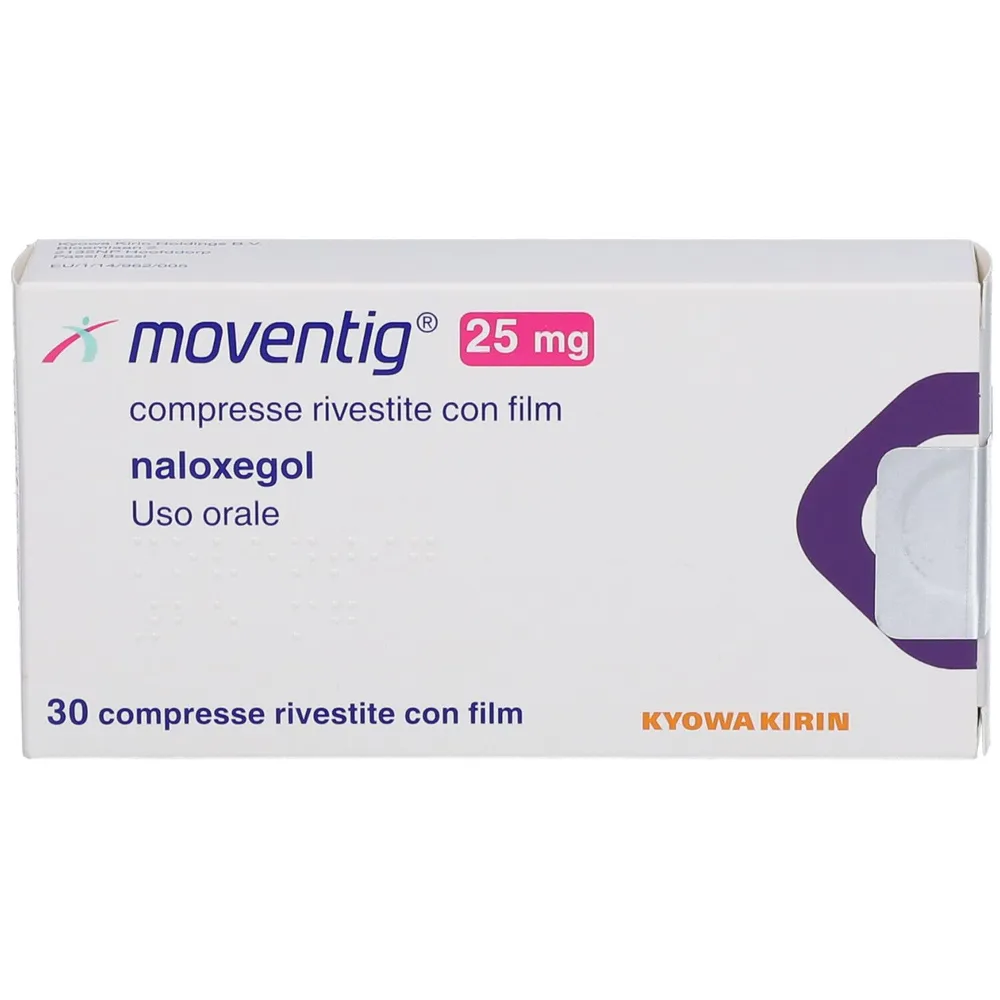
Table of Contents
- Package leaflet: Information for the user
- Moventig 12.5 mg film-coated tablets, 25 mg film-coated tablets
- 1. What Moventig is and what it is used for
- 2. What you need to know before taking Moventig
- 3. How to take Moventig
- 4. Possible side effects
- 5. How to store Moventig
- 6. Package contents and other information
Package leaflet: Information for the user
Moventig 12.5 mg film-coated tablets, 25 mg film-coated tablets
naloxegol
Please read all of this leaflet carefully before you start taking this medicine because it contains important information for you.
- Keep this leaflet. You may need to read it again.
- If you have any questions, ask your doctor, pharmacist, or nurse.
- This medicine has been prescribed for you only. Do not pass it on to other people, even if their symptoms are the same as yours, because it may be harmful.
- If you experience any side effects, including those not listed in this leaflet, talk to your doctor, pharmacist, or nurse. See section 4.
Contents of this leaflet
- What Moventig is and what it is used for
- What you need to know before taking Moventig
- How to take Moventig
- Possible side effects
- How to store Moventig
- Contents of the pack and other information
1. What Moventig is and what it is used for
Moventig contains the active substance naloxegol. This is a medicine used in adults to treat constipation specifically caused by opioid painkillers (e.g., morphine, oxycodone, fentanyl, tramadol, codeine) taken regularly. It is used when laxatives do not provide acceptable relief of constipation.
Opioid-related constipation may cause symptoms such as:
- stomach pain
- straining at defecation (the need to push very hard to pass stools from the rectum, which may also cause pain in the anus during straining)
- hard stools (stools as hard as "a stone")
- incomplete rectal emptying (after a bowel movement, the sensation that stools still remain in the rectum and need to be passed).
In patients with opioid-induced constipation who have tried at least one laxative and experienced incomplete relief from constipation, clinical studies have shown that Moventig increases the number of bowel movements and improves symptoms of opioid-induced constipation.
2. What you need to know before taking Moventig
Do not take Moventig
- if you are allergic to naloxegol or to medicines similar to naloxegol, or to any of the other ingredients of this medicine (listed in section 6)
- if your bowel is or may be blocked (obstructed), or if you have been told that your bowel is at risk of blockage
- if you have a malignant tumour in the bowel or in the ‘peritoneum’ (the lining of the stomach), advanced or recurrent ovarian carcinoma, or if you are taking medicines used to treat cancer such as “VEGF inhibitors” (e.g., bevacizumab)
- if you are taking other medicines including ketoconazole or itraconazole (for the treatment of fungal infections), clarithromycin or telithromycin (antibiotics), or ritonavir, indinavir or saquinavir (for the treatment of HIV).
You must not use Moventig if any of the above conditions apply to you. If you are unsure, consult your doctor, pharmacist or nurse before taking Moventig.
Warnings and precautions
Talk to your doctor, pharmacist or nurse before taking Moventig:
- if you have gastric ulcers, Crohn’s disease (a condition characterised by inflammation of the bowel), diverticulitis (another condition characterised by inflammation of the bowel), a malignant tumour in the bowel or in the ‘peritoneum’ (the lining of the stomach), or any condition that could damage the bowel wall
- if you currently have unusually severe, persistent or worsening stomach pain
- if the natural protective barrier between the blood vessels in the head and the brain is damaged, for example, if you have a malignant brain or central nervous system tumour, or if you have a central nervous system disease such as multiple sclerosis or Alzheimer’s disease. Contact your doctor immediately if you notice lack of pain relief from the opioid medicine or develop symptoms of opioid withdrawal syndrome (see section 4).
- if you are taking methadone (see section below “Other medicines and Moventig”)
- if you have had a heart attack within the last 6 months, suffer from heart failure with daily shortness of breath, or have other serious heart problems causing daily symptoms
- if you have kidney problems – your doctor may advise you to take a different dose (see section below “How to take Moventig”)
- if you have severe liver disease.
If any of the above conditions apply to you or if you are unsure, consult your doctor, pharmacist or nurse before taking Moventig.
Talk to your doctor, pharmacist or nurse during treatment with Moventig:
- if you develop severe, persistent or worsening stomach pain. This could be a sign of damage to the bowel wall and may be life-threatening. Seek immediate medical advice; it may be necessary to reduce the dose or stop treatment with Moventig.
- if treatment with your opioid medicine is to be stopped for more than 24 hours.
- if you experience symptoms of opioid withdrawal syndrome (see section 4 below). Contact your doctor; it may be necessary to stop treatment with Moventig.
Children and adolescents
Moventig is not recommended for children and adolescents under 18 years of age, as it has not been studied in these age groups.
Other medicines and Moventig
Tell your doctor or pharmacist if you are taking, have recently taken or might take any other medicines. Inform your doctor which opioid painkillers you are taking and the doses.
Do not take Moventig if you are taking any of the following medicines (see section “Do not take Moventig”):
- ketoconazole or itraconazole – for the treatment of fungal infections
- clarithromycin or telithromycin – antibiotics
- ritonavir, indinavir or saquinavir – for the treatment of HIV
Do not take Moventig if any of the above conditions apply to you.
Inform your doctor, pharmacist or nurse if you are taking any of the following medicines:
- other medicines for constipation (any laxative)
- methadone
- diltiazem or verapamil (for high blood pressure or angina). A lower dose of Moventig may be required
- rifampicin (an antibiotic), carbamazepine (for epilepsy), or St John’s wort herbal remedy (for depression). Treatment with Moventig may need to be stopped
- medicines called “opioid antagonists” (such as naltrexone and naloxone), used to counteract the effects of opioids
If any of the above conditions apply to you or if you are unsure, consult your doctor, pharmacist or nurse before taking Moventig.
Moventig and beverages
While taking Moventig, do not drink large amounts of grapefruit juice. This is because grapefruit juice may affect the amount of naloxegol absorbed by the body.
Pregnancy and breastfeeding
If you are pregnant, think you may be pregnant or are planning to become pregnant, ask your doctor, pharmacist or nurse for advice before taking this medicine. As additional data on the use of this medicine in pregnant women are not available, the use of Moventig during pregnancy is not recommended.
Since it is unknown whether this medicine is excreted in breast milk, do not use Moventig during breastfeeding.
Driving and using machines
Moventig is considered not to affect the ability to drive or use tools or machines.
Moventig contains sodium
This medicine contains less than 1 mmol (23 mg) of sodium per 12.5 mg/25 mg tablet, i.e. essentially ‘sodium-free’.
3. How to take Moventig
Take this medicine exactly as instructed by your doctor or pharmacist. If you have any doubts, consult your doctor or pharmacist.
The recommended dose is 1 tablet of 25 mg per day.
Moventig should be taken in the morning to avoid bowel movements during the night. Moventig must be taken on an empty stomach, at least 30 minutes before or 2 hours after the first meal of the day.
When starting treatment with Moventig, there is no need to stop using laxatives unless otherwise instructed by your doctor. Moventig may be used with or without laxatives.
Moventig should be discontinued if treatment with opioid pain medicines is also stopped.
Your doctor may prescribe you the lower dose of 12.5 mg:
- if you have kidney problems
- if you are taking diltiazem or verapamil (for high blood pressure or angina)
Your doctor may instruct you to increase the dose to 25 mg, depending on your response to the medicine.
If you have difficulty swallowing the tablet
If you have difficulty swallowing the tablet, you may crush it and mix it with water as follows:
- Crush the tablet and reduce it to powder
- Pour the powder into half a glass of water (120 mL)
- Stir and drink immediately
- To ensure no medicine is left, rinse the empty glass with another half glass of water (120 mL), and drink
If you take more Moventig than you should
If you take more Moventig than you should, contact your doctor immediately or go to hospital.
If you forget to take Moventig
- If you forget to take a dose of Moventig, take it as soon as you remember. However, if there are less than 12 hours until the next dose, do not take the missed dose.
- Do not take a double dose to make up for the missed dose.
If you have further questions about the use of this medicine, consult your doctor, pharmacist, or nurse.
4. Possible side effects
Like all medicines, this medicine can cause side effects, although not everyone gets them.
Stop taking the medicine and contact your doctor immediately if you develop symptoms of opioid withdrawal (if you experience a combination of three or more of these symptoms: depressed mood, nausea, vomiting, muscle aches, increased tearing, runny nose, dilated pupils, goosebumps, excessive sweating, diarrhoea, yawning, fever or insomnia), which usually occur within the first few days of starting naloxegol. Opioid withdrawal symptoms may occur in up to 1 in 100 people.
Other possible side effects
Very common (may affect more than 1 in 10 people):
- stomach pain
- diarrhoea (frequent passage of watery stools).
Common (may affect up to 1 in 10 people):
- flatulence
- nausea (feeling of discomfort in the stomach)
- vomiting
- nasopharyngitis (runny or stuffy nose)
- headache
- excessive sweating.
Not known (frequency cannot be estimated from the available data):
- allergic reaction
- gastrointestinal perforation (formation of a hole in the wall of the intestine)
Reporting of side effects
If you experience any side effect, including those not listed in this leaflet, talk to your doctor, pharmacist or nurse. You can also report side effects directly through the national reporting system listed in Annex V. By reporting side effects, you can help provide more information on the safety of this medicine.
5. How to store Moventig
Keep this medicine out of the sight and reach of children.
Do not use this medicine after the expiry date stated on the packaging after "EXP". The expiry date refers to the last day of that month.
Store below 25°C.
Do not dispose of any medicine via wastewater or household waste. Ask your pharmacist how to dispose of medicines you no longer use. This will help protect the environment.
6. Package contents and other information
What Moventig contains
- The active substance is naloxegol.
- Each film-coated tablet (tablet) of Moventig 12.5 mg contains 12.5 mg of naloxegol as naloxegol oxalate.
- Each film-coated tablet (tablet) of Moventig 25 mg contains 25 mg of naloxegol as naloxegol oxalate.
- The other components are:
- tablet core: mannitol (E421), microcrystalline cellulose (E460), sodium croscarmellose (E468) – see section 2, “Moventig contains sodium”, magnesium stearate (E470b), propyl gallate (E310)
- film coating: hypromellose (E464), titanium dioxide (E171), macrogol (E1521), red iron oxide (E172) and black iron oxide (E172).
Description of the appearance of Moventig and package contents
Moventig 12.5 mg: a film-coated tablet, lavender in colour, oval-shaped, size 10.5 × 5.5 mm, marked with “nGL” on one side and “12.5” on the other side.
Moventig 25 mg: a film-coated tablet, lavender in colour, oval-shaped, size 13 × 7 mm, marked with “nGL” on one side and “25” on the other side.
Moventig 12.5 mg tablets are available in non-perforated aluminium blisters in pack sizes of 30 or 90 film-coated tablets, and 30 × 1 or 90 × 1 film-coated tablets in single-dose perforated blisters.
Moventig 25 mg tablets are available in non-perforated aluminium blisters in pack sizes of 10, 30 or 90 film-coated tablets, and 10 × 1, 30 × 1, 90 × 1 or 100 × 1 film-coated tablets in single-dose perforated blisters.
Not all pack sizes may be marketed.
Marketing Authorization Holder
Grünenthal GmbH
Zieglerstraße 6
52078 Aachen
Germany
Manufacturer
Piramal Pharma Solutions (Dutch) B.V.
Bargelaan 200
Leiden
2333CW
The Netherlands
For further information on this medicinal product, please contact the local representative of the Marketing Authorization Holder:
More detailed information on this medicinal product is available on the website of the European Medicines Agency, http://www.ema.europa.eu.