Momenactcompi
Italy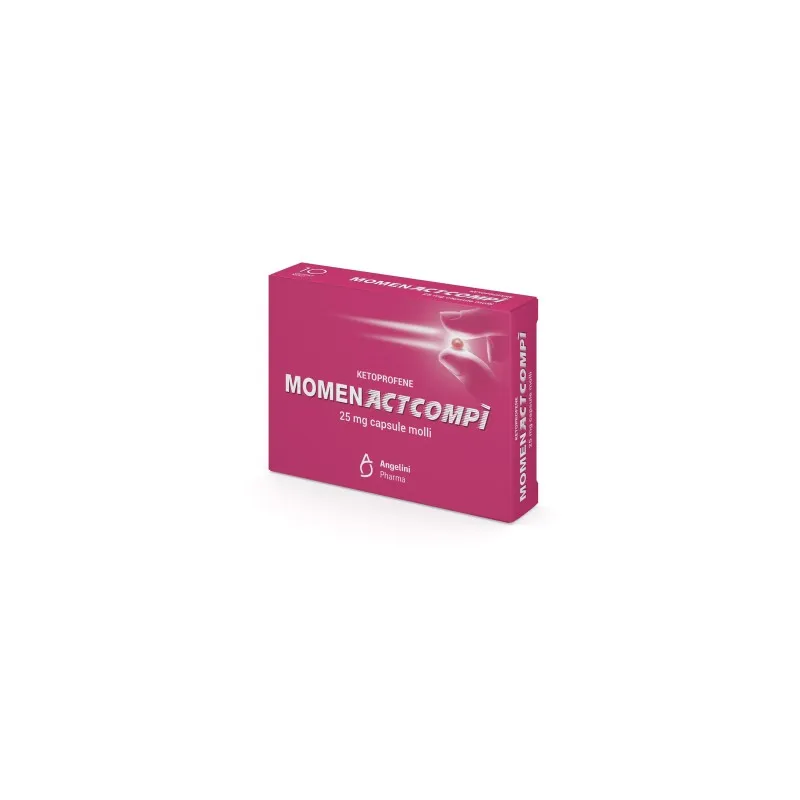
Table of Contents
PACKAGE LEAFLET: INFORMATION FOR THE USER
MOMENACTCOMPÌ 25 mg soft capsules
Ketoprofen
Read this leaflet carefully before taking this medicine because it contains
important information for you.
Always take this medicine exactly as described in this leaflet or as your doctor or
pharmacist has instructed.
- Keep this leaflet. You may need to read it again.
- If you need more information or advice, consult your pharmacist.
- If you experience any side effects, including those not listed in this leaflet, contact your doctor or pharmacist. See section 4.
- Consult your doctor if you do not notice improvement or if your symptoms worsen after three days.
Contents of this leaflet:
- What MOMENACTCOMPÌ is and what it is used for
- What you need to know before taking MOMENACTCOMPÌ
- How to take MOMENACTCOMPÌ
- Possible side effects
- How to store MOMENACTCOMPÌ
- Contents of the pack and other information
1. What MOMENACTCOMPÌ is and what it is used for
MOMENACTCOMPÌ contains the active substance ketoprofen, which belongs to a group of
medicines called non-steroidal anti-inflammatory drugs (NSAIDs) with analgesic and
anti-inflammatory properties.
MOMENACTCOMPÌ is used in adults and adolescents over 15 years of age for the treatment of pain of
various origin or nature (headache, toothache, neuralgia, menstrual pain, bone and
joint (musculoskeletal) pain, and muscular pain).
Consult your doctor if you do not feel better or if you feel worse after three days.
2. What you should know before taking MOMENACTCOMPÌ
Do not take MOMENACTCOMPÌ
- If you are allergic to the active substance or to any of the ingredients of this medicine, such as peanuts or soy (listed in section 6)
- If you are allergic or have previously experienced hypersensitivity reactions (such as asthma, bronchospasm, rhinitis, urticaria, etc.) to acetylsalicylic acid or to other anti-inflammatory drugs (known as NSAIDs)
- If you are undergoing intensive diuretic therapy
- If you suffer from severe liver failure (liver cirrhosis, severe hepatitis)
- If you suffer from certain blood disorders (leucopenia and thrombocytopenia)
- If you have active bleeding (active hemorrhage)
- If you are prone to bleeding (hemorrhagic diathesis)
- If you have blood coagulation disorders (hemostatic disorders)
- If you have severe heart failure
- If you suffer from a serious stomach condition known as active peptic ulcer, or have previously experienced gastrointestinal bleeding, ulceration, or perforation
- If the person taking the medicine is a child under 15 years of age.
Warnings and precautions
Consult your doctor or pharmacist before taking MOMENACTCOMPÌ.
You can minimize unwanted effects by using the lowest effective dose for the shortest duration necessary to control your symptoms.
Inform your doctor or pharmacist if you are taking other anti-inflammatory medicines, as you should avoid concomitant use with other NSAIDs.
Consult your doctor or nurse if you have an infection – see the section «Infections» below.
During treatment with MOMENACTCOMPÌ, gastrointestinal bleeding, ulceration, and perforation may occur at any time, without warning symptoms or prior history of serious gastrointestinal events, and these may be fatal. Therefore, if gastrointestinal bleeding (bleeding from the stomach or intestine) occurs, stop treatment with MOMENACTCOMPÌ and contact your doctor immediately.
Exercise particular caution if:
- You are elderly or have a history of peptic ulcer, especially if complicated by bleeding or perforation, as the risk of gastrointestinal bleeding, ulceration, or perforation is higher with higher doses of MOMENACTCOMPÌ;
- You are concurrently using low-dose aspirin or other drugs that may increase the risk of gastrointestinal events. In such cases, you may need to take gastro-protective agents (misoprostol or proton pump inhibitors). If in doubt, consult your doctor or pharmacist;
- You have stomach or intestinal problems, particularly if you are elderly; report any abdominal symptoms to your doctor, especially during the initial stages of treatment;
- You are taking concomitant medications that may increase the risk of ulceration or bleeding, such as oral corticosteroids (cortisone), anticoagulants (blood-thinning drugs such as warfarin), serotonin reuptake inhibitors (antidepressants), or antiplatelet agents (drugs that reduce blood clotting); caution is advised;
- You are a patient with a history of gastrointestinal disease (ulcerative colitis, Crohn’s disease); NSAIDs should be taken with caution, as these conditions may worsen;
- You have an active peptic ulcer;
- You have previously experienced asthmatic or allergic reactions after taking other types of non-steroidal anti-inflammatory drugs (such as acetylsalicylic acid and its derivatives).
Your doctor should carefully monitor you and perform appropriate tests if any of the following conditions apply:
- You suffer from certain blood disorders (leucopenia and thrombocytopenia);
- You suffer from serious heart problems (such as hypertension and/or congestive heart failure);
- You suffer from severe impairment of kidney or liver function;
- You have a predisposition to bleeding;
- You have diabetes mellitus;
- You are receiving concomitant treatment with agents that promote hyperkalemia (e.g., potassium supplements);
- You are elderly, as the likelihood of adverse reactions to NSAIDs is greater, particularly gastrointestinal bleeding and perforation, which may be fatal.
This medicine may cause:
- Serious heart and circulatory problems (arterial thrombotic events, heart attack, or stroke), especially at high doses and with prolonged treatment;
- Serious skin and mucous membrane disorders, even fatal ones, such as exfoliative dermatitis, Stevens-Johnson syndrome, and toxic epidermal necrolysis, which may present with skin and mucous membrane lesions. These may occur especially during the first month of treatment (see section “Possible side effects”);
- Vision problems such as blurred vision (see section “Possible side effects”).
You should also consult your doctor if you are a heavy smoker, have had previous episodes of stroke, have diabetes, or have high blood cholesterol levels.
If after three days of treatment you do not notice a reduction in pain, consult your doctor.
Infections
MOMENACTCOMPÌ may mask symptoms of infections such as fever and pain. Therefore, MOMENACTCOMPÌ may delay appropriate treatment of the infection, potentially increasing the risk of complications. This has been observed in bacterial pneumonia and bacterial skin infections associated with chickenpox. If you take this medicine while having an infection and infection symptoms persist or worsen, contact your doctor immediately.
Children and adolescents
This medicine must not be taken by children and adolescents under 15 years of age.
Other medicines and MOMENACTCOMPÌ
Inform your doctor or pharmacist if you are taking, have recently taken, or might take any other medicines.
Avoid taking the following medicines together with MOMENACTCOMPÌ:
- Other non-steroidal anti-inflammatory drugs (NSAIDs) (see section “Warnings and precautions”);
- Medicines that thin the blood (anticoagulants, e.g., heparin, warfarin, antiplatelet agents such as ticlopidine and clopidogrel, or other salicylates) (see sections “Do not take MOMENACTCOMPÌ” and “Warnings and precautions”);
- Lithium, used to treat depression or similar disorders;
- Methotrexate (a medicine used to treat rheumatoid arthritis and cancer) at high doses (15 mg per week).
Take MOMENACTCOMPÌ with caution if you are taking any of the following medicines:
- Medicines that increase potassium levels in the blood, such as potassium salts, potassium-sparing diuretics, ACE inhibitors, angiotensin II receptor antagonists, NSAIDs, heparin (low molecular weight or unfractionated), cyclosporine, tacrolimus, and trimethoprim;
- Diuretic medicines used to promote urine elimination (see sections “Do not take MOMENACTCOMPÌ” and “Warnings and precautions”);
- Medicines for high blood pressure (ACE inhibitors and angiotensin II antagonists), especially if you are elderly and drink little water (are dehydrated);
- Low-dose methotrexate (less than 15 mg per week);
- Corticosteroids (medicines used for inflammation);
- Pentoxifylline, a medicine used for circulatory problems;
- Tenofovir, a medicine used to treat certain viral infections.
Your doctor should monitor you and may reduce the dose of ketoprofen if you are taking any of the following medicines:
- Medicines used to treat high blood pressure, such as beta-blockers and angiotensin-converting enzyme inhibitors;
- Thrombolytics and antiplatelet agents, used for blood clotting disorders;
- Selective serotonin reuptake inhibitors (SSRIs) (see section “Warnings and precautions”);
- Probenecid, a medicine used for gout;
- Gemeprost, a medicine used in gynecological procedures;
- Intrauterine contraceptive devices (IUDs); the effectiveness of the device may be reduced, leading to pregnancy.
Pregnancy, breastfeeding, and fertility
If you are pregnant, suspect you may be pregnant, are planning a pregnancy, or are breastfeeding, consult your doctor or pharmacist before taking this medicine.
Pregnancy
Do not take MOMENACTCOMPÌ during the last three months of pregnancy, as it may harm the fetus or cause problems during delivery. It may cause kidney and heart problems in the fetus. It may affect your and your baby’s tendency to bleed and may delay or prolong labor beyond the expected duration. You should not take MOMENACTCOMPÌ during the first six months of pregnancy unless absolutely necessary and under medical advice. If treatment is required during this period or during attempts to conceive, the lowest possible dose for the shortest possible time should be used. From week 20 of pregnancy, MOMENACTCOMPÌ may cause kidney problems in the fetus if taken for more than a few days, reducing amniotic fluid levels surrounding the baby (oligohydramnios) or causing narrowing of a blood vessel (ductus arteriosus) in the baby’s heart. If treatment is needed for more than a few days, your doctor may recommend additional monitoring.
Breastfeeding
Do not take MOMENACTCOMPÌ while breastfeeding.
Fertility
MOMENACTCOMPÌ may cause fertility problems in women. Inform your doctor if you are planning a pregnancy or need fertility testing, as this medicine may reduce your fertility and affect test results.
Driving and using machines
While taking MOMENACTCOMPÌ, symptoms such as drowsiness, dizziness, vertigo, seizures, or visual disturbances may occur.
Therefore, if these occur, avoid driving, operating machinery, or performing activities requiring special alertness.
MOMENACTCOMPÌ contains sorbitol, ethyl p-hydroxybenzoate sodium, propyl p-hydroxybenzoate sodium, and soybean oil.
- Sorbitol: This medicine contains 3 mg of sorbitol per capsule, equivalent to 0.18 mg/kg/day. The additive effect of co-administered medicines containing sorbitol (or fructose) and daily dietary intake of sorbitol (or fructose) should be considered. The sorbitol content in oral medicines may alter the bioavailability of other co-administered oral medicines.
- Ethyl p-hydroxybenzoate sodium (E215) and propyl p-hydroxybenzoate sodium (E217): may cause allergic reactions (including delayed reactions).
- Sodium: MOMENACTCOMPÌ contains less than 1 mmol (23 mg) of sodium per capsule, i.e., essentially “sodium-free”.
- Soybean oil: MOMENACTCOMPÌ contains soybean oil. If you are allergic to peanuts or soy, do not take this medicine.
3. How to take MOMENACTCOMPÌ
Take this medicine exactly as described in this leaflet or as directed by your doctor or pharmacist. If you have any doubts, consult your doctor or pharmacist.
Adults and adolescents over 15 years: one capsule as a single dose or repeated 2–3 times daily in more intense pain conditions, preferably with food. Do not exceed the recommended doses.
The lowest effective dose for the shortest duration necessary to relieve symptoms should be used.
If you have an infection, contact your doctor immediately if symptoms (for example, fever and pain) persist or worsen (see section 2).
Special populations
Patients with renal impairment and elderly patients
If you are a patient with renal impairment or if you are elderly, your doctor may prescribe a lower dose than normally used. Therefore, follow your doctor’s instructions carefully.
Patients with hepatic impairment
If you are a patient with mild or moderate hepatic impairment, you must be closely monitored by your doctor, who will prescribe the lowest effective dose for you (see sections “Do not take MOMENACTCOMPÌ” and “Warnings and precautions”).
Children and adolescents
This medicine must not be used in children and adolescents under 15 years of age.
If you take more MOMENACTCOMPÌ than you should
In case of accidental ingestion/overdose of MOMENACTCOMPÌ, contact your doctor immediately or go to the nearest hospital.
If you have taken or are taking an excessive dose of MOMENACTCOMPÌ, you may experience symptoms such as headache, dizziness, confusion and loss of consciousness, as well as stomach pain, nausea and vomiting. You may also experience episodes of bleeding from the stomach and intestines (gastrointestinal haemorrhage), low blood pressure (hypotension), breathing difficulties (respiratory depression), and bluish-purple discoloration of the skin and mucous membranes (cyanosis).
If you forget to take MOMENACTCOMPÌ
Do not take a double dose to make up for a missed dose.
If you have any doubts about how to use MOMENACTCOMPÌ, consult your doctor or pharmacist.
4. Possible side effects
Like all medicines, this medicine can cause side effects, although not everybody gets them.
Stop using MOMENACTCOMPÌ and contact your doctor immediately if you experience:
- swelling due to fluid retention (oedema)
- severe increase in blood pressure (hypertension) and reduced heart function (heart failure)
- presence of digested blood in stools (as this may be a symptom of intestinal perforation or bleeding, potentially fatal, especially in elderly patients)
- severe abdominal pain (which may be a symptom of pancreatitis)
- vomiting blood (as this may be a symptom of stomach perforation or bleeding, potentially fatal, especially in elderly patients)
- worsening of colitis (inflammation of the colon) and Crohn's disease, sometimes fatal, particularly in the elderly. MOMENACTCOMPÌ, as well as other non-steroidal anti-inflammatory drugs (NSAIDs), is associated with a small increased risk of heart attack ("myocardial infarction") or stroke.
The most commonly observed adverse events with MOMENACTCOMPÌ are:
Common (may affect up to 1 in 10 people):
- stomach (peptic) ulcers
- perforation or bleeding of the stomach and intestine (gastrointestinal), sometimes fatal, particularly in the elderly
- digestive problems (dyspepsia)
- abdominal pain
- nausea, vomiting.
Uncommon (may affect up to 1 in 100 people):
- diarrhoea
- excessive intestinal gas production (flatulence)
- constipation
- inflammation of the stomach (gastritis)
- skin rash, itching
- headache, dizziness, vertigo, somnolence
- fatigue.
Rare (may affect up to 1 in 1,000 people):
- inflammation of the mouth with painful sores (ulcerative stomatitis)
- stomach ulcer
- inflammation of the colon (colitis)
- asthma attacks
- tingling in the limbs (paraesthesia)
- blurred vision
- ringing in the ears (tinnitus)
- inflammation of the liver (hepatitis), yellowing of the skin and the white part of the eye (jaundice)
- abnormal liver function tests (increased transaminase levels, increased serum bilirubin)
- reduction in red blood cells (anaemia) caused by bleeding
- reduction in certain white blood cells (leucopenia)
- weight gain.
Not known (frequency cannot be estimated from the available data):
- increased sensitivity to light (photosensitivity reactions), rare with systemic administration
- skin problems (cutaneous rash)
- hair loss
- urticaria
- swelling of the face and throat (angioedema)
- erythema, blistering skin reactions (including Stevens-Johnson syndrome) and Toxic Epidermal Necrolysis (a severe skin disease with extensive peeling, potentially fatal), pustule formation
- tightness in the chest with difficulty breathing (bronchospasm), particularly in patients with known hypersensitivity to acetylsalicylic acid (ASA) and other NSAIDs, rhinitis, difficulty breathing (dyspnoea)
- aseptic meningitis (inflammation of the meninges not caused by bacteria)
- seizures
- taste disturbances (dysgeusia)
- abnormal kidney function tests, acute kidney failure, tubulointerstitial nephritis, loss of nutrients (such as proteins) through urine (nephrotic syndrome)
- reduction in granulocytes leading to increased risk of infections (agranulocytosis), reduction in platelet count in blood (thrombocytopenia), reduced production of blood cells by the bone marrow (bone marrow aplasia), destruction of red blood cells (haemolytic anaemia)
- anaphylactic reactions (including shock)
- depression, hallucinations, confusion, mood alterations
- heart failure, atrial fibrillation, palpitations and tachycardia
- hypertension, vasodilation, inflammation of blood vessels (vasculitis including leukocytoclastic vasculitis)
- hyponatraemia (reduced sodium levels in blood), hyperkalaemia (increased potassium levels in blood).
Clinical studies and epidemiological data suggest that the use of some NSAIDs (especially at high doses and for long-term treatment) may be associated with a small increased risk of arterial thromboembolic events (e.g. myocardial infarction or stroke).
Reporting of suspected adverse reactions
Reporting suspected adverse reactions after the medicine has been authorised is important, as it allows continuous monitoring of the benefit-risk balance of the medicine. Healthcare professionals are encouraged to report any suspected adverse reactions via the national reporting system at the following website:
https://www.aifa.gov.it/content/segnalazioni-reazioni-avverse
By reporting side effects, you can help provide more information on the safety of this medicine.
5. How to store MOMENACTCOMPÌ
This medicinal product does not require any special storage conditions.
Keep this medicine out of the sight and reach of children.
Do not use this medicinal product after the expiry date stated on the packaging after "Exp.".
The expiry date refers to the last day of that month.
Do not dispose of any medicine via wastewater or household waste. Ask your pharmacist how to dispose of medicines you no longer use. This will help protect the environment.
6. Package contents and other information
What MOMENACTCOMPÌ contains
One capsule:
- The active substance is: ketoprofen 25 mg;
- The other components are: vegetable oil, partially hydrogenated oils, soybean oil, yellow wax, soy lecithin.
Capsule shell constituents:
Gelatin, glycerol (E422), sorbitol (E420) special solution, ethyl p-hydroxybenzoate sodium,
propyl p-hydroxybenzoate sodium (E217), titanium dioxide (E171), red iron oxide (E172), purified water.
Description of the appearance of MOMENACTCOMPÌ and the contents of the pack
MOMENACTCOMPÌ is available as soft capsules.
MOMENACTCOMPÌ 25 mg is available in packs of 10, 20 and 30 soft capsules in PVC-PVDC/Al blisters.
Marketing Authorization Holder
Angelini Pharma S.p.A.
Viale Amelia, 70
00181 Rome
Manufacturer
GENETIC S.p.A – Contrada Canfora – 84084 Fisciano (SA)
This leaflet was last updated on