Miovisin
Italy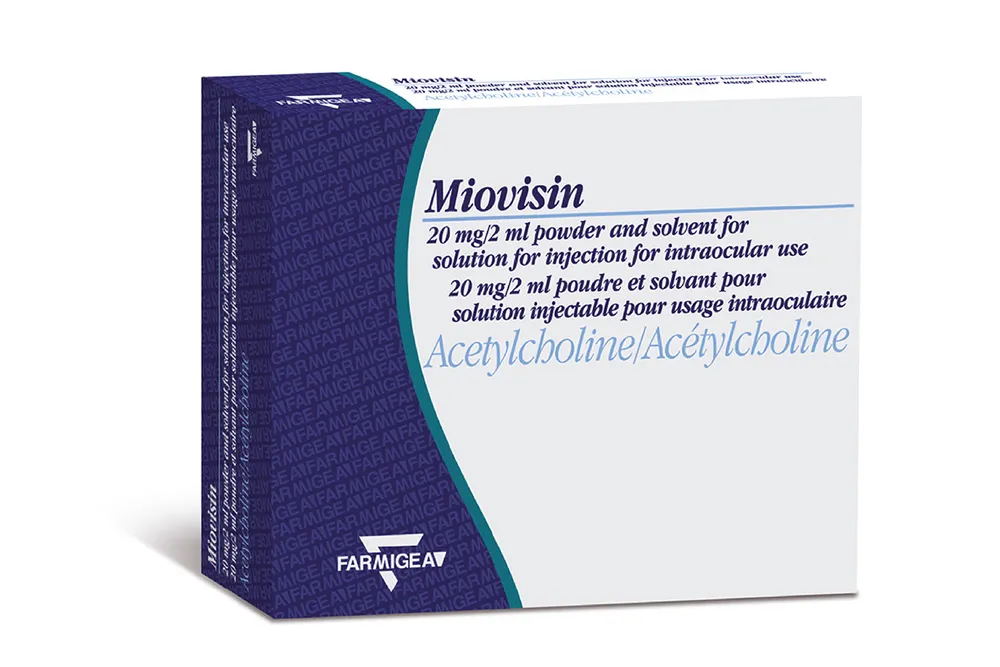
Table of Contents
- Package leaflet: Information for the patient
- Miovisin 20mg/2ml powder and solvent for injectable solution for intraocular use
- 1. What Miovisin is and what it is used for
- 2. What you need to know before Miovisin is administered to you
- 3. How to use Miovisin
- 4. Possible side effects
- 5. How to store Miovisin
- 6. Package contents and other information
Package leaflet: Information for the patient
Miovisin 20mg/2ml powder and solvent for injectable solution for intraocular use
Acetylcholine chloride
Please read this leaflet carefully before this medicine is administered to you because it contains
important information for you.
- Keep this leaflet. You may need to read it again.
- If you have any questions, ask your doctor, pharmacist or nurse.
- If you experience any side effects, including those not listed in this leaflet, tell your doctor, pharmacist or nurse. See section 4.
Contents of this leaflet:
- What Miovisin is and what it is used for
- What you need to know before Miovisin is administered to you
- How to use Miovisin
- Possible side effects
- How to store Miovisin
- Contents of the pack and other information
1. What Miovisin is and what it is used for
Miovisin contains the active substance acetylcholine chloride and belongs to a group of medicines called
parasympathomimetic miotics.
Miovisin is a locally-acting medicine administered during eye surgery to promote pupil constriction (miotic effect) when required.
2. What you need to know before Miovisin is administered to you
Miovisin must not be administered to you if:
- you are allergic to acetylcholine chloride or to any of the other ingredients of this medicine (listed in section 6);
- you are pregnant or think you might be pregnant (see "Pregnancy and breastfeeding").
Warnings and precautions
Talk to your doctor, pharmacist, or nurse before Miovisin is administered to you.
Acetylcholine administered into the eye (by intraocular route) must be used with caution in patients with:
- heart failure,
- bronchial asthma,
- hyperthyroidism,
- urinary tract obstruction,
- Parkinsonism.
Aqueous acetylcholine chloride solution is unstable and must therefore be prepared immediately before use (see "How to use Miovisin").
This medicine must be used exclusively by intraocular route (see "How to use Miovisin").
Before using Miovisin, it may be necessary to remove anatomical obstructions from the eye, such as anterior and posterior synechiae (adhesions forming between the iris and other structures of the anterior chamber of the eye following inflammatory processes involving the iris).
Intraocular irrigation must be performed slowly; a strong stream of solution may cause rupture of the membrane surrounding the vitreous, called the hyaloid membrane, vitreous detachment, or trauma or perforation of the iris.
Dissolve the contents of one vial of lyophilisate with one vial of solvent immediately before use (see "How to use Miovisin").
Other medicines and Miovisin
Inform your doctor or pharmacist if you are taking, have recently taken, or might take any other medicines.
Severe breathing problems (bronchospasm) have been reported after intraocular injection in patients treated with metoprolol, a medicine used to lower blood pressure.
Acetylcholine may be ineffective as a miotic agent when used in patients previously treated with non-steroidal anti-inflammatory drugs (NSAIDs).
Pregnancy and breastfeeding
If you are pregnant, think you may be pregnant, planning to become pregnant, or are breastfeeding, consult your doctor or pharmacist before this medicine is administered to you.
The safety and efficacy of Miovisin during pregnancy and breastfeeding have not been established.
In pregnant women, this medicine should be administered only if clearly needed and under direct medical supervision.
Driving and using machines
Possible temporary effects, such as blurred vision due to the osmotic effect of mannitol, may interfere with the ability of some patients to drive and/or operate machinery.
3. How to use Miovisin
This medicine will be administered by a doctor. If you have any doubts, consult your doctor or pharmacist.
Miovisin is a medicine for exclusive intraocular use.
The recommended dose ranges from a portion to the entire content of the vial (0.5–2 ml) (obtained by mixing one vial of powder with one vial of solvent).
Instructions for administration:
- open the vial by holding the neck and placing the thumb on the white spot,
- dissolve the contents of one vial of powder with one vial of solvent immediately before use,
- slowly instill the contents of the vial into the anterior chamber of the eye.
After administration, miosis occurs rapidly and persists for approximately 20 minutes.
This medicine must not be mixed with other medicinal products.
If you receive more Miovisin than you should
If you think you have been given an excessive dose of Miovisin, inform your doctor immediately.
If you have any doubts about how to use this medicine, consult your doctor or nurse.
4. Possible side effects
Like all medicines, this medicine can cause side effects, although not everybody gets them.
The following side effects have been reported:
Frequency not known (frequency cannot be estimated from the available data)
- low blood pressure (hypotension), slowed heart rate (bradycardia);
- hot flushes;
- difficulty breathing;
- corneal clouding, corneal swelling (edema), malfunction of a part of the cornea called endothelium (persistent bullous keratopathy);
- inflammation of a part of the eye called the iris following surgical procedure;
- weakening (atrophy) of the iris, particularly in case of excessive concentrations of acetylcholine chloride;
- detachment of a membrane in the eye called the retina;
- temporary clouding of a part of the eye called the lens due to the presence of mannitol (one of the components of this medicine);
- sweating.
As with all miotics, retinal detachment may very rarely occur in particularly susceptible individuals.
Reporting of side effects
If you experience any side effects, including those not listed in this leaflet, tell your doctor, pharmacist or nurse.
You can also report side effects directly via the national reporting system at: http://www.agenziafarmaco.gov.it/it/responsabili .
By reporting side effects, you can help provide more information on the safety of this medicine.
5. How to store Miovisin
Keep this medicine out of the sight and reach of children.
Do not use this medicine after the expiry date stated on the packaging after "Exp.". The expiry date refers to the last day of that month.
The expiry date refers to the product in its original, undamaged packaging, correctly stored.
The aqueous solution of acetylcholine chloride is unstable and must therefore be prepared immediately before use (see "How to use Miovisin").
Do not dispose of any medicine via wastewater or household waste. Ask your pharmacist how to dispose of medicines you no longer use. This will help protect the environment.
6. Package contents and other information
What Miovisin contains
- The active substance is acetylcholine chloride. Each powder vial contains 20 mg of acetylcholine chloride and each solvent vial contains 2 ml of water for injections.
- The other component is mannitol.
Description of the appearance of Miovisin and package contents
Miovisin is supplied as a powder and solvent for injectable solution for intraocular use.
The pack contains 6 powder vials + 6 solvent vials of 2 ml.
Marketing Authorization Holder
Farmigea S.p.A. - Via Giovan Battista Oliva, 6/8 - 56121 Pisa
Manufacturer
Alfa Wassermann S.p.A - Via Enrico Fermi, 1 - 65020 Alanno (Pescara)
Farmigea S.p.A. - Via Giovan Battista Oliva, 6/8 - 56121 Pisa