Mesalazine Dorom
Italy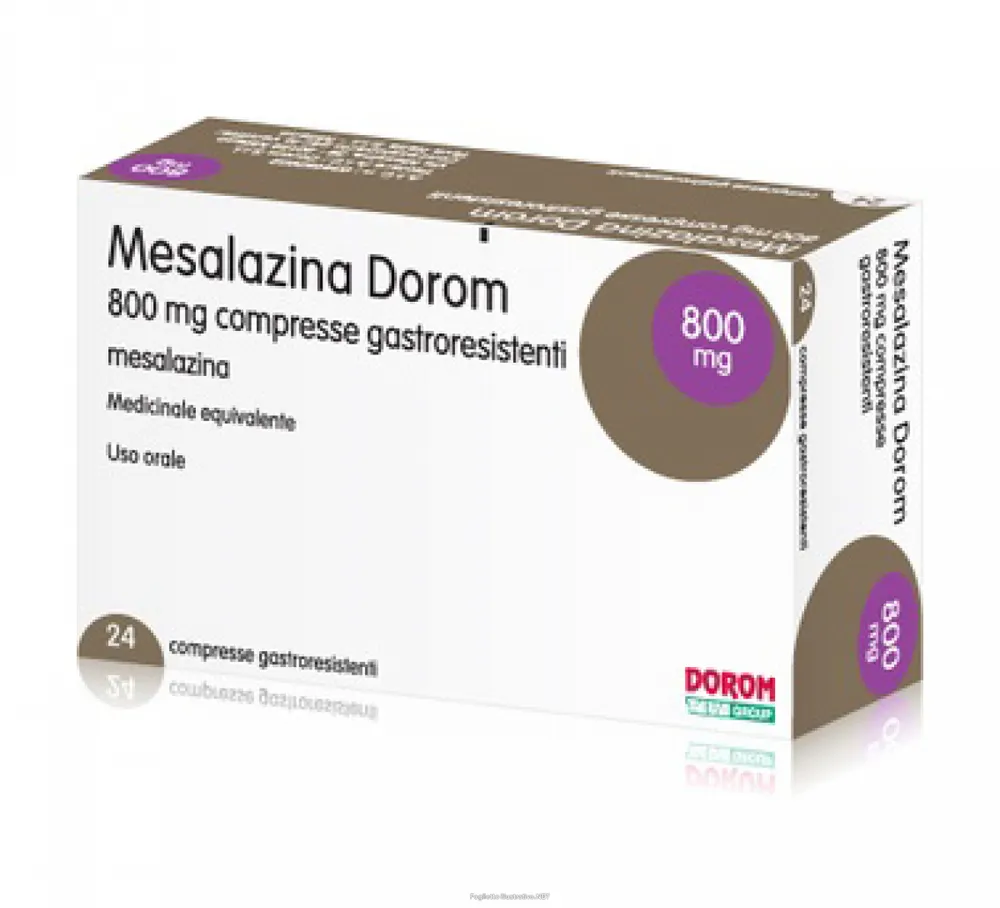
Table of Contents
- Package leaflet: information for the patient
- Mesalazina Dorom 400 mg gastro-resistant tablets, 800 mg gastro-resistant tablets
- 1. What Mesalazina Dorom is and what it is used for
- 2. What you need to know before taking Mesalazina Dorom
- 3. How to take Mesalazina Dorom
- 4. Possible adverse reactions
- 5. How to store Mesalazina Dorom
- 6. Package contents and other information
Package leaflet: information for the patient
Mesalazina Dorom 400 mg gastro-resistant tablets, 800 mg gastro-resistant tablets
mesalazine
Equivalent medicine
Please read all of this leaflet carefully before taking this medicine because it contains
important information for you.
- Keep this leaflet. You may need to read it again.
- If you have any questions, ask your doctor or pharmacist.
- This medicine has been prescribed for you only. Do not give it to other people, even if their symptoms are the same as yours, because it could be harmful.
- If you experience any side effects, including those not listed in this leaflet, tell your doctor or pharmacist. See section 4.
Contents of this leaflet:
- What Mesalazina Dorom is and what it is used for
- What you need to know before taking Mesalazina Dorom
- How to take Mesalazina Dorom
- Possible side effects
- How to store Mesalazina Dorom
- Contents of the pack and other information
1. What Mesalazina Dorom is and what it is used for
Mesalazina Dorom is a medicine containing mesalazine, an active substance with anti-inflammatory properties that acts on the terminal portion of the intestine. This medicine is therefore used to reduce symptoms and to prevent complications and relapses in diseases such as Ulcerative Colitis and Crohn's Disease, in which the intestine is particularly inflamed and may present even severe lesions.
In the treatment of acute phases of these diseases, your doctor may advise you to combine Mesalazina Dorom with other anti-inflammatory medicines called corticosteroids.
Talk to your doctor if you do not feel better or if you feel worse.
2. What you need to know before taking Mesalazina Dorom
Do not take Mesalazina Dorom
- if you are allergic to the active substance, to similar substances (salicylates), or to any of the other ingredients of this medicine (listed in section 6);
- if you suffer from stomach or duodenal diseases characterized by open bleeding wounds (gastric ulcers, duodenal ulcers, or peptic ulcer);
- if you have severe kidney or liver disease;
- if you have a personal predisposition to bleeding (hemorrhagic diathesis);
- for administration in children under 6 years of age;
- during the last weeks of pregnancy and while breastfeeding.
Tell your doctor before using mesalazine
- if you have ever developed a severe skin rash, skin peeling, blisters, and/or mouth ulcers after taking mesalazine.
Warnings and precautions
Talk to your doctor or pharmacist before taking Mesalazina Dorom.
During active phases of severe diseases, your doctor may decide to combine mesalazine with other potent anti-inflammatory drugs called corticosteroids, administered systemically (i.e., so that the drug can reach all parts of the body).
Symptoms of the disease may recur after discontinuation of treatment or during maintenance therapy, especially if inadequate.
In patients with particularly slow digestion or those with narrowing of the valve between the stomach and intestine (pyloric stenosis), mesalazine may be partially released in the stomach rather than directly in the intestine. This phenomenon may cause irritation of the stomach lining and reduce the effectiveness of the drug.
Mesalazine may cause a red-brown discoloration of urine after contact with sodium hypochlorite contained in bleach present in toilet water. This is due to a harmless chemical reaction between mesalazine and bleach.
Stop treatment promptly (see also section “Possible side effects”):
- if allergic-type reactions occur;
- in case of suspected acute intolerance syndrome, which may present with symptoms such as cramps, acute abdominal pain and bloody diarrhea, sometimes accompanied by fever, headache, and erythema.
If you experience severe or recurrent headache, vision disturbances, or ringing or buzzing in the ears, contact your doctor immediately.
Exercise particular caution with mesalazine
Serious skin adverse reactions have been reported in association with mesalazine treatment, including drug reaction with eosinophilia and systemic symptoms (DRESS), Stevens-Johnson syndrome (SJS), and toxic epidermal necrolysis (TEN). Stop taking mesalazine and contact your doctor immediately if you notice any of the symptoms related to these serious skin reactions described in section 4.
Before starting mesalazine therapy, your doctor will perform all necessary tests to correctly diagnose your condition (e.g., blood and urine tests).
Your doctor may decide to carry out regular monitoring, even during treatment, to check your health status, for example if you suffer from lung diseases such as asthma, or if you previously experienced adverse effects after taking sulfasalazine.
Mesalazine use may lead to the formation of kidney stones. Symptoms may include pain in the sides of the abdomen and blood in the urine. It is recommended to drink an adequate amount of fluids during mesalazine treatment.
Your doctor will carefully evaluate your health status and prescribe mesalazine only if strictly necessary, especially if you have kidney or liver problems, myocarditis or pericarditis, or if you are already taking medications for diabetes (oral hypoglycemics), diuretics (medicines that help eliminate excess fluid in urine), anticoagulants (coumarins), or anti-inflammatory drugs (corticosteroids). See also the next section “Other medicines and Mesalazina Dorom”.
Prolonged use may lead to sensitization phenomena (allergies). If you have any doubts about using this medicine, consult your doctor or pharmacist.
Children and adolescents
Avoid use of this medicine in children under 6 years of age.
Other medicines and Mesalazina Dorom
Inform your doctor or pharmacist if you are taking, have recently taken, or might take any other medicines.
Taking mesalazine may enhance the effect of the following medicines:
- medicines used to treat diabetes (such as sulfonylureas).
Taking mesalazine may interfere with the proper functioning of the following medicines:
- anticoagulant drugs that help thin the blood (coumarins);
- anticancer drugs (methotrexate);
- medicines used to treat or prevent gout (probenecid and sulfinpyrazone);
- diuretic medicines that help eliminate excess fluid in urine (spironolactone and furosemide);
- certain antibiotics (rifampicin);
- non-steroidal anti-inflammatory drugs (NSAIDs);
- azathioprine (an anti-inflammatory and immunosuppressive drug).
Mesalazina Dorom should not be taken together with lactulose (a sugar often used to relieve constipation) or other substances capable of lowering intestinal pH, as this may hinder the release of mesalazine from the tablet.
In cases of severe colitis, when mesalazine treatment is combined with corticosteroids, mesalazine may increase the adverse effects of corticosteroids on the stomach. In particular, your doctor may decide to combine topical mesalazine with systemic corticosteroids.
Pregnancy and breastfeeding
If you are pregnant, think you may be pregnant, plan to become pregnant, or are breastfeeding, consult your doctor or pharmacist before taking this medicine.
Pregnancy
Mesalazine should not be taken during the last weeks of pregnancy. During other weeks, it will be prescribed by your doctor only if strictly necessary and under close medical supervision.
Breastfeeding
Mesalazine should not be taken during breastfeeding.
Driving and using machines
This medicine does not affect the ability to drive or operate machinery.
Mesalazina Dorom contains sodium
This medicine contains less than 1 mmol (23 mg) of sodium per dose (per 400 mg or 800 mg tablet), i.e., essentially “sodium-free”.
3. How to take Mesalazina Dorom
Take this medicine exactly as directed by your doctor or pharmacist. If
you have any doubts, consult your doctor or pharmacist.
Your doctor will adjust the dosage according to the extent and severity of your condition.
If you are starting treatment with mesalazine for the first time, the full dose should be reached gradually over several days of therapy, by slowly increasing the dosage.
Use in adults
The recommended dose is 1–2 tablets of 400 mg or one 800 mg tablet three times a
day.
In more severe cases, the dose may be increased up to 10 tablets of 400 mg or 5
tablets of 800 mg per day.
The dose may vary according to your doctor's prescription.
Active phase of the disease
The maximum total daily dose must not exceed 4 g per day.
Maintenance treatment of the disease
A total daily dose of 2 g is recommended.
Use in children and adolescents (aged 6 years and older up to 18 years)
It is generally recommended that half the adult dose be given to children weighing up to 40 kg, and the full adult dose to those weighing more than 40 kg.
Acute phase of the disease
The recommended dose will be determined by the doctor. Normally, treatment is initiated with 30–50 mg/kg per day given in divided doses. The usual maximum dose is 75 mg/kg per day in divided doses.
The total daily dose must not exceed 4 g.
Maintenance phase of the disease
The recommended dose will be determined by the doctor. Normally, treatment is initiated with 15–30 mg/kg per day given in divided doses. The total daily dose must not exceed 2 g/kg per day.
Swallow the tablets whole, without breaking or chewing them, preferably with a glass of water and away from meals.
Duration of treatment
The duration of treatment for acute phases is typically 4–6 weeks, but may vary according to the doctor's judgment based on your health status. In long-term treatment to prevent relapses, the daily dose will be determined by the doctor according to the course of the disease.
If you take more Mesalazina Dorom than you should
Inform your doctor, pharmacist, or go immediately to the nearest hospital if you (or someone else) have taken an excessive amount of this medicine; bring this leaflet with you.
If you forget to take Mesalazina Dorom
Do not take a double dose to make up for the missed tablet.
If you stop taking Mesalazina Dorom
Consult your doctor before stopping treatment with mesalazine.
If you have any doubts about how to use this medicine, contact your doctor or pharmacist.
4. Possible adverse reactions
Like all medicines, this medicine can cause adverse reactions, although not everyone experiences them.
Stop treatment with mesalazine and contact your doctor immediately if you notice any of the
following symptoms:
-
flat red spots on the trunk, target-shaped or circular, often with central blisters, skin peeling, ulcers in the mouth, throat, nose, genitals and eyes,
extensive rash, fever and swollen lymph nodes. These serious skin rashes may be preceded by fever and flu-like symptoms; -
symptoms of a severe allergic reaction such as: difficulty breathing, swelling of the face, eyes, mouth or throat;
-
episodes of acute intestinal intolerance with abdominal pain, bloody diarrhoea, cramps, fever, headache and rash.
Contact your doctor immediately if you experience severe or recurrent headache, visual disturbances, ringing or buzzing in the ears. These could be symptoms of increased pressure inside the skull (idiopathic intracranial hypertension) (frequency cannot be estimated from the available data).
The following adverse reactions may occur during treatment with mesalazine:
Common (may affect up to 1 in 10 people):
- headache*;
- skin reactions;
- nausea*;
- diarrhoea*;
- abdominal discomfort;
- feeling of marked fatigue (asthenia);
- fever;
- hypertension.
Uncommon (may affect up to 1 in 100 people):
- tachycardia;
- drowsiness;
- tremor;
- pruritus;
- upper abdominal pain (epigastric pain);
- diarrhoea with blood;
- abdominal pain*;
- fatigue;
- fluid accumulation in the face (facial oedema);
- hypotension.
Rare (may affect up to 1 in 1,000 people):
- inflammation of the heart (myocarditis, pericarditis);
- dizziness;
- flatulence;
- vomiting;
- increased skin sensitivity to sunlight and ultraviolet light (photosensitivity).
Very rare (may affect up to 1 in 10,000 people):
- allergic reaction (e.g. allergic dermatitis);
- drug fever (rise in body temperature occurring concurrently with taking a medicine, which resolves once the medicine is discontinued);
- development of a chronic autoimmune disease called systemic lupus erythematosus or lupus-like conditions (lupus-like syndrome);
- inflammation of the colon (colitis);
- changes in blood cell counts (aplastic anaemia, agranulocytosis, pancytopenia, neutropenia, leucopenia, thrombocytopenia);
- nerve disorders (peripheral neuropathy);
- hair loss (alopecia);
- changes in liver function tests (elevated transaminases and cholestasis);
- hepatitis (including cholestatic hepatitis);
- inflammation of the pancreas (pancreatitis and acute pancreatitis);
- kidney problems (tubulo-interstitial nephritis, nephrotic syndrome, renal failure);
- respiratory disorder characterised by hardening of the tissue (pulmonary fibrosis and other symptoms including dyspnoea, cough, bronchospasm, alveolitis, eosinophilic pneumonia, pulmonary infiltration, pneumonia and interstitial lung disease);
- painful muscle syndrome (myalgia);
- joint pain (arthralgia);
- decreased number of sperm in semen (oligospermia);
- very high fever (hyperpyrexia);
- gallstones (cholelithiasis).
*especially in patients who do not tolerate similar substances such as sulfasalazine.
Not known (frequency cannot be estimated from the available data):
- excessive fluid accumulation (angioedema);
- kidney stones and associated renal pain (see also section 2).
Reporting of adverse reactions
If you experience any adverse reaction, including those not listed in this leaflet, talk to your doctor or pharmacist. You can also report adverse reactions directly via the national reporting system at:
https://www.aifa.gov.it/content/segnalazioni-reazioni-avverse . By reporting adverse reactions, you can help provide more information on the safety of this medicine.
5. How to store Mesalazina Dorom
Keep this medicine out of the sight and reach of children.
Store below 25°C.
Do not use this medicine after the expiry date stated on the packaging after “Exp.”.
The expiry date refers to the last day of that month.
Do not dispose of any medicine via wastewater or household waste. Ask your pharmacist how to
dispose of medicines no longer in use. This will help protect the environment.
6. Package contents and other information
What Mesalazina Dorom contains
- The active substance is mesalazine. One gastro-resistant tablet contains 400 mg or 800 mg of mesalazine.
- The other ingredients are: within the tablet: maltodextrin, povidone, sodium lauryl sulfate, sodium carboxymethyl starch (Type A), talc, magnesium stearate; in the tablet coating: polyacrylate dispersion 30 percent, sodium hydroxide, triethyl citrate, red iron oxide, yellow iron oxide, titanium dioxide, talc, macrogols.
Description of the appearance of Mesalazina Dorom and package contents
Mesalazina Dorom 400 mg gastro-resistant tablets are supplied in a box containing a blister of 50 or 60 tablets.
Mesalazina Dorom 800 mg gastro-resistant tablets are supplied in a box containing a blister of 24 or 60 tablets.
Marketing Authorisation Holder and Manufacturer
Marketing Authorisation Holder
Teva Italia S.r.l. - Piazzale Luigi Cadorna, 4 - 20123 Milan
Manufacturer
Fine Foods & Pharmaceuticals N.T.M. S.p.A. – Via Grignano, 43 – 24041 Brembate (Bergamo)