Maviret
Italy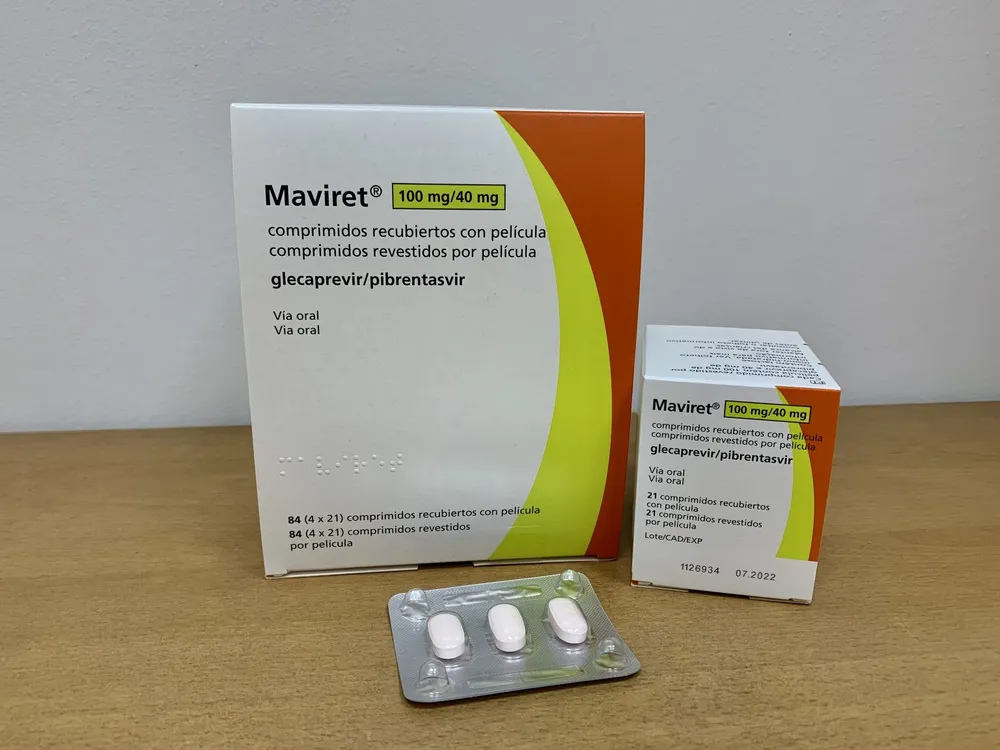
Table of Contents
- Package leaflet: Information for the user
- Maviret 100 mg/40 mg film-coated tablets
- 1. What Maviret is and what it is used for
- 2. What you need to know before taking Maviret
- 3. How to take Maviret
- 4. Possible side effects
- 5. How to store Maviret
- 6. Package contents and other information
- Package leaflet: Information for the user
- Maviret 50 mg/20 mg granulato rivestito in bustina
- 1. What Maviret is and what it is used for
- 2. What you should know before your child takes Maviret
- 3. How to take Maviret
- 4. Possible side effects
- 5. How to store Maviret
- 6. Package contents and other information
- 7. Instructions for use
Package leaflet: Information for the user
Maviret 100 mg/40 mg film-coated tablets
glecaprevir/pibrentasvir
Please read this leaflet carefully before you start taking this medicine because it contains important information for you.
- Keep this leaflet. You may need to read it again.
- If you have any questions, ask your doctor or pharmacist.
- This medicine has been prescribed for you only. Do not pass it on to other people, even if their symptoms are the same as yours, because it may be harmful to them.
- If you experience any side effects, including those not listed in this leaflet, inform your doctor, pharmacist or nurse. See section 4.
Contents of this leaflet
- What Maviret is and what it is used for
- What you need to know before taking Maviret
- How to take Maviret
- Possible side effects
- How to store Maviret
- Contents of the pack and other information
1. What Maviret is and what it is used for
Maviret is an antiviral medicine used to treat adult and pediatric patients aged 3 years and older with chronic hepatitis C. This is an infectious disease affecting the liver, caused by the hepatitis C virus. Maviret contains the active substances glecaprevir and pibrentasvir.
Maviret works by preventing the hepatitis C virus from multiplying and infecting new cells. This helps eliminate the infection from the body.
2. What you need to know before taking Maviret
Do not take Maviret if:
- You are allergic to glecaprevir, pibrentasvir, or any of the other ingredients of this medicine (listed in section 6).
- You have severe liver problems other than hepatitis C.
- You are taking the following medicines:
- atazanavir (for HIV infection)
- atorvastatin or simvastatin (to lower cholesterol levels in the blood)
- carbamazepine, phenobarbital, phenytoin, primidone (commonly used for epilepsy)
- dabigatran etexilate (to prevent blood clots)
- medicines containing ethinylestradiol (e.g. contraceptives, including vaginal rings, transdermal patches, and tablets)
- rifampicin (for infections)
- St John’s wort (Hypericum perforatum) (a herbal remedy used for mild depression).
Do not take Maviret if any of the above conditions apply to you. If you are unsure, consult your doctor, pharmacist, or nurse before taking Maviret.
Warnings and precautions
Talk to your doctor if you have any of the following conditions, as your doctor may decide to monitor you more closely:
- Liver problems other than hepatitis C
- Current or past infection with hepatitis B virus
- You have diabetes. After starting treatment with Maviret, closer monitoring of blood glucose levels and/or adjustment of your antidiabetic treatment may be needed. Some diabetic patients have experienced low blood sugar levels (hypoglycaemia) after starting treatment with medicines such as Maviret.
Blood tests
Your doctor will perform blood tests before, during, and after treatment with Maviret. These tests help your doctor decide:
- Whether you should take Maviret and for how long
- Whether the treatment has been effective and whether you have been cured of hepatitis C virus.
Children
Do not give this medicine to children under 3 years of age or weighing less than 12 kg.
The use of Maviret in children under 3 years of age or weighing less than 12 kg has not yet been studied.
Other medicines and Maviret
Tell your doctor or pharmacist if you are taking, have recently taken, or might take any other medicines.
Tell your doctor or pharmacist before taking Maviret if you are taking any of the medicines listed in the following table. Your doctor may consider it necessary to adjust the dose of these medicines.
| Medicines you must inform your doctor about before taking Maviret | |
| Medicine | Purpose of the medicine |
| ciclosporine, tacrolimus | to reduce immune system activity |
| darunavir, efavirenz, lopinavir, ritonavir | to treat HIV infection |
| digoxin | heart problems |
| fluvastatin, lovastatin, pitavastatin, pravastatin, rosuvastatin | to reduce cholesterol levels in the blood |
| warfarin and other similar medicines* | to prevent blood clots |
* Your doctor may increase the frequency of blood tests to monitor that blood clotting is occurring properly.
If any of the above conditions occur (or if you have any doubts), consult your doctor or pharmacist before taking Maviret.
Pregnancy and contraception
The effects of Maviret during pregnancy are unknown. If you are pregnant, suspect you may be pregnant, or are planning to become pregnant, consult your doctor before taking this medicine, as the use of Maviret during pregnancy is not recommended. Medicinal products containing ethinylestradiol must not be used in combination with Maviret.
Breast-feeding
Inform your doctor before taking Maviret if you are breast-feeding. It is not known whether the two active substances contained in Maviret are excreted in breast milk.
Driving and using machines
Maviret is unlikely to affect the ability to drive or use machines.
Maviret contains lactose
If your doctor has diagnosed you with an intolerance to certain sugars, contact him or her before taking this medicine.
Maviret contains sodium
This medicine contains less than 1 mmol (23 mg) of sodium per tablet, i.e. essentially "sodium-free".
3. How to take Maviret
Take this medicine exactly as your doctor or pharmacist has told you. If you have any doubts, consult your doctor or pharmacist. Your doctor will tell you for how long you should take Maviret. Maviret tablets are intended for adults, adolescents aged 12 years and older, or children weighing 45 kg or more. Maviret granules are intended for children aged 3 years to less than 12 years and weighing between 12 kg and less than 45 kg.
Dosage
The recommended dose for adults, adolescents aged 12 years and older, or children weighing 45 kg or more is three Maviret 100 mg/40 mg tablets taken together once daily.
The three tablets contained in one blister pack represent the daily dose.
How to take it
- Take the tablets with food.
- Swallow the tablets whole.
- Do not chew, split, or crush the tablets, as this may affect the amount of Maviret in the blood.
If you feel unwell (vomit) after taking Maviret, this may affect the amount of Maviret in your blood. This could reduce the effectiveness of Maviret.
- If you vomit within 3 hours of taking Maviret, take another dose.
- If you vomit more than 3 hours after taking Maviret, do not take another dose; wait and take the next dose at the usual time.
If you take more Maviret than you should
If you accidentally take more than the recommended dose, contact your doctor immediately or go to the nearest hospital. Take the medicine pack with you so you can show the doctor what you have taken.
If you forget to take Maviret
It is important not to miss any doses of this medicine.
If you forget a dose, consider how much time has passed since you were supposed to take Maviret:
- If you remember within 18 hours of your usual dosing time, take the missed dose as soon as possible. Then take the next dose at the usual time.
- If you remember after 18 hours or more from your usual dosing time, wait and take only the next dose at the usual time. Do not take a double dose to make up for the missed tablet.
If you have any questions about the use of this medicine, ask your doctor or pharmacist.
4. Possible side effects
Like all medicines, this medicine can cause side effects, although not everyone experiences them.
Tell your doctor or pharmacist if you notice any of the following side effects:
Very common: may affect more than 1 in 10 people
- feeling extremely tired (fatigue)
- headache
Common: may affect up to 1 in 10 people
- feeling unwell (nausea)
- diarrhoea
- feeling weak or lacking in energy (asthenia)
- increased bilirubin (an indicator of liver function)
Uncommon: may affect up to 1 in 100 people
- swelling of the face, lips, tongue, throat, abdomen, arms or legs
Not known: cannot be estimated from the available data
- itching
Reporting of side effects
If you experience any side effect, including those not listed in this leaflet, please contact your doctor or pharmacist. You can also report side effects directly through the national reporting system listed in Annex V. By reporting side effects, you can help provide more information on the safety of this medicine.
5. How to store Maviret
Keep this medicine out of the sight and reach of children.
Do not use this medicine after the expiry date stated on the carton and blister after 'Exp./EXP'. The expiry date refers to the last day of that month.
This medicine requires no special storage conditions.
Do not dispose of medicines via wastewater or household waste. Ask your pharmacist how to dispose of medicines you no longer use. This will help protect the environment.
6. Package contents and other information
What Maviret contains
- The active substances are glecaprevir and pibrentasvir. Each tablet contains 100 mg of glecaprevir and 40 mg of pibrentasvir.
- The other components are:
- Tablet core: copovidone (type K 28), vitamin E polyethylene glycol succinate, anhydrous colloidal silica, propylene glycol monocaprylate (type II), croscarmellose sodium, sodium stearate fumarate.
- Tablet coating: hypromellose (E464), lactose monohydrate, titanium dioxide, macrogol 3350, iron oxide red (E172).
Maviret contains lactose and sodium. See section 2.
Description of the appearance of Maviret and package contents
Maviret tablets are film-coated tablets (tablets) of pink colour, elongated in shape, curved on both sides (biconvex), measuring 18.8 mm x 10.0 mm, with ‘NXT’ engraved on one side.
Maviret tablets are packaged in aluminium blisters, each containing 3 tablets. Maviret is available in a pack containing 84 tablets, comprising 4 cardboard boxes, each containing 21 film-coated tablets.
Marketing Authorisation Holder
AbbVie Deutschland GmbH & Co. KG
Knollstrasse
67061 Ludwigshafen
Germany
Manufacturer
AbbVie Deutschland GmbH & Co. KG
Knollstrasse
67061 Ludwigshafen
Germany
or
AbbVie Logistics B.V
Zuiderzeelaan 53
8017 JV Zwolle
The Netherlands
For further information on this medicinal product, please contact the local representative of the Marketing Authorisation Holder:
België/Belgique/Belgien Lietuva
AbbVie SA AbbVie UAB
Tél/Tel: +32 10 477811 Tel: +370 5 205 3023
България Luxembourg/Luxemburg
АбВи ЕООД AbbVie SA
Тел.: +359 2 90 30 430 Belgique/Belgien
Tél/Tel: +32 10 477811
Česká republika Magyarország
AbbVie s.r.o. AbbVie Kft.
Tel: +420 233 098 111 Tel.: +36 1 455 8600
Danmark Malta
AbbVie A/S V.J.Salomone Pharma Limited
Tlf: +45 72 30-20-28 Tel: +356 22983201
Deutschland Nederland
AbbVie Deutschland GmbH & Co. KG AbbVie B.V.
Tel: 00800 222843 33 (toll-free) Tel: +31 (0)88 322 2843
Tel: +49 (0) 611 / 1720-0
Eesti Norge
AbbVie OÜ AbbVie AS
Tel: +372 623 1011 Tlf: +47 67 81 80 00
Ελλάδα Österreich
AbbVie ΦΑΡΜΑΚΕΥΤΙΚΗ Α.Ε. AbbVie GmbH
Τηλ: +30 214 4165 555 Tel: +43 1 20589-0
España Polska
AbbVie Spain, S.L.U. AbbVie Sp. z o.o.
Tel: +34 91 384 09 10 Tel.: +48 22 372 78 00
France Portugal
AbbVie AbbVie, Lda.
Tél: +33 (0)1 45 60 13 00 Tel: +351 (0)21 1908400
Hrvatska România
AbbVie d.o.o. AbbVie S.R.L.
Tel: +385 (0)1 5625 501 Tel: +40 21 529 30 35
Ireland Slovenija
AbbVie Limited AbbVie Biofarmacevtska družba d.o.o.
Tel: +353 (0)1 4287900 Tel: +386 (1)32 08 060
Ísland Slovenská republika
Vistor hf. AbbVie s.r.o.
Sími: +354 535 7000 Tel: +421 2 5050 0777
Italia Suomi/Finland
AbbVie S.r.l. AbbVie Oy
Tel: +39 06 928921 Puh/Tel: +358 (0)10 2411 200
Κύπρος Sverige
Lifepharma (Z.A.M.) Ltd AbbVie AB
Τηλ: +357 22 34 74 40 Tel: +46 (0)8 684 44 600
Latvija United Kingdom (Northern Ireland)
AbbVie SIA AbbVie Deutschland GmbH & Co. KG
Tel: +371 67605000 Tel: +44 (0)1628 561090
Other sources of information
More detailed information on this medicinal product is available on the website of the European Medicines Agency: http://www.ema.europa.eu/.
To listen to or request a copy of this package leaflet in , or
, please contact the local representative of the Marketing Authorisation Holder.
Package leaflet: Information for the user
Maviret 50 mg/20 mg granulato rivestito in bustina
glecaprevir/pibrentasvir
Read this leaflet carefully before the child starts taking this medicine
as it contains important information.
- Keep this leaflet. You may need to read it again.
- If you have any questions, consult the paediatrician or pharmacist.
- This medicine has been prescribed for the child only. Do not give it to other people, even if their symptoms are the same as the child's, because it could be harmful.
- If the child experiences any side effect, including those not listed in this leaflet, consult the paediatrician or pharmacist. See section 4.
Contents of this leaflet
- What Maviret is and what it is used for
- What you need to know before the child takes Maviret
- How to take Maviret
- Possible side effects
- How to store Maviret
- Contents of the pack and other information
- Instructions for use
1. What Maviret is and what it is used for
Maviret is an antiviral medicine used to treat chronic hepatitis C in children aged 3 years and older.
Chronic hepatitis C is an infectious disease affecting the liver, caused by the hepatitis C virus. Maviret contains the active substances glecaprevir and pibrentasvir.
Maviret works by preventing the hepatitis C virus from multiplying and infecting new cells. This allows the infection to be cleared from the body.
2. What you should know before your child takes Maviret
Do not give Maviret if:
- your child is allergic to glecaprevir, pibrentasvir, or any of the other ingredients of this medicine (listed in section 6).
- your child has severe liver problems other than hepatitis C.
- your child is taking any of the following medicines:
- atazanavir (for HIV infection)
- atorvastatin or simvastatin (to lower cholesterol levels in the blood)
- carbamazepine, phenobarbital, phenytoin, primidone (commonly used for epilepsy)
- dabigatran etexilate (to prevent blood clots)
- medicines containing ethinylestradiol (e.g. contraceptives, including vaginal rings, transdermal patches, and tablets)
- rifampicin (for infections)
- St John’s wort (Hypericum perforatum) (a herbal remedy used for mild depression).
Do not give Maviret to your child if any of the conditions listed above apply. If you are unsure, consult your child’s paediatrician or pharmacist before giving Maviret to your child.
Warnings and precautions
Contact your child’s paediatrician if your child has any of the following conditions, as the paediatrician may decide to monitor your child more closely:
- liver problems other than hepatitis C
- current or past hepatitis B virus infection
- diabetes. After starting treatment with Maviret, closer monitoring of blood glucose levels and/or adjustment of antidiabetic treatment may be needed. Some diabetic patients have experienced low blood sugar levels (hypoglycaemia) after starting treatment with medicines such as Maviret.
Blood tests
Your child’s paediatrician will perform blood tests before, during, and after treatment with Maviret.
These tests help the paediatrician determine:
- whether your child should take Maviret and for how long
- whether the treatment has been effective and your child has been cured of hepatitis C virus.
Children under 3 years of age
Do not give this medicine to children under 3 years of age or weighing less than 12 kg.
The use of Maviret in children under 3 years of age or weighing less than 12 kg has not yet been studied.
Other medicines and Maviret
Inform the paediatrician or pharmacist if your child is taking, has recently taken, or might take any other medicines.
Inform the paediatrician or pharmacist before administering Maviret if your child is taking any of the medicines listed in the following table. The paediatrician may consider it necessary to adjust the dose of these medicines.
| Medicines you must inform your pediatrician about before administering Maviret | |
| Medicine | Purpose of the medicine |
| ciclosporin, tacrolimus | to reduce immune system activity |
| darunavir, efavirenz, lopinavir, ritonavir | to treat HIV infection |
| digoxin | heart problems |
| fluvastatin, lovastatin, pitavastatin, pravastatin, rosuvastatin | to reduce cholesterol levels in the blood |
| warfarin and other similar medicines* | to prevent blood clots |
* The pediatrician may increase the frequency of blood tests to monitor that blood clotting is occurring properly.
If any of the above conditions occur (or if you have any doubts), consult the pediatrician or pharmacist before administering Maviret.
Maviret contains lactose
If the pediatrician has diagnosed the child with intolerance to certain sugars, contact them before administering this medicine.
Maviret contains propylene glycol
This medicine contains 4 mg of propylene glycol in each sachet.
Maviret contains sodium
This medicine contains less than 1 mmol (23 mg) of sodium per sachet, i.e. essentially "sodium-free".
3. How to take Maviret
Take this medicine exactly as directed by your paediatrician or pharmacist. If you have any doubts, consult your paediatrician or pharmacist. Maviret granules for oral suspension are intended for children aged 3 years to less than 12 years and weighing between 12 kg and less than 45 kg. Maviret tablets are intended for adults, adolescents aged 12 years and older, or children weighing 45 kg or more.
Your paediatrician will tell you how long your child should take Maviret.
How much to take
The recommended dose for children aged 3 to less than 12 years is based on the child's body weight, as shown in the table below.
| Child's weight (kg) | Number of sachets once daily |
| From 12 to less than 20 kg | 3 sachets |
| From 20 to less than 30 kg | 4 sachets |
| From 30 to less than 45 kg | 5 sachets |
For children weighing 45 kg or more, speak with your paediatrician about the possibility of administering Maviret tablets.
How to take Maviret
- Administer Maviret once daily just before or after a snack or meal.
- Mix all granules contained in the sachet with a small amount of recommended food and have the child swallow the mixture. The granules must not be crushed or chewed (see the instructions for use for the list of recommended foods).
- Do not administer Maviret granules through a feeding tube.
If the child feels unwell (vomits) after taking Maviret, this may affect the amount of Maviret in the blood. This could reduce the effectiveness of Maviret.
- If the child vomits within 3 hours of taking Maviret, administer another dose.
- If the child vomits more than 3 hours after taking Maviret, do not administer another dose until the next scheduled dose.
If the child takes more Maviret than they should
If the child accidentally takes more than the recommended dose, contact your paediatrician immediately or go to the nearest hospital. Take the medicine pack with you so you can show the doctor what the child has taken.
If you forget to administer Maviret
It is important not to miss any doses of this medicine.
If you forget a dose, consider how much time has passed since the child was supposed to take Maviret:
- If you remember within 18 hours of the usual time the child takes Maviret, administer the missed dose as soon as possible. Then give the next dose at the usual time.
- If you remember after 18 hours or more from the usual time the child takes Maviret, wait and administer only the next dose at the usual time. Do not give a double dose to make up for the missed dose. If you have any doubts about using this medicine, consult your paediatrician or pharmacist.
4. Possible side effects
Like all medicines, this medicine may cause side effects, although not everyone gets them.
Tell the paediatrician or pharmacist if you notice any of the following side effects:
Very common: may affect more than 1 in 10 people
- feeling extremely tired (fatigue)
- headache
Common: may affect up to 1 in 10 people
- feeling unwell (nausea)
- diarrhoea
- feeling weak or lacking energy (asthenia)
- increased bilirubin (a marker of liver function)
Uncommon: may affect up to 1 in 100 people
- swelling of the face, lips, tongue, throat, abdomen, arms or legs
Not known: frequency cannot be estimated from the available data
- itching
Reporting of side effects
If the child experiences any side effects, including those not listed in this leaflet, please consult the paediatrician or pharmacist. You may also report side effects directly through the national reporting system detailed in Annex V. By reporting side effects, you can help provide more information on the safety of this medicine.
5. How to store Maviret
Keep this medicine out of the sight and reach of children.
Do not use this medicine after the expiry date stated on the carton and sachet after 'Exp./EXP'. The expiry date refers to the last day of that month.
This medicine does not require any special storage conditions.
Do not dispose of any medicine via wastewater or household waste. Ask your pharmacist how to dispose of medicines you no longer use. This will help protect the environment.
6. Package contents and other information
What Maviret contains
- The active substances are glecaprevir and pibrentasvir. Each sachet contains 50 mg of glecaprevir and 20 mg of pibrentasvir.
- The other components are: Copovidone, tocopherol hydrogen succinate, propylene glycol monocaprylate, colloidal silicon dioxide, sodium croscarmellose (only in glecaprevir granules), sodium stearate fumarate, hypromellose (E464), lactose monohydrate, titanium dioxide, macrogol, iron oxide red (E172), iron oxide yellow (E172).
Maviret contains lactose, propylene glycol and sodium. See section 2.
Description of the appearance of Maviret and contents of the pack
Maviret granules for oral use are supplied in polyester/aluminium/polyethylene sachets contained in cardboard boxes. Each box contains 28 sachets. Each sachet contains pink and yellow granules.
Marketing Authorisation Holder
AbbVie Deutschland GmbH & Co. KG
Knollstrasse
67061 Ludwigshafen
Germany
Manufacturer
AbbVie S.r.l.
S.R. 148 Pontina km 52 SNC
04011 Campoverde di Aprilia (LT)
Italy
For further information about this medicinal product, please contact the local representative of the Marketing Authorisation Holder.
België/Belgique/Belgien Lietuva
AbbVie SA AbbVie UAB
Tél/Tel: +32 10 477811 Tel: +370 5 205 3023
България Luxembourg/Luxemburg
АбВи ЕООД AbbVie SA
Тел.: +359 2 90 30 430 Belgique/Belgien
Tél/Tel: +32 10 477811
Česká republika Magyarország
AbbVie s.r.o. AbbVie Kft.
Tel: +420 233 098 111 Tel.: +36 1 455 8600
Danmark Malta
AbbVie A/S V.J.Salomone Pharma Limited
Tlf: +45 72 30-20-28 Tel: +356 22983201
Deutschland Nederland
AbbVie Deutschland GmbH & Co. KG AbbVie B.V.
Tel: 00800 222843 33 (free of charge) Tel: +31 (0)88 322 2843
Tel: +49 (0) 611 / 1720-0
Eesti Norge
AbbVie OÜ AbbVie AS
Tel: +372 623 1011 Tlf: +47 67 81 80 00
Ελλάδα Österreich
AbbVie ΦΑΡΜΑΚΕΥΤΙΚΗ Α.Ε. AbbVie GmbH
Τηλ: +30 214 4165 555 Tel: +43 1 20589-0
España Polska
AbbVie Spain, S.L.U. AbbVie Sp. z o.o.
Tel: +34 91 384 09 10 Tel.: +48 22 372 78 00
France Portugal
AbbVie AbbVie, Lda.
Tél: +33 (0)1 45 60 13 00 Tel: +351 (0)21 1908400
Hrvatska România
AbbVie d.o.o. AbbVie S.R.L.
Tel: +385 (0)1 5625 501 Tel: +40 21 529 30 35
Ireland Slovenija
AbbVie Limited AbbVie Biofarmacevtska družba d.o.o.
Tel: +353 (0)1 4287900 Tel: +386 (1)32 08 060
Ísland Slovenská republika
Vistor hf. AbbVie s.r.o.
Sími: +354 535 7000 Tel: +421 2 5050 0777
Italia Suomi/Finland
AbbVie S.r.l. AbbVie Oy
Tel: +39 06 928921 Puh/Tel: +358 (0)10 2411 200
Κύπρος Sverige
Lifepharma (Z.A.M.) Ltd AbbVie AB
Τηλ: +357 22 34 74 40 Tel: +46 (0)8 684 44 600
Latvija United Kingdom (Northern Ireland)
AbbVie SIA AbbVie Deutschland GmbH & Co. KG
Tel: +371 67605000 Tel: +44 (0)1628 561090
Other sources of information
More detailed information on this medicinal product is available on the European Medicines Agency website: http://www.ema.europa.eu.
To listen to or request a copy of this package leaflet in , or , please contact the local representative of the Marketing Authorisation Holder.
7. Instructions for use
Read paragraph 7 entirely before using Maviret granules in sachet.
Step 1. Obtain the number of sachets recommended by the pediatrician
| Child's weight (kg) | Number of sachets once daily | Amount of food (approximate) |
| From 12 to less than 20 kg | 3 sachets | About 1–2 teaspoons (5–10 mL) of a recommended food listed in step 2 |
| From 20 to less than 30 kg | 4 sachets | |
| From 30 to less than 45 kg | 5 sachets |
For children weighing 45 kg or more, speak with the pediatrician about the possibility of
administering Maviret tablets.
Do not administer more than 5 sachets.
Step 2. Choose the appropriate food to mix with Maviret granules
Appropriate foods must adhere to the spoon. They should be soft, low in water
content, and able to be swallowed without chewing.
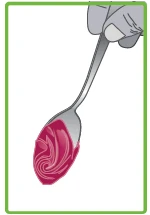
Examples of recommended foods:
- Greek yogurt
- Soft/creamy cheese
- Peanut butter
- Chocolate hazelnut cream
- Thick jam
- Other foods that adhere to the spoon
Note: In addition to mixing the granules with an appropriate food, Maviret must be administered during or immediately after a meal or snack. The food used to mix the granules does not replace the meal or snack that must be taken with Maviret. Do not use foods that drip from the spoon, as the medicine could dissolve quickly, develop a bitter taste, and become less effective. Do not use any food to which the child is allergic.
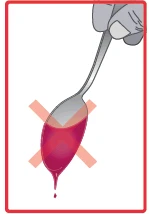
Examples of foods not to use:
✘ Liquids or watery foods
✘ Applesauce
✘ Heated or frozen foods or liquids
✘ Bread or other foods requiring chewing
✘ Non-Greek yogurt
✘ Baby food purees
✘ Food that drips from the spoon
For further information on suitable foods, contact the pediatrician or
pharmacist.
Step 3. Gather the materials
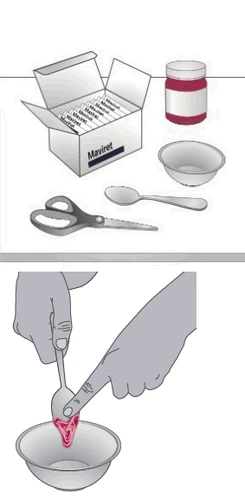
Place the following materials on a clean surface:
- Box containing the sachets
- Soft food
- Container for mixing
- Teaspoon
- Scissors
Step 4. Measure the food
- Place a small amount (1–2 teaspoons or 5–10 mL) of soft food into the container.
- The granules inside the sachets are very small; therefore, placing food in the container first helps contain them.
Step 5. Prepare the sachet
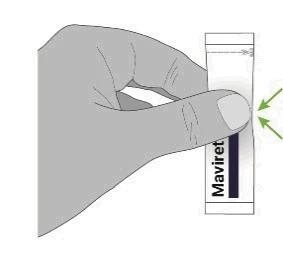
- Locate the dotted line on the sachet to identify the top end.
- Hold the sachet vertically and tap the top portion gently. Continue tapping until all granules have fallen to the bottom.
- Carefully feel the upper part of the sachet to ensure all granules have moved to the lower part.
Step 6. Cut off the top of the sachet
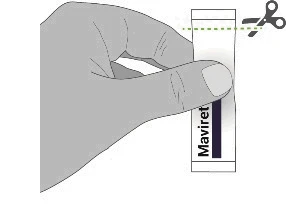
- Grasp the sachet in the center, above the granules inside.
- Using a pair of scissors, cut and completely remove the top portion of the sachet. Be careful: the granules are very small and may easily fall out.
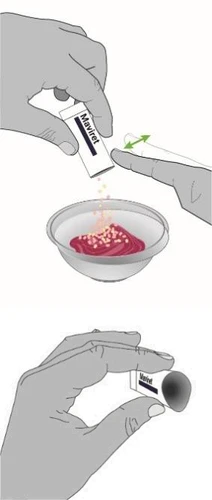
Step 7. Pour the contents of the sachet
- Ensure the sachet is fully open.
- Carefully pour all granules (pink and yellow) into the container with the food.
- Tap the sachet gently to release all granules.
- Repeat this procedure for the number of sachets that make up the child’s daily dose.
Step 8. Check the sachet
Look inside each sachet to make sure no granules remain inside.
Do not leave any granules behind, as the medicine will be less effective if the full dose is not taken.
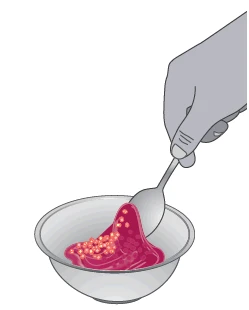
Step 9. Mix
- Using the teaspoon, gently mix the granules with the food.
- Do not crush the granules. If the granules break, they will have a bitter taste.
- Do not store the mixture; administer it immediately to the child. If not given within 5 minutes, the mixture may become bitter. If not administered within 15 minutes, the medicine may become less effective. Discard the mixture and start again.
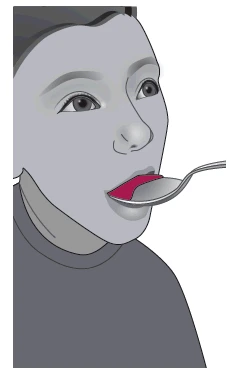
Step 10. Administer the medicine
- Take a small amount of the mixture with the teaspoon.
- Ensure the child swallows the mixture without chewing.
- Repeat until the child has consumed the entire mixture.
- If any granules remain, add more food and mix. Then complete the dose.
- Ensure the child receives the full dose of the medicine.
⚠ If the child misses a dose, refer to section 3, "How to take Maviret," for instructions on what to do.
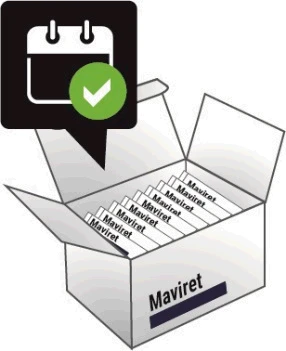
Step 11. Verify that an adequate supply is available for the next day's dose
Check that enough sachets are available for the child’s next dose of Maviret.
For replacement sachets or to renew the prescription, contact the pediatrician or
pharmacist.