LidoFast
Italy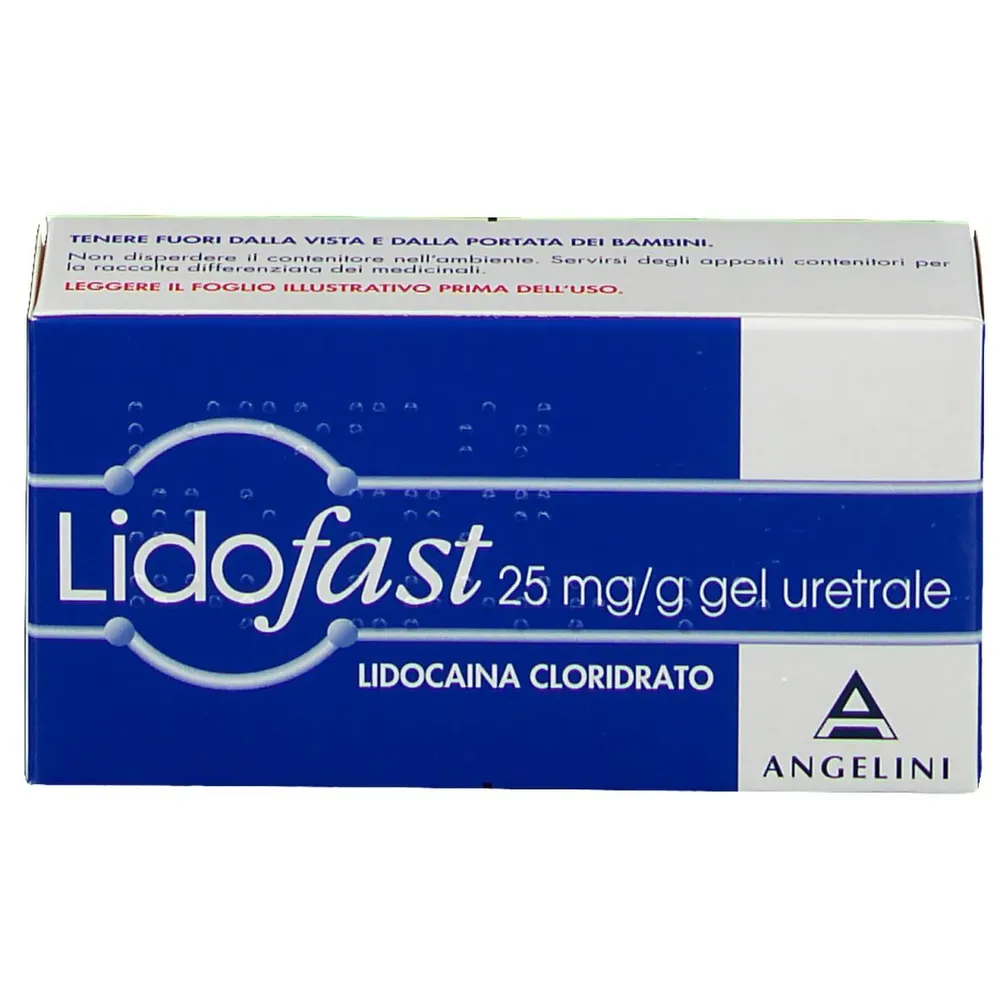
Table of Contents
- Package leaflet: Information for the patient and user
- LIDOFAST 25 mg/g urethral gel, 10 mg/g gel
- 1. What LIDOFAST is and what it is used for
- 2. What you need to know before using LIDOFAST
- 3. How to use LIDOFAST
- 4. Possible side effects
- 5. How to store LIDOFAST
- 6. Contents of the pack and other information
Package leaflet: Information for the patient and user
LIDOFAST 25 mg/g urethral gel, 10 mg/g gel
Lidocaine hydrochloride
Please read this leaflet carefully before using this medicine because it contains
important information for you.
Keep this leaflet. You may need to read it again.
If you have any questions, ask your doctor or pharmacist.
If you experience any side effects, including those not listed in this leaflet,
please contact your doctor or pharmacist. See section 4.
Contents of this leaflet:
- What LIDOFAST is and what it is used for
- What you need to know before using LIDOFAST
- How to use LIDOFAST
- Possible side effects
- How to store LIDOFAST
- Contents of the pack and other information
1. What LIDOFAST is and what it is used for
LIDOFAST is a medicine containing lidocaine, an active ingredient belonging to the group of amide-type local anaesthetics, which works by reducing pain.
LIDOFAST is used for certain medical procedures requiring special instruments (e.g. catheters, endoscopes or dilators), as it reduces pain sensitivity and, being a lubricant, facilitates the procedures. Specifically:
- LIDOFAST 10 mg/g gel is used in endoscopic examinations, such as gastroscopy or bronchoscopy. These examinations are performed using a camera-equipped instrument (endoscope) inserted into the body to diagnose or treat diseases;
- LIDOFAST 25 mg/g urethral gel is used to facilitate procedures performed through the urethra, such as the insertion of a catheter or cystoscopy.
2. What you need to know before using LIDOFAST
Do not use LIDOFAST:
- if you are allergic to the active substance or to other substances closely related from a chemical point of view, for example other amide-type local anaesthetics;
- if you are allergic to any of the other ingredients of this medicine (listed in section 6);
- if you are pregnant or breastfeeding, unless specifically instructed by your doctor (see "Pregnancy and breastfeeding").
Warnings and precautions
Inform your doctor if:
- you have or have recently had trauma or inflammation at the site to be treated;
- you have recently had a severe blood infection (sepsis). In such cases, excessive absorption of the medicine may occur, leading to undesirable effects on the central nervous system and cardiovascular system, especially in children, elderly or debilitated patients.
Other medicines and LIDOFAST
Inform your doctor if you are taking, have recently taken, or might take any other
medicine, as certain drugs may interact with LIDOFAST or increase the risk of
adverse events, even serious ones.
In particular, inform your doctor if you are taking:
- propranolol, a medicine used for heart conditions;
- cimetidine, a medicine used to reduce stomach acidity.
Pregnancy and breastfeeding
If you are pregnant, suspect you may be pregnant, planning a pregnancy, or are breastfeeding,
please consult your doctor or pharmacist before taking this medicine.
LIDOFAST should be used during pregnancy only if clearly needed and under medical advice.
Lidocaine passes into breast milk: if you are breastfeeding, inform your doctor, who will decide whether this medicine should be used.
Driving and using machines
LIDOFAST does not impair the ability to drive or operate machinery.
LIDOFAST contains:
- methyl and propyl parahydroxybenzoate, which may cause allergic reactions (including delayed-type reactions).
LIDOFAST 25 mg/g urethral gel also contains:
- sodium benzoate: This medicine contains 5.6 mg of sodium benzoate per tube (15 g), equivalent to 5.6 mg/15 g. Sodium benzoate may cause local irritation. Sodium benzoate may increase jaundice (yellowing of the skin and eyes) in newborns (up to 4 weeks of age).
LIDOFAST 10 mg/g gel also contains:
- sodium benzoate: This medicine contains 1.125 mg of sodium benzoate per dose (3 g), equivalent to 1.125 mg/3 g. Sodium benzoate may cause local irritation. Sodium benzoate may increase jaundice (yellowing of the skin and eyes) in newborns (up to 4 weeks of age).
- sodium: This medicine contains less than 1 mmol (23 mg) of sodium per dose (3 g), i.e. essentially 'sodium-free'.
3. How to use LIDOFAST
LIDOFAST is a topical gel for local use, which must be administered exclusively by physicians or
healthcare professionals:
- LIDOFAST 10 mg/g gel is applied onto the instrument used for endoscopic examinations;
- LIDOFAST 25 mg/g urethral gel is inserted directly into the urethra using an applicator.
If you are given more LIDOFAST than you should
It is unlikely that excessive doses of LIDOFAST will be used, as this medicine is administered by medical and healthcare personnel. However, if this should happen, you may experience:
tremors and seizures, depression, breathing difficulties, coma, heart problems with
decreased blood pressure and slowed heart rate. In such a case, contact your doctor or nurse
immediately.
4. Possible side effects
Like all medicines, this medicine can cause side effects, although not everybody will experience them.
Inform your doctor if you notice, while using LIDOFAST:
- allergic reactions at the site where the medicine has been applied, presenting as pain, burning, or itching (possible sensitization phenomena);
- severe allergic reactions characterized by the more or less sudden onset of skin lesions, for example discolouration in spots or widespread, itching all over the body, swelling of the face, eyes, lips, tongue and throat with breathing difficulties, swelling of the hands, increased heart rate with possible sudden drop in blood pressure (anaphylactic shock). These side effects occur rarely.
Reporting of side effects
If you experience any side effect, including those not listed in this leaflet, please contact your doctor or pharmacist. You may also report side effects directly through the national reporting system at the following website: https://www.aifa.gov.it/content/segnalazioni-reazioni-avverse.
By reporting side effects, you can help provide further information on the safety of this medicine.
5. How to store LIDOFAST
Keep this medicine out of the sight and reach of children.
This medicine does not require any special storage conditions.
LIDOFAST 10 mg/g gel: After first opening, use the medicine within 12 months.
Do not use this medicine after the expiry date stated on the packaging. The expiry date refers to the last day of that month.
Do not dispose of any medicine via wastewater or household waste. Ask your pharmacist how to dispose of medicines you no longer use. This will help protect the environment.
6. Contents of the pack and other information
What LIDOFAST contains
The active substance is: lidocaine hydrochloride.
100 g of LIDOFAST 10 mg/g gel contains 1 g of lidocaine hydrochloride.
100 g of LIDOFAST 25 mg/g urethral gel contains 2.5 g of lidocaine hydrochloride.
The other components are: sodium carboxymethylcellulose; glycerol; methyl parahydroxybenzoate;
propyl parahydroxybenzoate; sodium benzoate; purified water.
Description of the appearance of LIDOFAST and contents of the pack
LIDOFAST 10 mg/g gel is available in a 100 g aluminum tube with a screw cap.
LIDOFAST 25 mg/g urethral gel is available in a 15 g aluminum tube with a screw cap, supplied with a urethral applicator.
Marketing Authorization Holder
AZIENDE CHIMICHE RIUNITE ANGELINI FRANCESCO - A.C.R.A.F. S.p.A.
Viale Amelia, 70 - 00181 ROMA
Manufacturer
A.C.R.A.F. S.p.A., Via Vecchia del Pinocchio 22 - 60131 ANCONA
The following information is intended exclusively for physicians or healthcare professionals. For further
details, refer to the Summary of Product Characteristics.
The efficacy and safety of lidocaine depend on correct dosing and proper application technique. Therefore, the smallest amount of the preparation necessary to achieve the desired effect should be used, and caution must be exercised when applying it to patients with severely damaged mucous membranes or in the presence of inflammatory processes and sepsis, which may lead to excessive absorption of the active substance.
Excessive absorption of lidocaine may cause adverse effects on the central nervous system and cardiovascular system, especially in children, elderly patients, and debilitated individuals. Therefore, particular care must be taken when using LIDOFAST in these populations.
Prolonged use of the product should be avoided.
Topically applied products, especially if used for extended periods or repeatedly, may lead to sensitization reactions. In such cases, treatment must be discontinued and appropriate therapy initiated.
THERAPEUTIC INDICATIONS
LIDOFAST 25 mg/g urethral gel
For endourethral procedures (insertion of catheters, dilatations, cystoscopies, etc.), combining lubricating and anesthetic effects.
LIDOFAST 10 mg/g gel
For esophagoscopy and curare anesthesia, tracheobronchoscopy, pharyngoscopy, gastroscopy, rectoscopy, and all diagnostic and therapeutic endoscopic procedures. By combining lubricating and anesthetic actions, the product helps prevent spastic reactions and reflexes originating from mucous membranes that come into contact with instruments during endoscopic procedures.
DOSAGE AND ADMINISTRATION
LIDOFAST 25 mg/g urethral gel
Express the gel directly into the urethra by squeezing the tube while simultaneously massaging the posterior urethra. Apply a urethral clamp for 10 minutes, after which the desired endourethral procedures may be performed. The contents of the tube are sufficient to completely fill the urethra.
Insertion of the gel into the urethra is facilitated by using the provided plastic applicator.
LIDOFAST 10 mg/g gel
Apply a thin, even layer of the product onto the instrument prior to insertion.
INCOMPATIBILITIES
The neutral nature of the vehicle in both formulations of the product, its complete water solubility, and absence of fatty substances ensure that, even with repeated use of LIDOFAST, the lenses of instruments used in various procedures do not become cloudy and rubber components are not degraded.
Lidocaine hydrochloride causes precipitation of amphotericin B. In solution, lidocaine hydrochloride (2 g/L) forms a precipitate when mixed with sodium methohexital (2 g/L) and a crystalline precipitate with sodium sulfadiazine (4 g/L).
More detailed information on this medicinal product is available on the website of the Italian Medicines Agency: “https://farmaci.agenziafarmaco.gov.it/bancadatifarmaci/”.