Lidocaine hydrochloride and hydrocortisone acetate Zeta
Italy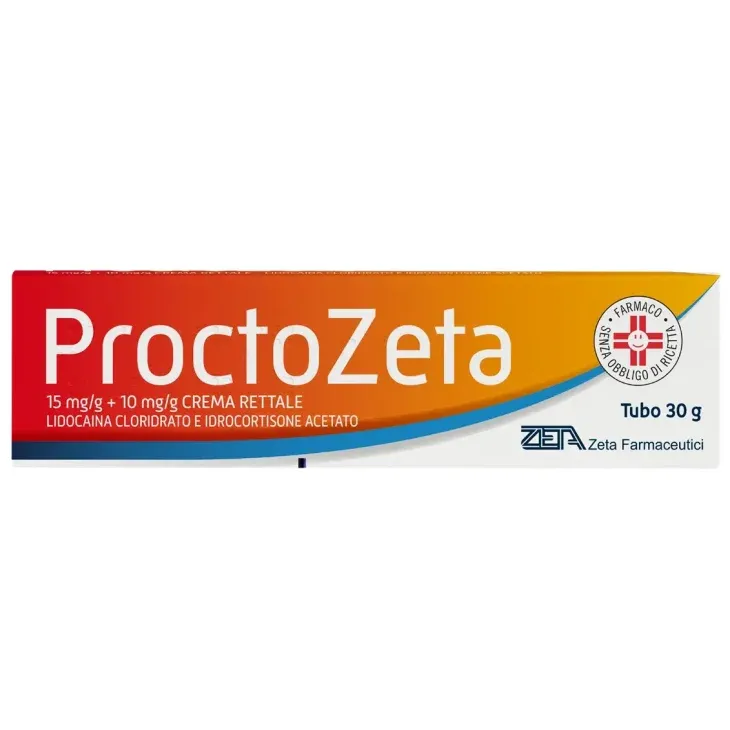
Table of Contents
Patient Information Leaflet: Information for the User
PROCTOZETA 15 mg/g + 10 mg/g Rectal Cream
Hydrochloride lidocaine and hydrocortisone acetate
Please read this leaflet carefully before using this medicine because it contains
important information for you.
Always use this medicine exactly as described in this leaflet or as your
doctor or pharmacist has instructed you.
- Keep this leaflet. You may need to read it again.
- If you need more information or advice, consult your pharmacist.
- If you experience any side effects, including those not listed in this leaflet, consult your doctor or pharmacist. See section 4.
- Consult your doctor if you do not notice improvement or if you experience worsening of symptoms after a few days.
Contents of this leaflet:
- What PROCTOZETA is and what it is used for
- What you need to know before using PROCTOZETA
- How to use PROCTOZETA
- Possible side effects
- How to store PROCTOZETA
- Package contents and other information
1. What PROCTOZETA is and what it is used for
PROCTOZETA is a combination of two active substances: lidocaine hydrochloride and hydrocortisone acetate. Lidocaine hydrochloride belongs to a group of medicines called local anaesthetics, which relieve pain, while hydrocortisone acetate, belonging to a group of medicines called corticosteroids, reduces inflammation and swelling.
This medicine is indicated:
- for the treatment of internal and external haemorrhoids;
- in cases of inflammation (eczema), irritation (erythema), lesions (fissures), itching and burning in the anal area due to haemorrhoids;
- before and after surgical procedures on the anus or the terminal portion of the intestine (anorectal surgery).
Consult your doctor if you do not feel better or if you feel worse after a few days.
2. What you need to know before using PROCTOZETA
Do not use PROCTOZETA
- if you are allergic to lidocaine hydrochloride, hydrocortisone acetate, medicines of similar type (amide-type local anesthetics, corticosteroids), or to any of the other ingredients of this medicine (listed in section 6);
- if you have or think you may have a fungal infection (mycotic infection);
- if you have a viral infection, such as cutaneous tuberculosis, herpes simplex, varicella, or a bacterial infection;
- if the person who is to use this medicine is under 12 years of age (See section “Children”);
- if you are pregnant or breastfeeding (See section “Pregnancy and breastfeeding”).
Warnings and precautions
Talk to your doctor or pharmacist before using PROCTOZETA.
This medicine must not be applied to the eyes.
The safety of medicines containing lidocaine as the active substance depends on the dose, correct application of the product, and adherence to all precautions.
Your doctor will determine the dose based on your age and health condition. In particular, it is recommended to use the lowest effective dose to achieve the desired results.
If you are elderly or suffering from an illness (in the acute phase), your doctor should prescribe a lower dose.
If you have an infection, this medicine may worsen its symptoms. Therefore, inform your doctor, who will determine the most appropriate therapy in this case.
Use this medicine with great caution and inform your doctor if you have:
- severe trauma (traumatism);
- a severe systemic infection (sepsis);
- extensive skin lesions.
During treatment with PROCTOZETA, avoid applying excessive amounts of the product over large areas of skin, and do not use the medicine for prolonged periods or at closely spaced intervals. These precautions are necessary because corticosteroids (hydrocortisone) may pass through the skin, potentially causing serious adverse effects. In particular, you may experience:
- during treatment, symptoms typical of Cushing's disease, such as sudden weight gain, increased hair growth (hirsutism), hair loss, irregular menstrual cycle in women, loss of muscle tone, irritability, fatigue, and difficulty concentrating;
- after discontinuation of treatment, reduced production of certain hormones called glucocorticosteroids. Therefore, if you need to use this medicine at high doses and over large skin areas, your doctor should perform frequent checks of certain hormone levels in your blood and, if necessary, may decide to discontinue treatment, reduce the frequency of applications, or prescribe a similar but less potent medicine. Usually, after stopping treatment with PROCTOZETA, hormone levels return to normal (restoration of HPA axis function); only in some cases is administration of other medicines (systemic corticosteroids) required.
Contact your doctor if you experience blurred vision or other visual disturbances.
The absorption of lidocaine through damaged skin and mucous membranes is very high. Therefore, use the medicine with great caution in such cases.
Stop treatment immediately after achieving the desired effect.
Discontinue treatment and inform your doctor if you develop an allergic reaction (sensitization), bleeding, or skin irritation and burning following the use of this medicine, especially after prolonged use.
For athletes: using this medicine without therapeutic need constitutes doping and may lead to a positive result in anti-doping tests.
Children
The use of this medicine is contraindicated in children under 12 years of age.
Other medicines and PROCTOZETA
Inform your doctor or pharmacist if you are taking, have recently taken, or might take any other medicines, including those obtained without a prescription.
Use this medicine with caution and inform your doctor if you are taking the following medicines:
- cimetidine, used for stomach problems;
- beta-blockers (such as propranolol) for heart conditions and lowering blood pressure;
- digitalis, used for certain heart disorders;
- other medicines similar to lidocaine (such as tocainide) used to induce anesthesia;
- barbiturates, used to induce anesthesia and treat seizures (antiepileptics);
- antihistamines for treating allergies;
- phenytoin, used for treating epilepsy;
- anti-inflammatory medicines used to relieve pain and inflammation (such as salicylates and phenylbutazone);
- oral hypoglycemics and insulin for treating diabetes.
Some medicines may enhance the effects of PROCTOZETA, and your doctor may wish to monitor you closely if you are taking these medicines (including certain HIV treatments: ritonavir, cobicistat).
Long-term use of this medicine over extensive skin areas may lead to a condition characterized by the presence of sugar in the urine (glycosuria) and increased blood sugar levels (postprandial hyperglycemia). Moreover, if the cream is applied under an occlusive dressing, which enhances drug absorption through the skin, excessive amounts of the medicine may accumulate in the blood and its elimination through urine may be reduced (decreased urinary excretion of 17-KS and 17-OHCS).
Pregnancy, breastfeeding and fertility
If you are pregnant, think you may be pregnant, planning to become pregnant, or breastfeeding, consult your doctor or pharmacist before using this medicine.
Since glucocorticoids, including hydrocortisone contained in this medicine, may have harmful effects on pregnancy and/or the fetus/newborn:
- if you are pregnant, do not use PROCTOZETA except in cases of absolute necessity;
- if you are breastfeeding, do not use this medicine.
Driving and using machines
This medicine does not affect the ability to drive or operate machinery.
PROCTOZETA contains:
- cetostearyl alcohol, which may cause localized skin reactions (e.g., contact dermatitis);
- parahydroxybenzoates, which may cause allergic reactions (including delayed ones);
- propylene glycol; this medicine contains 30 mg of propylene glycol per 1 g, which may cause skin irritation.
3. How to use PROCTOZETA
Use this medicine exactly as stated in this leaflet or as directed by your doctor or pharmacist. If you have any doubts, consult your doctor or pharmacist.
Apply a small amount of cream to the affected area, with gentle massage, two or more times a day.
If you need to apply this medicine inside the anus, before use, pierce the safety seal and screw on the provided rectal cannula included in the package. After applying the cream, remove the cannula from the tube and clean it.
If you use more PROCTOZETA than you should
Serious toxic effects may occur following rapid absorption of lidocaine into the bloodstream or after using excessive doses of this medicine.
In particular, using an excessive dose of this medicine may cause the following symptoms: tremors, seizures, depression, severe breathing difficulties (respiratory failure), low blood pressure (hypotension), reduced heart rate (bradycardia), and deep unconsciousness (coma).
Prolonged use of the medicine may lead to reduced levels of certain hormones in the blood (secondary adrenal insufficiency) (see section “Warnings and precautions”). In such cases, the doctor may decide, if necessary, to discontinue treatment, reduce the frequency of applications, or prescribe a similar but less potent medicine (corticosteroid). Symptoms are spontaneously reversible and treatment is symptomatic. It may be necessary to rebalance body fluids and electrolytes (fluid and electrolyte balance). In cases of chronic toxicity, the doctor will need to gradually withdraw hydrocortisone.
The doctor will determine the most appropriate therapy based on the severity of symptoms.
In case of accidental ingestion/overdose of PROCTOZETA, contact your doctor or go immediately to the nearest hospital.
If you forget to use PROCTOZETA
Do not use a double dose to make up for the missed dose.
If you have any doubts about how to use this medicine, consult your doctor or pharmacist.
4. Possible side effects
Like all medicines, this medicine can cause side effects, although not everyone experiences them.
If PROCTOZETA is applied as directed, absorption through the skin is minimal and, consequently, side effects are reduced.
The following side effects may occur due to the medicine passing through the skin (systemic effect):
Frequency not known (frequency cannot be estimated from available data)
- skin irritation and dryness, thinning of the skin and mucous membranes (atrophy), burning, itching;
- allergic reactions, including severe reactions (anaphylactic shock);
- dizziness, drowsiness, visual disturbances, anxiety, tremors, altered consciousness, seizures, respiratory depression (respiratory arrest);
- reduced heart rate (bradycardia), low blood pressure (hypotension), reduced heart activity (myocardial depression) up to complete cardiac arrest (cardiac arrest);
- blurred vision. Following the instructions provided in this leaflet reduces the risk of side effects.
Reporting of side effects
If you experience any side effect, including those not listed in this leaflet, please inform your doctor or pharmacist. You may also report side effects directly via the national reporting system at the following website:
http://www.aifa.gov.it/content/segnalazioni-reazioni-avverse. By reporting side effects, you can help provide further information on the safety of this medicine.
5. How to store PROCTOZETA
Keep this medicine out of the sight and reach of children.
Do not use this medicine after the expiry date stated on the packaging after "Exp.".
The expiry date refers to the last day of that month.
Store this medicine in the original packaging and protect it from light.
After first opening the container, the medicine should be used within 3 months.
After this period, any remaining medicine must be disposed of.
Do not dispose of any medicine via wastewater or household waste. Ask your pharmacist
how to dispose of medicines you no longer use. This will help protect the environment.
6. Package contents and other information
What PROCTOZETA contains
- The active substances are: lidocaine hydrochloride and hydrocortisone acetate. 1 g of rectal cream contains 15 mg of lidocaine hydrochloride and 10 mg of hydrocortisone acetate.
- The other components are: white soft paraffin, liquid paraffin, methyl 4-hydroxybenzoate, propyl 4-hydroxybenzoate, propylene glycol, dimethicone, cetostearyl alcohol, isooctyl stearate, PEG-20 monostearate, glyceryl monostearate, purified water.
Description of the appearance of PROCTOZETA and contents of the pack
30 g tube of rectal cream.
Marketing Authorisation Holder and Manufacturer
Marketing Authorisation Holder
Zeta Farmaceutici S.p.A. - Via Mentana, 38 – 36100 Vicenza - Italy
Manufacturer
Zeta Farmaceutici S.p.A. - Via Galvani, 10 – 36066 Sandrigo (VI) - Italy