Lexil
Italy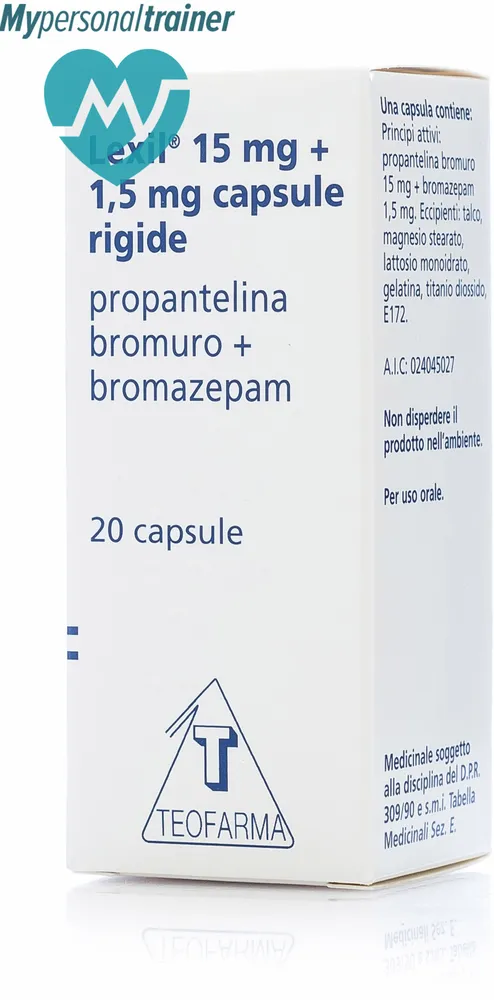
Table of Contents
Package leaflet: Information for the patient
Lexil 15 mg + 1.5 mg hard capsules
propanteline bromide + bromazepam
Please read this leaflet carefully before taking this medicine because it contains important information for you.
- Keep this leaflet. You may need to read it again.
- If you have any questions, ask your doctor or pharmacist.
- This medicine has been prescribed for you only. Do not give it to others, even if their symptoms are the same as yours, as it could be harmful.
- If you experience any side effects, including those not listed in this leaflet, tell your doctor or pharmacist. See section 4.
Contents of this leaflet:
- What Lexil is and what it is used for
- What you need to know before taking Lexil
- How to take Lexil
- Possible side effects
- How to store Lexil
- Contents of the pack and other information
1. What Lexil is and what it is used for
Lexil contains the active substances propanteline bromide and bromazepam.
Propanteline reduces excessive secretion and motility in the gastrointestinal tract and relaxes intestinal muscles (spasmolytic activity).
Bromazepam acts on the brain to correct emotional imbalances, e.g. tension and anxiety states, with or without associated depression.
Lexil is indicated in patients suffering from painful contractions (spastic-painful manifestations) of the stomach and intestine associated with anxiety.
2. What you need to know before taking Lexil
Do NOT take Lexil
- if you are allergic to propanteline bromide or bromazepam or to any of the other ingredients of this medicine (listed in section 6);
- if you have high internal eye pressure (glaucoma);
- if you have an enlarged prostate (prostatic hypertrophy);
- if you have difficulty urinating (urinary retention);
- if you suffer from intestinal obstruction;
- if you have a disease causing muscle weakness (myasthenia gravis);
- if you have serious heart problems (heart failure);
- if you have serious kidney problems (renal failure);
- if you have serious liver problems (hepatic failure);
- if you are in the first trimester of pregnancy;
- if you are breastfeeding.
Warnings and precautions
Talk to your doctor or pharmacist before taking Lexil. Pay particular attention:
- if you are taking other medicines acting on the brain (psychotropic drugs), to avoid unexpected adverse effects due to drug interactions (see section “Other medicines and Lexil”);
- if you are taking this medicine at high doses and for a long time, because in predisposed individuals, treatment with bromazepam at high doses and for prolonged periods may lead to dependence, as occurs with other medicines having similar activity. If treatment is prolonged, your doctor may prescribe blood tests and liver function monitoring.
Children
The administration of benzodiazepines, including bromazepam, in children should be avoided and requires careful medical evaluation. When benzodiazepine administration in children is necessary, treatment duration should be as short as possible.
Other medicines and Lexil
Tell your doctor or pharmacist if you are using, have recently used, or might use any other medicine.
-
If you take Lexil together with the following medicines, the central nervous system depressant effect may increase:
- antipsychotics or neuroleptics (medicines used to treat severe mental disorders);
- hypnotics (medicines that induce sleep);
- anxiolytics/sedatives (medicines that reduce anxiety/relax);
- antidepressants (medicines used to treat depression);
- antiepileptics (for the treatment of epilepsy);
- anaesthetics (to relieve pain);
- sedating antihistamines (medicines used to treat allergies that cause drowsiness);
- narcotic analgesics (used to relieve pain).
Taking Lexil with narcotic analgesics may also increase euphoria, thereby increasing the risk of psychological dependence.
-
Concomitant use of Lexil and opioid derivatives (strong painkillers, medicines for substitution therapy, and some cough medicines) increases the risk of drowsiness, breathing difficulties (respiratory depression), coma, and may be life-threatening. For this reason, concomitant use should only be considered when no other treatment options are available. However, if your doctor prescribes Lexil together with another opioid derivative, the dose and duration of concomitant treatment must be limited by your doctor. Inform your doctor about all opioid-derived medicines you are taking and strictly follow the dosing instructions provided by your doctor. It may be helpful to inform family members and friends to watch for the signs and symptoms listed above. Contact your doctor if these symptoms occur.
-
If you take Lexil together with medicines that inhibit certain liver enzymes (particularly cytochrome P450), the activity of benzodiazepines, such as bromazepam contained in Lexil, may increase.
-
If you take Lexil with cimetidine (an anti-ulcer medicine), the time required to eliminate bromazepam (contained in Lexil) from the body may be prolonged.
Lexil with drinks and alcohol
Do not consume alcohol when taking Lexil. Alcohol may enhance the sedative effect of Lexil. See also “Driving and using machines”.
Pregnancy and breastfeeding
If you are pregnant, think you may be pregnant, are planning to become pregnant, or are breastfeeding, consult your doctor or pharmacist before taking this medicine. Lexil must not be used during the first trimester of pregnancy. After the first trimester, the medicine should be administered only if clearly needed and under direct medical supervision.
Women of childbearing potential should use an effective contraceptive method during treatment.
If this medicine is administered during the last stages of pregnancy or during labour for serious medical reasons and at high doses, effects on the newborn due to the drug’s action may occur, including low body temperature (hypothermia), poor muscle tone (hypotonia), and moderate respiratory depression.
Newborns of mothers who have continuously taken benzodiazepines during the later stages of pregnancy may develop physical dependence and may experience withdrawal symptoms in the postnatal period.
Benzodiazepines must not be used during breastfeeding because they pass into breast milk.
Driving and using machines
Lexil, like other medicines acting via the same mechanism, may impair your ability to drive or operate machinery.
Taking alcohol with Lexil may increase the sedative effect of this medicine. This negatively affects your ability to drive and operate machinery.
Lexil contains lactose
Lexil capsules contain lactose: if your doctor has diagnosed you with an intolerance to certain sugars, contact your doctor before taking this medicine.
3. How to take Lexil
Take this medicine exactly as directed by your doctor or pharmacist. If you have
any doubts, consult your doctor or pharmacist.
The recommended dose is one capsule of Lexil 3–4 times daily. Lexil should preferably be taken with main meals and before going to bed.
If symptoms are particularly severe, the daily dose of Lexil may be increased to 6 capsules, taken in 3–4 divided doses throughout the day.
Treatment should be as short as possible.
Have regular check-ups with your doctor, who will determine how long treatment should continue based on your symptoms.
Use in elderly patients
If you are elderly or debilitated, start with 1–2 capsules of Lexil per day; your doctor will decide whether the dose should later be increased to reach the optimal daily dosage.
If you have any doubts about how to use this medicine, consult your doctor or pharmacist.
Use in children
Experience with the use of Lexil in children is limited; see paragraph 2.
If you take more Lexil than you should
If you accidentally take an excessive dose of this medicine, inform your doctor immediately or go to the nearest hospital.
If you experience symptoms such as constipation, dry mouth, visual disturbances, dizziness, difficulty urinating, breathing or heart problems, or drowsiness and confusion up to coma, seek immediate medical attention or go to the emergency department.
If you forget to take Lexil
Do not take a double dose to make up for the missed dose.
If you stop taking Lexil
If you have any doubts about using this medicine, consult your doctor or pharmacist.
4. Possible side effects
Like all medicines, this medicine can cause side effects, although not everybody will experience them.
The following side effects may occur with the use of Lexil:
- Dependence
The use of benzodiazepines (even at doses used for treatment) may lead to physical dependence.
Discontinuation of therapy may cause a worsening of symptoms (rebound phenomena) or the onset of withdrawal symptoms. Psychological dependence may occur.
Abuse of benzodiazepines has been reported.
- Depression
A depressive state that was already present before starting treatment may emerge during benzodiazepine use. - Amnesia
Memory loss (anterograde amnesia) may occur even at commonly used treatment doses, and the risk may increase at higher doses. - Allergic reactions in predisposed individuals.
- Fairly severe reactions that may be caused by benzodiazepines or benzodiazepine-like compounds, and are more likely in children and elderly patients:
o restlessness or agitation or irritability or aggression or delusion or rage or nightmares or hallucinations or severe mental disturbances (psychosis) or behavioural changes. - Adverse reactions reported occasionally:
o gastrointestinal problems
o changes in sexual desire
o skin reactions
o dry mouth
o difficulty urinating
o difficulty seeing nearby objects clearly (accommodation disorders)
o low blood pressure (hypotension). - Other side effects that mainly occur at the beginning of treatment and usually disappear with continued administration:
o drowsiness
o emotional blunting
o reduced attention
o confusion
o fatigue
o headache
o dizziness
o decreased muscle tone
o loss of coordination of movements (ataxia)
o double vision.
Reporting of side effects
If you experience any side effect, including those not listed in this leaflet, please contact your doctor or pharmacist. You may also report side effects directly via the national reporting system at the website
https://www.aifa.gov.it/content/segnalazioni-reazioni-avverse
By reporting side effects, you can help provide more information on the safety of this medicine.
5. How to store Lexil
Keep this medicine out of the sight and reach of children.
Do not use this medicine after the expiry date which is stated on the packaging after "Exp". The expiry date refers to the last day of that month.
Do not dispose of medicines via wastewater or household waste. Ask your pharmacist how to dispose of medicines you no longer use. This will help protect the environment.
6. Package contents and other information
What Lexil contains
- The active substances are propanteline bromide and bromazepam. Each capsule contains 15 mg of propanteline bromide and 1.5 mg of bromazepam.
- The other components are talc, magnesium stearate, monohydrate lactose, gelatin, titanium dioxide, E 172. Description of the appearance of Lexil and contents of the pack Each pack of Lexil contains one glass bottle with 20 hard capsules for oral use. Marketing Authorization Holder TEOFARMA S.r.l. Via F.lli Cervi, 8 27010 Valle Salimbene (PV) Manufacturer and responsible for final control TEOFARMA S.r.l. Viale Certosa, 8/A 27100 Pavia