Levotuss cough
ItalyTable of Contents
- Patient Information Leaflet: Information for the User
- Levotuss Cough 60 mg/ml oral drops, solution
- 1. What Levotuss Cough is and what it is used for
- 2. What you need to know before taking Levotuss Cough
- 3. How to take Levotuss Tosse
- 4. Possible side effects
- 5. How to store Levotuss Tosse
- 6. Contents of the pack and other information
Patient Information Leaflet: Information for the User
Levotuss Cough 60 mg/ml oral drops, solution
Levodropropizine
Please read this leaflet carefully before taking this medicine because it contains
important information for you.
- Keep this leaflet. You may need to read it again.
- If you have any questions, ask your doctor or pharmacist.
- This medicine has been prescribed for you only. Do not give it to other people, even if their symptoms are the same as yours, as it may be harmful.
- If you experience any side effects, including those not listed in this leaflet, talk to your doctor or pharmacist. See section 4.
Contents of this leaflet:
- What Levotuss Cough is and what it is used for
- What you need to know before taking Levotuss Cough
- How to take Levotuss Cough
- Possible side effects
- How to store Levotuss Cough
- Contents of the pack and other information
1. What Levotuss Cough is and what it is used for
Levotuss Cough contains the active substance levodropropizine, a compound belonging to a group of medicines called antitussives (cough suppressants).
This medicine is used for the treatment of cough symptoms.
Consult your doctor if you do not feel better or feel worse after 2 weeks of treatment.
2. What you need to know before taking Levotuss Cough
Do not take Levotuss Cough
- if you are allergic to levodropropizine or to any of the other ingredients of this medicine (listed in section 6);
- if you suffer from a bronchial disease characterized by excessive mucus production (bronchial hypersecretion);
- if you have been born with certain respiratory mucosal disorders characterized by reduced ability to expel mucus (Kartagener syndrome, ciliary dyskinesia);
- if you are pregnant or breastfeeding (see subsection “Pregnancy and breastfeeding”).
Do not administer this medicine to children under two years of age (see subsection
“Children”).
Warnings and precautions
Talk to your doctor or pharmacist before taking Levotuss Cough:
- if you have severe reduction in kidney function (severe renal insufficiency with creatinine clearance below 35 ml/min);
- if you are elderly, as sensitivity to various medicines may be altered in older people;
- if you are taking sedative medicines and are particularly sensitive (see subsection “Other medicines and Levotuss Cough”).
Cough suppressant medicines treat only the symptoms and should be used only while awaiting diagnosis of the underlying cause and/or the effect of treatment for the underlying disease.
Therefore, do not use for prolonged treatments. If after a short period of treatment (2 weeks) there are no noticeable results, consult your doctor.
Children
Do not give this medicine to children under 2 years of age (see subsection “Do not take
Levotuss”).
Other medicines and Levotuss Cough
Inform your doctor or pharmacist if you are taking, have recently taken, or might take any other medicines.
Take this medicine with caution and inform your doctor if you are taking sedative medicines used for the treatment of anxiety.
Pregnancy and breastfeeding
If you are pregnant, think you may be pregnant, planning to become pregnant, or breastfeeding, ask your doctor or pharmacist for advice before taking this medicine.
Do not take Levotuss Cough if you are pregnant or suspect you may be pregnant, and if you are breastfeeding.
Driving and using machines
This medicine may cause drowsiness (see section 4 “Possible side effects”). If you experience this symptom, avoid driving or operating machinery.
Levotuss Cough contains methyl para-hydroxybenzoate
This medicine contains methyl para-hydroxybenzoate (parabens), which may cause allergic reactions (including delayed reactions).
Levotuss Cough contains alcohol (ethanol)
This medicine contains 5.52 mg of alcohol (ethanol) per dose (20 drops). The amount in 20 drops of this medicine is equivalent to less than 1 ml of beer or 1 ml of wine.
The small amount of alcohol in this medicine will not produce significant effects.
Levotuss Cough contains propylene glycol
This medicine contains 206 mg of propylene glycol per dose (20 drops), equivalent to 206 mg/ml.
Levotuss Cough contains sodium
This medicine contains less than 1 mmol (23 mg) of sodium per dose (20 drops), i.e. essentially “sodium-free”.
3. How to take Levotuss Tosse
Take this medicine exactly as directed by your doctor or pharmacist. If
you have any doubts, consult your doctor or pharmacist.
Take this medicine until symptoms disappear. If you do not notice any improvement after 2 weeks of treatment,
discontinue treatment and consult your doctor.
Recommended doses are:
Adults: 20 drops (equivalent to 60 mg) up to 3 times daily, at intervals of at least
6 hours between doses, unless otherwise prescribed by the doctor.
Use in children over 2 years of age:
The dose will be determined by the doctor according to the child's weight, as follows:
- 3 drops if the child weighs between 7 and 10 kg;
- 4 drops if the child weighs between 11 and 13 kg;
- 5 drops if the child weighs between 14 and 16 kg;
- 6 drops if the child weighs between 17 and 19 kg;
- 7 drops if the child weighs between 20 and 22 kg;
- 8 drops if the child weighs between 23 and 25 kg;
- 9 drops if the child weighs between 26 and 28 kg;
- 10 drops if the child weighs between 29 and 31 kg;
- 11 drops if the child weighs between 32 and 34 kg;
- 12 drops if the child weighs between 35 and 37 kg;
- 13 drops if the child weighs between 38 and 40 kg;
- 14 drops if the child weighs between 41 and 43 kg;
- 15 drops if the child weighs between 44 and 46 kg;
- 20 drops if the child weighs more than 46 kg. The drops may be administered up to 3 times daily, at intervals of at least 6 hours between doses.
If the doctor treating your child considers it necessary, the dose may be increased up to
a maximum of 20 drops, 3 times daily.
Method of administration
Dilute the drops in half a glass of water.
Warning: Do not exceed the indicated doses.
It is recommended to take and administer Levotuss Tosse away from meals.
Instructions for use
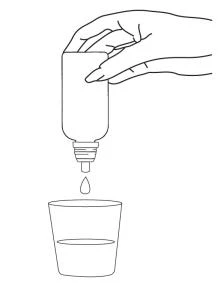
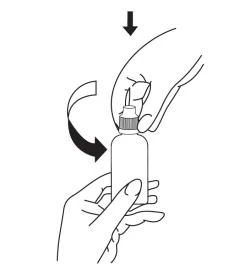
The bottle has a child-resistant cap. To dispense the drops:
To open, press down slightly on the cap and
turn it simultaneously
counterclockwise until it opens.
If you take more Levotuss Tosse than you should
In case of accidental ingestion or overdose of Levotuss, contact your doctor immediately
or go to the nearest hospital.
If you take an excessive dose of this medicine, you may experience: abdominal pain and vomiting,
not severe.
The doctor will determine the most appropriate treatment for you based on the severity of symptoms.
If you forget to take Levotuss Tosse
Do not take a double dose to make up for the forgotten dose.
If you have any doubts about the use of this medicine, consult your doctor or pharmacist.
4. Possible side effects
Like all medicines, this medicine can cause side effects, although not everybody gets them.
Most of the adverse reactions reported following levodropropizine administration were non-severe and symptoms resolved upon discontinuation of therapy and, in some cases, with specific pharmacological treatment.
The adverse reactions observed have a frequency not known (frequency cannot be estimated from the available data):
- mydriasis (dilation of the pupil), bilateral blindness (affecting both eyes);
- allergic and anaphylactoid reactions, eyelid edema (swelling of the eyelid), angioneurotic edema (swelling of deep dermis and subcutaneous tissue, which may also affect mucous membranes), urticaria;
- nervousness, drowsiness, personality alteration, personality disorder;
- syncope (transient loss of consciousness), dizziness, vertigo, tremors, paresthesia (abnormal skin sensation, tingling), tonic-clonic seizure (grand mal) and petit mal seizure, hypoglycemic coma (loss of consciousness caused by a severe drop in blood glucose levels);
- palpitations, tachycardia (rapid heartbeat), atrial bigeminy (irregular heartbeat);
- hypotension (low blood pressure);
- dyspnea (difficulty breathing), cough, edema (swelling) of the respiratory tract;
- stomach pain, abdominal pain, nausea, vomiting, diarrhea;
- cholestatic hepatitis (liver inflammation due to impaired bile excretion);
- urticaria, erythema (redness of the skin), exanthema (skin rash), pruritus, angioedema (facial and mucosal swelling), skin reactions, glossitis (inflammation of the tongue), and aphthous stomatitis (painful mouth ulcers);
- epidermolysis (rare and potentially serious skin disorders);
- weakness of the lower limbs;
- general malaise, generalized edema (swelling), asthenia (physical weakness).
Additional side effects in breastfed newborns whose mothers have taken levodropropizine
One case of drowsiness, hypotonia (reduced muscle tone), and vomiting has been reported in a newborn following maternal intake of levodropropizine. Symptoms appeared after breastfeeding and resolved spontaneously after temporarily suspending breastfeeding for a few feeds.
Following the instructions provided in this leaflet reduces the risk of side effects.
Reporting of side effects
If you experience any side effect, including those not listed in this leaflet, talk to your doctor or pharmacist. You can also report side effects directly via the national reporting system at
https://www.aifa.gov.it/content/segnalazioni-reazioni-avverse.
By reporting side effects, you can help provide more information on the safety of this medicine.
5. How to store Levotuss Tosse
Keep this medicine out of the sight and reach of children.
Do not use this medicine after the expiry date stated on the packaging after "Exp." The expiry date refers to the last day of that month. The expiry date indicated applies to the product in its original, unopened packaging, stored correctly.
Do not dispose of any medicine via wastewater or household waste. Ask your pharmacist how to dispose of medicines you no longer use. This will help protect the environment.
6. Contents of the pack and other information
What Levotuss Tosse contains
- The active substance is levodropropizine. 100 ml of solution contain 6 g of levodropropizine.
- The other components are: propylene glycol, xylitol, sodium saccharin, methyl p-hydroxybenzoate, fruit flavour (containing ethanol and propylene glycol), anise flavour (containing ethanol), anhydrous citric acid, purified water.
Description of the appearance of Levotuss Tosse and contents of the pack
Oral drops, solution – 1 bottle of 30 ml solution.
Marketing Authorization Holder
Dompé farmaceutici S.p.A. - Via San Martino, 12 - 20122 Milan
Manufacturer
Dompé farmaceutici S.p.A. - Via Campo di Pile - L'Aquila