Ledaga
Italy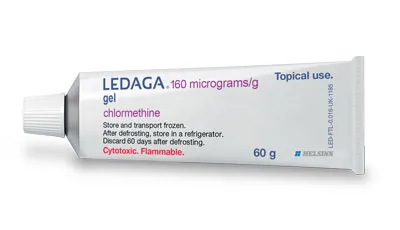
Table of Contents
Package leaflet: Information for the patient
Ledaga 160 micrograms/g gel
clomethiazole
Please read all of this leaflet carefully before you start using this medicine, because it contains important information for you.
- Keep this leaflet. You may need to read it again.
- If you have any questions, ask your doctor or pharmacist.
- This medicine has been prescribed for you only. Do not give it to others, even if their symptoms are the same as yours, as it could be harmful.
- If you experience any side effects, including those not listed in this leaflet, talk to your doctor or pharmacist. See section 4.
Contents of this leaflet
- What Ledaga is and what it is used for
- What you need to know before using Ledaga
- How to use Ledaga
- Possible side effects
- How to store Ledaga
- Contents of the pack and other information
1. What Ledaga is and what it is used for
Ledaga contains the active substance chlorambucil. This is an anticancer medicine used on the
skin to treat cutaneous T-cell lymphoma of the mycosis fungoides type (MF-type CTCL).
MF-type CTCL is a condition in which certain cells of the body's immune system,
called T-lymphocytes, become cancerous and affect the skin. Chlorambucil is a type of anticancer
medicine called an "alkylating agent"; it binds to the DNA of multiplying cells, such as
cancer cells, thereby blocking their growth and proliferation.
Ledaga is intended for use in adults only.
2. What you need to know before using Ledaga
Do not use Ledaga
- if you are allergic (hypersensitive) to chlormethine or to any of the other ingredients of this medicine (listed in section 6).
Warnings and precautions
Talk to your doctor or pharmacist before using Ledaga.
- Contact with the eyes must be avoided. Do not apply the medicine near the eyes, inside the nostrils, inside the ear, or on the lips.
- If Ledaga comes into contact with your eyes, it may cause pain, burning, swelling, redness, light sensitivity, and blurred vision. It may also cause blindness and serious permanent eye damage. If Ledaga gets into your eyes, immediately rinse your eyes for at least 15 minutes with plenty of water, with a solution known as "0.9% sodium chloride solution", or with an eye wash solution, and seek medical assistance (including an ophthalmologist) as soon as possible.
- If this medicine comes into contact with your mouth or nose, it may cause pain, redness, and lesions which may be severe. Immediately wash the affected area for at least 15 minutes with plenty of water and seek medical help as soon as possible.
- This medicine may cause skin reactions such as skin inflammation (redness and swelling), itching, blisters, skin lesions, and skin infections (see section 4). The risk of skin inflammation increases if Ledaga is applied to the face, genital area, anus, or skin folds.
- Inform your doctor if you have had an allergic reaction to chlormethine. Contact your doctor or seek immediate medical help if you experience an allergic reaction to Ledaga (see section 4).
- Skin tumors (abnormal growth of skin cells) have been reported after application of chlormethine to the skin, although it is not known whether chlormethine can cause them. Your doctor will monitor your skin for the development of skin tumors during and after treatment with Ledaga. Inform your doctor if you develop new areas of skin lesions or ulcers.
- Direct skin contact with Ledaga in individuals other than the patient, such as caregivers, must be avoided. Risks of direct skin contact include skin inflammation (dermatitis), eye, mouth, and nose lesions, and skin tumors. If a caregiver accidentally comes into contact with Ledaga, they should immediately wash the affected area for at least 15 minutes. Remove and wash any contaminated clothing. Immediate medical assistance is required if Ledaga has entered the eyes, mouth, or nose.
Children and adolescents
Do not use this medicine in children and adolescents under 18 years of age, as safety and efficacy have not been established in this age group.
Other medicines and Ledaga
Inform your doctor or pharmacist if you are taking, have recently taken, or might take any other medicines.
Pregnancy and breastfeeding
If you are pregnant or breastfeeding, if you suspect you may be pregnant, or if you are planning a pregnancy, consult your doctor before taking this medicine.
There is limited experience with chlormethine in pregnant women. Furthermore, the use of this medicine is not recommended during pregnancy or in women of childbearing potential who are not using contraception.
It is not known whether Ledaga is present in breast milk or whether there is a risk that the infant may be exposed to Ledaga through contact with the mother's skin. Therefore, breastfeeding is not recommended while using this medicine. You should discuss with your doctor whether it is preferable to breastfeed or to use Ledaga.
Driving and using machines
This medicine is not expected to have any effect on your ability to drive or operate machinery.
Ledaga contains propylene glycol and butylated hydroxytoluene
Propylene glycol may cause skin irritation. Butylated hydroxytoluene may cause local skin reactions (e.g. contact dermatitis) or irritation of the eyes and mucous membranes.
3. How to use Ledaga
Use this medicine exactly as directed by your doctor or pharmacist. If you have any doubts, consult your doctor or pharmacist.
The use of Ledaga is for cutaneous application only.
The recommended dose is the application of a thin layer once daily to the affected area of skin. The dose is the same for elderly patients (65 years and older) and younger patients (18 years and older).
Your doctor may interrupt treatment if you develop severe skin inflammation (e.g. redness and swelling), blisters, or ulcers. Your doctor may resume treatment once your symptoms have improved.
Instructions for use:
- Use Ledaga exactly as directed by your doctor or pharmacist.
- The person assisting the patient must wear disposable nitrile gloves when applying this medicine to the patient (these are a special type of glove; ask your doctor or pharmacist if you have any questions).
- Remove the cap from the tube immediately before use. Use the cap to pierce the seal.
- Apply Ledaga immediately or within 30 minutes after removing it from the refrigerator.
- Apply a thin layer of this medicine to completely dry skin, at least 4 hours before or 30 minutes after a shower or bath.
- Apply Ledaga to the affected areas of skin. If Ledaga comes into contact with unaffected areas of skin, wash the exposed areas thoroughly with water and soap.
- After applying the medicine, allow the area to dry for 5–10 minutes before covering with clothing.
- For patients who apply the gel themselves, wash hands immediately with water and soap after application.
- For those assisting the patient and applying the gel: carefully remove the gloves (turning them inside out to avoid contact with Ledaga), then wash hands thoroughly with water and soap.
- Ledaga is supplied inside a transparent, resealable plastic pouch with child-resistant features. If this is not the case, please consult your pharmacist.
- With clean hands, place Ledaga back into its box, then place the box into the plastic pouch. Return it to the refrigerator after each use.
- Do not cover the treated area with occlusive, non-breathable, or waterproof dressings after applying this medicine.
- Until Ledaga has dried completely on the skin, avoid contact with open flames or lit cigarettes. Ledaga contains alcohol and is therefore flammable.
- Do not apply moisturizing creams or other skin products (including topical medicines) within 2 hours before or 2 hours after the daily application of Ledaga.
- Keep Ledaga out of the reach of children and away from contact with food by storing it in its box inside the plastic pouch.
If you use more Ledaga than you should
Do not apply Ledaga more than once a day. If you apply more than recommended, speak to your doctor.
If you forget to use Ledaga
Do not apply a double dose to make up for a missed dose. Apply the next dose as scheduled.
If you stop using Ledaga
Your doctor will decide how long you should use Ledaga and when treatment should be stopped. Do not stop using this medicine unless your doctor tells you to.
If you have any doubts about how to use this medicine, consult your doctor or pharmacist.
4. Possible side effects
Like all medicines, this medicine can cause side effects, although not everybody gets them.
Stop using Ledaga immediately and inform your doctor if you experience allergic reactions (hypersensitivity).
These reactions may include one or more of the following symptoms:
- Swelling of the lips, face, throat and tongue
- Redness
- Difficulty breathing
Other possible side effects
Contact your doctor or pharmacist as soon as possible if you notice any of the following side effects listed below.
Very common side effects in the treated area (may affect more than 1 in 10 people):
- Inflammation of the skin (dermatitis)
- Skin infection
- Itching (pruritus)
Common side effects in the treated area (may affect 1 in 10 people):
- Skin ulcers
- Blisters
- Darkening of the skin
Reporting of side effects
If you experience any side effect, including those not listed in this leaflet, talk to your doctor or pharmacist. You can also report side effects directly via the national reporting system detailed in Annex V. Reporting side effects can help provide more information on the safety of this medicine.
5. How to store Ledaga
Keep this medicine out of the sight and reach of children.
Do not use this medicine after the expiry date stated on the tube and carton after EXP. The expiry date refers to the last day of that month.
Store in the refrigerator (+2 °C to +8 °C) at all times, ensuring that the tube is kept inside the carton and the transparent, resealable, child-resistant plastic bag.
Do not use a tube of Ledaga, whether opened or unopened, after 60 days of storage in the refrigerator.
Ask your pharmacist how to dispose of used nitrile gloves, the plastic bag, and unused medicine. Do not dispose of any medicine via wastewater or household waste. This will help protect the environment.
6. Package contents and other information
What Ledaga contains
- The active substance is chlorambucil. One gram of gel contains 160 micrograms of chlorambucil.
- The other ingredients are: diethylene glycol monoethyl ether, propylene glycol (E 1520), isopropyl alcohol, glycerol (E 422), lactic acid (E 270), hydroxypropylcellulose (E 463), sodium chloride, racemic menthol, disodium edetate, butylated hydroxytoluene (E 321). See section 2 for further information on propylene glycol and butylated hydroxytoluene.
Description of the appearance of Ledaga and contents of the pack
Ledaga is a colourless, transparent gel.
Each aluminium tube contains 60 grams of gel and has a white screw cap.
Marketing Authorisation Holder and Manufacturer
Helsinn Birex Pharmaceuticals Ltd.
Damastown
Mulhuddart
Dublin 15
Ireland
For further information about this medicinal product, please contact the local representative of the Marketing Authorisation Holder:
België/Belgique/Belgien Lietuva
Recordati Recordati AB.
Tél/Tel: +32 2 46101 36 Tel: + 46 8 545 80 230
Švedija
България Luxembourg/Luxemburg
Recordati Rare Diseases Recordati
Teл.: +33 (0)1 47 73 64 58 Tél/Tel: +32 2 46101 36
France Belgique/Belgien
Česká republika Magyarország
Recordati Rare Diseases Recordati Rare Diseases
Tel: +33 (0)1 47 73 64 58 Tel: +33 (0)1 47 73 64 58
France Hungary
Danmark Malta
Recordati AB. Recordati Rare Diseases
Tlf: + 46 8 545 80 230 Tel: +33 1 47 73 64 58
Sweden Malta
Deutschland Nederland
Recordati Rare Diseases Germany GmbH Recordati
Tel: +49 731 140 554 0 Tel: +32 2 46101 36
Belgium
Eesti Norge
Recordati AB. Recordati AB.
Tel: + 46 8 545 80 230 Tlf: + 46 8 545 80 230
Sweden Sweden
Ελλάδα Österreich
Recordati Hellas Recordati Rare Diseases Germany GmbH
Τηλ: +30 210 6773822 Tel: +49 731 140 554 0
Greece Germany
España Polska
Recordati Rare Diseases Spain S.L.U. Recordati Rare Diseases
Tel: + 34 91 659 28 90 Tel: +33 (0)1 47 73 64 58
Poland
France Portugal
Recordati Rare Diseases Jaba Recordati S.A.
Tél: +33 (0)1 47 73 64 58 Tel: +351 21 432 95 00
Hrvatska România
Recordati Rare Diseases Recordati Rare Diseases
Tél: +33 (0)1 47 73 64 58 Tel: +33 (0)1 47 73 64 58
Croatia Romania
Ireland Slovenija
Recordati Rare Diseases Recordati Rare Diseases
Tél: +33 (0)1 47 73 64 58 Tel: +33 (0)1 47 73 64 58
France Slovenia
Ísland Slovenská republika
Recordati AB. Recordati Rare Diseases
Simi: + 46 8 545 80 230 Tel: +33 (0)1 47 73 64 58
Iceland Slovakia
Italia Suomi/Finland
Recordati Rare Diseases Italy Srl Recordati AB.
Tel: +39 02 487 87 173 Puh/Tel: +46 8 545 80 230
Sweden
Κύπρος Sverige
Recordati Rare Diseases Recordati AB.
Τηλ: +33 1 47 73 64 58 Tel: +46 8 545 80 230
France
Latvija United Kingdom (Northern Ireland)
Recordati AB. Recordati Rare Diseases
Tel: + 46 8 545 80 230 Tél: +33 (0)1 47 73 64 58
Latvia France
More detailed information on this medicinal product is available on the website of the European Medicines Agency: http://www.ema.europa.eu/