Kinpeygo
Italy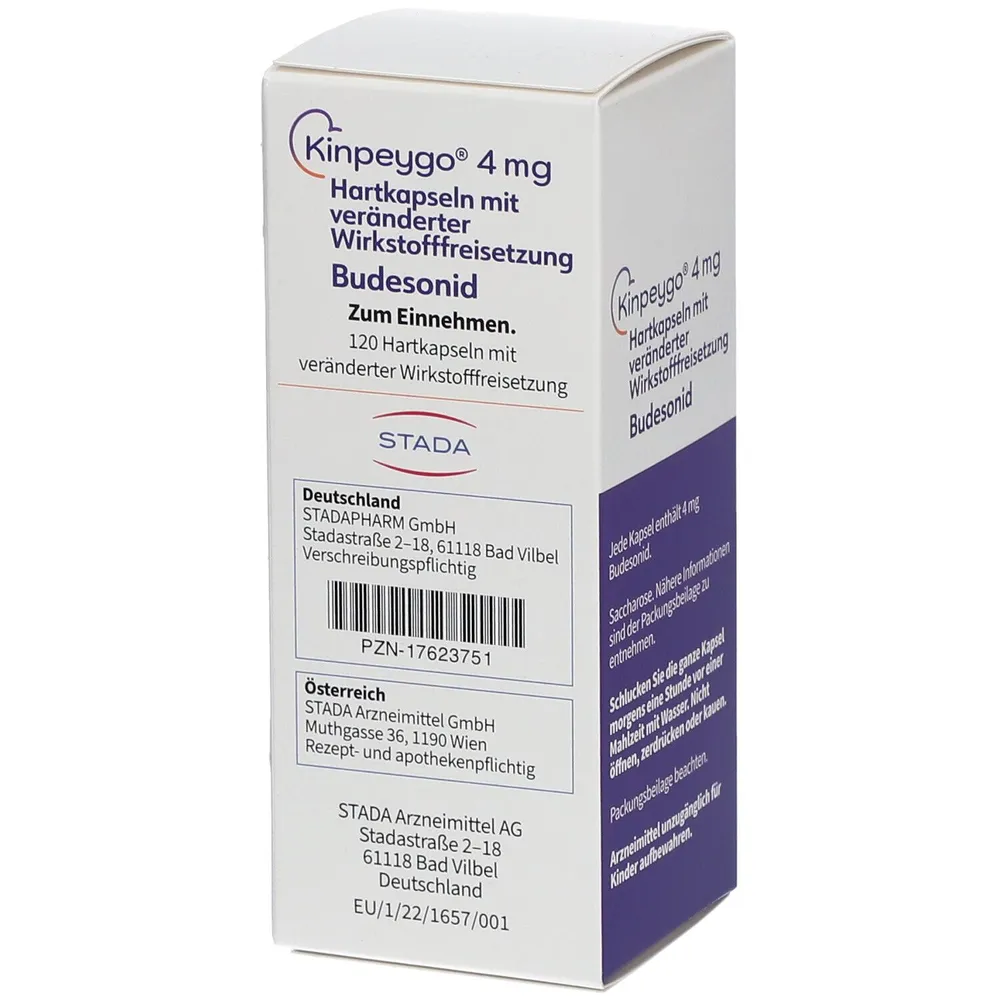
Table of Contents
Package leaflet: Information for the patient
Kinpeygo 4 mg modified-release hard capsules
budesonide
Please read this leaflet carefully before taking this medicine because it contains
important information for you.
- Keep this leaflet. You may need to read it again.
- If you have any questions, ask your doctor or pharmacist.
- This medicine has been prescribed for you only. Do not give it to other people, even if their symptoms are the same as yours, as it may be harmful.
- If you experience any side effects, including those not listed in this leaflet, tell your doctor or pharmacist. See section 4.
Contents of this leaflet
- What Kinpeygo is and what it is used for
- What you need to know before taking Kinpeygo
- How to take Kinpeygo
- Possible side effects
- How to store Kinpeygo
- Contents of the pack and other information
1. What Kinpeygo is and what it is used for
Kinpeygo contains the active substance budesonide, a corticosteroid medicine that acts
mainly locally in the intestine to reduce inflammation associated with primary immunoglobulin A (IgA) nephropathy.
Kinpeygo is used for the treatment of primary IgA nephropathy in adults aged 18 years and older.
2. What you need to know before taking Kinpeygo
Do not take Kinpeygo
- if you are allergic to budesonide or to any of the other ingredients of this medicine (listed in section 6);
- if you have impaired liver function and your doctor has told you it is "severe".
Warnings and precautions
Talk to your doctor or pharmacist before taking Kinpeygo
- if you are due to undergo surgery;
- if you have liver problems;
- if you are taking or have recently taken corticosteroids;
- if you have recently had an infection;
- if you have active or quiescent tuberculosis, fungal, bacterial, systemic viral or parasitic infections, or untreated ocular herpes simplex;
- if you have high blood pressure;
- if you have diabetes or if someone in your family has had diabetes;
- if you have fragile bones (osteoporosis);
- if you have stomach ulcers;
- if you have glaucoma (increased eye pressure) or cataracts, or if someone in your family has had glaucoma.
If you fall into any of the categories listed above, you may be at increased risk of developing
undesirable effects. Your doctor will decide which measures are appropriate and whether you should
still take this medicine.
Pay attention to possible side effects
If you experience blurred vision or other vision problems, consult your doctor. See section 4 for
further information.
Chickenpox or measles
Diseases such as chickenpox and measles may be more severe if you are taking this medicine.
If you have not previously had these diseases, avoid contact with people who have chickenpox or measles
while you are taking this medicine. Consult your doctor if you think you have contracted
chickenpox or measles during treatment with this medicine.
Adrenal function tests
Kinpeygo may affect the results of adrenal function tests (ACTH stimulation tests) prescribed by your doctor.
Inform your doctor that you are taking Kinpeygo before undergoing any such test.
Children and adolescents
Kinpeygo must not be used in children and adolescents under 18 years of age. The use of
this medicine in children under 18 years of age has not been studied.
Other medicines and Kinpeygo
Inform your doctor or pharmacist if you are taking, have recently taken, or might take
any other medicines. This includes medicines obtained without a prescription and
herbal medicines.
Kinpeygo capsules may affect the way some medicines work, and some
medicines may affect Kinpeygo capsules.
In particular, inform your doctor or pharmacist if you are taking any of the following medicines:
- ketoconazole or itraconazole, used to treat fungal infections;
- HIV medicines known as "protease inhibitors", such as ritonavir, indinavir and saquinavir;
- erythromycin, an antibiotic used to treat infections;
- cyclosporine, used to suppress the immune system;
- carbamazepine, for epilepsy and neuralgia-related conditions;
- cardiac glycosides, such as digoxin, medicines used to treat heart disorders;
- diuretics, to eliminate excess fluid from the body.
If you fall into any of the above categories (or are unsure), consult your doctor or pharmacist
before taking Kinpeygo.
Kinpeygo with food and drink
Do not eat grapefruit or drink grapefruit juice during treatment with Kinpeygo. It may
affect how this medicine works.
Pregnancy and breastfeeding
If you are pregnant, think you might be pregnant, are planning to become pregnant, or are breastfeeding,
consult your doctor or pharmacist before taking this medicine.
Do not take this medicine during pregnancy without first consulting your doctor.
Do not take this medicine while breastfeeding without first consulting your doctor. Budesonide
passes into breast milk in small amounts. Your doctor will help you decide whether to continue
treatment and stop breastfeeding, or discontinue treatment for the duration of breastfeeding.
Driving and using machines
Kinpeygo is not expected to affect the ability to drive or use machinery.
Kinpeygo contains sucrose
If your doctor has diagnosed you with an intolerance to certain sugars, consult him or her before taking
this medicine.
3. How to take Kinpeygo
Always take this medicine exactly as instructed by your doctor. If you have any doubts, consult your doctor or pharmacist.
How to take the medicine
The recommended dose of Kinpeygo is 16 mg (4 capsules of Kinpeygo 4 mg) once daily.
Take the capsules in the morning, at least 1 hour before a meal.
- Swallow the capsules whole with a glass of water.
- Do not open, crush, or chew the capsules, as this could affect the release of the medicine. The capsules have a special coating to ensure that the medicine is released in the correct part of the intestine.
When treatment needs to be discontinued, your doctor will reduce the dose to 8 mg (2 capsules of Kinpeygo 4 mg) once daily for the final 2 weeks of therapy. If your doctor considers it necessary, the dose may be further reduced to 4 mg once daily (1 capsule of Kinpeygo 4 mg) for an additional 2 weeks.
If you take more Kinpeygo than you should
If you take more Kinpeygo than you should, contact your doctor or pharmacist immediately. Bring the pack with you.
If you take more of the medicine than you should for a prolonged period, the possible side effects listed in section 4 may occur.
If you forget to take Kinpeygo
If you forget a dose of Kinpeygo, wait and take the medicine the next day as usual.
Do not take a double dose to make up for the missed dose.
If you stop taking Kinpeygo
Do not stop treatment with Kinpeygo without first consulting your doctor. If you stop taking this medicine suddenly, you may feel unwell.
If you have any questions about the use of this medicine, consult your doctor or pharmacist.
4. Possible side effects
Like all medicines, this medicine can cause side effects, although not everybody gets them.
Tell your doctor if you notice any of the following side effects associated with this medicine:
Very common (may affect more than 1 in 10 people)
- Skin rash or itching
- Acne
- Decrease in blood potassium levels (hypokalaemia)
Common (may affect up to 1 in 10 people)
- Increased blood pressure
- Swelling of arms or legs, for example swelling of the ankle
- Facial swelling
- Cushingoid features such as moon face, increased body hair and weight gain
- Indigestion
- Muscle cramps
- Weight gain
- Diabetes mellitus
- Increase in white blood cell count (detected by blood tests)
Rare (may affect up to 1 in 1,000 people)
- Blurred vision
Reporting of side effects
If you experience any side effect, including those not listed in this leaflet, consult your doctor or pharmacist.
You can also report side effects directly through the national reporting system listed in Annex V.* By reporting side effects, you can help provide more information on the safety of this medicine.
5. How to store Kinpeygo
Keep this medicine out of the sight and reach of children.
Do not use this medicine after the expiry date stated on the carton and on the label of the vial.
The expiry date refers to the last day of that month.
Do not store above 25°C.
Do not dispose of medicines via wastewater or household waste. Ask your pharmacist how to
dispose of medicines you no longer use. This will help protect the environment.
6. Package contents and other information
What Kinpeygo contains
- The active substance is budesonide. Each modified-release hard capsule contains 4 mg of budesonide.
- The other components are:
Capsule content: sugar spheres (sucrose and maize starch), hypromellose, macrogol, monohydrate citric acid, ethylcellulose, medium-chain triglycerides, oleic acid (see also section 2 “Kinpeygo contains sucrose”).
Capsule shell: hypromellose, macrogol, titanium dioxide (E171), methacrylic acid and methyl methacrylate copolymers, talc, dibutyl sebacate.
Printing ink: shellac, black iron oxide (E172).
Description of the appearance of Kinpeygo and package contents
Kinpeygo 4 mg modified-release hard capsules are 19 mm opaque white-coated capsules with the imprint “CAL10 4MG” printed in black.
The capsules are supplied in a white high-density polyethylene (HDPE) bottle with a white polypropylene (PP) child-resistant closure and induction seal.
This medicinal product is available in bottles containing 28, 100, and 120 modified-release hard capsules, and in multiple-pack containers containing 360 modified-release hard capsules, consisting of 3 bottles each containing 120 modified-release hard capsules.
Not all pack sizes may be marketed.
Marketing Authorization Holder
STADA Arzneimittel AG
Stadastrasse 2-18
61118 Bad Vilbel
Germany
Manufacturer
Tjoapack Netherlands B.V.
Nieuwe Donk 9
4879 AC Etten-Leur
Noord-Brabant
The Netherlands
STADA Arzneimittel AG
Stadastrasse 2 – 18
61118 Bad Vilbel
Germany
For further information about this medicinal product, please contact the local representative of the Marketing Authorization Holder:
België/Belgique/Belgien Lietuva
EG (Eurogenerics) NV UAB „STADA Baltics“
Tél/Tel: +32 24797878 Tel: +370 52603926
България Luxembourg/Luxemburg
STADA Bulgaria EOOD EG (Eurogenerics) NV
Teл.: +359 29624626 Tél/Tel: +32 24797878
Česká republika Magyarország
STADA PHARMA CZ s.r.o. STADA Hungary Kft
Tel: +420 257888111 Tel.: +36 18009747
Danmark Malta
STADA Nordic ApS Pharma.MT Ltd.
Tlf: +45 44859999 Tel: +356 21337008
Deutschland Nederland
STADAPHARM GmbH Centrafarm B.V.
Tel: +49 61016030 Tel.: +31 765081000
Eesti Norge
UAB „STADA Baltics“ STADA Nordic ApS
Tel: +370 52603926 Tlf: +45 44859999
Ελλάδα Österreich
FΑRAN S.A. STADA Arzneimittel GmbH
Τηλ: +30 2106254175 Tel: +43 136785850
España Polska
Laboratorio STADA, S.L. STADA Poland Sp. z o.o.
Tel: +34 934738889 Tel: +48 227377920
France Portugal
EG Labo - Laboratoires EuroGenerics Stada, Lda.
Tél: +33 146948686 Tel: +351 211209870
Hrvatska România
STADA d.o.o. STADA M&D SRL
Tel: +385 13764111 Tel: +40 213160640
Ireland Slovenija
Clonmel Healthcare Ltd. Stada d.o.o.
Tel: +353 526177777 Tel: +386 15896710
Ísland Slovenská republika
STADA Nordic ApS STADA PHARMA Slovakia, s.r.o.
Tlf: +45 44859999 Tel: +421 252621933
Italia Suomi/Finland
EG SpA STADA Nordic ApS, Suomen sivuliike
Tel: +39 028310371 Puh/Tel: +358 207416888
Κύπρος Sverige
STADA Arzneimittel AG STADA Nordic ApS
Τηλ: +30 2106664667 Tel: +45 44859999
Latvija United Kingdom (Northern Ireland)
UAB „STADA Baltics“ STADA Arzneimittel AG
Tel: +370 52603926 Tel: +49 61016030
ANNEX IV
SCIENTIFIC CONCLUSIONS AND REASONS FOR THE VARIATION OF THE TERMS
OF THE MARKETING AUTHORISATIONS
Scientific conclusions
Taking into account the evaluation by the Pharmacovigilance Risk Assessment Committee (PRAC) of the Periodic Safety Update Reports (PSURs) for budesonide (only for centrally authorised products indicated for primary immunoglobulin A nephropathy), the scientific conclusions of the PRAC are as follows:
In light of available data from clinical studies on hypokalaemia, one spontaneous report, and considering a plausible mechanism of action, the PRAC considers that a causal relationship between budesonide (for centrally authorised products indicated for primary IgA nephropathy) and hypokalaemia is at least a reasonable possibility. The PRAC concluded that the product information for medicinal products containing budesonide (for centrally authorised products indicated for primary IgA nephropathy) should be amended accordingly.
Having reviewed the PRAC's recommendation, the Scientific Committee for Human Medicinal Products (CHMP) agrees with the PRAC's overall conclusions and the reasoning behind the recommendation.
Reasons for the variation of the terms of the marketing authorisations
Based on the scientific conclusions regarding budesonide (only for centrally authorised products indicated for primary immunoglobulin A nephropathy), the CHMP considers that the benefit-risk balance of medicinal products containing budesonide (only for centrally authorised products indicated for primary immunoglobulin A nephropathy) remains favourable, subject to the proposed amendments to the product information.
The CHMP recommends the variation of the terms of the marketing authorisations.