Jumex
Italy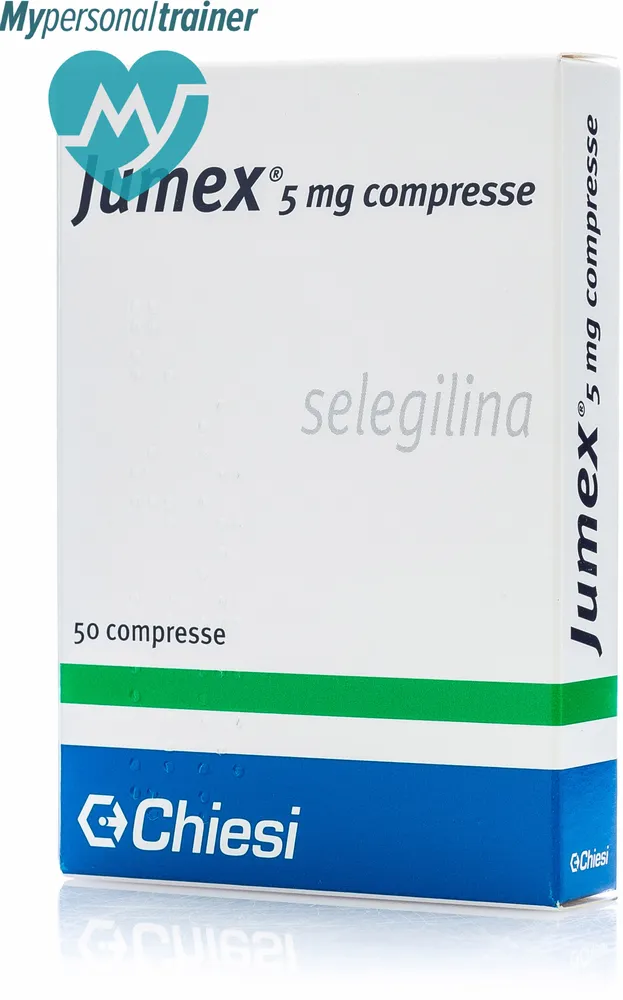
Table of Contents
- Package leaflet: Information for the patient
- JUMEX 5 mg tablets
- 1. What JUMEX is and what it is used for
- 2. What you should know before taking JUMEX
- 3. How to take JUMEX
- 4. Possible side effects
- 5. How to store JUMEX
- 6. Package contents and other information
- Patient information leaflet
- JUMEX 10 mg tablets
- 1. What JUMEX is and what it is used for
- 2. What you need to know before taking JUMEX
- 3. How to take JUMEX
- 4. Possible side effects
- 5. How to store JUMEX
- 6. Package contents and other information
Package leaflet: Information for the patient
JUMEX 5 mg tablets
selegiline hydrochloride
Please read this leaflet carefully before taking this medicine because it contains important information for you.
- Keep this leaflet. You may need to read it again.
- If you have any questions, ask your doctor or pharmacist.
- This medicine has been prescribed for you only. Do not give it to other people, even if their symptoms are the same as yours, as it may be harmful.
- If you experience any adverse reactions, including those not listed in this leaflet, contact your doctor or pharmacist. See section 4.
Contents of this leaflet:
- What Jumex is and what it is used for
- What you need to know before taking Jumex
- How to take Jumex
- Possible side effects
- How to store Jumex
- Contents of the pack and other information
1. What JUMEX is and what it is used for
Jumex is a medicine that contains as its active substance a compound called selegiline.
Jumex blocks the action of an enzyme called monoamine oxidase (MAO) type B, thereby increasing
the concentrations of a substance called dopamine.
Jumex is indicated in adult patients for the treatment of Parkinson's disease (a disorder of the central
nervous system characterized, for example, by tremor, muscle rigidity, slowness of movement, and
difficulty maintaining balance) and symptomatic parkinsonism (conditions with the same symptoms as
Parkinson's disease but with a different cause).
Jumex may be prescribed alone or in combination with other medicines used to treat Parkinson's disease.
2. What you should know before taking JUMEX
Do not take JUMEX
- If you are allergic to selegiline or to any of the other ingredients of this medicine (listed in section 6);
- if you suffer from severe movement disorders not due to dopamine deficiency (e.g. essential tremor, Huntington's disease);
- if you are taking:
- medicines for the treatment of depression and certain psychiatric disorders such as selective serotonin reuptake inhibitors (SSRIs), serotonin-norepinephrine reuptake inhibitors (SNRIs, e.g. venlafaxine), tricyclic antidepressants, monoamine oxidase inhibitors (MAOIs);
- sympathomimetic medicines, a class of drugs that stimulate the nervous system;
- linezolid (an antibiotic);
- opioids such as meperidine (pethidine), medicines used to treat pain; (see section Other medicines and Jumex).
- If you have a stomach or intestinal lesion (active gastric or duodenal ulcer);
Warnings and precautions
Talk to your doctor before taking Jumex if:
- you suffer from high blood pressure (hypertension),
- you suffer from heart rhythm disorders (cardiac arrhythmia),
- you suffer from severe chest pain (severe angina pectoris),
- you suffer from a mental disorder (psychosis),
- you have previously had a stomach lesion (peptic ulcer), as worsening of these conditions may occur during treatment,
- you suffer from severe liver or kidney disease (severe hepatic or renal impairment),
- you are scheduled for surgery under general anesthesia,
- you are taking substances or medicines acting on the central nervous system.
For athletes
Using this medicine without a therapeutic need constitutes doping and may lead to a positive anti-doping test.
Children and adolescents
There is no indication for the use of Jumex in patients under 18 years of age.
Other medicines and JUMEX
Tell your doctor or pharmacist if you are taking, have recently taken, or might take any other medicines.
Combinations contraindicated
- with sympathomimetic medicines, a class of drugs that stimulate the nervous system;
- with meperidine (also known as pethidine), a medicine used to treat pain;
- with selective serotonin reuptake inhibitors (SSRIs) and serotonin-norepinephrine reuptake inhibitors (SNRIs, e.g. venlafaxine), medicines used to treat depression and certain psychiatric disorders;
- with medicines used to treat migraine attacks (e.g. sumatriptan, naratriptan, zolmitriptan, rizatriptan, lasmiditan);
- with fluoxetine, a medicine used to treat depression. This medicine must not be used within 14 days after stopping treatment with Jumex. Allow at least 5 weeks between stopping fluoxetine and starting treatment with Jumex;
- with tricyclic antidepressants (e.g. amitriptyline, imipramine, nortriptyline), medicines used to treat depression;
- with monoamine oxidase inhibitors (MAOIs), medicines used to treat depression or Parkinson's disease;
- linezolid, an antibiotic used to treat infections.
Combinations not recommended
- with oral contraceptives (birth control pills);
- with digitalis, a medicine used to treat heart failure;
- with anticoagulants, medicines that slow down or interrupt the blood clotting process.
Combinations requiring caution
- with levodopa (a medicine used to treat Parkinson's disease), as side effects of levodopa such as involuntary movements and/or agitation may increase.
In particular, inform your doctor if you are taking:
- reserpine, a medicine used to treat mental disorders,
- papaverine, a medicine used to treat pain,
- vitamin B6 (pyridoxine), as they may reduce the effects of levodopa.
JUMEX with food, drinks and alcohol
- If you are taking selegiline together with non-selective MAO inhibitors or selective MAO-A inhibitors (medicines for treating depression or Parkinson's disease), avoid consuming foods high in tyramine such as aged cheese and fermented products.
- Avoid concomitant use of alcohol.
Pregnancy, breastfeeding and fertility
If you are pregnant, think you may be pregnant, planning a pregnancy, or breastfeeding, consult your doctor or pharmacist before taking this medicine.
Pregnancy
Jumex should not be used during pregnancy: therefore, your doctor will carefully evaluate any potential prescription of Jumex.
Breastfeeding
It is not known whether selegiline is excreted in breast milk. Therefore, Jumex must not be used during breastfeeding.
Fertility
Given the specific indications for this product, use of Jumex in individuals of reproductive age is unlikely.
Driving and using machines
Since Jumex may cause dizziness, do not drive or operate machinery if you experience this side effect during treatment.
JUMEX contains lactose
Jumex contains lactose (milk sugar). If your doctor has diagnosed you with an intolerance to certain sugars (e.g. lactose), contact your doctor before taking this medicine.
3. How to take JUMEX
Take this medicine exactly as stated in this leaflet or as instructed by your doctor. If you have any doubts, consult your doctor or pharmacist.
If you are taking JUMEX as monotherapy
The recommended dose is 2 tablets daily, taken in the morning as a single dose or divided into two daily doses (morning and afternoon).
If you are taking JUMEX in combination with other medicines to treat Parkinson's disease
The initially recommended dose is 1-2 tablets daily, taken in the morning or divided into two daily doses (morning and afternoon).
The recommended dose in patients experiencing reduced or loss of ability to perform automatic movements (akinesia), or abnormal and uncoordinated muscle movements (dyskinesias), and alternating phases of the disease ("on-off") is 2 tablets daily.
There are no available data on dose adjustments in patients with renal or hepatic impairment (mild renal and/or hepatic insufficiency, renal impairment, hepatic impairment).
If you take more JUMEX than you should
In case of accidental ingestion or overdose of JUMEX, contact your doctor immediately or go to the nearest hospital.
You may experience an increase in blood pressure (hypertension).
If you forget to take JUMEX
Do not take a double dose to make up for the missed tablet.
If you stop taking JUMEX
If you have any doubts about using this medicine, consult your doctor or pharmacist.
4. Possible side effects
Like all medicines, this medicine can cause side effects, although not everybody gets them.
Following the instructions contained in this leaflet reduces the risk of side effects.
The frequency of the side effects listed below is defined according to the following convention:
Common (may affect up to 1 in 10 people)
- insomnia,
- dizziness,
- headache (cephalalgia),
- vertigo,
- reduced heart rate (bradycardia),
- nausea,
- slight increase, detected through blood tests, in values indicating liver function.
Uncommon (may affect up to 1 in 100 people)
- altered mood,
- sleep disturbance (mild and temporary),
- increased heart rate (supraventricular tachycardia),
- dry mouth.
Rare (may affect up to 1 in 1,000 people)
- drop in blood pressure when moving from sitting to standing (postural hypotension),
- skin reaction.
Not known (frequency cannot be estimated from the available data)
- Problems with impulse control and compulsive behaviours (such as compulsive shopping, gambling, eating, or sexual behaviour),
- urinary retention.
If you are taking JUMEX together with levodopa, the side effects of levodopa may be increased
(restlessness, uncoordinated movements, abnormal movements, agitation, confusion, hallucinations,
drop in blood pressure when moving from sitting to standing, disturbances in heart rhythm).
Reporting of side effects
If you experience any side effect, including those not listed in this leaflet, talk to your doctor or pharmacist.
You can also report side effects directly via the national reporting system at: “https://www.aifa.gov.it/content/segnalazioni-reazioni-
avverse”.
By reporting side effects, you can help provide more information on the safety of this medicine.
5. How to store JUMEX
Store below 25 °C.
Keep this medicine out of the sight and reach of children.
Do not use this medicine after the expiry date stated on the packaging after "Exp".
The expiry date refers to the last day of that month.
Do not dispose of any medicine via wastewater or household waste. Ask your pharmacist how to
dispose of medicines you no longer use. This will help protect the environment.
6. Package contents and other information
What JUMEX contains
- The active substance is selegiline hydrochloride (l-deprenyl) 5 mg.
- The other components are lactose (see section 2. JUMEX contains lactose), maize starch, povidone, monohydrate citric acid, magnesium stearate.
Description of the appearance of JUMEX and package contents
JUMEX is presented as white tablets.
It is available in a box containing 50 tablets of 5 mg.
Marketing Authorization Holder and Manufacturer
Marketing Authorization Holder
CHIESI ITALIA S.p.A., Via Giacomo Chiesi, 1 – 43122 Parma
Manufacturers
CHIESI FARMACEUTICI S.p.A., Parma facility, Via San Leonardo 96
Fine Foods and Pharmaceuticals NTM S.p.A., Via Grignano, 43 - 24041 Brembate - BG - Italy
Patient information leaflet
JUMEX 10 mg tablets
selegiline hydrochloride
Please read this leaflet carefully before taking this medicine as it contains important information for you.
- Keep this leaflet. You may need to read it again.
- If you have any questions, consult your doctor or pharmacist.
- This medicine has been prescribed for you only. Do not give it to others, even if their symptoms are the same as yours, as it could be harmful.
- If you experience any adverse reactions, including those not listed in this leaflet, consult your doctor or pharmacist. See section 4.
Contents of this leaflet:
- What Jumex is and what it is used for
- What you need to know before taking Jumex
- How to take Jumex
- Possible side effects
- How to store Jumex
- Contents of the pack and other information
1. What JUMEX is and what it is used for
Jumex is a medicine that contains as its active substance a compound called selegiline.
Jumex blocks the action of an enzyme called monoamine oxidase (MAO) type B, thereby increasing
the concentrations of a substance known as dopamine.
Jumex is indicated in adult patients for the treatment of Parkinson's disease (a disorder of the central
nervous system characterized, for example, by tremor, muscle rigidity, slowness of movement, and
difficulty maintaining balance) and symptomatic parkinsonism (conditions with the same symptoms as
Parkinson's disease but with a different cause).
Jumex may be prescribed alone or in combination with other medicines used to treat Parkinson's disease.
2. What you need to know before taking JUMEX
Do not take JUMEX
- If you are allergic to selegiline or to any of the other ingredients of this medicine (listed in section 6);
- if you suffer from severe movement disorders not due to dopamine deficiency (e.g. essential tremor, Huntington's disease);
- if you are taking:
- medicines for the treatment of depression and certain psychiatric conditions such as selective serotonin reuptake inhibitors (SSRIs), serotonin-norepinephrine reuptake inhibitors (SNRIs, e.g. venlafaxine), tricyclic antidepressants, monoamine oxidase inhibitors (MAOIs);
- sympathomimetic medicines, a class of drugs that stimulate the nervous system;
- linezolid (an antibiotic);
- opioids such as meperidine (pethidine), medicines used to treat pain; (see section "Other medicines and Jumex");
- if you have a stomach or intestinal lesion (active gastric or duodenal ulcer).
Warnings and precautions
Talk to your doctor before taking Jumex if:
- you suffer from high blood pressure (hypertension);
- you suffer from heart rhythm disorders (cardiac arrhythmia);
- you suffer from severe chest pain (severe angina pectoris);
- you suffer from a mental disorder (psychosis);
- you have previously had a stomach lesion (peptic ulcer), as worsening of this condition may occur during treatment;
- you suffer from severe liver or kidney disease (severe hepatic or renal dysfunction);
- you are about to undergo surgery under general anesthesia;
- you are taking substances or medicines acting on the central nervous system.
For athletes
Use of the drug without therapeutic need constitutes doping and may lead to a positive result in anti-doping tests.
Children and adolescents
There is no indication for the use of Jumex in patients under 18 years of age.
Other medicines and JUMEX
Inform your doctor or pharmacist if you are taking, have recently taken, or might take any other medicine.
Contraindicated combinations
- with sympathomimetic medicines, a class of drugs that stimulate the nervous system;
- with meperidine (also known as pethidine), a medicine used to treat pain;
- with selective serotonin reuptake inhibitors (SSRIs) and serotonin-norepinephrine reuptake inhibitors (SNRIs, e.g. venlafaxine), medicines used to treat depression and certain psychiatric disorders;
- with medicines used to treat migraine attacks (e.g. sumatriptan, naratriptan, zolmitriptan, rizatriptan, lasmiditan);
- with fluoxetine, a medicine used to treat depression. This medicine must not be used within 14 days after stopping treatment with Jumex. Allow at least 5 weeks to pass between stopping fluoxetine and starting treatment with Jumex;
- with tricyclic antidepressants (e.g. amitriptyline, imipramine, nortriptyline), medicines used to treat depression;
- with monoamine oxidase inhibitors (MAOIs), medicines used to treat depression or Parkinson's disease;
- linezolid, an antibiotic used to treat infections.
Combinations not recommended
- with oral contraceptives (birth control pills);
- with digitalis, a medicine used to treat heart failure;
- with anticoagulants, medicines that slow down or stop the blood clotting process.
Combinations requiring caution
- with levodopa (a medicine used to treat Parkinson's disease), as side effects of levodopa such as involuntary movements and/or agitation may increase.
In particular, inform your doctor if you are taking:
- reserpine, a medicine used to treat mental disorders;
- papaverine, a medicine used to treat pain;
- vitamin B6 (pyridoxine), as these may reduce the effects of levodopa.
JUMEX with food, drinks and alcohol
- If you are taking selegiline together with non-selective MAO inhibitors or selective MAO-A inhibitors (medicines for treating depression or Parkinson's disease), avoid eating foods high in tyramine such as aged cheese and fermented products.
- Avoid concomitant use of alcohol.
Pregnancy, breastfeeding and fertility
If you are pregnant, think you may be pregnant or are planning to become pregnant, or if you are breastfeeding, ask your doctor or pharmacist for advice before taking this medicine.
Pregnancy
Jumex should not be used during pregnancy: therefore, your doctor will carefully evaluate any potential prescription of Jumex.
Breastfeeding
It is not known whether selegiline is excreted in breast milk. Therefore, Jumex must not be used during breastfeeding.
Fertility
Given the specific indications of the product, use of Jumex in individuals of reproductive age is unlikely.
Driving and using machines
Since Jumex may cause dizziness, do not drive or operate machinery if you experience this side effect during treatment.
JUMEX contains lactose
Jumex contains lactose (milk sugar). If your doctor has diagnosed you with an intolerance to certain sugars (e.g. lactose), contact your doctor before taking this medicine.
3. How to take JUMEX
Take this medicine exactly as described in this leaflet or as directed by your doctor. If you have any doubts, consult your doctor or pharmacist.
If you are taking JUMEX as monotherapy
The recommended dose is 1 tablet daily in the morning, taken as a single dose or divided into two daily doses (morning and afternoon).
If you are taking JUMEX in combination with other medicines for the treatment of Parkinson's disease
The initially recommended dose is half a tablet or 1 tablet daily in the morning, or divided into two daily doses (morning and afternoon).
The recommended dose in patients who have a reduction or loss of the ability to perform automatic movements (akinesia), or abnormal and uncoordinated muscle movements (dyskinesias), and alternating phases of the disease ("on-off") is 1 tablet daily.
There are no available data on dose adjustments in patients with renal or hepatic impairment (mild renal and/or hepatic insufficiency, renal impairment, hepatic impairment).
If you take more JUMEX than you should
In case of accidental ingestion or overdose of JUMEX, contact your doctor immediately or go to the nearest hospital.
You may experience an increase in blood pressure (hypertension).
If you forget to take JUMEX
Do not take a double dose to make up for the missed tablet.
If you stop taking JUMEX
If you have any doubts about using this medicine, consult your doctor or pharmacist.
4. Possible side effects
Like all medicines, this medicine can cause side effects, although not everyone gets them.
Following the instructions contained in this leaflet reduces the risk of side effects.
The frequency of the side effects listed below is defined according to the following convention:
Common (may affect up to 1 in 10 people)
- insomnia,
- dizziness,
- headache (cephalalgia),
- vertigo,
- reduced heart rate (bradycardia),
- nausea,
- slight increase in liver function test values shown by blood tests.
Uncommon (may affect up to 1 in 100 people)
- altered mood,
- sleep disturbance (mild and temporary),
- increased heart rate (supraventricular tachycardia),
- dry mouth.
Rare (may affect up to 1 in 1,000 people)
- drop in blood pressure when moving from sitting to standing (postural hypotension),
- skin reaction.
Not known (frequency cannot be estimated from the available data)
- Impulse control disorders and compulsive behaviours (such as compulsive shopping, gambling, eating or sexual behaviour),
- urinary retention.
If you are taking JUMEX together with levodopa, the side effects of levodopa may be increased
(restlessness, uncoordinated movements, abnormal movements, agitation, confusion, hallucinations,
drop in blood pressure when moving from sitting to standing, heart rhythm disturbances).
Reporting of side effects
If you experience any side effect, including those not listed in this leaflet, talk to your doctor or pharmacist.
You can also report side effects directly via the national reporting system at: “https://www.aifa.gov.it/content/segnalazioni-reazioni-avverse”.
By reporting side effects, you can help provide more information on the safety of this medicine.
5. How to store JUMEX
Store below 25°C.
Keep this medicine out of the sight and reach of children.
Do not use this medicine after the expiry date stated on the packaging after "Exp."
The expiry date refers to the last day of that month.
Do not dispose of any medicine via wastewater or household waste. Ask your pharmacist how to dispose of medicines you no longer use. This will help protect the environment.
6. Package contents and other information
What JUMEX contains
- The active substance is selegiline hydrochloride (l-deprenyl) 10 mg.
- The other ingredients are lactose monohydrate (see section 2. Jumex contains lactose), maize starch, povidone, citric acid monohydrate, magnesium stearate.
Description of the appearance of JUMEX and contents of the pack
Jumex is presented as white tablets.
It is available in a box containing 25 tablets of 10 mg.
Marketing Authorization Holder and Manufacturer
Marketing Authorization Holder
CHIESI ITALIA S.p.A., Via Giacomo Chiesi, 1- 43122 Parma
Manufacturers
CHIESI FARMACEUTICI S.p.A., Parma plant, Via San Leonardo 96
Fine Foods and Pharmaceuticals NTM S.p.A., Via Grignano, 43 - 24041 Brembate - BG - Italy