Itamidol
Italy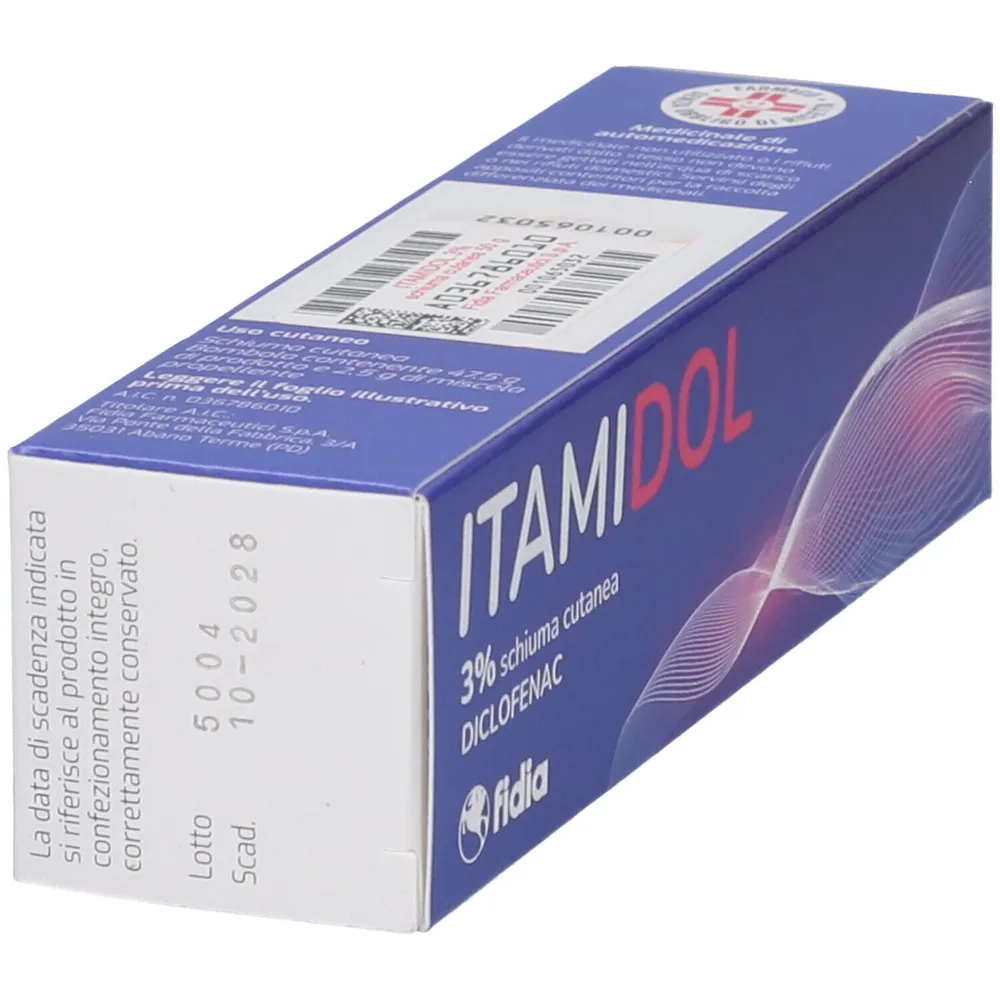
Table of Contents
PACKAGE LEAFLET: Information for the user
ITAMIDOL 3% Cutaneous foam
diclofenac
Read this entire leaflet carefully before using this medicine because it contains important information for you.
Always use this medicine exactly as described in this leaflet or as your doctor or pharmacist has instructed.
- Keep this leaflet. You may need to read it again.
- If you need more information or advice, consult your pharmacist.
- If you experience any side effects, including those not listed in this leaflet, talk to your doctor or pharmacist. See section 4.
- Consult your doctor if you do not notice any improvement or if your symptoms worsen after 7 days.
Contents of this leaflet:
- What Itamidol is and what it is used for
- What you need to know before using Itamidol
- How to use Itamidol
- Possible side effects
- How to store Itamidol
- Contents of the pack and other information
1. What Itamidol is and what it is used for
Itamidol contains the active substance diclofenac, which belongs to a group of medicines called non-steroidal anti-inflammatory drugs (NSAIDs), used to reduce pain and inflammation.
Itamidol is indicated for the local treatment of painful and inflammatory conditions of rheumatic or traumatic origin affecting:
- joints
- muscles
- tendons and ligaments
Consult your doctor if you do not feel better or if you feel worse after 7 days of treatment.
2. What you need to know before using Itamidol
Do not use Itamidol
- if you are allergic to diclofenac or to any of the other ingredients of this medicine (listed in section 6);
- if you are allergic to acetylsalicylic acid or to other non-steroidal anti-inflammatory drugs (NSAIDs) and, after taking these medicines, have experienced asthma attacks, skin allergic reactions (urticaria) or nasal irritation (rhinitis);
- if you are allergic to isopropanol, a type of alcohol;
- if you are in the third trimester of pregnancy (see section “Pregnancy and breastfeeding and fertility”);
- if the person using this medicine is a child or adolescent under 14 years of age (see section “Children”);
Warnings and precautions
Talk to your doctor or pharmacist before using Itamidol.
Talk to your doctor before using Itamidol:
- if you suffer or have suffered from asthma;
- if you suffer or have suffered from chronic bronchial obstruction;
- if you suffer or have suffered from allergic rhinitis (nasal inflammation due to allergy);
- if you suffer or have suffered from inflammation of the nasal mucosa (nasal polyps), as you may be more likely than other patients to experience asthma attacks, local skin or mucosal inflammation (Quincke's edema), or urticaria.
Take particular care:
- do not ingest Itamidol;
- do not apply Itamidol to damaged, diseased or open-wound skin;
- avoid contact of Itamidol with eyes or mucous membranes;
- if you are an elderly patient and/or have stomach problems, do not use Itamidol together with other anti-inflammatory medicines taken orally, by injection or rectally;
- do not use Itamidol with an occlusive dressing, i.e. covering the affected area with an airtight plastic film. You may instead use Itamidol with a gauze that allows air to pass through;
- the use, especially for prolonged periods, of topical medicines may cause allergic reactions, such as skin rash. If this occurs, stop treatment with Itamidol and consult your doctor, who will recommend appropriate therapy;
- avoid excessive exposure to sunlight during use of Itamidol, as this may reduce the risk of sun-induced skin reactions;
- if you use diclofenac over large skin areas and for long periods, you may experience adverse effects affecting the whole body.
Children
Itamidol must not be used in children and adolescents under 14 years of age.
Other medicines and Itamidol
Inform your doctor or pharmacist if you are currently using, have recently used, or might use any other medicine.
Since absorption of Itamidol through the skin is very low, interactions with other medicines are highly unlikely.
However, with high-dose and long-term treatments, interactions with other medicines cannot be completely ruled out.
Pregnancy, breastfeeding and fertility
If you are pregnant, think you may be pregnant, are planning a pregnancy, or are breastfeeding, consult your doctor or pharmacist before using this medicine.
Pregnancy
Oral forms (e.g. tablets) of diclofenac may increase the risk of miscarriage or cause adverse effects in the unborn child. It is not known whether the same risk applies with ITAMIDOL when used on the skin.
Do not use ITAMIDOL during the last trimester of pregnancy, as it may expose your baby to serious heart, lung, and kidney problems. At the end of pregnancy, diclofenac may expose both mother and newborn to complications during childbirth, such as inhibition of uterine contractions (delayed or prolonged labour), possible prolongation of bleeding time, and antiplatelet effects, which may occur even at very low doses of the medicine.
Do not use ITAMIDOL during the first 6 months of pregnancy or if you are planning a pregnancy unless strictly necessary and under medical advice. If treatment is required during this period, the lowest effective dose for the shortest possible duration should be used.
Breastfeeding
If you are breastfeeding, do not apply Itamidol to the breast, over large skin areas, or for prolonged periods, as diclofenac passes into breast milk in small amounts. Although effects on the infant are not expected when Itamidol is used at recommended doses, caution is advised.
Do not use Itamidol during breastfeeding unless you have first consulted your doctor.
If you have fertility problems or are undergoing fertility investigations, discontinue use of this medicine.
Driving and using machines
Itamidol does not affect the ability to drive vehicles or operate machinery.
Itamidol contains soybean lecithin, potassium sorbate, polysorbate and benzyl alcohol
Itamidol contains a soy derivative. If you are allergic to peanuts or soy, do not use this medicine.
Itamidol contains potassium sorbate, which may cause localized skin reactions (e.g. contact dermatitis).
Polysorbates may cause allergic reactions.
This medicine contains 4.75 mg of benzyl alcohol per 1 g of product.
Benzyl alcohol may cause allergic reactions and may cause mild local irritation.
3. How to use Itamidol
Use this medicine exactly as described in this leaflet or as directed by your doctor or pharmacist. If you are unsure, consult your doctor or pharmacist.
The duration of treatment should be as short as possible. If you do not notice any improvement after 7 days of treatment, consult your doctor.
Use in adults
Apply this medicine 1–3 times a day.
Method of administration
Itamidol is for topical use only.
Use the medicine as follows:
- shake the can before use;
- spray a small amount of foam, approximately 3–5 cm in diameter, onto the palm of your hand, holding the can in an upside-down position;
- apply the foam to the affected area and gently massage until completely absorbed;
- afterwards, wipe your hands with a paper towel and then wash them, to avoid the medicine acting on the hands, unless the hands themselves are the area to be treated;
- if too much foam has been accidentally applied, the excess foam should be removed with a paper towel. The paper towel should be disposed of in household waste to prevent unused product from entering the aquatic environment;
- if a dressing is to be applied, allow the foam to dry on the skin for a few minutes first.
This medicine may be administered using ultrasound or iontophoresis; in the latter case, the product must be applied to the negative pole.
Use in adolescents aged 14 to 18 years
Apply this medicine 1–3 times a day.
Method of administration
Itamidol is for topical use only.
Use the medicine as follows:
- shake the can before use;
- spray a small amount of foam, approximately 3–5 cm in diameter, onto the palm of your hand, holding the can in an upside-down position;
- apply the foam to the affected area and gently massage until completely absorbed;
- afterwards, wipe your hands with a paper towel and then wash them, to avoid the medicine acting on the hands, unless the hands themselves are the area to be treated;
- if too much foam has been accidentally applied, the excess foam should be removed with a paper towel. The paper towel should be disposed of in household waste to prevent unused product from entering the aquatic environment;
- if a dressing is to be applied, allow the foam to dry on the skin for a few minutes first.
This medicine may be administered using ultrasound or iontophoresis; in the latter case, the product must be applied to the negative pole.
Use in children and adolescents under 14 years of age
Do not use this medicine in children and adolescents under 14 years of age.
Use in elderly patients
Elderly patients may use the doses recommended for adults.
If you use more Itamidol than you should
In case of accidental ingestion of Itamidol, inform your doctor immediately or go to the nearest hospital.
Cases of overdose with this medicine are unlikely.
If you forget to use Itamidol
Do not use a double dose to make up for a forgotten dose.
If you have any doubts about how to use this medicine, consult your doctor or pharmacist.
4. Possible side effects
Like all medicines, this medicine can cause side effects, although not everyone experiences them.
After application to the skin, the amount of diclofenac that reaches the bloodstream is very low; therefore, the risk of experiencing side effects affecting the whole body is limited.
However, gastrointestinal problems may occur following long-term use and application over large areas of skin.
The following side effects may occur:
Common (may affect up to 1 in 10 people)
- skin irritations (rash, eczema);
- redness (erythema);
- skin inflammation (dermatitis), including contact dermatitis;
- itching.
Rare (may affect up to 1 in 1,000 people)
- skin inflammation with blister formation (bullous dermatitis).
Very rare (may affect up to 1 in 10,000 people)
- allergic reactions including hives and swelling of the face, lips, mouth, tongue or throat, which may cause difficulty in swallowing or breathing and could be potentially life-threatening (angioedema);
- skin irritation with blister-like lesions (rash with pustules);
- asthma;
- light sensitivity (photosensitivity).
Not known
- burning sensation at the application site;
- dry skin.
If you use this medicine together with other medicines containing diclofenac, serious skin reactions may occur (Stevens-Johnson syndrome, Lyell's syndrome).
Reporting of side effects
If you experience any side effect, including those not listed in this leaflet, talk to your doctor or pharmacist. You can also report side effects directly via the national reporting system at https://www.aifa.gov.it/content/segnalazioni-reazioni-avverse . By reporting side effects, you can help provide more information on the safety of this medicine.
5. How to store Itamidol
Keep this medicine out of the sight and reach of children.
Do not use this medicine after the expiry date stated on the packaging after "Exp.".
The expiry date refers to the last day of that month.
Store below 30 °C. Pressurised container: may burst if heated. Itamidol 3%
Topical foam contains flammable propellant. Keep away from heat sources, hot surfaces, sparks,
open flames or other sources of ignition. Do not smoke. Do not spray near open flame or other source of ignition.
Do not pierce or burn, even after use. Protect from sunlight. Do not expose to temperatures above 50 °C.
Do not dispose of any medicine via wastewater or household waste. Ask your pharmacist how to dispose of medicines you no longer use. This will help protect the environment.
6. Contents of the pack and other information
What Itamidol 3% Cutaneous Foam contains
- The active substance is diclofenac. 100 g of cutaneous foam contain 3 g of diclofenac.
- The other components are: sodium hydroxide, caprylic/capric macrogol glycerides, hydrogenated soybean lecithin, polysorbate 80, benzyl alcohol, potassium sorbate, dibasic sodium phosphate dodecahydrate, all-rac--α-tocopheryl acetate, mint/eucalyptus flavouring, purified water. Each pressurized container (50 g) contains: 47.5 g of solution and 2.5 g of propellant (isobutane; n-butane; propane).
Description of the appearance of Itamidol and contents of the pack
Pack containing one 50 g aluminum can of cutaneous foam.
Marketing Authorization Holder
Fidia Farmaceutici S.p.A.
Via Ponte della Fabbrica, 3/A
35031 Abano Terme (PD) – Italy.
Manufacturer
Farmol Health Care S.r.l.
Via del Maglio, 6
23868 Valmadrera (LC) – Italy.