Indobufene Eg
Italy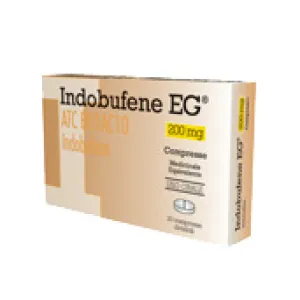
Table of Contents
Patient Information Leaflet
INDOBUFENE EG 200 mg tablets
Generic Medicine
Please read this leaflet carefully before taking this medicine, as it contains important information for you.
- Keep this leaflet. You may need to read it again.
- If you have any questions, ask your doctor or pharmacist.
- This medicine has been prescribed for you only. Do not give it to other people, even if they have the same symptoms as you, because it may be harmful.
- If you experience any side effects, including those not listed in this leaflet, tell your doctor or pharmacist. See section 4.
Contents of this leaflet:
- What INDOBUFENE EG is and what it is used for
- What you need to know before taking INDOBUFENE EG
- How to take INDOBUFENE EG
- Possible side effects
- How to store INDOBUFENE EG
- Contents of the pack and other information
1. What INDOBUFENE EG is and what it is used for
INDOBUFENE EG contains the active substance indobufene, which belongs to a class of medicines called antiplatelet agents. These improve blood circulation by preventing the formation of blood clots (thrombi) that may block blood flow.
INDOBUFENE EG is used:
- to prevent narrowing of heart artery bypass grafts (coronary arteries);
- for the treatment of movement difficulties caused by problems with blood circulation (intermittent claudication);
2. What you need to know before taking INDOBUFENE EG
Do not take INDOBUFENE EG
- if you are allergic to the active substance or to any of the other ingredients of this medicine (listed in section 6);
- if you have stomach or intestinal lesions (gastro-duodenal ulcer);
- if you have inflammation of the stomach accompanied by bleeding (hemorrhagic gastritis);
- if you have severe liver and/or kidney disorders;
- if you are prone to bleeding (hemorrhagic diathesis);
- if in the past, after taking acetylsalicylic acid (aspirin) or other non-steroidal anti-inflammatory drugs (also known as NSAIDs), you experienced breathing difficulties (asthma), allergic-type nasal congestion (rhinitis), or skin irritations (urticaria).
Warnings and precautions
Talk to your doctor or pharmacist before taking INDOBUFENE EG.
Use this medicine with caution in the following cases:
- if you have kidney problems (renal insufficiency); in this case, a dose reduction may be necessary;
- if you have previously had stomach or intestinal lesions;
- if you are taking non-steroidal anti-inflammatory drugs (NSAIDs) or medicines that increase blood fluidity (antiplatelet agents).
Inform your doctor if you notice the onset of the following conditions, as it may be necessary to reduce the dosage or discontinue treatment with this medicine:
- skin irritations (urticaria);
- central abdominal pain (epigastric pain) and a burning sensation in the stomach (pyrosis), a condition called dyspepsia, which involves digestive disturbances.
Other medicines and INDOBUFENE EG
Inform your doctor or pharmacist if you are taking, have recently taken, or might take any other medicine.
If you have diabetes and are taking oral antidiabetic medicines (taken by mouth) that lower blood sugar levels (hypoglycemic agents), such as sulfonylureas, you should have periodic blood tests to monitor your blood sugar levels.
If you are taking oral medicines that increase blood fluidity (oral anticoagulants), such as coumarin derivatives and/or heparin, you must undergo the following blood tests to monitor blood coagulation:
- prothrombin time;
- other coagulation tests.
Pregnancy, breastfeeding and fertility
If you are pregnant, think you may be pregnant, are planning a pregnancy, or are breastfeeding, ask your doctor or pharmacist for advice before taking this medicine.
The use of this medicine is not recommended during confirmed or suspected pregnancy and during breastfeeding.
Driving and using machines
This medicine does not affect the ability to drive or use machinery.
INDOBUFENE EG contains monohydrate lactose
If your doctor has diagnosed you with an intolerance to certain sugars, contact him/her before taking this medicine.
3. How to take INDOBUFENE EG
Take this medicine exactly as prescribed by your doctor. If you have any doubts,
consult your doctor or pharmacist.
The recommended dose is 400 mg daily, taken in two separate doses, one every 12 hours.
Take one tablet in the morning after breakfast and one in the evening after dinner.
Elderly patients and/or patients with renal problems
Your doctor will adjust the dosage according to your renal function, assessed by creatinine clearance.
In elderly patients over 65 years of age, the dose must be evaluated by the doctor.
If you take more INDOBUFENE EG than you should
No cases of overdose with this medicine have been reported.
In case of accidental ingestion of an excessive dose, contact your doctor immediately or go to the nearest hospital.
If you forget to take INDOBUFENE EG
Do not take a double dose to make up for the forgotten tablet.
If you have any doubts about how to use this medicine, consult your doctor or pharmacist.
4. Possible adverse reactions
Like all medicines, this medicine can cause adverse reactions, although not everyone experiences them.
The most common adverse reactions affect the gastrointestinal tract and include:
- indigestion (dyspepsia);
- burning sensation in the stomach (pyrosis);
- stomach ache (epigastric and abdominal pain);
- constipation or diarrhoea;
- abdominal bloating;
- nausea and vomiting.
Rarely reported are:
- allergic skin reactions;
- purpura associated with thrombocytopenia, a skin disorder associated with bleeding lesions due to a decrease in platelets;
- severe headache (cephalalgia).
Very rarely, cases have been reported of:
- inflammation of the stomach and/or intestine, accompanied by lesions (erosive peptic ulcer and/or haemorrhagic gastritis), sometimes associated with blood in vomit or faeces, and cases of cerebral haemorrhage.
Cases have been observed of:
- itching (frequency not known);
- nosebleeds (epistaxis);
- minor bleeding from gums, lower eye area (conjunctiva), lips, bladder, and anus (rectum);
- bleeding from the mouth, often after a coughing fit (haemoptysis);
- changes in certain liver function parameters (increased transaminase levels and blood urea nitrogen);
- changes in certain kidney function parameters (decreased creatinine clearance).
Reporting of adverse reactions
If you experience any adverse reaction, including those not listed in this leaflet, talk to your doctor or pharmacist. You can also report adverse reactions directly via the national reporting system at the following website:
http://www.agenziafarmaco.gov.it/it/responsabili. By reporting adverse reactions, you can help provide more information on the safety of this medicine.
5. How to store INDOBUFENE EG
Keep this medicine out of the sight and reach of children.
Do not use this medicine after the expiry date stated on the packaging after “Exp.”.
The expiry date refers to the last day of that month.
Do not dispose of any medicine via wastewater or household waste. Ask your pharmacist how to
dispose of medicines you no longer use. This will help protect the environment.
6. Package contents and other information
What INDOBUFENE EG contains
- The active substance is indobufen. Each tablet contains 200 mg of indobufen.
- The other ingredients are monohydrate lactose, microcrystalline cellulose, sodium carboxymethylstarch (type A), sodium lauryl sulfate, magnesium stearate.
Description of the appearance of INDOBUFENE EG and package contents
Box containing 30 divisible tablets.
Marketing Authorization Holder
EG S.p.A.
Via Pavia, 6
20136 Milan
Italy
Manufacturer
Doppel Farmaceutici S.r.l.
Via Volturno 48
Quinto de’ Stampi, Rozzano (Milan)
Italy