Imovax polio
Italy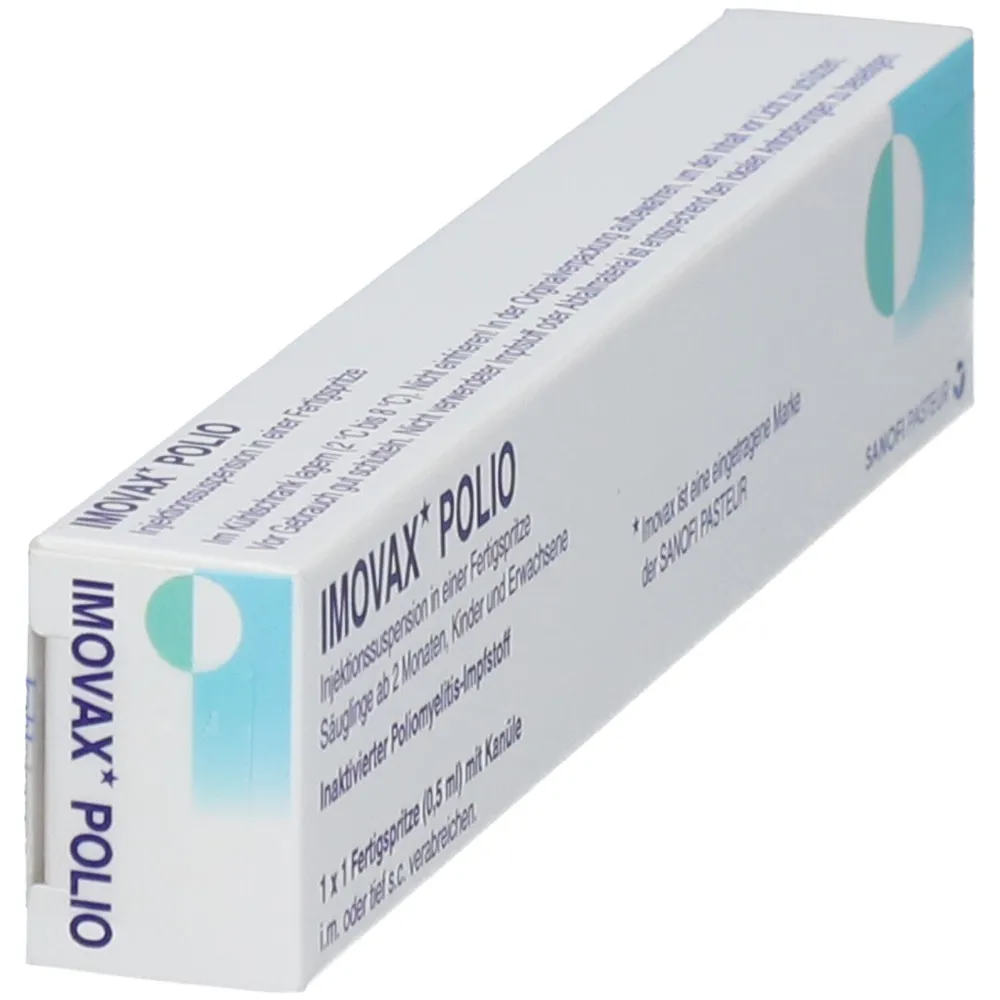
Table of Contents
- Package leaflet: Information for the user
- IMOVAX POLIO
- 1. What IMOVAX POLIO is and what it is used for
- 2. What you need to know before you and/or the child are administered IMOVAX POLIO
- 3. How IMOVAX POLIO will be administered to you and/or your child
- 4. Possible side effects
- 5. How to store IMOVAX POLIO
- 6. Package contents and other information
- The following information is intended exclusively for doctors or healthcare professionals
Package leaflet: Information for the user
IMOVAX POLIO
Injectable suspension in pre-filled syringe
Inactivated poliomyelitis vaccine
Please read all of this leaflet carefully before you and/or the child are given this
medicine, as it contains important information for you and/or the child.
- Keep this leaflet. You may need to read it again.
- If you have any questions, ask your doctor or pharmacist.
- This medicine has been prescribed for you and/or the child only. Do not give it to others, as it may be harmful.
- If you experience any side effects, including those not listed in this leaflet, contact your doctor or pharmacist. See section 4.
Contents of this leaflet:
- What IMOVAX POLIO is and what it is used for
- What you need to know before you and/or the child are given IMOVAX POLIO
- How you and/or the child will be given IMOVAX POLIO
- Possible side effects
- How to store IMOVAX POLIO
- Contents of the pack and other information
1. What IMOVAX POLIO is and what it is used for
IMOVAX POLIO (IPV) is a vaccine.
Vaccines are used to protect you and/or your child against infectious diseases. They work
by stimulating the body to produce its own protection against the specific disease for which the vaccine is intended.
IMOVAX POLIO is a vaccine that helps protect adults and children over 2 months of age against
Poliomyelitis, and is used in the following cases:
- primary vaccination (vaccination for primary prevention against poliomyelitis);
- booster dose (to strengthen protection against poliomyelitis). You and/or your child may receive the booster vaccination even if previously vaccinated with the oral polio vaccine. IMOVAX POLIO may also be used if you and/or your child cannot take the oral polio vaccine and/or have immune system problems (for example, in case of HIV infection).
What is poliomyelitis?
Poliomyelitis is a viral infection. Poliomyelitis often causes only mild discomfort.
However, sometimes it can be very severe and cause permanent damage or even death.
Poliomyelitis can cause muscle weakness (muscle paralysis), including in muscles involved in breathing and movement. Arms or legs affected by this disease may become painfully deformed.
2. What you need to know before you and/or the child are administered IMOVAX POLIO
Do not use/do not give the child IMOVAX POLIO if you and/or the child
- are allergic to the active substance or to any of the other ingredients of this medicine (listed in section 6);
- have had an allergic reaction after previous vaccination with IMOVAX POLIO or with another vaccine containing the same components;
- have a fever or are suffering from ongoing illnesses.
Warnings and precautions
Talk to your doctor or pharmacist before you and/or the child are administered IMOVAX POLIO.
In particular, inform your doctor before vaccination if you and/or the child:
suffer from thrombocytopenia (reduced number of platelets in the blood), as you and/or the child
may experience bleeding after vaccination;
suffer from blood coagulation disorders, as you and/or the child may experience
bleeding after vaccination;
have previously received other vaccinations;
have previously experienced allergic reactions after earlier vaccinations;
have recently suffered from an illness. It is important to inform the doctor about your and/or the child's current health status;
are allergic to neomycin, streptomycin, and polymyxin B (antibiotics). Since IMOVAX POLIO
may contain traces of these substances, healthcare professionals will take appropriate precautions if you and/or the child are allergic to them;
are receiving immunosuppressive treatment (treatment that reduces the activity of the immune
system, for example after an organ transplant) or have problems with the immune system (the
system that protects the body from infections). The doctor may decide to postpone vaccination
until the end of treatment or illness. However, if you and/or the child have chronic immune
system problems (for example, in case of HIV infection), vaccination with IMOVAX POLIO
may be carried out.
The decision to administer any vaccine must be carefully evaluated by the doctor, weighing the potential benefits against the possible risks for you and/or the child.
Fainting may occur following, or even before, any needle injection. Therefore, inform the
doctor or nurse if you or your child have fainted after a previous injection.
Children and adolescents
This vaccine can be used for primary vaccination in children from two months of age, and for booster doses in children from 5-6 years of age.
In case of primary vaccination in newborns, inform the doctor if the newborn was born very prematurely (at 28 weeks of gestation or earlier), and particularly if the newborn has had respiratory problems. In this case, the doctor will monitor the newborn's breathing for 48-72 hours after vaccination due to a potential risk of apnea (longer than normal pauses between breaths). Since the benefit of vaccination in this group of newborns is high, the doctor will never consider withholding or postponing vaccination (see section 4 “Additional undesirable effects in children”).
Other medicines and IMOVAX POLIO
Inform your doctor or pharmacist if you and/or the child are taking, have recently taken, or might take any other medicines.
IMOVAX POLIO may be administered to you and/or the child during the same vaccination session as other common vaccines for children and adults. When administered simultaneously with other vaccines, healthcare professionals will use separate syringes and different injection sites.
In particular, inform your doctor if you and/or the child are receiving immunosuppressive treatment (treatment that reduces the activity of the immune system), for example:
- hormones (long-term therapy)
- chemotherapy
- radiotherapy, as the response to the vaccine may be reduced. In such cases, the doctor may decide to postpone vaccination until the end of treatment.
Pregnancy, breastfeeding, and fertility
If you are pregnant, suspect you may be pregnant, planning to become pregnant, or are breastfeeding, ask your doctor or pharmacist for advice before using this medicine.
Pregnancy
IMOVAX POLIO will not be administered to you if you are pregnant, unless your doctor considers it absolutely necessary.
Breastfeeding
IMOVAX POLIO will not be administered to you if you are breastfeeding, unless your doctor considers it absolutely necessary.
Fertility
Generally, if you are of childbearing age and not using contraceptive methods, IMOVAX POLIO will not be administered to you.
Driving and using machines
No studies on the ability to drive vehicles and use machines have been conducted.
IMOVAX POLIO contains phenylalanine, ethanol, and sodium
IMOVAX POLIO contains 12.5 micrograms of phenylalanine in each 0.5 ml dose. Phenylalanine may be harmful if you suffer from phenylketonuria (PKU), a rare genetic disorder in which phenylalanine accumulates because the body cannot properly metabolize it.
IMOVAX POLIO contains 2 mg of alcohol (ethanol) in each 0.5 ml dose. The amount in one dose of this medicine is equivalent to less than 1 ml of beer or 1 ml of wine. The small amount of alcohol in this medicine will have no noticeable effects.
IMOVAX POLIO contains less than 1 mmol of sodium per dose, i.e., essentially "sodium-free".
3. How IMOVAX POLIO will be administered to you and/or your child
This medicine will be prepared and administered to you and/or your child only by healthcare professionals.
This medicine will be given to you and/or your child as an injection into a muscle or
under the skin.
Adults and children over 2 months of age
➢ Primary vaccination (vaccination for primary prevention against poliomyelitis)
Children from the age of 2 months: 3 injections of 0.5 ml each, given 6-8 weeks apart.
Adults: 2 injections of 0.5 ml each, given 1 or 2 months apart.
➢ Booster dose (to strengthen protection against poliomyelitis)
Children aged 5-6 years: 1 injection of 0.5 ml
Adults: 1 injection of 0.5 ml given 6-12 months after the second primary vaccination injection.
Immunized adults
➢ In case of increased risk of exposure to poliomyelitis
1 injection of 0.5 ml.
If you and/or the child receive more IMOVAX POLIO than you should
Since this medicine is prepared and administered by healthcare professionals, it is unlikely that you and/or the
child will receive an overdose.
4. Possible side effects
Like all medicines, this medicine can cause side effects, although not everybody gets them.
If you and/or the child experience any of the following side effects immediately after vaccination or after leaving the place where the vaccine was administered, consult a doctor IMMEDIATELY:
Systemic disorders and administration site conditions
Very common (may affect up to 1 in 10 people)
pain at the injection site
fever
Common (may affect up to 1 in 100 people)
redness at the injection site
swelling at the injection site
Pain, redness, and swelling at the injection site are side effects that may occur within 48 hours after vaccination and may last for at least one or two days.
Additionally, the following side effects may occur with frequency not known:
Not known (cannot be estimated from the available data)
Blood and lymphatic system disorders
- lymphadenopathy (swollen lymph nodes, structures located mainly in the neck, chest, and groin)
Systemic disorders and administration site conditions - allergic reactions, including severe reactions (anaphylactic reactions or anaphylactic shock)
Musculoskeletal and connective tissue disorders - mild and transient arthralgia (joint pain)
- myalgia (muscle pain)
Nervous system disorders - seizures (with or without fever)
- headache
- mild and transient paraesthesia (tingling), mainly localized in arms and legs
Psychiatric disorders - agitation
- somnolence (drowsiness)
- irritability
Skin and subcutaneous tissue disorders - skin rashes (rash)
- urticaria (red, itchy skin rash)
Additional side effects in children
In very premature infants (born at 28 weeks of gestation or earlier), prolonged pauses between breaths (apnoea) may occur 2–3 days after vaccination.
Reporting of side effects
If you experience any side effect, including those not listed in this leaflet, talk to your doctor, pharmacist, or nurse. You can also report side effects directly via the national reporting system at the following website: https://www.aifa.gov.it/content/segnalazioni-reazioni-avverse . By reporting side effects, you can help provide more information on the safety of this medicine.
5. How to store IMOVAX POLIO
Keep this medicine out of the sight and reach of children.
Do not use this medicine after the expiry date stated on the carton after "EXP".
The expiry date refers to the last day of that month.
Store in a refrigerator (2°C - 8°C). Do not freeze.
Do not dispose of any medicine via wastewater or household waste. Ask your pharmacist how to dispose of
medicines no longer required. This will help protect the environment.
6. Package contents and other information
What IMOVAX POLIO contains
- The active substances are:
inactivated poliovirus type 1* D-antigen: 29 units**
inactivated poliovirus type 2* D-antigen: 7 units**
inactivated poliovirus type 3* D-antigen: 26 units**
*Grown on Vero cells
** These antigen amounts are strictly equivalent to the previously stated values of 40-8-32 D-antigen units, respectively for virus types 1, 2 and 3, when measured by another suitable immunochemical method.
- The other components are: 2-phenoxyethanol, formaldehyde, Medium 199, hydrochloric acid or sodium hydroxide for pH adjustment. (Contains sodium and potassium. See section "IMOVAX POLIO contains sodium and potassium".)
Description of the appearance of IMOVAX POLIO and contents of the pack
IMOVAX POLIO is an injectable suspension in a 0.5 ml pre-filled syringe with a fixed needle and needle shield cap. Packs contain 1 pre-filled syringe.
Marketing Authorisation Holder:
Sanofi Winthrop Industrie
82 avenue Raspail
94250 Gentilly
France
Local representative in Italy:
Sanofi S.r.l. - Viale L. Bodio, 37/B – 20158 Milano
Manufacturers:
Sanofi Pasteur
Campus Merieux
1541 Avenue Marcel Merieux
69280 Marcy l’Etoile (France)
Sanofi Pasteur
Parc industriel d’Incarville
27100 Val de Reuil (France)
Sanofi-Aventis Zrt.
Building DC5
Campona utca 1.
Budapest, 1225
Hungary
This leaflet was last revised on
The following information is intended exclusively for doctors or healthcare professionals
Precautions for use
Under no circumstances should the vaccine be administered intravascularly: ensure that the needle does not enter a blood vessel.
Before administering any biological product, the person responsible for administration must take all necessary precautions to prevent allergic or other types of reactions. As with all injectable vaccines, appropriate medical treatments and supervision must always be readily available to manage rare anaphylactic reactions that may occur following vaccine administration.
Method of administration
The vaccine must be administered by a physician or healthcare professional trained in the use of vaccines and equipped to intervene should any uncommon severe allergic reaction occur after injection.
The vaccine is administered by subcutaneous or intramuscular injection.
The recommended injection sites are the anterolateral aspect of the thigh in infants and the deltoid muscle in children, adolescents, and adults.
Do not administer intravascularly: ensure that the needle does not enter a blood vessel.
For primary immunization and booster doses, IMOVAX POLIO may be administered according to current local recommendations (National Vaccination Prevention Plan 2012–2014, Official Journal No. 60 of 12/3/2012) or in accordance with international recommendations regarding traveler's prophylaxis.
See also section 3. How IMOVAX POLIO will be administered to you and/or your child.