Hydrochinidin Lirca
Italy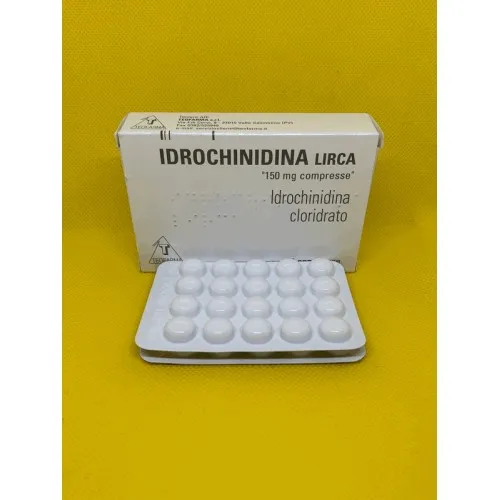
Table of Contents
- Package leaflet: Information for the patient
- IDROCHINIDINA LIRCA 150 mg tablets
- 1. What IDROCHINIDINA LIRCA is and what it is used for
- 2. What you need to know before taking IDROCHINIDINA LIRCA
- 3. How to take IDROCHINIDINA LIRCA
- 4. Possible side effects
- 5. How to store IDROCHINIDINA LIRCA
- 6. Contents of the pack and other information
Package leaflet: Information for the patient
IDROCHINIDINA LIRCA 150 mg tablets
Hydroquinidine hydrochloride
Please read this leaflet carefully before taking this medicine because it contains important information for you.
- Keep this leaflet. You may need to read it again.
- If you have any questions, ask your doctor or pharmacist.
- This medicine has been prescribed for you only. Do not give it to other people, even if their symptoms are the same as yours, as it could be harmful.
- If you experience any adverse reactions, including those not listed in this leaflet, contact your doctor or pharmacist. See section 4.
Contents of this leaflet:
- What IDROCHINIDINA LIRCA is and what it is used for
- What you need to know before taking IDROCHINIDINA LIRCA
- How to take IDROCHINIDINA LIRCA
- Possible side effects
- How to store IDROCHINIDINA LIRCA
- Contents of the pack and other information
1. What IDROCHINIDINA LIRCA is and what it is used for
IDROCHINIDINA LIRCA contains the active substance hydroquinidine hydrochloride,
which belongs to a class of medicines called antiarrhythmics, used to regulate
the heartbeat.
This medicine is indicated:
- for the treatment of disturbances in heart rhythm such as: premature heartbeat (supraventricular and ventricular extrasystoles); rapid, uncoordinated and ineffective contraction of the atria (atrial fibrillation and atrial flutter).
- for the maintenance of normal heart rhythm (sinus rhythm) after a corrective procedure known as pharmacological or electrical cardioversion of atrial tachyarrhythmias;
- for the prevention (prophylaxis) of disturbances in heart rhythm (paroxysmal supraventricular tachyarrhythmias and ventricular tachycardias).
2. What you need to know before taking IDROCHINIDINA LIRCA
Do not take IDROCHINIDINA LIRCA
-
if you are allergic to hydroquinidine hydrochloride or to any of the other ingredients of this medicine (listed in section 6);
-
if you have the following heart conditions:
disturbances in the normal heart rhythm (sinus automatism disorders);
disturbance in the transmission of the cardiac impulse (complete atrioventricular block) without the presence of a corrective device known as a "pacemaker";
heart rhythm disorders (prolongation of the QT interval);
if you have a specific type of heartbeat irregularity called torsades de pointes, or bundle branch block, or other intraventricular conduction disorders;
if you are taking heart medications called digitalis and have recently experienced digitalis intoxication;
if you have uncompensated heart failure;
if you have recently had a heart attack; -
if you have been diagnosed with a blood disorder known as thrombocytopenic purpura following administration of quinidine;
-
if you suffer from a disease characterized by muscle weakness (myasthenia).
Warnings and precautions
Talk to your doctor or pharmacist before taking IDROCHINIDINA LIRCA.
Take this medicine with caution and inform your doctor in the following cases:
- if you have severe heart problems (heart failure);
- if you are taking digoxin, a medicine used to treat heart conditions. Your doctor will determine the appropriate dose;
- if you have kidney problems (renal failure). In this case, your doctor must monitor your electrolyte levels (water and electrolyte balance) and will adjust the dose based on your kidney function and blood levels of this medicine;
- if you have high potassium levels in the blood (hyperkalemia) or alkaline urine, as this medicine may be more effective under these conditions.
Before starting treatment, your doctor must check your blood potassium levels and assess your sensitivity by administering a test dose of hydroquinidine, followed after 4 hours by a cardiac examination (electrocardiographic tracing).
If you develop abnormalities in the cardiac test (abnormal widening of the QRS complex, cardiac rhythm disturbances, increase ≥ 50% in duration of the QRS complex), your doctor will determine whether you can take this medicine.
During treatment with this medicine, your doctor must monitor your heart function (electrocardiographic checks) and control blood levels of the medicine.
If you develop abnormalities in the cardiac test (increase ≥ 50% in duration of the QRS complex), treatment must be discontinued.
Other medicines and IDROCHINIDINA LIRCA
Inform your doctor or pharmacist if you are taking, have recently taken, or might take any other medicines.
Do not take this medicine if you are taking the following medicines:
- other antiarrhythmics, medicines used for heart rhythm disorders, which may increase the risk of torsades de pointes (cepidil, sotalol, amiodarone);
- medicines used for heart conditions such as lidoflazine, prenylamine, and vincamine, because they may increase the risk of torsades de pointes.
Take this medicine with caution and inform your doctor if you are taking the following medicines:
- medicines used to regulate urine pH, such as acetazolamide, sodium bicarbonate, trismethanol, or THAM;
- digoxin, a medicine used to treat heart conditions;
- medicines used for heart conditions (disorders of contractility, automatism, and conduction), such as beta-blockers;
- medicines that cause a decrease in potassium levels in the body, such as: amphotericin B, a medicine used to treat infections; gluco- and mineralocorticoids, medicines used to treat inflammatory states (glucocorticoids) and to regulate body electrolytes (mineralocorticoids); tetracosactide, a medicine used in the diagnosis of reduced adrenal gland function (hypofunction); hypokalemic diuretics, medicines used to increase urine production; stimulant laxatives, medicines used to facilitate bowel movements;
- medicines that may reduce the effectiveness of hydroquinidine by increasing its elimination: antiepileptic medicines such as phenobarbital, phenytoin, and primidone; rifampicin, a medicine used to treat infections.
Pregnancy and breastfeeding
If you are pregnant, suspect you may be pregnant, planning a pregnancy, or are breastfeeding, consult your doctor or pharmacist before taking this medicine.
This medicine is not recommended during pregnancy or while breastfeeding.
Driving and using machines
This medicine may cause dizziness, tremors, and visual disturbances (cinchonism), thereby reducing judgment and reaction ability in dangerous situations. If you experience these effects, avoid driving vehicles or operating machinery.
IDROCHINIDINA LIRCA contains lactose
This medicine contains lactose, a type of sugar. If your doctor has diagnosed you with an intolerance to certain sugars, contact them before taking this medicine.
3. How to take IDROCHINIDINA LIRCA
Take this medicine exactly as directed by your doctor or
pharmacist. If you have any doubts, consult your doctor or pharmacist.
The recommended dose is 3-4 tablets per day.
Your doctor may decide to increase the dose.
If you take more IDROCHINIDINA LIRCA than you should
If you (or someone else) have taken an excessive dose of IDROCHINIDINA LIRCA, or if
you suspect that a child may have taken this medicine, inform your doctor immediately or go to the nearest hospital emergency department.
After taking an excessive dose of this medicine, gastrointestinal disturbances, vision and hearing problems (neurosensory disturbances),
respiratory problems (apnea), agitation, low blood pressure
(hypotension), and heart problems (bundle branch block, bifascicular block,
QRS widening, ventricular tachycardia, torsade de pointes, ventricular
fibrillation, asystole) may occur.
If you forget to take IDROCHINIDINA LIRCA
Do not take a double dose to make up for a forgotten tablet.
If you have any doubts about how to use this medicine, consult your doctor or
pharmacist.
4. Possible side effects
Like all medicines, this medicine can cause side effects, although
not everyone gets them.
The side effects that may occur with IDROCHINIDINA LIRCA are:
Not known (frequency cannot be estimated from the available data)
- headache (cephalalgia), dizziness;
- hearing problems (tinnitus, hearing loss);
- vision problems (diplopia, photophobia);
- heart problems (QRS widening, atrioventricular conduction disturbances, torsades de pointes, ventricular extrasystoles, idioventricular rhythms (including ventricular tachycardia and ventricular fibrillation));
- heart block (cardiac arrest);
- loss of consciousness (syncope);
- problems with blood circulation (arterial embolism);
- reduction in blood pressure (hypotension and, in more severe cases, cardiocirculatory collapse);
- nausea, vomiting, diarrhoea and stomach ache (abdominal pain);
- changes in blood tests (haemolytic anaemia, agranulocytosis), a disease characterised by the formation of numerous haemorrhagic spots (thrombocytopenic purpura);
- skin rash (cutaneous rash) accompanied by itching, skin reactions after exposure to light (photosensitisation);
- vision problems (optic neuritis);
- swelling due to fluid accumulation around the mouth and eyes (angioedema);
- asthma.
Reporting of side effects
If you experience any side effect, including those not listed in
this leaflet, talk to your doctor or pharmacist. You can also report
side effects directly via the national reporting system at www.agenziafarmaco.gov.it/it/responsabili. By reporting side effects, you can help provide more information on the safety of this medicine.
5. How to store IDROCHINIDINA LIRCA
Keep this medicine out of the sight and reach of children.
Do not use this medicine after the expiry date stated on the packaging
after Exp. The expiry date refers to the last day of that month.
Do not dispose of any medicine via wastewater or household waste. Ask your
pharmacist how to dispose of medicines you no longer use. This will help
protect the environment.
6. Contents of the pack and other information
What IDROCHINIDINA LIRCA contains
- The active substance is hydroquinidine hydrochloride. Each tablet contains 150 mg of hydroquinidine hydrochloride.
- The other ingredients are corn starch, lactose, arabic gum, talc, magnesium stearate.
Description of the appearance of IDROCHINIDINA LIRCA and contents of the pack
Carton pack containing 40 tablets
Marketing Authorization Holder
TEOFARMA S.r.l. – Via F.lli Cervi, 8 – 27010 Valle Salimbene (PV)
Manufacturer
TEOFARMA S.r.l. – Viale Certosa, 8/A – 27100 Pavia