Heplisav B
Italy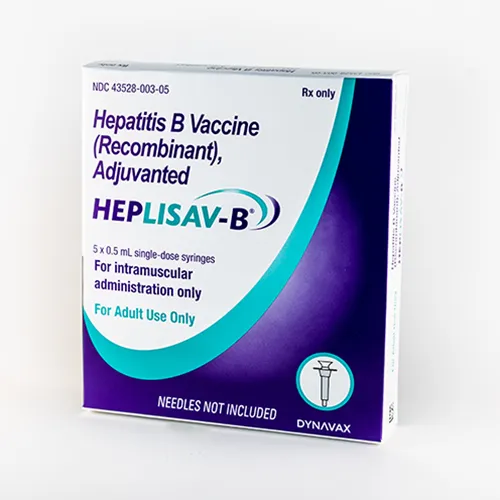
Table of Contents
- Package leaflet: Information for the user
- HEPLISAV B 20 micrograms solution for injection in pre-filled syringe
- 1. What is HEPLISAV B and what is it used for
- 2. What you should know before receiving HEPLISAV B
- 3. How HEPLISAV B is administered
- 4. Possible side effects
- 5. How to store HEPLISAV B
- 6. Package contents and other information
- The following information is intended for healthcare professionals only:
Package leaflet: Information for the user
HEPLISAV B 20 micrograms solution for injection in pre-filled syringe
Hepatitis B vaccine (recombinant DNA, adjuvanted)
Please read all of this leaflet carefully before you are given the vaccine because it contains
important information for you.
- Keep this leaflet. You may need to read it again.
- If you have any questions, ask your doctor, pharmacist, or nurse.
- If you get any side effects, including those not listed in this leaflet, tell your doctor, pharmacist, or nurse. See section 4.
Contents of this leaflet
- What HEPLISAV B is and what it is used for
- What you need to know before receiving HEPLISAV B
- How HEPLISAV B is administered
- Possible side effects
- How to store HEPLISAV B
- Contents of the pack and other information
1. What is HEPLISAV B and what is it used for
HEPLISAV B is a vaccine indicated for adults aged 18 years and older for protection against hepatitis B virus infection.
HEPLISAV B may also provide protection against hepatitis D, which can occur only in patients already affected by hepatitis B.
What is hepatitis B?
- Hepatitis B is an infectious liver disease caused by a virus. Infection with the hepatitis B virus can lead to serious liver problems such as "cirrhosis" (scarring of liver tissue) or liver cancer.
- Some individuals infected with the hepatitis B virus become carriers of the infection, meaning they may not show symptoms of the disease but can still harbor the virus in their body and thus infect others.
- The disease spreads when the hepatitis B virus enters the body through contact with bodily fluids from an infected person, including vaginal secretions, blood, semen, or saliva. An infected mother can also transmit the virus to her baby at birth.
- Main signs and symptoms of the disease include mild flu-like symptoms (such as headache, fever, and severe fatigue), dark urine, pale stools, and yellowing of the skin and eyes (jaundice). However, some people with hepatitis B may not appear or feel ill.
How HEPLISAV B works
When a person is vaccinated with HEPLISAV B, the vaccine helps the body's natural defense system (immune system) produce specific protective substances (antibodies) against the hepatitis B virus.
- HEPLISAV B contains an adjuvant, a substance that enhances the body's production of antibodies and increases the duration of protection.
- A complete course of two HEPLISAV B injections is required to achieve full protection against hepatitis B.
- HEPLISAV B is not indicated for the treatment of individuals who are already infected with the hepatitis B virus, including those who have become chronic carriers of the infection.
2. What you should know before receiving HEPLISAV B
Do not receive HEPLISAV B vaccination if:
- you are allergic to any of the components of this vaccine, including yeast (listed in section 6). Signs of an allergic reaction may include itching, rash, shortness of breath, and swelling of the face or tongue.
- you have previously experienced a sudden, potentially life-threatening allergic reaction after receiving HEPLISAV B.
Do not receive HEPLISAV B vaccination if any of the above conditions apply to you. If in doubt, consult your doctor, pharmacist, or nurse before receiving HEPLISAV B vaccination.
Warnings and precautions
Talk to your doctor, pharmacist, or nurse before receiving HEPLISAV B vaccination:
- if you are allergic to any of the components of HEPLISAV B (see section 6),
- if you have previously experienced health problems after receiving a vaccine.
- Fainting may occur before or sometimes after an injection. Therefore, inform your doctor, pharmacist, or nurse if you have ever fainted before or after an injection in the past.
- If you have a high fever, your doctor, pharmacist, or nurse may delay your vaccination until you feel better. A minor infection such as a cold should not be a problem, but it is up to your doctor, pharmacist, or nurse to decide whether vaccination should proceed.
If you are on dialysis due to kidney problems or if your immune system is weakened, your doctor may need to perform a blood test to check whether the vaccination has provided sufficient protection against hepatitis B.
HEPLISAV B does not protect against other liver infections such as hepatitis A, C, and E.
Like any other vaccine, HEPLISAV B may not protect all vaccinated individuals.
If you are unsure whether any of the above conditions apply to you, discuss this with your doctor, pharmacist, or nurse before receiving HEPLISAV B vaccination.
Children and adolescents
Since HEPLISAV B has not been fully tested in individuals under 18 years of age, it must not be used in this age group.
Other medicines and HEPLISAV B
Inform your doctor, pharmacist, or nurse if you are taking, have recently taken, or might take any other medicines or vaccines.
If HEPLISAV B is administered at the same time as an injection of hepatitis B "immunoglobulins" (given to provide immediate, short-term protection against hepatitis B virus infection), your doctor, pharmacist, or nurse will ensure that the two products are administered at different injection sites.
Pregnancy, breastfeeding, and fertility
If you are pregnant, suspect you may be pregnant, planning to become pregnant, or breastfeeding, consult your doctor before receiving this vaccine.
It is not known whether HEPLISAV B is excreted in human breast milk. A risk to breastfed infants cannot be ruled out. Consult your doctor or nurse to evaluate whether to discontinue breastfeeding or to forego vaccination with HEPLISAV B, taking into account the benefits of breastfeeding for the infant and the benefits of vaccination for you.
Driving and using machines
After receiving HEPLISAV B vaccination, you may experience fatigue, dizziness, or headache. If so, avoid driving vehicles or operating tools or machinery.
HEPLISAV B contains sodium and polysorbate 80
This medicine contains less than 1 mmol (23 mg) of sodium per dose, i.e., essentially 'sodium-free'. This medicine contains 0.05 mg of polysorbate 80 per dose, equivalent to 0.1 mg/ml. Polysorbates may cause allergic reactions. Inform your doctor if you have known allergies.
3. How HEPLISAV B is administered
HEPLISAV B will be administered to you by a doctor, pharmacist, or nurse as an intramuscular
injection, usually in the upper arm.
For adults, the vaccination schedule consists of 2 injections:
- the first injection on a date agreed with your doctor or nurse;
- the second injection 1 month after the first.
For adults with kidney problems, including those undergoing haemodialysis, the vaccination schedule consists of
4 injections:
- The first injection on a date agreed with your doctor or nurse.
- The second injection 1 month after the first.
- The third injection 2 months after the first.
- The fourth injection 4 months after the first.
Your doctor will advise you whether you will need additional or "booster" injections in the future.
If you forget to attend your appointment for the second dose of HEPLISAV B
Contact your doctor and schedule another appointment.
Make sure to complete the full vaccination course to ensure you are fully protected. After
receiving a first dose of HEPLISAV B, all subsequent doses must also be HEPLISAV B (and not another type of hepatitis B vaccine).
4. Possible side effects
Like all medicines, this vaccine may cause side effects, although not everyone experiences them.
Serious side effects
Very rare (may affect up to 1 in 10,000 people)
Seek immediate medical advice if you notice signs of a severe allergic reaction.
Such signs may include: swelling of the face, low blood pressure, breathing difficulties, loss of consciousness, fever, joint stiffness, and skin rash. These reactions usually begin shortly after injection.
Other side effects
Very common (may affect more than 1 in 10 people)
- Headache
- Muscle pain (myalgia)
- Feeling tired
- Pain at the injection site
- Feeling unwell
Common (may affect up to 1 in 10 people)
- Swelling at the injection site
- Redness at the injection site
- Fever
Uncommon (may affect up to 1 in 100 people)
- Allergic reactions (including hives, skin rash and itching)
- Nausea
- Vomiting
- Diarrhoea
- Abdominal pain (stomach ache)
- Allergic reactions (hives, skin rash and itching)
- Itching at the injection site
Rare (may affect up to 1 in 1,000 people)
- Dizziness
- Tingling and pricking sensations (paraesthesia)
Reporting of side effects
If you experience any side effect, including those not listed in this leaflet, tell your doctor, pharmacist or nurse. You can also report side effects directly via the national reporting system referred to in Annex V. By reporting side effects, you can help provide more information on the safety of this medicine.
5. How to store HEPLISAV B
Keep the vaccine out of the sight and reach of children.
Do not use the vaccine after the expiry date stated on the label and packaging after the word "Exp.". The expiry date refers to the last day of that month.
Store in the refrigerator (2°C-8°C). Do not freeze.
Keep the pre-filled syringe in the outer carton to protect it from light.
Do not dispose of any medicine via wastewater or household waste. Ask your pharmacist how to dispose of medicines no longer required. This will help protect the environment.
6. Package contents and other information
What HEPLISAV B contains
Each dose (0.5 mL) contains:
Active substances:
Hepatitis B surface antigen (HBsAg) 20 micrograms
Added 3,000 micrograms of CpG 1018 adjuvant, an immunostimulatory 22-mer oligonucleotide
Produced in yeast cells (Hansenula polymorpha) using recombinant DNA technology
The CpG 1018 substance is included in the vaccine as an adjuvant. Adjuvants are substances added to
certain vaccines to speed up, enhance, and/or prolong their protective effects.
Other components: sodium chloride, disodium phosphate dodecahydrate, sodium dihydrogen phosphate dihydrate, polysorbate 80 (E 433), water for injectable preparations (see section 2 “HEPLISAV B contains sodium and polysorbate 80”).
Description of the appearance of HEPLISAV B and package contents
HEPLISAV B is an injectable solution in a pre-filled syringe, from clear to slightly milky, colourless to slightly yellow (0.5 mL).
HEPLISAV B is available in packs of 1 and 5 pre-filled syringes without needles.
Not all pack sizes may be marketed.
Marketing Authorisation Holder and Manufacturer
Dynavax GmbH
Eichsfelder Strasse 11
D-40595 Düsseldorf
Germany
For any information regarding this medicinal product, contact the local representative of the Marketing Authorisation Holder:
België/Belgique/Belgien, България, Česká republika, Danmark, Eesti, Ελλάδα, España, Deutschland, France, Hrvatska, Ireland, Ísland, Italia, Κύπρος, Latvija, Lietuva, Luxembourg/Luxemburg, Magyarország, Malta, Nederland, Norge, Österreich, Polska, Portugal, România, Slovenija, Slovenská republika, Suomi/Finland, Sverige
Bavarian Nordic A/S
Tel: +49 89 26200980
Dynavax GmbH
Tél/Tel/Teл./Tlf/Τηλ/Sími/Puh: +49 211 758450
More detailed information on this medicinal product is available on the website of the European Medicines Agency: https://www.ema.europa.eu.
The following information is intended for healthcare professionals only:
HEPLISAV-B:
- is a solution ranging from clear to slightly opalescent, colorless to slightly yellow, and should be essentially free from visible particles. The medicinal product must be discarded if its contents appear different;
- must be administered by intramuscular (i.m.) injection into the deltoid muscle of the shoulder;
- must not be administered into the gluteal muscle;
- must not be administered intravenously, subcutaneously, or intradermally;
- must not be given to individuals with hypersensitivity to the active substance or to any of the excipients;
- must not be administered to subjects suffering from severe febrile illness in the acute phase. The presence of a minor infection, such as a cold, is not a contraindication to immunization;
- must not be mixed in the same syringe with other vaccines.
As with all injectable vaccines, appropriate medical treatment must be immediately available in case of rare anaphylactic reactions following administration of HEPLISAV-B.
Any unused medicinal product and waste materials derived from such medicinal product must be disposed of in accordance with local regulations.