Fluifort
Italy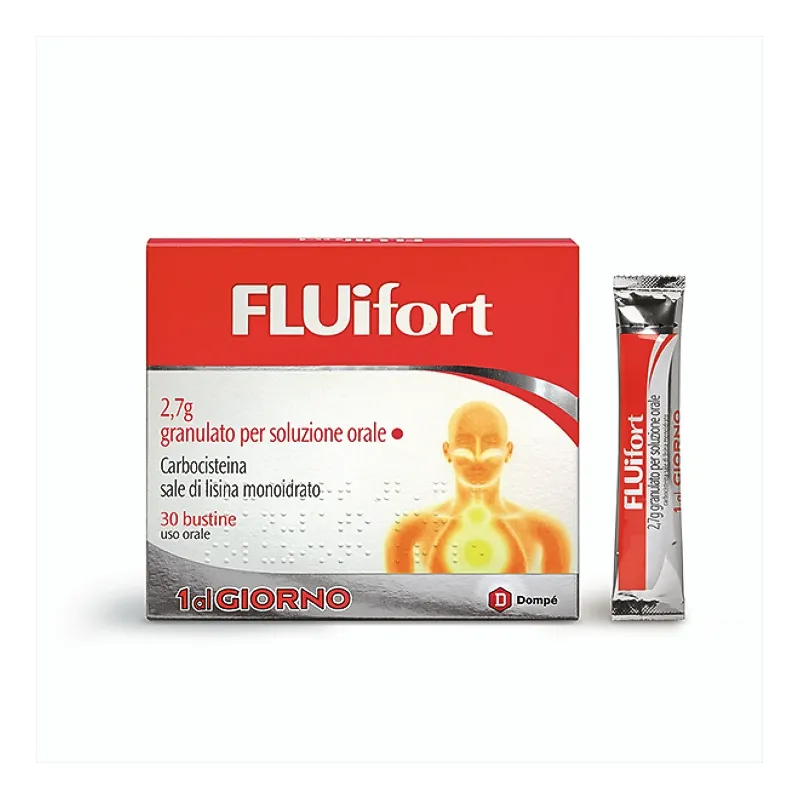
Instructions for Use
Package leaflet: information for the patient
Fluifort 2.7 g granules for oral solution
Carbocysteine lysine salt monohydrate
Read this entire leaflet carefully before taking this medicine because it contains
important information for you.
Always take this medicine exactly as described in this leaflet or as your doctor or pharmacist has instructed you.
- Keep this leaflet. You may need to read it again.
- If you need more information or advice, consult your pharmacist.
- If you experience any side effects, including those not listed in this leaflet, contact your doctor or pharmacist. See section 4.
- Contact your doctor if you do not notice any improvement or if your symptoms worsen after 14 days.
Contents of this leaflet:
- What Fluifort is and what it is used for
- What you need to know before taking Fluifort
- How to take Fluifort
- Possible side effects
- How to store Fluifort
- Contents of the pack and other information
1. What Fluifort is and what it is used for
Fluifort contains the active substance carbocisteine lysine salt monohydrate, which belongs to a group of cough and cold medicines called mucolytics, used to help clear mucus from the airways.
This medicine is indicated for the treatment of cough and acute and chronic respiratory tract disorders.
Consult your doctor if you do not feel better or if you feel worse after 14 days.
2. What you should know before taking Fluifort
Do not take Fluifort
- if you are allergic to carbocysteine lysine salt monohydrate or to any of the other ingredients of this medicine (listed in section 6);
- if you have gastroduodenal ulcer, a condition affecting the stomach or the first part of the intestine;
- if you are pregnant or breastfeeding (see section “Pregnancy and breastfeeding”). Do not administer this medicine to children under 11 years of age (see section “Children”).
Warnings and precautions
Talk to your doctor or pharmacist before taking Fluifort.
No reduction in the effectiveness of the medicine after prolonged treatment or phenomena of dependence (need to continue taking the medicine) are known with the use of Fluifort.
Caution is recommended in elderly patients, asthmatic patients with a history of severe respiratory problems, debilitated patients, in those with a history of gastroduodenal ulcers, or in those taking medicines known to cause gastrointestinal bleeding. You must stop treatment with carbocysteine if gastrointestinal bleeding occurs.
This medicine must not be used concomitantly with cough suppressants and/or medicines that inhibit bronchial secretion.
Consult your doctor if symptoms recur repeatedly or if you notice any recent change in their characteristics.
Fluifort does not affect body weight, therefore it can be taken if you are on a low-calorie (hypocaloric) diet or if you have diabetes.
The medicine does not contain gluten and therefore can be used by patients with celiac disease.
Children
Fluifort must not be taken by children under 11 years of age (see section “Do not take Fluifort”).
Other medicines and Fluifort
Inform your doctor or pharmacist if you are taking, have recently taken, or might take any other medicines.
No adverse effects due to concomitant use with medicines used to treat upper and lower respiratory tract diseases are known.
Pregnancy and breastfeeding
If you are pregnant, think you may be pregnant, planning to become pregnant, or breastfeeding, consult your doctor or pharmacist before taking this medicine.
Pregnancy
Do not take Fluifort during pregnancy.
Breastfeeding
If you are breastfeeding, do not take Fluifort.
Driving and using machines
Fluifort does not impair the ability to drive or operate machinery.
Fluifort contains aspartame.
This medicine contains 30 mg of aspartame per dose, equivalent to 6 mg/g. Aspartame is a source of phenylalanine. It may be harmful if you have phenylketonuria, a rare genetic disorder causing accumulation of phenylalanine because the body cannot properly eliminate it.
3. How to take Fluifort
Take this medicine exactly as stated in this leaflet or as instructed by your doctor or pharmacist. If you have any doubts, consult your doctor or pharmacist.
The recommended dose is 1 sachet per day.
Dissolve the contents of the sachet in about half a glass of water and mix well.
Warning: Do not exceed the recommended dose.
Fluifort may also be taken for prolonged periods. However, if symptoms persist after 14 days of treatment, it is recommended to consult a doctor.
If you have kidney or liver problems, you can still take Fluifort and there is no need to adjust the dose.
If you take more Fluifort than you should
Symptoms reported in case of overdose may include: headache, nausea, vomiting, diarrhea, stomach ache, skin reactions, and disturbances of the senses.
In case of accidental ingestion or overdose of Fluifort, inform your doctor immediately or go to the nearest hospital.
If you forget to take Fluifort
Do not take a double dose to make up for the missed dose.
If you stop taking Fluifort
If you have any doubts about using this medicine, consult your doctor or pharmacist.
4. Possible side effects
Like all medicines, this medicine can cause side effects, although not everybody gets them.
Contact your doctor if you experience any of the following side effects:
Frequency not known (frequency cannot be estimated from the available data):
- skin irritations and skin disorders (Stevens-Johnson syndrome; bullous dermatitis; erythema multiforme; toxic skin eruption). (In such cases, discontinue treatment and consult your doctor to establish appropriate therapy.)
- gastrointestinal bleeding. (In such cases, discontinue treatment and consult your doctor to establish appropriate therapy.)
- skin reactions (rash, urticaria, erythema, dermatitis), with appearance of spots, blisters or bullae (exanthema, bullous exanthema/erythema), itching, swelling due to fluid accumulation around the eyes, mouth, tongue and throat, possibly causing breathing difficulties (angioedema).
- abdominal pain, nausea, vomiting, diarrhoea.
- dizziness.
- difficulty in breathing (dyspnoea).
- flushing.
Reporting of side effects
If you experience any side effect, including those not listed in this leaflet, talk to your doctor or pharmacist.
You can also report side effects directly via the national reporting system at
https://www.aifa.gov.it/content/segnalazioni-reazioni-avverse.
By reporting side effects, you can help provide more information on the safety of this medicine.
5. How to store Fluifort
Keep this medicine out of the sight and reach of children.
Do not use this medicine after the expiry date stated on the packaging after
Exp. The expiry date refers to the last day of that month. The expiry date applies to the product in its original unopened packaging, properly stored.
This medicine does not require any special storage conditions.
Do not dispose of medicines via wastewater or household waste. Ask your pharmacist how to dispose of medicines you no longer use. This will help protect the environment.
6. Package contents and other information
What Fluifort contains
- The active substance is carbocisteine lysine salt monohydrate. One 5-gram sachet contains 2.7 g of carbocisteine lysine salt.
- The other components are: citric acid, mannitol, povidone, natural cedar flavour, natural orange flavour, orange juice, aspartame, maltodextrins.
Description of the appearance of Fluifort and contents of the pack
Fluifort is a granulate for oral solution.
Fluifort is available in packs of 10, 20 and 30 sachets.
Not all pack sizes may be marketed.
Marketing Authorization Holder
Dompé farmaceutici S.p.A. - Via San Martino, 12 - 20122 Milano
Manufacturer
Dompé farmaceutici S.p.A. - Via Campo di Pile - L'Aquila
Similar Medications
-
Broncolib
Form: solution, oral for preparation from granules
Active substance Dosage CARBOCYSTEINE LYSINE SALT — Manufacturer: IPSO PHARMA S.R.L.
-
Carbocysteine Ipsopharma
Form: solution, oral for preparation from granules
Active substance Dosage CARBOCYSTEINE LYSINE SALT — Manufacturer: IPSO PHARMA S.R.L.
-
Glosid
Form: solution, oral for preparation from granules
Active substance Dosage CARBOCYSTEINE LYSINE SALT — Manufacturer: DYMALIFE PHARMACEUTICAL S.R.L.
-
KofituSS mucolytic
Form: solution, oral for preparation from granules
Active substance Dosage CARBOCYSTEINE LYSINE SALT — Manufacturer: POOL PHARMA SRL
-
Lisomucil cough mucolytic Unidie
Form: solution, oral for preparation from granules
Active substance Dosage CARBOCYSTEINE LYSINE SALT — Manufacturer: EG S.P.A.
-
Tusselim expectorant cough
Form: solution, oral for preparation from granules
Active substance Dosage CARBOCYSTEINE LYSINE SALT — Manufacturer: FARMITALIA INDUSTRIA CHIMICO FARMACEUTICA S.R.L.
This page has been machine-translated and may contain inaccuracies. The original data is available in the manufacturing country's language.
Last data check: May 11, 2026 · Data source: Agenzia Italiana del Farmaco (AIFA)