Fendrix
Italy
Table of Contents
F Patient Information Leaflet: Information for the User
Fendrix injectable suspension
Hepatitis B vaccine (rDNA) (adjuvanted, adsorbed)
Please read this leaflet carefully before using this medicine, as it contains
important information for you.
- Keep this leaflet. You may need to read it again.
- If you have any questions, ask your doctor or pharmacist.
- This medicine has been prescribed for you only. Never give it to others.
- If you experience any adverse reaction, including those not listed in this leaflet, contact your doctor or pharmacist. See section 4.
Contents of this leaflet:
- What Fendrix is and what it is used for
- What you need to know before receiving Fendrix
- How Fendrix is administered
- Possible side effects
- How to store Fendrix
- Contents of the pack and other information
1. What Fendrix is and what it is used for
Fendrix is a vaccine that prevents hepatitis B.
It is used in patients with kidney problems:
- patients undergoing "haemodialysis", a condition in which a "dialysis" machine removes waste products from the blood
- patients who will undergo "haemodialysis" in the future.
Fendrix is indicated for adults and adolescents from 15 years of age.
What is hepatitis B?
Hepatitis B is caused by a virus that causes swelling of the liver.
- Symptoms may not be noticed by the patient for up to 6 weeks and as long as 6 months after infection.
- Main symptoms include mild flu-like symptoms such as headache or fever, feeling very tired, dark urine, pale stools, yellowing of the skin or eyes (jaundice). These or other symptoms may require hospital treatment. Most people recover from the disease.
- Some people with hepatitis B do not appear or feel ill and have no symptoms of the disease.
- The virus is present in body fluids such as vaginal fluid, blood, semen or saliva (spit).
Hepatitis B carriers
- The hepatitis B virus remains in the body of some people for life.
- This means they can still infect others and are known as "carriers" of the virus.
- "Carriers" of the virus are at risk of developing serious liver problems such as "cirrhosis" or liver cancer.
How Fendrix works
- Fendrix helps the body produce its own protection against the virus (antibodies). These antibodies will protect you against the disease.
- Fendrix contains two substances called "MPL" (a purified, non-toxic, fatty substance derived from bacteria) and "aluminium phosphate". These substances help the vaccine work better, faster, and for a longer duration.
- As with all vaccines, a complete course of Fendrix may not fully protect all vaccinated individuals.
- Fendrix may not protect against the disease if you have already been infected with the hepatitis B virus.
- Fendrix can only help protect you against infection with the hepatitis B virus. It cannot protect against other infections that may affect the liver—even if these infections may cause symptoms similar to those caused by the hepatitis B virus.
2. What you need to know before taking Fendrix
Fendrix must not be administered:
- if you are allergic to the active substance or to any of the other ingredients of this medicine (listed in section 6). Signs of an allergic reaction may include itchy red rash, rapid breathing, swelling of the face or tongue;
- if you have previously had an allergic reaction to any other hepatitis B vaccine;
- if you have a severe infection with high fever. The vaccine can be given after recovery. A mild infection such as a cold does not pose a problem, but you should inform your doctor beforehand.
Fendrix must not be administered if you are in any of the conditions listed above. If you are unsure, speak with your doctor or pharmacist before receiving Fendrix.
Warnings and precautions
Talk to your doctor or pharmacist before receiving Fendrix:
- if you have known allergies;
- if you have experienced health problems after previous vaccine administration.
Fainting (especially in adolescents) may occur following, or even before, any injection with a needle. Therefore, inform the doctor or nurse if you have previously fainted after an injection.
Talk to your doctor or pharmacist before receiving Fendrix if any of the above conditions apply to you (or if you are unsure).
Other medicines and Fendrix
Talk to your doctor or pharmacist if you are taking, have recently taken, or are about to take any other vaccine.
- There should be an interval of 2 to 3 weeks between administration of Fendrix and any other vaccine.
- It may be necessary to administer Fendrix simultaneously with hepatitis B "immunoglobulins". The doctor will ensure that the vaccines are administered at different injection sites.
Pregnancy, breastfeeding and fertility
If you are pregnant, suspect you may be pregnant, are planning a pregnancy, or are breastfeeding, consult your doctor before using this medicine.
Driving and operating machinery
You may feel tired or experience headache after receiving Fendrix. If this occurs, exercise particular caution when driving or operating tools or machinery.
Fendrix contains sodium
This vaccine contains less than 1 mmol (23 mg) of sodium per dose, i.e. essentially 'sodium-free'.
3. How Fendrix is administered
How the vaccine is administered
Your doctor or nurse will administer Fendrix as an intramuscular injection, usually in the upper limbs.
How many injections should be given
- You will receive a series of 4 injections.
- The injections must be administered within 6 months:
- First injection: on a date agreed with your doctor
- Second injection: 1 month after the first injection
- Third injection: 2 months after the first injection
- Fourth injection: 6 months after the first injection
- Your doctor or nurse will inform you when you need to return for subsequent injections.
- After the first dose of Fendrix has been administered, Fendrix must be used for all subsequent doses (not another type of hepatitis B vaccine).
Your doctor will inform you if additional doses are needed and about future booster vaccinations. Fendrix may be used as a booster dose following a primary vaccination course with a different hepatitis B vaccine.
If you miss a scheduled appointment
- If you miss an injection, speak with your doctor and schedule another appointment.
- Make sure you complete the full series of four injections. Otherwise, you may not be fully protected against the disease.
4. Possible side effects
Like all medicines, this vaccine may cause side effects, although not everybody gets them.
The following side effects may occur with this vaccine. Their frequency is defined using the conventions listed below:
Very common (may occur in more than 1 in 10 doses of vaccine): headache,
tiredness, pain or discomfort at the injection site.
Common (may occur in up to 1 in 10 doses of vaccine): redness, swelling at the
injection site, fever, digestive and stomach disturbances.
Uncommon (may occur in up to 1 in 100 doses of vaccine): chills,
flushing, raised skin redness (erythema), other reactions at the injection site.
Rare (may occur in up to 1 in 1,000 doses of vaccine): allergy, hot flushes,
dizziness, thirst, nervousness, viral infection, backache, tendon inflammation.
In addition, the following side effects have been reported with other hepatitis B vaccines:
Very rare (may occur in up to 1 in 10,000 doses of vaccine): seizures,
fainting, eye nerve problems (optic neuritis), multiple sclerosis, loss of sensation or difficulty moving certain parts of the body, severe headache with neck stiffness, numbness or weakness of arms and legs (neuropathy), inflammation of nerves (neuritis), weakness and paralysis of limbs, which often progresses to the chest and face (Guillain-Barré syndrome), swelling or infection of the brain (encephalitis, encephalopathy).
Allergic reactions including anaphylactoid reactions (may occur very rarely, up to 1 in 10,000 doses of vaccine). These may include localized or widespread skin rashes, which may be itchy or blistering, swelling of the eyes and face, difficulty breathing or swallowing, a sudden drop in blood pressure, and loss of consciousness. Such reactions may occur before leaving the medical office. However, in any case, immediate medical treatment must be sought.
Reporting of side effects
If you experience any side effects, including those not listed in this leaflet, talk to your doctor or pharmacist. You can also report side effects directly through the national reporting system detailed in Annex V. By reporting side effects, you can help provide more information on the safety of this medicine.
5. How to store Fendrix
- Keep this vaccine out of the sight and reach of children.
- Do not use this vaccine after the expiry date stated on the pack. The expiry date refers to the last day of the month.
- Store in a refrigerator (2°C - 8°C).
- Keep in the original packaging to protect the medicine from light.
- Do not freeze. Freezing will damage the vaccine.
- Do not dispose of any medicine via wastewater or household waste. Ask your pharmacist how to dispose of medicines no longer required. This will help protect the environment.
6. Package contents and other information
What Fendrix contains
- The active substance in 1 dose (0.5 ml) of Fendrix is:
Hepatitis B surface antigen 20 micrograms
adjuvanted with AS04C containing
- 3-O-desacyl-4’-monophosphoryl lipid A (MPL)² 50 micrograms
adsorbed onto aluminium phosphate (0.5 milligrams Al in total)
produced in yeast cells (Saccharomyces cerevisiae) by recombinant DNA technology.
- The other components in Fendrix are: sodium chloride, water for injections.
Description of the appearance of Fendrix and package contents
Fendrix is a white, milky suspension.
Fendrix is available in a pre-filled syringe containing 1 dose, with or without separate needles, in packs of 1 and 10.
Not all pack sizes may be marketed.
Marketing Authorisation Holder and Manufacturer:
GlaxoSmithKline Biologicals s.a.
Rue de l’Institut 89
B-1330 Rixensart
Belgium
For further information about this product, please contact the local representative of the Marketing Authorisation Holder.
België/Belgique/Belgien Lietuva
GlaxoSmithKline Pharmaceuticals SA/NV GlaxoSmithKline Biologicals SA Tel. +370
Tél/Tel: +32 10 85 52 00 80000334
България Luxembourg/Luxemburg
GlaxoSmithKline Biologicals SA Tel. +359 GlaxoSmithKline Pharmaceuticals SA/NV
80018205 Tél/Tel: +32 10 85 52 00
Česká republika Magyarország
GlaxoSmithKline s.r.o. GlaxoSmithKline Biologicals SA Tel.: +36
Tel: +420 2 22 00 11 11 80088309
[email protected]
Danmark Malta
GlaxoSmithKline Pharma A/S GlaxoSmithKline Biologicals SA Tel: +356
Tlf: +45 36 35 91 00 80065004
[email protected]
Deutschland Nederland
GlaxoSmithKline GmbH & Co. KG GlaxoSmithKline BV
Tel: +49 (0)89 360448701 Tel: +31 (0)33 2081100
[email protected]
Eesti Norge
GlaxoSmithKline Biologicals SA Tel: +372 GlaxoSmithKline AS
8002640 Tlf: +47 22 70 20 00
Ελλάδα Österreich
GlaxoSmithKline Μονοπρόσωπη A.E.B.E. GlaxoSmithKline Pharma GmbH.
Tηλ: +30 210 68 82 100 Tel: +43 1 970 75-0
[email protected]
España Polska
GlaxoSmithKline, S.A. GSK Services Sp. z o.o.
Tel: +34 900 202 700 Tel.: +48 (22) 576 9000
[email protected]
France Portugal
Laboratoire GlaxoSmithKline Smith Kline & French Portuguesa - Produtos
Tél: +33 (0)1 39 17 84 44 Farmacêuticos, Lda.
[email protected] Tel: +351 21 412 95 00
[email protected]
Hrvatska România
GlaxoSmithKline Biologicals SA Tel.: +385 GlaxoSmithKline Biologicals SA Tel: +40
800787089 800672524
Ireland Slovenija
GlaxoSmithKline (Ireland) Ltd GlaxoSmithKline Biologicals SA Tel: +386
Tel: +353 (0)1 495 5000 80688869
Ísland Slovenská republika
Vistor hf. GlaxoSmithKline Biologicals SA.
Sími: +354 535 7000 Tel: +421 800500589
Italia Suomi/Finland
GlaxoSmithKline S.p.A. GlaxoSmithKline Oy
Tel: +39 (0)45 7741 111 Puh/Tel: +358 (0)10 30 30 30
Κύπρος Sverige
GlaxoSmithKline Biologicals SA Τηλ: +357 GlaxoSmithKline AB
80070017 Tel: +46 (0)8 638 93 00
[email protected]
Latvija United Kingdom (Northern Ireland)
GlaxoSmithKline Biologicals SA Tel: +371 GlaxoSmithKline Biologicals SA Tel: +44 (0)800
80205045 221441
[email protected]
Other sources of information
More detailed information on this medicine is available on the European Medicines Agency website: http://www.ema.europa.eu/.
The following information is intended exclusively for healthcare professionals:
During storage, a fine white deposit with a clear supernatant may be observed.
Before administration, the vaccine must be thoroughly shaken to obtain a uniform white
milky suspension.
The vaccine must be inspected visually both before and after reconstitution to check for the
absence of particulate matter and/or any changes in physical appearance. The vaccine must
not be used if any alteration in its physical appearance is observed.
Any unused portion of the medicine or waste material must be disposed of in accordance
with local regulations.
Fendrix must not be administered to individuals with hypersensitivity to the active
substance or to any of the excipients.
Fendrix must not be administered to individuals who have shown hypersensitivity after a
previous administration of other hepatitis B vaccines.
Fendrix must not be administered to individuals suffering from severe acute febrile
illnesses. The presence of a minor infection, such as a cold, does not constitute a
contraindication to vaccination.
Fendrix must be administered by intramuscular injection into the deltoid region.
Since intramuscular administration into the gluteal region may result in a suboptimal
immune response, this route of administration should be avoided.
Under no circumstances should Fendrix be administered intradermally or intravenously.
Patients undergoing pre-dialysis or haemodialysis are particularly exposed to the hepatitis B
virus and have a higher risk of chronic infection. Therefore, as a precautionary measure,
administration of a booster dose should be duly considered to ensure antibody protection,
according to national recommendations and guidelines.
Appropriate medical treatment must always be readily available in case rare anaphylactic
reactions occur following vaccine administration.
Instructions for the pre-filled syringe
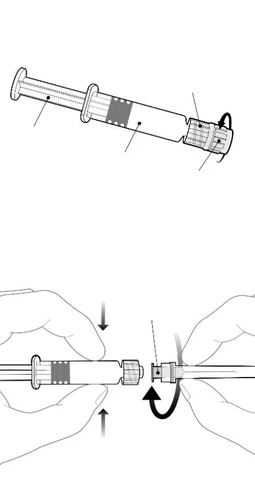
Luer Lock adapter
Hold the syringe by the body, not by the
plunger.
Unscrew the syringe cap by turning it
Plunger
counterclockwise.
Body
Cap
To attach the needle to the syringe, gently
Needle hub
connect the needle hub to the Luer Lock
adapter and rotate one-quarter turn
clockwise until a click is felt.
Do not remove the plunger from the syringe body. If this occurs, do not administer the
vaccine.
Any unused medicine and waste material derived from this medicine must be disposed of in
accordance with current local regulations.