Fabrazyme
Italy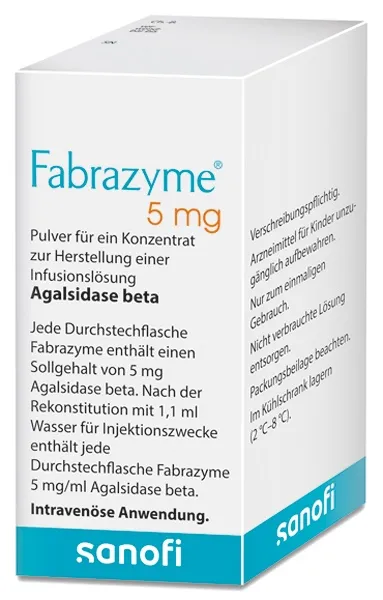
Table of Contents
- Package leaflet: Information for the user
- Fabrazyme 35 mg powder for concentrate for solution for intravenous infusion
- 1. What Fabrazyme is and what it is used for
- 2. What you need to know before using Fabrazyme
- 3. How to use Fabrazyme
- 4. Possible side effects
- 5. How to store Fabrazyme
- 6. Package contents and other information
- The following information is intended exclusively for healthcare professionals:
- Package leaflet: information for the user
- Fabrazyme 5 mg powder for concentrate for infusion solution for intravenous use
- 1. What Fabrazyme is and what it is used for
- 2. What you need to know before using Fabrazyme
- 3. How to use Fabrazyme
- 4. Possible side effects
- 5. How to store Fabrazyme
- 6. Package Contents and Other Information
- The following information is intended exclusively for healthcare professionals:
Package leaflet: Information for the user
Fabrazyme 35 mg powder for concentrate for solution for intravenous infusion
agalsidase beta
Please read this leaflet carefully before using this medicine because it contains important information for you.
- Keep this leaflet. You may need to read it again.
- If you have any questions, ask your doctor or pharmacist.
- This medicine has been prescribed for you only. Do not give it to other people, even if their symptoms are the same as yours, as it may be harmful.
- If you experience any side effects, including those not listed in this leaflet, tell your doctor or pharmacist. See section 4.
Contents of this leaflet:
- What Fabrazyme is and what it is used for
- What you need to know before using Fabrazyme
- How to use Fabrazyme
- Possible side effects
- How to store Fabrazyme
- Contents of the pack and other information
1. What Fabrazyme is and what it is used for
Fabrazyme contains the active substance agalsidase beta and is used as enzyme replacement therapy
in Fabry disease, a condition in which the activity level of the enzyme α-galactosidase is absent or below
normal. If you have Fabry disease, a lipid substance called globotriaosylceramide (GL-3) is not properly
cleared from the cells of your body and accumulates in the walls of blood vessels in your organs.
Fabrazyme is indicated for use as long-term enzyme replacement therapy in patients with a confirmed
diagnosis of Fabry disease.
Fabrazyme is indicated in adults, children, and adolescents from the age of 8 years.
2. What you need to know before using Fabrazyme
Do not use Fabrazyme
If you are allergic to agalsidase beta or to any of the other ingredients of this medicine (listed in section 6).
Warnings and precautions
Talk to your doctor or pharmacist before using Fabrazyme.
If you are being treated with Fabrazyme, you may develop infusion-associated reactions. An infusion-associated reaction is any adverse event occurring during or within the same day of the infusion (see section 4). If you experience such a reaction, contact your doctor immediately. You may need to receive additional medications to prevent such reactions from occurring.
Children and adolescents
Clinical studies have not been conducted in children aged between 0 and 4 years. The risks and benefits of Fabrazyme in children aged between 5 and 7 years have not yet been established, and therefore there is no recommended dose for this age group.
Other medicines and Fabrazyme
Inform your doctor or pharmacist if you are taking or might take any other medicines.
Inform your doctor if you have taken any medicine containing chloroquine, amiodarone, hydroxychloroquine, or gentamicin. There is a theoretical risk that these medicines may reduce the activity of agalsidase beta.
Pregnancy, breastfeeding, and fertility
Experience with the use of Fabrazyme in pregnant women is limited. As a precaution, it is preferable to avoid using Fabrazyme during pregnancy. Fabrazyme is excreted in human milk. Discuss with your doctor the risks and benefits of breastfeeding versus continuing treatment with Fabrazyme. No studies have been conducted to evaluate the effects of Fabrazyme on fertility.
If you are pregnant, suspect you may be pregnant, plan to become pregnant, or are breastfeeding, consult your doctor or pharmacist before taking this medicine.
Driving and using machines
Do not drive if you experience dizziness, somnolence, vertigo, or fainting during or immediately after administration of Fabrazyme (see section 4). Discuss this with your doctor beforehand.
Fabrazyme contains sodium
This medicine contains less than 1 mmol (23 mg) of sodium per vial, i.e. essentially “sodium-free”.
3. How to use Fabrazyme
Fabrazyme is administered by intravenous infusion (into a vein). It is supplied as a powder, which must be mixed with sterile water before administration (see the information for healthcare professionals at the end of this leaflet).
Always use this medicine exactly as instructed by your doctor. If you have any doubts, consult your doctor.
Fabrazyme should only be used under the supervision of a doctor experienced in managing patients with Fabry disease. Your doctor may decide that you can be treated at home, provided certain criteria are met. Contact your doctor if you wish to receive treatment at home.
The recommended dose of Fabrazyme for adults is 1 mg/kg body weight, administered once every 2 weeks.
Dose adjustments are not required in patients with renal disease.
Use in children and adolescents
The recommended dose of Fabrazyme for children and adolescents aged between 8 and 16 years is 1 mg/kg body weight, administered once every 2 weeks. Dose adjustments are not necessary in patients with renal disease.
If you use more Fabrazyme than you should
Doses up to 3 mg/kg body weight have been shown to be safe.
If you forget to use Fabrazyme
If you miss an infusion of Fabrazyme, contact your doctor.
If you have any doubts about how to use this medicine, consult your doctor.
4. Possible side effects
Like all medicines, this medicine can cause side effects, although not everyone experiences them.
In clinical studies, side effects occurred mainly during or immediately after administration of the medicine ("infusion-related reactions"). In some patients, serious and potentially life-threatening allergic reactions ("anaphylactic reactions") have been reported. If you experience any serious side effect, you must contact your doctor immediately.
Very common symptoms (may affect more than 1 in 10 people) include chills, fever, feeling cold, nausea, vomiting, headache, and abnormal skin sensations such as itching and tingling. Your doctor may decide to reduce the infusion rate or administer other medicines to prevent these reactions.
List of other side effects:
Common (may affect up to 1 in 10 people):
- chest pain - drowsiness - fatigue
- difficulty breathing - increased heart rate - flushing
- pallor - abdominal pain - pain
- itching - back pain - throat tightness
- abnormal tearing - rash - dizziness
- weakness - low heart rate - palpitations
- tinnitus - lethargy - reduced sensitivity to pain
- nasal congestion - syncope - burning sensation
- diarrhoea - cough - wheezing
- redness - abdominal discomfort - urticaria
- muscle pain - facial swelling - pain in extremities
- increased blood pressure - joint pain - nasopharyngitis
- sudden facial swelling - decreased blood pressure - hot flush
- extremity oedema - chest discomfort - feeling of warmth
- dizziness - facial oedema - hyperthermia
- stomach disturbances - increased breathing difficulty - decreased mouth sensitivity
- muscle spasms - muscle tension - musculoskeletal rigidity
Uncommon (may affect up to 1 in 100 people):
- tremor - eye itching - low heart rate due to conduction disorders
- red eyes - ear swelling - increased sensitivity to pain
- ear pain - bronchospasm - congestion of upper respiratory tract
- sore throat - runny nose - red-coloured rash
- shortness of breath - heartburn - change in skin colour (purple patches)
- itchy rash - skin discomfort - cold extremities
- sensation of cold and warmth - musculoskeletal pain - blood clots at injection site
- difficulty swallowing - rhinitis - change in skin colour
- pain at infusion site - influenza-like illness - oedema at infusion site
- reaction at infusion site - malaise
Frequency not known (frequency cannot be estimated from the available data):
- decrease in oxygen levels in the blood - severe inflammation of blood vessels
In some patients initially treated with the recommended dose and subsequently with a reduced dose over a prolonged period, certain symptoms of Fabry disease have been reported more frequently.
Reporting of side effects
If you experience any side effect, including those not listed in this leaflet, talk to your doctor or pharmacist. You can also report side effects directly through the national reporting system listed in Annex V. By reporting side effects, you can help provide more information on the safety of this medicine.
5. How to store Fabrazyme
Keep this medicine out of the sight and reach of children.
Do not use this medicine after the expiry date which is stated on the label after “Exp.”. The expiry date refers to the last day of that month.
Closed vials
Store in the refrigerator (2 °C - 8 °C).
Reconstituted and diluted solutions
The reconstituted solution must not be stored and should be diluted immediately. Only the diluted solution may be stored for up to 24 hours at 2 °C – 8 °C.
Do not dispose of medicines via wastewater or household waste. Ask your pharmacist how to dispose of medicines you no longer use. This will help protect the environment.
6. Package contents and other information
What Fabrazyme contains
- The active substance is agalsidase beta; each vial contains 35 mg. After reconstitution, each vial contains 5 mg of agalsidase beta per mL.
- The other excipients are:
- Mannitol (E421)
- Monosodium dihydrogen phosphate monohydrate (E339)
- Disodium phosphate heptahydrate (E339)
Description of the appearance of Fabrazyme and contents of the pack
Fabrazyme is supplied as a white to off-white powder. After reconstitution, it appears as a clear, colourless liquid free from foreign particles. The reconstituted solution must be further diluted. Pack sizes: 1, 5 and 10 vials per carton. Not all pack sizes may be marketed.
Marketing Authorisation Holder and Manufacturer(s)
Marketing Authorisation Holder
Sanofi B.V., Paasheuvelweg 25, 1105 BP Amsterdam, The Netherlands.
Manufacturing Authorisation Holder responsible for batch release
Genzyme Ireland Limited, IDA Industrial Park, Old Kilmeadean Road, Waterford, Ireland
For further information about this medicinal product, please contact the local representative of the Marketing Authorisation Holder.
België/Belgique/Belgien/ Lietuva
Luxembourg/Luxemburg Swixx Biopharma UAB
Sanofi Belgium Tel: +370 5 236 91 40
Tél/Tel: + 32 2 710 54 00
България Magyarország
Swixx Biopharma EOOD SANOFI-AVENTIS Zrt.
Тел.: +359 (0)2 4942 480 Tel: +36 1 505 0050
Česká republika Malta
Sanofi s.r.o. Sanofi S.r.l.
Tel: +420 233 086 111 Tel: +39 02 39394275
Danmark Nederland
Sanofi A/S Sanofi B.V.
Tlf: +45 45 16 70 00 Tel: +31 20 245 4000
Deutschland Norge
Sanofi-Aventis Deutschland GmbH sanofi-aventis Norge AS
Tel.: 0800 04 36 996 Tlf: + 47 67 10 71 00
Tel. aus dem Ausland: +49 69 305 70 13
Eesti Österreich
Swixx Biopharma OÜ sanofi-aventis GmbH
Tel: +372 640 10 30 Tel: + 43 1 80 185 - 0
Ελλάδα Polska
Sanofi-Aventis Μονοπρόσωπη AEBE Sanofi Sp. z o.o.
Τηλ: +30 210 900 1600 Tel.: +48 22 280 00 00
España Portugal
sanofi-aventis, S.A. Sanofi – Produtos Farmacêuticos, Lda.
Tel: +34 93 485 94 00 Tel: +351 21 35 89 400
France România
Sanofi Winthrop Industrie Sanofi Romania SRL
Tél: 0 800 222 555 Tel: +40 (0) 21 317 31 36
Appel depuis l’étranger: +33 1 57 63 23 23
Hrvatska Slovenija
Swixx Biopharma d.o.o. Swixx Biopharma d.o.o.
Tel: +385 1 2078 500 Tel: +386 1 235 51 00
Ireland Slovenská republika
sanofi-aventis Ireland Ltd. T/A SANOFI Swixx Biopharma s.r.o.
Tel: +353 (0) 1 403 56 00 Tel: +421 2 208 33 600
Ísland Suomi/Finland
Vistor hf. Sanofi Oy
Sími: +354 535 7000 Puh/Tel: + 358 201 200 300
Italia Sverige
Sanofi S.r.l. Sanofi AB
Tel: 800 536389 Tel: +46 (0)8 634 50 00
Κύπρος United Kingdom (Northern Ireland)
C.A. Papaellinas Ltd. sanofi-aventis Ireland Ltd. T/A SANOFI
Τηλ: +357 22 741741 Tel: +44 (0) 800 035 2525
Latvija
Swixx Biopharma SIA
Tel: +371 6 616 47 50
Other sources of information
More detailed information on this medicinal product is available on the European Medicines Agency website: http://www.ema.europa.eu. Links to other websites on rare diseases and their therapeutic treatments are also provided.
The following information is intended exclusively for healthcare professionals:
Instructions for use – reconstitution, dilution and administration
The powder for concentrate for solution for intravenous infusion must be reconstituted with water
for injections, further diluted with 0.9% sodium chloride solution for injection, and finally administered by intravenous infusion.
From a microbiological standpoint, the medicinal product should be used immediately. If not used immediately, storage and conditions of use are the responsibility of the user. The reconstituted solution must not be stored and should be promptly diluted; only the diluted solution may be stored at 2 °C–8 °C for up to 24 hours.
Use aseptic technique.
- The number of vials to be reconstituted must be determined based on the individual patient's body weight. The required number of vials should be removed from the refrigerator to allow them to reach room temperature (within approximately 30 minutes). Fabrazyme must not be mixed with other products within the same infusion.
Reconstitution
-
Each 35 mg Fabrazyme vial must be reconstituted with 7.2 mL of water for injections. The water for injections should be added slowly onto the powder, avoiding foam formation. To achieve this, add the water dropwise along the walls of the vial and not directly onto the lyophilized powder. Each vial should be gently rotated and tilted. The vial must not be inverted, vigorously rotated, or shaken.
-
The reconstituted solution contains 5 mg of agalsidase beta per mL and appears as a clear, colourless solution. The pH of the reconstituted solution is approximately 7.0. Prior to further dilution, the reconstituted solution in each vial should be visually inspected for particulate matter and discoloration. The solution must not be used if foreign particles are present or if discoloration occurs.
-
After reconstitution, it is recommended to dilute the vials promptly to minimize particle formation over time.
-
Unused medicinal product and waste materials arising from its use must be disposed of in accordance with local regulations.
Dilution
-
Before adding the required volume of reconstituted Fabrazyme to the patient's infusion bag, it is recommended to remove an equivalent volume of 0.9% sodium chloride solution for injection from the infusion bag.
-
Air present in the infusion bag should be removed to minimize the air/liquid interface.
-
Slowly withdraw 7.0 mL of reconstituted solution from each vial (equivalent to 35 mg) until the total volume required for the patient's dose is obtained. Filter needles must not be used, and foam formation must be avoided.
-
Subsequently, the reconstituted solution should be slowly injected directly into the 0.9% sodium chloride solution for injection (not into any remaining air space), to achieve a final concentration between 0.05 mg/mL and 0.7 mg/mL. The total volume of 0.9% sodium chloride solution for infusion (between 50 and 500 mL) should be determined based on the individual dose. For doses below 35 mg, a minimum of 50 mL must be used; for doses between 35 and 70 mg, a minimum of 100 mL must be used; for doses between 70 and 100 mg, a minimum of 250 mL must be used; for doses exceeding 100 mg, only 500 mL must be used. The infusion bag should be gently inverted or lightly rubbed to mix the diluted solution. The infusion bag must not be shaken or excessively agitated.
Administration
- It is recommended to administer the diluted solution through a low-protein-binding in-line filter of 0.2 μm to remove any protein particles without causing loss of agalsidase beta activity. The initial intravenous infusion rate must not exceed 0.25 mg/min (15 mg/h). The infusion rate may be reduced in case of infusion-associated reactions (IARs).
Once patient tolerance is well established, the infusion rate may be increased incrementally by 0.05 to 0.083 mg/min (3 to 5 mg/h) with each subsequent infusion.
In clinical studies with classic patients, the infusion rate was increased incrementally to achieve a minimum duration of 2 hours. This was achieved after the initial 8 infusions administered at a rate of 0.25 mg/min (15 mg/h), with no IARs, changes in infusion rate, or infusion interruptions. A further reduction of infusion time to 1.5 hours was allowed for patients who had not experienced new IARs during the last 10 infusions or serious adverse events during the last 5 infusions. Each increase in infusion rate of 0.083 mg/min (~5 mg/h) was maintained for 3 consecutive infusions without new IARs, changes in infusion rate, or infusion interruptions before further rate increases.
For patients weighing < 30 kg, the maximum infusion rate must remain at 0.25 mg/min (15 mg/h).
Package leaflet: information for the user
Fabrazyme 5 mg powder for concentrate for infusion solution for intravenous use
agalsidase beta
Please read this leaflet carefully before using this medicine because it contains important information for you.
- Keep this leaflet. You may need to read it again.
- If you have any questions, ask your doctor or pharmacist.
- This medicine has been prescribed for you only. Do not give it to others, even if their symptoms are the same as yours, because it could be dangerous.
- If any adverse reaction occurs, including those not listed in this leaflet, contact your doctor or pharmacist. See section 4.
Contents of this leaflet:
- What Fabrazyme is and what it is used for
- What you need to know before using Fabrazyme
- How to use Fabrazyme
- Possible side effects
- How to store Fabrazyme
- Contents of the pack and other information
1. What Fabrazyme is and what it is used for
Fabrazyme contains the active substance agalsidase beta and is used as an enzyme replacement therapy
in Fabry disease, a condition in which the activity level of the enzyme α-galactosidase is absent or below
normal. If you have Fabry disease, a lipid substance called globotriaosylceramide (GL-3) is not properly
cleared from the cells of your body and accumulates in the walls of blood vessels in your organs.
Fabrazyme is indicated for long-term enzyme replacement therapy in patients with a confirmed diagnosis of Fabry disease.
Fabrazyme is indicated in adults, children, and adolescents aged 8 years and older.
2. What you need to know before using Fabrazyme
If you are allergic to agalsidase beta or to any of the other ingredients of this medicine
(listed in section 6).
Warnings and precautions
Talk to your doctor or pharmacist before using Fabrazyme.
If you are being treated with Fabrazyme, you may develop infusion-associated reactions. An infusion-associated reaction is any adverse effect that occurs during the infusion or by the end of the day on which the infusion is administered (see section 4). If you experience such a reaction, contact your doctor immediately. You may need to receive additional medications to prevent such reactions from occurring.
Children and adolescents
Clinical studies have not been conducted in children aged between 0 and 4 years. The risks and benefits of Fabrazyme in children aged between 5 and 7 years have not yet been established, and therefore no recommended dose exists for this age group.
Other medicines and Fabrazyme
Inform your doctor or pharmacist if you are taking or might take any other medicines.
Inform your doctor if you have taken any medicine containing chloroquine, amiodarone, quinacrine, or gentamicin. There is a theoretical risk of reduced activity of agalsidase beta.
Pregnancy, breastfeeding and fertility
Experience with the use of Fabrazyme in pregnant women is limited. As a precaution, it is preferable to avoid using Fabrazyme during pregnancy. Fabrazyme is excreted in human milk.
Discuss with your doctor the risks and benefits of breastfeeding versus continuing therapy with Fabrazyme. Studies examining the effects of Fabrazyme on fertility have not been conducted.
If you are pregnant, suspect you may be pregnant, planning to become pregnant, or breastfeeding with human milk, consult your doctor or pharmacist before taking this medicine.
Driving and using machines
Do not drive if you experience dizziness, somnolence, vertigo, or fainting during or immediately after administration of Fabrazyme (see section 4). Discuss this with your doctor beforehand.
Fabrazyme contains sodium
This medicine contains less than 1 mmol (23 mg) of sodium per vial, i.e. essentially “sodium-free”.
3. How to use Fabrazyme
Fabrazyme is administered by intravenous infusion (into a vein). It is supplied as a powder that must be mixed with sterile water before administration (see information for healthcare professionals at the end of this leaflet).
Always use this medicine exactly as your doctor has instructed. If you have any doubts, consult your doctor.
Fabrazyme must be used only under the supervision of a physician experienced in managing patients with Fabry disease. Your doctor may decide that you can receive treatment at home, provided certain criteria are met. Contact your doctor if you wish to be treated at home.
The recommended dose of Fabrazyme for adults is 1 mg/kg of body weight, administered once every two weeks.
Dose adjustments are not required in patients with renal disease.
Use in children and adolescents
The recommended dose of Fabrazyme for children and adolescents aged between 8 and 16 years is 1 mg/kg of body weight, administered once every two weeks. Dose modifications are not necessary in patients with renal disease.
If you use more Fabrazyme than you should
Doses up to 3 mg/kg of body weight have been shown to be safe.
If you forget to use Fabrazyme
If you miss an infusion of Fabrazyme, contact your doctor.
If you have any questions about the use of this medicine, consult your doctor.
4. Possible side effects
Like all medicines, this medicine can cause side effects, although not everybody gets them.
In clinical studies, side effects were observed mainly during or immediately after administration of the medicine ("infusion-related reactions"). In some patients, serious allergic reactions, potentially life-threatening ("anaphylactic reactions"), have been reported. If you experience any severe side effect, you must contact your doctor immediately.
Very common symptoms (may affect more than 1 in 10 people) include chills, fever, feeling cold, nausea, vomiting, headache, and abnormal skin sensations such as itching and tingling. Your doctor may decide to reduce the infusion rate or administer other medicines to prevent these reactions from occurring.
Common (may affect up to 1 in 10 people):
- chest pain - drowsiness - fatigue
- breathing difficulties - increased heart rate - flushing
- pallor - abdominal pain - pain
- itching - back pain - throat tightness
- abnormal tearing - rash - dizziness
- feeling of weakness - low heart rate - palpitations
- tinnitus - lethargy - reduced sensitivity to pain
- nasal congestion - syncope - burning sensation
- diarrhoea - cough - wheezing
- redness - abdominal disorders - urticaria
- muscle pain - facial swelling - pain in extremities
- increased blood pressure - joint pain - nasopharyngitis
- sudden facial swelling - decreased blood pressure - hot flush and throat
- oedema of extremities - chest discomfort - feeling of warmth
- dizziness - facial oedema - hyperthermia
- stomach disorders - increased breathing difficulties - decreased sensitivity in mouth
- muscle spasms - muscle tension - musculoskeletal rigidity
Uncommon (may affect up to 1 in 100 people):
- tremor - eye itching - low heart rate due to conduction disorders
- red eyes - ear swelling - increased sensitivity to pain
- earache - bronchospasm - upper respiratory tract congestion
- sore throat - runny nose - red skin rash
- laboured breathing - heartburn - skin colour change (purple patches)
- itchy rash - skin discomfort - cold extremities
- sensation of cold and heat - musculoskeletal pain - blood clots at injection site
- difficulty swallowing - rhinitis - skin colour change
- pain at site - flu-like illness - infusion site oedema
- reaction at infusion site - malaise
Frequency not known (frequency cannot be estimated from the available data):
- drop in blood oxygen levels - severe inflammation of blood vessels
List of other side effects:
In some patients initially treated with the recommended dose and subsequently with a reduced dose over a prolonged period, certain symptoms of Fabry disease have been reported more frequently.
Reporting of side effects
If you experience any side effect, including those not listed in this leaflet, talk to your doctor or pharmacist. You can also report side effects directly via the national reporting system listed in Annex V. By reporting side effects, you can help provide more information on the safety of this medicine.
5. How to store Fabrazyme
Keep this medicine out of the sight and reach of children.
Do not use this medicine after the expiry date stated on the label after "Exp.". The expiry date refers to the last day of that month.
Closed vials
Store in a refrigerator (2 °C - 8 °C).
Reconstituted and diluted solutions
The reconstituted solution cannot be stored and must be diluted immediately. Only the diluted solution may be stored for up to 24 hours at 2 ºC – 8 ºC.
Do not dispose of any medicine via wastewater or household waste. Ask your pharmacist how to dispose of medicines no longer required. This will help protect the environment.
6. Package Contents and Other Information
What Fabrazyme Contains
- The active substance is agalsidase beta; each vial contains 5 mg. After reconstitution, each vial contains 5 mg of agalsidase beta per mL.
- The other ingredients (excipients) are:
- Mannitol (E421)
- Monosodium dihydrogen phosphate monohydrate (E339)
- Disodium phosphate heptahydrate (E339).
Description of the Appearance of Fabrazyme and Contents of the Pack
Fabrazyme is supplied as a white to off-white powder. After reconstitution, it forms a clear, colourless solution free from foreign particles. The reconstituted solution must be further diluted before use.
Pack sizes: 1, 5 and 10 vials per carton. Not all pack sizes may be marketed.
Marketing Authorization Holder and Manufacturer(s)
Marketing Authorization Holder
Sanofi B.V., Paasheuvelweg 25, 1105 BP Amsterdam, The Netherlands.
Responsible Manufacturing Authorization Holder and Batch Release
Genzyme Ireland Limited, IDA Industrial Park, Old Kilmeaden Road, Waterford, Ireland.
For further information on this medicinal product, please contact the local representative of the Marketing Authorization Holder.
België/Belgique/Belgien / Luxembourg/Luxemburg
Sanofi Belgium
Tél/Tel: +32 2 710 54 00
Lietuva
Swixx Biopharma UAB
Tel: +370 5 236 91 40
България
Swixx Biopharma EOOD
Тел.: +359 (0)2 4942 480
Magyarország
SANOFI-AVENTIS Zrt.
Tel: +36 1 505 0050
Česká republika
Sanofi s.r.o.
Tel: +420 233 086 111
Malta
Sanofi S.r.l.
Tel: +39 02 39394275
Danmark
Sanofi A/S
Tlf: +45 45 16 70 00
Nederland
Sanofi B.V.
Tel: +31 20 245 4000
Deutschland
Sanofi-Aventis Deutschland GmbH
Tel.: 0800 04 36 996
For calls from abroad: +49 69 305 70 13
Eesti
Swixx Biopharma OÜ
Tel: +372 640 10 30
Österreich
sanofi-aventis GmbH
Tel: +43 1 80 185 - 0
Ελλάδα
Sanofi-Aventis Μονοπρόσωπη AEBE
Τηλ: +30 210 900 1600
Polska
Sanofi Sp. z o.o.
Tel.: +48 22 280 00 00
España
sanofi-aventis, S.A.
Tel: +34 93 485 94 00
Portugal
Sanofi – Produtos Farmacêuticos, Lda.
Tel: +351 21 35 89 400
France
Sanofi Winthrop Industrie
Tél: 0 800 222 555
From abroad: +33 1 57 63 23 23
Hrvatska
Swixx Biopharma d.o.o.
Tel: +385 1 2078 500
Slovenija
Swixx Biopharma d.o.o.
Tel: +386 1 235 51 00
Ireland
sanofi-aventis Ireland Ltd. T/A SANOFI
Tel: +353 (0) 1 403 56 00
Slovenská republika
Swixx Biopharma s.r.o.
Tel: +421 2 208 33 600
Ísland
Vistor hf.
Sími: +354 535 7000
Suomi/Finland
Sanofi Oy
Puh/Tel: +358 201 200 300
Italia
Sanofi S.r.l.
Tel: 800536389
Sverige
Sanofi AB
Tel: +46 (0)8 634 50 00
Κύπρος
C.A. Papaellinas Ltd.
Τηλ: +357 22 741741
United Kingdom (Northern Ireland)
sanofi-aventis Ireland Ltd. T/A SANOFI
Tel: +44 (0) 800 035 2525
Latvija
Swixx Biopharma SIA
Tel: +371 6 616 47 50
Other Sources of Information
More detailed information on this medicinal product is available on the website of the European Medicines Agency: http://www.ema.europa.eu. Links to other websites on rare diseases and their treatments are also provided.
The following information is intended exclusively for healthcare professionals:
Instructions for use – reconstitution, dilution, and administration
The powder for concentrate for solution for intravenous infusion must be reconstituted with water
for injections, further diluted with 0.9% sodium chloride injection solution, and finally administered by intravenous infusion.
From a microbiological standpoint, the medicinal product should be used immediately. If not used immediately, storage and conditions of use are the responsibility of the user. The reconstituted solution must not be stored and should be promptly diluted; only the diluted solution may be stored at 2 °C – 8 °C for a maximum of 24 hours.
Use aseptic technique.
- The number of vials to be reconstituted must be determined based on the individual patient's weight; the required number of vials should then be removed from the refrigerator to reach room temperature (within approximately 30 minutes). Fabrazyme must not be mixed with other products within the same infusion.
Reconstitution
- Each Fabrazyme 5 mg vial must be reconstituted with 1.1 mL of water for injections. The water for injections should be slowly added onto the powder, avoiding foam formation. To achieve this, add the water for injections drop by drop along the walls of the vial and not directly onto the lyophilized drug. Each vial should be gently rotated and tilted. The vial must not be inverted, vigorously rotated, or shaken.
- The reconstituted solution contains 5 mg of agalsidase beta per mL and appears as a clear, colourless solution. The pH of the reconstituted solution is approximately 7.0. Prior to further dilution, the reconstituted solution in each vial should be inspected visually for the presence of particulate matter and discoloration. The solution must not be used if foreign particles are present or if discoloration occurs.
- After reconstitution, it is recommended to dilute the vials promptly to minimize particle formation over time.
- Unused medicinal product and waste materials arising from this medicinal product must be disposed of in accordance with local regulations.
Dilution
- Before adding the required volume of reconstituted Fabrazyme for the patient's dose, it is recommended to remove an equivalent volume of 0.9% sodium chloride injection solution from the infusion bag.
- The air present in the infusion bag should be aspirated to minimize the air/liquid interface.
- Slowly withdraw 1.0 mL of reconstituted solution from each vial (equivalent to 5 mg), until the total volume required for the patient's dose is obtained. Filter needles must not be used, and foam formation must be avoided.
- Subsequently, the reconstituted solution must be slowly injected directly into the 0.9% sodium chloride injection solution (not into any remaining empty space), to achieve a final concentration between 0.05 mg/mL and 0.7 mg/mL. The total volume of 0.9% sodium chloride infusion solution (between 50 and 500 mL) must be determined based on the individual dose. For doses below 35 mg, a minimum of 50 mL must be used; for doses between 35 and 70 mg, a minimum of 100 mL must be used; for doses between 70 and 100 mg, a minimum of 250 mL must be used; for doses above 100 mg, only 500 mL must be used. The infusion bag should be gently inverted or lightly rubbed to mix the diluted solution. The infusion bag must not be shaken or excessively agitated.
Administration
- It is recommended to administer the diluted solution through an in-line, low-protein-binding 0.2 μm filter to remove any protein particles without causing loss of agalsidase beta activity. The initial intravenous infusion rate must not exceed 0.25 mg/min (15 mg/hour). The infusion rate may be reduced in case of infusion-associated reactions (IARs).
Once patient tolerance is well established, the infusion rate may be increased by increments of 0.05 to 0.083 mg/min (increments of 3 to 5 mg/h) with each subsequent infusion. In clinical studies with classic patients, the infusion rate was incrementally increased to achieve a minimum duration of 2 hours. This was achieved after the initial 8 infusions administered at a rate of 0.25 mg/min (15 mg/h), without any IARs, changes in infusion rate, or infusion interruptions. A further reduction of infusion time to 1.5 hours was allowed for patients who had not experienced new IARs during the last 10 infusions or serious adverse events reported during the last 5 infusions. Each increase in infusion rate of 0.083 mg/min (~5 mg/h) was maintained for 3 consecutive infusions without new IARs, changes in infusion rate, or infusion interruptions before subsequent rate increases.
For patients weighing < 30 kg, the maximum infusion rate must remain at 0.25 mg/min (15 mg/h).