Expose
Italy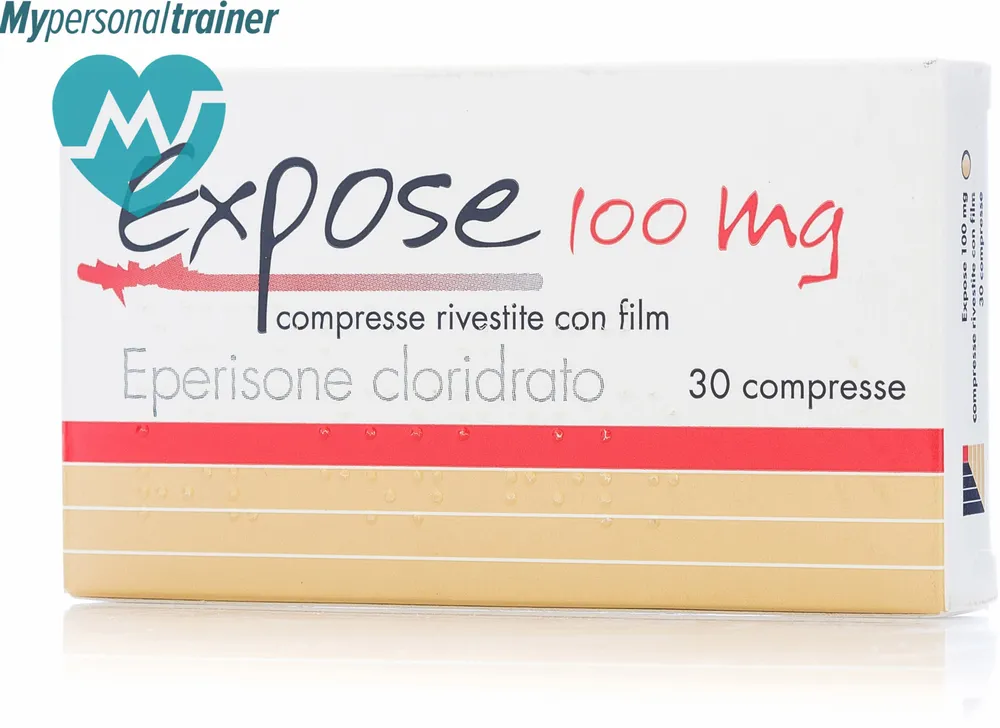
Table of Contents
- Package leaflet: information for the patient
- EXPOSE 50 mg film-coated tablets, 100 mg film-coated tablets
- 1. What Expose is and what it is used for
- 2. What you need to know before taking Expose
- 3. How to take Expose
- 4. Possible side effects
- 5. How to store Expose
- 6. Package contents and other information
PACKAGE LEAFLET
Package leaflet: information for the patient
EXPOSE 50 mg film-coated tablets, 100 mg film-coated tablets
eperisone hydrochloride
Please read this leaflet carefully before taking this medicine because it contains important information for you.
- Keep this leaflet. You may need to read it again.
- If you have any questions, ask your doctor or pharmacist.
- This medicine has been prescribed for you only. Do not give it to others, even if they have the same symptoms as you, because it could be harmful.
- If you experience any adverse reactions, including those not listed in this leaflet, consult your doctor or pharmacist. See section 4.
Contents of this leaflet:
- What Expose is and what it is used for
- What you need to know before taking Expose
- How to take Expose
- Possible side effects
- How to store Expose
- Contents of the pack and other information
1. What Expose is and what it is used for
Expose contains eperisone hydrochloride, an active substance belonging to the class of muscle relaxants, used for the treatment of muscle spasms, associated pain, and involuntary muscle contractions (spasticity).
Expose is used for:
- muscle spasms due to diseases of the bones, joints, and muscles (cervical osteoarthritis, shoulder joint arthritis, lumbosciatica, general muscle pain)
- involuntary muscle contractions (spasticity) in multiple sclerosis
- spasticity in spinal cord diseases of infectious, degenerative, traumatic, or cancerous origin
- cerebral-origin spasticity
Consult your doctor if you do not feel better or if you feel worse after the prescribed treatment period.
2. What you need to know before taking Expose
Do not take Expose
- if you are allergic to eperisone hydrochloride or to any of the other ingredients of this medicine (listed in section 6)
- during pregnancy and breastfeeding
- if you suffer from severe liver disease (severe hepatic insufficiency)
Warnings and precautions
Talk to your doctor or pharmacist before taking Expose.
Inform your doctor
- if you currently have or have previously had liver and/or kidney diseases
- if you have abnormal liver and/or kidney function test results (laboratory tests), as your doctor will advise you on what to do and which monitoring tests to carry out.
Children
The use of Expose is not recommended in children.
Other medicines and Expose
Inform your doctor or pharmacist if you are taking, have recently taken, or might take any other medicines.
Particular caution and medical supervision are recommended when Expose is taken concomitantly with the following drugs:
- salicylates (e.g. aspirin), as blood levels of these may be reduced
- calcium antagonists, as their blood pressure-lowering effect may be enhanced.
Pregnancy and breastfeeding
If you are pregnant, suspect you may be pregnant, planning a pregnancy, or breastfeeding, consult your doctor or pharmacist before taking this medicine.
Expose must not be taken during pregnancy and breastfeeding.
When Expose needs to be taken, breastfeeding must be discontinued.
Driving and using machines
Expose may reduce alertness. Caution is advised when driving vehicles or operating machinery.
Expose
Expose contains less than 1 mmol of sodium (23 mg) per tablet and per maximum daily dose, i.e. essentially "sodium-free".
3. How to take Expose
Take this medicine exactly as directed by your doctor or pharmacist. If you have
any doubts, consult your doctor or pharmacist.
The recommended dose is:
Adults
For the treatment of muscle spasms due to diseases of the bones, joints, and muscles, the recommended dosage is 150–300 mg per day, depending on the severity of symptoms:
- 1 tablet of 50 mg or 100 mg three times daily after meals.
For the treatment of spasticity, the recommended dosage is 300 mg per day:
- 1 tablet of 100 mg three times daily after meals.
Elderly patients
In elderly patients, or those with liver and/or kidney disease, the dosage should be reduced under close medical supervision.
It is recommended not to exceed a daily dose of 150 mg.
Use in children
The use of Expose is not recommended in children.
If you take more Expose than you should
In case of accidental overdose, seek medical advice from your doctor or go to the nearest hospital.
Although no such effects have been reported in the literature, accidental overdose could lead to reduced muscle tone (hypotonia), possibly affecting the muscles involved in respiration.
If you have any doubts about how to use this medicine, consult your doctor or pharmacist.
4. Possible side effects
Like all medicines, this medicine can cause side effects, although not everyone gets them.
Serious side effects
The following symptoms could be signs of severe skin reactions such as oculo-muco-cutaneous syndrome (Stevens-Johnson syndrome) or death of skin cells (Lyell syndrome).
Stop treatment with Expose immediately and contact your doctor if you notice any of the following symptoms:
- redness
- itching
- allergic skin reactions (urticaria)
- swelling (edema) of the face or other body parts
- breathing difficulties (dyspnea)
- fever
- skin irritation (erythema)
- blisters
- increased and/or impaired blood circulation in the eye (ocular congestion)
- inflammation of the mucous membranes of the mouth (stomatitis)
The side effects associated with Expose have been classified by frequency according to the following scheme:
Very common side effects (may affect more than 1 in 10 people):
- drowsiness, headache, confusion
- stomach pain, diarrhoea, nausea, vomiting, constipation, stomach discomfort, difficulty digesting
- sudden appearance of red spots or swellings on the skin (skin rash)
- reduced appetite (anorexia)
- feeling weak, tired
- insomnia
Common side effects (may affect up to 1 in 10 people):
- abnormal blood test results showing increased levels of liver enzymes (AST, ALT and alkaline phosphatase)
- increased awareness of heartbeat (palpitations)
- dizziness, loss of balance (vertigo), mood changes, tremor in arms or legs, decreased sensitivity
- inflammation of the mouth mucosa, stomach swelling
- difficulty urinating, inability to retain urine
- itching, excessive sweating
- muscle stiffness, reduced muscle tone
- hot flushes
- fluid accumulation in tissues (edema), thirst
Uncommon side effects (may affect up to 1 in 100 people):
- abnormal blood test results (increased blood urea nitrogen levels), deficiency of red blood cells (anaemia)
- sensation of not having emptied the bladder completely
- abnormal urine test results showing presence of protein (proteinuria)
Rare side effects (may affect up to 1 in 10,000 people):
- severe skin reactions (oculo-muco-cutaneous syndrome, Stevens-Johnson syndrome), death of skin cells (Lyell syndrome)
- shock and severe allergic reactions (hypersensitivity)
Reporting of side effects
If you experience any side effect, including those not listed in this leaflet, please inform your doctor or pharmacist. You may also report side effects directly via the national reporting system at https://www.aifa.gov.it/content/segnalazioni-reazioni-avverse.
By reporting side effects, you can help provide more information on the safety of this medicine.
5. How to store Expose
Store below 30 °C.
Keep this medicine out of the sight and reach of children.
Do not use this medicine after the expiry date stated on the packaging.
The expiry date refers to the last day of that month.
Do not use this medicine if the packaging is open or damaged.
Do not dispose of any medicine via wastewater or household waste. Ask your pharmacist how to dispose of
medicines you no longer use. This will help protect the environment.
6. Package contents and other information
What EXPOSE contains
EXPOSE 50 mg film-coated tablets:
- The active substance is eperisone hydrochloride 50 mg.
- The other components are: maize starch, microcrystalline cellulose, cross-linked sodium carboxymethylcellulose, hydroxypropylcellulose, calcium stearate.
- Film coating: hypromellose, polyethylene glycol 6000, titanium dioxide, dimethicone, talc.
EXPOSE 100 mg film-coated tablets:
- The active substance is eperisone hydrochloride 100 mg.
- The other components are: maize starch, microcrystalline cellulose, cross-linked sodium carboxymethylcellulose, hydroxypropylcellulose, calcium stearate.
- Film coating: hypromellose, polyethylene glycol 6000, titanium dioxide, dimethicone, talc.
Description of the appearance of EXPOSE and contents of the pack
Pack: 30 film-coated tablets 50 mg for oral use
Pack: 30 film-coated tablets 100 mg for oral use
Marketing Authorisation Holder and Manufacturer
Marketing Authorisation Holder:
Alfasigma S.p.A. - Via Ragazzi del ‘99, n. 5 - 40133 Bologna (BO)
Manufacturer:
Alfasigma S.p.A. – Via E. Fermi, n. 1 – 65020 Alanno (PE)